Showing posts with label Earth. Show all posts

Thursday, March 22, 2012

Destroying the Earth

This post is inspired by a question I got on my Ask Tsana page. Katrina asked:
I'm trying to come up with a simple (haha) and plausible way to destroy a planet to kick things off for a story but am having trouble getting the science right.

One of the first sites I visited to figure this out was this Geocide site: http://qntm.org/geocide

Under the Geocide in fiction page (http://qntm.org/fictional), the author says, "The Sun Crusher is a relatively small ship which carries a small number of missiles, each of which is tough enough to shoot into the centre of a star and cause it to go nova, which would certainly annihilate any nearby Earthlike planet."

My question is, don't stars that get massive enough to go nova have brief lives and thus not live long enough for a habitable planet to develop? I'm just basing that on Wikipedia (http://en.wikipedia.org/wiki/Planetary_habitability#Massive_stars), though, so I was wondering if you could tell me more. Can the habitable zones of massive stars ever actually be inhabited (and then later die in a supernova)?
Excellent question!

The answer depends a bit on to what extent you want to destroy your planet. Geocide pretty much defines "destroy the Earth" as "annihilate in the particle physics sense, or dismantle/tear apart on either a macroscopic (large) or microscopic scale". He doesn't count Earth as destroyed if there's still a planet-like object there. However, for many narrative purposes, rendering the Earth entirely uninhabitable will do the trick.

So, leaving the dismantling and annihilation to Geocide (the website is amusing, although be warned that some of the details of physics are slightly off, but close enough), what are some ways of rendering Earth unfit for life?

Destroy all humans

So maybe what you want is not so much to destroy the planet as to destroy all the people on it. That's not really that hard. Or, at least, destroying most of the people isn't that hard. Some methods, which generally don't require elaboration:
  • Widespread nuclear holocaust
  • Some sort of plague
  • Climate change. No, really, melt the icecaps and raise the temperature enough so that it is too hot and humid to survive without air-conditioning and eventually you'll run out of people. Or throw in some crazy weather disasters too. The Rhesus Factor by Sonny Whitelaw touches on this a bit (see my review here), also on the plague scenario.
  • Very large volcano eruption. This is one of the things thought to have caused at least one of the prehistoric dinosaur(ish)-era extinctions. A less epically large volcano (actually, a few of them probably contributed) in 1816 caused the Northern Hemisphere (or Europe and America at least, not sure that Asia was affected as strongly, but google it if you're interested) to not thaw out in the summer. This was "the year without a summer". (And now I have that Rasputina song stuck in my head. Click the link and you will too.)
  • Asteroid -- this one's a toss up between destroying all (most) humans and destroying all life. Ultimately, I suppose it's a matter of scale. Let's say this asteroid kills human life but not necessarily all the microbes. It would be somewhat similar to the volcano in the throwing dust and rubbish into the atmosphere, blocking out light and generalised doom.
  • Magnetic field of the Earth turning off in the process of flipping. This is something that happens spontaneously every so often. It's bad because a whole bunch of ionising radiation (miscellaneous charged particles) from space is kept at bay thanks to our nifty magnetic field. Taking it away would give us a lot more cancer and sterility and could wipe out a large chunk of humanity. Microbes and probably a lot of (some?) sea life would be OK. Good luck artificially killing the magnetic field, though.
All of those methods probably won't wipe out all life and, frankly, it's possible/likely that some tenacious dregs of humanity will hold on. Generally, evacuation is the surest way to avoid these apocalypses. Or prevention, but that's only really applicable in two or three of those scenarios.

Destroy all life

Why aim low? Bugger humanity and everything else with one of these sterilising scenarios:
  • Self-replicating nanobots (von Neumann machines) which consume all the [insert important chemical here -- carbon is popular]. This is also know as the grey goo scenario. Depending on the nanobots, this is likely to render the Earth inhospitable to life while they're still doing their thing.
  • Large asteroid/comet or small moon colliding with Earth. Where a small impact would cause natural disasters (earthquakes, tsunamis) and potentially block out the sun with dust, a large impact could do many detrimental things. It could change the Earth's rotation, knock it into a slightly different orbit (or send it spiralling into the sun, but that would require a particularly large body), it could smash the Earth into chucks (which, thanks to gravity, would probably later re-collide to form Earth 2.0), render an appreciable fraction of the surface molten... Actually, I now have a brilliant mental picture of two or six asteroids hitting the Earth simultaneously from opposite sides and sort of turning it into molten goop... Not actually sure that would work with two, but six seems faintly plausible in a hand-waving way. Anyway, point is, hit Earth with something big enough and bye-bye life. Depending on conditions, it's possible life could spontaneously arise again, depending on how reliably life arises and how long it takes (before, for example, the sun goes red giant).
  • Supernova/nearby gamma ray burst. The main problem with this notion is the lack of suitable supernovaing stars nearby, as Geocide mentions. However, you mentioned destroying a planet, not specifically Earth. A planet orbiting a star when it went supernova would be toast. Probably, it would be fairly inhospitable before the actual explosion, if Eta Carinae is anything to go by. A planet orbiting a non-explosive star near another star that went supernova could well end up sterilised, which is what I talked about in my post about the galactic habitable zone (and near in the astronomical sense isn't that close by). And, actually, if we're talking about Type Ia (which is to say not core-collapse supernovae; not the death throes of a large star) supernovae, which involve white dwarfs and (probably) ordinary stars going through their red giant stage, we might not even see the supernova coming. That's a slightly unsettling thought.
  • Some sort of implausible doomsday device. Really, you can make up whatever rubbish you want for this one if you're so inclined. (But if you do, I don't promise not to tear your science apart if I read/see/whatever it.)

A few words on supernovae and novae

Supernovae are how stars bigger than about 8 solar masses end their lives. Novae are not small supernovae. I know, that's what I originally learnt as a child/teenager by osmosis from SF novels. I think the connection between the words nova and supernova are primarily historic; a star suddenly appeared or became much brighter and acquired the label (nova meaning new), but the different causes weren't understood until much more recently.

Stars smaller than around 8 solar masses don't explode. They expand relatively slowly (well, y'know, compared with a supernova explosion) when they run out of hydrogen to fuse in their cores, then contract then expand again when they run out of helium. At this point, a large star going through the stages much more rapidly would collapse again under its own gravity and then kaboom supernova. Smaller stars aren't massive enough to collapse again under their own gravity. Instead, after the helium is used up, leaving either carbon or oxygen (or a combination) in the star's core, what was once the stellar atmosphere will keep expanding indefinitely. Initially, it forms a planetary nebula (not actually anything to do with planets), but eventually it will all dissipate and be undetectable. What's left behind is a white dwarf; basically a small, hot star which was once the core of the red giant star.

Suppose there were two stars near each other, and one went through the red giant to white dwarf steps before the other. When the companion star undergoes its red giant phase, maybe it expands enough that some of it's outer atmosphere is close enough to the white dwarf to accrete onto it. The reason these stars didn't supernova is because they were too small. There is a very definite upper limit to how massive a white dwarf can be before it collapses in on itself and explodes. That limit is 1.4 solar masses (but remember, most of the original star's mass is lost when it's doing the expanding thing, which is why the original star can be up to 8 solar masses). If the companion star accretes too much matter onto the white dwarf, the white dwarf will go over the 1.4 solar mass limit and explode. This is a Type Ia supernova. For the record, the alternative explanation for Type Ia supernovae, which is presently gaining more traction, is two white dwarfs colliding.

Since white dwarfs are small (1.4 solar masses in a volume roughly the size of Earth), they're not very visible, especially once they start to cool down. See how we might not see that kind of supernova coming? It could potentially not be that difficult to artificially orchestrate, either, if you have enough spare matter to throw at a conveniently placed white dwarf. Well, y'know, sort of easier than some large-scale astro-engineering projects could be.

 Back to the point

 If you recall the original question, Katrina asked:
My question is, don't stars that get massive enough to go nova have brief lives and thus not live long enough for a habitable planet to develop? Can the habitable zones of massive stars ever actually be inhabited (and then later die in a supernova)?
In general, the bigger the star, the shorter its life. Our sun's total lifespan is something like 10 billion years, a blue giant could live only 10 million years, and a red dwarf's lifespan is in the trillions of years. The current theory is that it took a couple of billion years for (very basic) life to arise on Earth. It then took a long time to progress to where we are now (Earth's age is 4.6 billion years, from memory). If we see this as typical, it seems like there isn't enough time for life to arise around a much larger star. On the other hand, if there was a planet at a suitable distance from the star, it could be inhabited by sufficiently motivated humans with spaceships. They wouldn't be able to stay there indefinitely, but even a few million years is more than ages on human scales, so that's OK.

The other issue is metallicity. Planets like Earth have rocky cores, which means they have high metallicity. Remember, metallicity in an astronomical sense refers to the abundance of elements heavier than helium, not necessarily just the things chemists/sane people identify as metals. Very massive stars generally form in metal-poor environments and are metal-poor themselves. This makes the presence of heavier elements as requires for rocky planet building less likely. Not necessarily impossible, but much less likely.

So yes, you can potentially have planets around the sort of stars that go supernova and, while native life probably won't get very complex if it arises at all, said planets could be inhabited by plucky humans.


Wednesday, October 5, 2011

Let's talk seasons

Depending on where you live, you probably experience two or four seasons a year. Does this have to be the case on planets other than Earth? What causes Earth's seasons and what else might cause seasons on other planets? Read on!

Tilting

Earth spins about an axis that runs approximately from the North Pole to the South Pole. It completes one rotation per day (and, indeed, a day is defined by the period of rotation). the degree of tilt of the axis never changes. This is because one of the fundamental laws of physics is that angular momentum must always be conserved. If the angle of tilt changed then the direction of the angular momentum would also change and this isn't possible without some sort of external influence (like an asteroid, which isn't quite something we want to happen).

What is this angle of tilt relative to? Well, it's the amount by which the axis of rotation differs from making a 90º angle with the plane of Earth's orbit around the sun. Hopefully the image below helps.

Nabbed from Wiki. Credit: Dennis Nilsson, NASA.
As I said, the tilt doesn't change, so for part of the year the northern hemisphere is more exposed to the sun and for another part of the year, six months later, the southern hemisphere is more exposed to the sun. In temperate climates, these periods of greater exposure are called summer while the periods of least exposure are called winter. The in-betweens, as I'm sure you're aware, are spring and autumn. Here is another diagram to illustrate this:
Light and heat from the sun is hitting more of the southern hemisphere than the northern hemisphere.
Hot and/or tropical regions, which tend to lie close to the equator, experience two seasons: the wet season and the dry season. Similarly, the other extremes of the planet, the poles, also experience two seasons: polar day and polar night. This is because during winter the sun never rises the poles and never sets during summer. Within the polar circle but away from the actual rotational poles, there will be a period of transition between the two seasons (of varying length, depending on distance from the poles).

The greater the axial tilt, the more pronounced the differences between summer and winter will be (see the bit about Uranus at the very end for a very extreme case).

OK, so axial tilt causes Earth's seasons. What else can cause seasons?

Near and Far

Another possible cause of seasons is an elliptical orbit. This occurs when for part of the year a planet is noticeably closer to its sun than for the rest of the year. So when the planet is physically closer to the sun, the whole planet experiences summer (not just one hemisphere). During the more distant part of its orbit, the whole planet would experience winter.

On Earth, key seasonal dates, such as the solstices and equinoxes, are defined by the length of daylight (shortest day/night of the year and equal day and night respectively). On a planet with an elliptic orbit the key dates would be defined by significant points in the orbit. The equivalent of the summer solstice would be the periastron, the point of the planet's closest approach to the star. The winter solstice would be replaced with the apoastron, the time when the planet is furthest from the sun.

An interesting thing to note is that, thanks to Kepler's second law, a planet will move more quickly in its orbit when it's closer to its star than when it's further away. (If you follow that wiki link, there's a nice little animation which sort of explains it.) The result is that summer on such a plane will be briefer than winter. The more eccentric (non-circular) the orbit, the greater the difference between the lengths of summer and winter (and the closer the planet will be to its sun during summer). Could make for an interesting cultural interpretation of the seasons.

Pulsing star?

Some stars vary their brightness. Cepheid variables, for example, pulse with a regular period (which can be anywhere from one day to a few months). Theoretically, this could induce a seasonal variation for any surrounding planets. However, there is a problem when it comes to life evolving on such a planet. These stars are unstable and won't last very long (on an astronomical scale) in their pulsing state. This makes it a bit more difficult to justify having an inhabited planet around them. Maybe a planet with a colony that's studying the star. Anything more natural probably wouldn't last or might not have enough time to have evolved (depending on the size of the star). Of course, there's no rule saying impending doom couldn't be central to a plot.

Wacky planets

Uranus is sideways. (Also, the rings aren't
really red, just coloured that way for emphasis
here.) Credit: Lawrence Sromovsky, (Univ.
Wisconsin-Madison), Keck Observatory.
via APOD
Uranus is an interesting case. It's axis of rotation lies almost in the plane of it's orbit. So for part of the year the south pole points directly towards the sun and part of the year the south pole points directly away from the sun. In between is a transition similar to the type of seasons Earth experiences, but with more extreme beginning and end.

Of course, Uranus is too large and with too dense an atmosphere to support life as we know it. However, it's possible that a rocky planet more suitable for human habitation could also have this kind of extreme tilt. Everywhere except on the equator there would be periods of multiple days of darkness. Even on the equator, polar summer and winter would be spent in perpetual twilight.

I suspect this sort of configuration could also cause interesting weather/climate issues, but I think that would depend a lot on the atmosphere as well. Could be problematic.


Wednesday, June 1, 2011

Lifting life off Earth

A friend suggested I blog about getting a biosphere off Earth and onto another planet (within the solar system). This is a bit of a challenge for me since, if I am anything, then I am not a biologist. As a result, I am going to focus on the transportation logistics more than what, specifically, we would need to get to said other planet.

However, if you are interested in the what and how to maintain it once there, I strongly suggest reading these two posts by Patty Jansen: So you want to be a space farmer (part 1) and Growing crops in space (part 2). She has a background in agricultural science and hence is significantly more knowledgeable than I on the matter.

Getting off the ground

Lifting anything off Earth into orbit requires a large chunk of energy. Exactly how much depends mainly on the weight (and a little bit on the size, in the sense of how big—and hence heavy—the spaceship doing the lifting needs to be). To get something off Earth (pretty much to anywhere further away than the moon, though it's not that different for the moon either), we need to give it enough energy to overcome the energy of Earth's gravitational pull.

Some basic terminology first:
  • Kinetic energy is the energy something has due to its movement. It mostly depends on how fast the object is moving, but also on its mass. A faster object will have more kinetic energy, but of two objects moving at the same speed, the heavier one will have more kinetic energy. The formula for kinetic energy is
  • Potential energy is stored energy that has the potential to turn into a more directly useful form of energy. For example, if you lift a brick off the ground, you're giving it the potential to turn gain kinetic energy when you drop it. In fact, thanks to conservation of energy, the amount of potential energy you add to it when you lift it up will be equal to the kinetic energy it gains as it falls and just before it hits the ground. What we are interested in is gravitational potential energy. You can have other types, like spring potential energy, which is the energy stored in a spring when it is stretched or compressed. The general formula for gravitational potential energy is
  • Conservation of energy is the law that says energy cannot be created or destroyed but can only change forms. Hence, potential energy can be transformed into kinetic energy and vice versa, but neither can appear out of nothing. (On a macroscopic level. Things get a little bit more complicated on a quantum scale, but that's not relevant here.)
  • Escape velocity is the velocity required to get something off the surface of a planet. It's basically the amount of kinetic energy required to overcome the potential energy stored between your object and the planet. It's found by equating the kinetic and potential energies above (ignore the minus sign, it's just a convention). Doing that, the mass for the object, m, cancels out and we find a common escape velocity depending only on the mass of the planet, M, and the radius of the planet, R. (This is assuming we're trying to get off the surface. For other distances, replace radius with distance from the centre of the planet.) Incidentally, Earth's escape velocity is about 11 kilometres per second (more than 40 000 km/h). The general formula for escape velocity is


OK, so that's the basics. To get something off the ground and into space, we need to make it go pretty fast to overcome Earth's gravitational pull. However, we don't do it all in one go; it's just not logistically a brilliant idea. Among other things, the faster you go within Earth's atmosphere, the greater air resistance (the friction air exerts on the spaceship) is. This is why rockets usually have stages. The space shuttles, for instance, had two initial boosters to get it off the ground, another large rocket to get them out of the atmosphere, then some small rockets which stay attached to the shuttle (the others are discarded when the fuel is used up) for orbital manoeuvring and coming back down to Earth. Here is an infographic from Wiki.

The tricky thing, when we're talking about getting the elements of an ecosystem off the ground, is how much they weigh. I don't know of any reason why crops wouldn't be transported as seeds which, compared with plants weigh a lot less and take up a lot less room. Depending on where you're taking them, giving them enough water and the right kind of soil is likely to be much more of a problem. In most cases, I think it would be best to mine the necessary water from whatever nearby source you can (the rings of Saturn, mayhaps?) and possibly ditto with the minerals needed for soil, but see Patty's posts linked to up top because I'm far from an expert.

Animals, however, would be a lot harder. With our current technology, we can't really transport a bunch of animals in foetus form and then grow them when we get to wherever like we can with plant seeds. Animals weigh a lot and eat a lot and produce a lot of waste products. That sort of thing (while making good fertiliser for our off-world plants) would be very difficult to transport.

To put this in a bit of perspective, let's look at the weight and lifting capacity of the space shuttle (which have almost all been decommissioned now with only Atlantis having one mission left). According to Wiki, an empty space shuttle weighs close to 70 000 kg, has a maximum payload weight of 25 000 kg and the payload bay is 4.6 times 18.3 metres (doesn't say how tall, but let's assume tall enough for cows). Twenty-five thousand kilograms may seem like a lot, but remember that the shuttles have been used to lift several bits of International Space Station into orbit. So a cow weighs around 500 kg, depending on the type, but let's run with this number because it's round and convenient. That means theoretically, we could squish 500 cows into a space shuttle and lift them into orbit. Well, that's not very helpful because we're ignoring all the food and water they'd need. I also think they wouldn't quite actually fit into the payload bay. Let's say cows need a metre by two metres of space to stand around in. That leaves us with only around 70 cows in our cargo bay. Well, OK, that means we could use the rest of the space for that pesky food and water I keep mentioning...

Let's say a cow eats 50 kg of hay a day... WolframAlpha tells me that hay weighs around 380 kg for a cubic metre (when pressed, because anything else would be silly in this context...) Our 70 cows would eat more than nine cubic metres of pressed hay a day and since getting to anywhere other than the moon takes at least months... we quickly run into problems being able to carry enough, even without worrying about the water.

It's fair, at this point, to mention that the space shuttles were obviously not designed to carry cows anywhere. They were designed to carry bits of ISS and other space-based equipment into orbit and not further. But in terms of lifting power they and the Soyuz rockets are all we've currently got. Also, cows probably aren't the best thing to start off carrying to other planets, I was just trying to make a point.

It takes a lot of energy to launch anything into space, let alone an ecosystem. Unlike the ISS which was built by launching bits up in manageable chunks, it's not really practical to do that with live animals. Flora poses less of a challenge and the difficult part becomes setting it up sensibly on the other end. Also the part where we haven't actually sent people on very long space flights yet.

More on this topic at a later date.

Wednesday, May 25, 2011

Conquering the Horizon

And now for something completely different. The horizon; how far away is it? How different would it look on another planet? We're used to horizons on Earth but if we're writing a story set on an asteroid or on a small moon or planet the horizon will be closer because the planet's surface falls away more quickly.

Distance to the Horizon

When I talk about the distance to the horizon, what I mean is if you're somewhere flat, what's the furthest you can see (including with the aid of binoculars or a telescope etc)? On Earth a good example of this would be how far away the point where the sea meets the sky is, when you're standing on a jetty. Once we have trees and buildings in the way it can get a bit more complicated. Luckily, the sort of extraterrestrial locales where the horizon is going to be most different to Earth's are least likely to have a large abundance of trees. Convenient.

Working out how far away the horizon is takes a little bit of trigonometry. I've drawn a sketch below of all the relevant distances and whatnot.

R is the radius of the planet/moon, h is the height of your person (well, of their eyes) or if they're in a building, it can be how high up they are, d is the straight line distance to the horizon, s is the distance along the surface of the planet/moon and θ is an angle that will be useful in some calculations.
The important thing to that you need to know about your non-Earth planet is how big it is or, more specifically, it's radius which is labelled R in the image above. It's a reasonable assumption that you'll have at least a rough idea of how tall your characters are. If you don't, it doesn't really matter, you can just guess something close since there's not going to be much difference between a tall person's horizon and a short person's (the differences really come into play in non-horizon situations, such as crowds). For the purposes of my calculations later on, I'm going to set h = 1.7 meters. Because I can.

Now, that's a right angle between the line I've labelled d and the left hand radius line. Since we know R and h we can now use Pythagoras's Theorem to work out the distance d. Don't worry if you don't remember any maths, I'm just going to tell you the answer.


Chances are, your planet is significantly larger than your person, so you will usually be able to ignore the h2 but not always (if on a small asteroid, for example). If in doubt, leave it in. It won't make your answer worse.

This is not an unhelpful result. However, I can't help but feel that when people stand in a tall tower and say things like "They're ten miles away but gaining ground!" they don't mean ten miles from their eyes, but ten miles from the bottom of the tower (if nothing else, they'd probably be estimating based on land marks and those are definitely relative to the ground distance).

So how do we find the distance along the ground, s? Unsurprisingly, with more maths. We use the fact that s = Rθ and then work out θ so we can substitute for it and not have to actually calculate it directly. Using the same triangle as before, we can find s in two different ways:

If you're wondering, cos and tan are trigonometric functions all scientific calculators (including the ones hiding in all your computers) can do. The -1 indicates that's it's the inverse of the function which you can usually access by pressing shift/2nd or something like that, depending on the calculator.

For planets/moons which are much, much larger than a person, s and d will be very close; it's the tiny, tricksy moons or asteroids are where it'll really make a difference.

So how far?

Some examples now for a person 170 cm tall and for a ten storey building (30 metres high):
  •  On Earth, ignoring atmospheric effects which actually extend the apparent horizon thanks to bending light, the horizon is 4.7 km away. From a ten storey building it's 19.7 km.
  • On the moon or Io, which are similar in size, a standing horizon is just under 2.5 km and the ten storey building horizon is about 10 km.
  • Ganymede and Titan (moons of Jupiter and Saturn, respectively) are a bit bigger than those two, with standing and ten storey building horizons of 3 km and 12.5 km.
  • Mars is about one and a half times the size of Ganymede and a bit more than half the size of  Earth. It has horizons 3.3 km and 14 km for standing and building respectively.
  • Deimos, Mars's moon, is rounder than Mars's other moon, Phobos, but still not that round. If you stand on a fortuitously round bit, the horizon will be 140 meters away (that's right, metres not kilometres—Deimos is actually an oblong with dimensions only 15⨉12.2⨉10.4 km across. Its average radius is 6.2 km). If you somehow managed to put a 10 storey building on it... well you'd see about 600 meters away.
  • Ceres is a large, round asteroid (or dwarf planet) in the asteroid belt. It was one of the bodies that, when Pluto's planethood was called into question, was up for being classified as a planet if Pluto got to stay. (If you're wondering, it is considerably larger than Deimos, with a radius of 471 km.) A person would see the horizon 1.3 km away (pretty close if you think about how far a kilometre looks when you're driving, for example) and a ten storey building would see the horizon drop off 5.3 km away.
  • And speaking of Pluto, Pluto's largest moon (it also has two tiny ones), Charon, is a bit bigger than Ceres and has a standing horizon of 1.4 km and a building horizon of 6 km.

Seeing things beyond the horizon

The horizons I've talked about above are the limiting distances for seeing things on (or close to) the ground. Things are a little bit different if we want to work out from how far away we can start to see the top of a tall building, for example.

The diagram below shows that although my little stick figure can only see the ground up to d distance away, s/he can see the top of a building which is d+b distance away. Huzzah!

My drawing skillz know no bounds. Close up of previous diagram with a building of height H, that the stick figure can just start to see the top of, added in. The building is b distance further away than the ground point being cut off by the curvature of the planet.
So what if we want to work out how from how far away we start to see the top of a building/monument/spaceport/volcano? Easy. All we have to do is work out the distances to the horizon for both the person and the building/monument/spaceport/volcano and add them together. The distance, D, from which the person starts to see the top of the building/whatever is then approximately given by:


You may have noticed that if we want to work out the distance from which someone can start to see a ten storey building, all we have to do is add the horizons I worked out above together. How convenient! Just quickly, the distances at which the building will start looming out of the ground are:
  • Earth: 25.5 km (assuming you can find an isolated ten storey building in the middle of a 25 km circle of flat ground...)
  • Moon/Io: 12.5 km
  • Ganymede/Titan: 15.5 km
  • Mars: 17 km
  • Deimos: 740 meters if you can manage an ideal situation (I strongly suspect that you can't, but these calculations do give you a good idea of how small Deimos is... the edge of Deimos would look so close!)
  • Ceres: 6.6 km
  • Charon: 7.4 km
There you have it. Note that with Earth being the largest rocky body in the solar system, it by far has the widest plains (or planes, if you prefer to be mathematical about it) around. The larger-but-not-as-bit-as-Earth planets and moons (Mars, the moon, Io, Ganymede and Titan) give us similar results for their horizons, which suggests to me that someone travelling between them wouldn't notice much of a difference. Our small-but-still-roundish bodies (Ceres, Charon) both give results about half that of the larger bodies (and hence a quarter that of Earth). I only included Deimos for fun, but it is important to remember that standing (or floating, as the case may be) on or near the surface of this moon (or any similarly sized asteroid, of course) would, visually, be a very different experience to any other body I discussed.

Wednesday, May 11, 2011

Tides and their locks

Gravity causes tides. On Earth, a planet with a whole bunch of wet stuff sloshing around on the surface, this leads to the sort of sea and ocean tides that most of you have probably encountered at some point.

Tidal interactions

Tides on Earth are mainly caused by the gravitational force of the moon pulling on the Earth. Water, unlike the rock making up most of the surface of the Earth, is able to move a little bit towards the moon in response. Obviously, it's not a massive effect—we're not talking about losing chunks of ocean into space—but it's significant for the sea level to rise a few meters in certain places. The sun also has a similar effect on the Earth so if we didn't have a moon, we'd still have some tides, just on a smaller scale and rather more regularly. As it is, the reason tides are so irregular is because moon and sun aren't in sync (this is also why lunar calendars and solar calendars are so different).

I should also add that while the water on the side of the Earth closest to the moon becomes deeper due to the gravitational pull of the moon, it is conservation of angular momentum which causes the water on the side of the Earth furthest from the moon to also bulge out. I won't go into the specifics unless someone asks in the comments, but the short version is that that opposite bulge of water is require to "balance out" the bulge formed by the gravitational pull of the moon.

OK, so the only thing that really sloshes around on the Earth is water, but what would happen if the moon was bigger or the Earth was closer to the sun and had no water? Or what if we had a rocky moon orbiting close to a gas giant? Well, instead of water sloshing about, it's possible that the gravitational pull of the large planet would pull on the moon strongly enough to deform rock. This is exactly what happens with Io and Europa, Jupiter's two innermost (Galilean) moons (although Europa is more ice than rock). The tidal tug of gravity on Io is what keeps its core molten and causes so many volcanoes on its surface. It's what keeps the interior of Europa liquid (or at least, what keeps some water in liquid form below the surface) and it's also what keeps Earth's core molten (because of our moon's tidal forces). Without these tidal interactions, there would have been more than enough time for these planets and moons to cool enough for their cores to solidify. In the case of Io, I believe the smaller gravitational tugs of the other Galilean satellites, particularly Europa and Ganymede, may also play a small part in its tidal heating.

The take home message is: tidal forces cause volcanoes. It's an important point to remember if you're situating your planet/moon close to its star/primary.

Locked with tides

Let's move away from the Earth and the Jovian satellites for a moment and think about a miscellaneous rocky planet, close to it's star. Like Mercury, for example. For a long time, it was thought that Mercury was tidally locked, meaning that the same side always faces towards the sun. It turns out this isn't quite true thanks to gravitational tugs from some of the other, bigger planets. So let's ignore the other planets. We have a star and a planet forms in place around it. I've mentioned before that conservation of momentum dictates which direction planets and moons will initially rotate and orbit. Any deviations from this will be a result of later collisions. So the planet will form orbiting in the same direction that its star rotates and also rotating in this same direction. (If you're a bit confused about how an orbit and a rotation can be in the same direction, stick your thumb out and curl your fingers around. Your thumb is pointing in the direction of angular velocity of something rotating in the direction your fingers are curling. You could make a looser curl with your fingers to represent an orbit and, so long as your thumb continued pointing in the same direction, that orbit would be in the same direction as the previous rotation.)

The angular momentum of the star-planet system has to be conserved. (Angular) Momentum is mass multiplied by (angular) velocity for each body and then summed. Since the mass of the system isn't going to change much (ignore comets and spare dust/gas that might accrete), then for the planet's rotation to change (that is, get faster or slower) one of the other angular velocities has to change to compensate. This is exactly what happens when a planet becomes tidally locked around its star or when a moon becomes tidally locked around its primary (example: the Galilean moons of Jupiter); rotational angular momentum is slowly converted into orbital angular momentum resulting in a slightly faster orbit but a slower period of rotation. Given enough time, the planet will become locked in a synchronous orbit (the same side always facing its sun). This is where the "tidal" part of "tidally locked" comes from.

Now, it's possible to work out how long this process takes or, for a given time frame, what the "tidal lock radius" is; that is, the distance from the star inside of which planets will be tidally locked after that time period has elapsed. The general equation for this, as given by von Bloh et al. (2007) (and Kastings (1993), pdf sorry) is:

This isn't the most helpful equation ever. And the units are confusing
Where P0 is the original period of the planet, Q is a factor to do with the rotational properties of the planet and M* is the mass of the star. As the caption says, this isn't super useful and they use somewhat baffling units. Subbing in the values they assume for P0 and Q and assuming the same time they assume which is 4.5 Gyr (the G stands for giga—yes, just like in your computer—and means 4.5 billion years or 4 500 000 000 years), I get something close to:

See, isn't that nicer to deal with? And now we have rT in AU and M* in solar masses—yay!
So if you put in the mass of your star in units of solar masses (or the mass of your gas giant, but you still have to use solar masses) then you will learn the tidal lock radius in AU for systems which have had 4.5 Gyr in which to evolve. I think 4.5 Gyr was chosen because that's roughly the age of the Earth/solar system (actually, it's more like 4.6 Gyr, but close enough).

If you want to read more about orbital mechanics, I found a review written by the guy who originally worked this stuff out in 1977: Peale (1999) (pdf again, sorry). I haven't had the chance to read through all of it yet, and it's a bit heavy on the maths, but it looks interesting.

There is more that I want to say about tides, but I feel this post has gotten long enough so I'll leave it for a future blog. Coming up soon: the Roche limit and why Saturn has rings (and all the other gas giants too). Stay tuned!

Wednesday, April 20, 2011

Gravity: Relatively general space

Two weeks ago, I talked about basic Newtonian gravity. Today I'll be talking about some of the contributions Einstein made.

Curvy

You may have heard in passing phrases like "space is curved" or "the curvature of spacetime", but what do these phrases actually mean? Einstein's theory of general relativity brought us the understanding that the force of gravity is the result of masses deforming (curving) the fabric of spacetime surrounding them. This is different to the other forces of nature which are quantised and mediated by force-carrier particles, and can be mathematically combined into a single force known as electroweak. Don't worry if that last sentence didn't make sense. The important thing is that our deepest understanding of gravity does not include quantum theories* but does involve classical geometry.

The most common metaphor used to describe the curvature of spacetime gives something like this:

Imagine the universe is an infinite rubber sheet (infinite because this is not the place to think about what's happening at the edges or even whether edges exist). Masses such as stars, planets and so forth are like ball-bearings stuck to the surface which, because of their mass, create dips in the sheet. Heavier things make deeper dips. Then, if you roll another ball bearing along the sheet (it doesn't actually have to be a lighter one, but it's easier to picture if it is). As it rolls past the other masses, it's path will be deflected by the dips so that it doesn't go in a straight line from the point of view of an external observer. If you were to draw a grid on the sheet before letting the masses stretch it, then rolled a very small mass very quickly along along it, it would follow the grid lines, even though the grid lines themselves are now stretched.

The very small, light mass I mentioned at the end would have to be a photon, a massless particle of light. Anything with a mass, even a small one, would get deflected off the grid lines by the masses because it would be travelling more slowly that the speed of light.

Of course, the universe isn't a two-dimensional rubber sheet and this metaphor isn't perfect. It's a little bit harder to picture in three dimensions, but the qualitative ideas are the same. And you can think of the grid lines as geodesics which mean they represent the shortest distance between two points and hence the path light takes. That's right, gravity curves the path light takes. The larger the mass, the greater the curvature. This is called gravitational lensing and is all sorts of useful in different areas of astrophysics.

Now, Newtonian gravity doesn't take the curvature of spacetime into account. Usually this doesn't matter much because even the sun only causes enough curvature for Mercury, the innermost planet, to really be effected. The general relativistic (GR) corrections for the other planets are small enough to be insignificant. GR becomes much more relevant around small and dense objects such as neutron stars and black holes.

* miscellaneous proposed but untested theories notwithstanding.

Black as black

Black holes are an interesting concept that falls out of general relativity. Chances are you've heard of them if you haven't lived in an internetless cave for the past hundred years. But what exactly are they?

A black hole is an extremely small and extremely massive object. It is so small and massive that it is denser than any form of matter we know of. We don't really know what sort of matter black holes are made of. This comes from the fact that we don't have a theory of quantum gravity as I mentioned earlier.

Escape velocity is the speed you need to go to escape a body's gravitational pull. To completely escape Earth's gravitational field, for example, you need to leave the Earth at about 11 km/s which is about forty thousand kilometres per hour. To escape the sun's gravity from the surface of the sun (let's ignore the fact that you'd be fried while you were there) you need to leave at about 618 km/s or more than two million kilometres per hour. To escape the sun's gravity from a distance of 1 AU (the distance between Earth and sun) you need a velocity of 42 km/s (150 thousand km/h) because the force of gravity drops off with the square of distance.

Because black holes are so dense, there is a point where the force of gravity is so strong that the escape velocity is equal to the speed of light. This is called the event horizon and from within the escape horizon nothing can escape the gravitational pull of the black hole (since nothing can move faster than the speed of light). This is where the "black" part of "black hole" comes from.

In practice, it would be very hard to escape the black hole long before you reached the event horizon, purely due to the energy needed to overcome gravity. And even before you reached the event horizon (also known as the Schwarzschild radius), lots of strange and interesting things start happening. Any signals you try to send out (to people further away from the black hole) would be redshifted as the wavelengths of light get "stretched out" by the extreme curvature of spacetime around the black hole. Notice how "spacetime" includes the word "time" as well as "space"? Time also gets stretched out near a black hole and passes more slowly (for complicated reasons I might explain in a future blog post). Not that you would necessarily notice if you were falling into a black hole because the tidal forces would be ripping you apart.

Tidal forces come from the difference in the force of gravity between the end of you/your spaceship closest to the black hole and the end further away. Gravity acts more strongly on the closer end, causing interesting (and painful) things to happen. This is the same principle which leads to moons being tidally locked in their orbits around their planets, but taken to an extreme scale. If the force of gravity on your feet is appreciably stronger than on your head, nothing pleasant will result from your feet being sucked into the black hole more quickly than your head.

In terms of where we can find black holes, that's a good question. The only black hole whose existence we're sure of is the supermassive black hole at the centre of our galaxy. We're also quite confident that most other galaxies also contain central black holes. The supermassive part relates to the fact that they are hundreds of thousands times more massive than the sun. In face, our supermassive black hole, Sagittarius A, is about four hundred thousand times the mass of the sun.

Theoretically, there should also be much smaller black holes around, only a few times the mass of the sun, ranging up to a hundred or so solar masses. These would come from very large stars which reached the end of their lifetimes, went up in a supernova and then collapsed into a (stellar) black hole. Even though there's no reason for these to not exist, we have yet to decisively detect any. The black part of the black hole makes that a little tricky. (The is some radiation coming off them, known as Hawking radiation, as well as some interesting things happing as things fall into black holes, which gives us some candidates, but as far as I know they're still only candidates.)

Barely scratching the surface

So that, very briefly, is what general relativity and black holes are about. You might have noticed that there weren't any equations in this post. (Gasp!) That is because most of maths that describes general relativity requires a maths or physics degree to understand. In my experience, general relativity is usually a graduate level subject (or Honours at most Australian universities).

Maths aside, I feel like I've barely scratched the surface of black holes [insert bad pun here], so I suspect another post focussing on black holes will happen some time in the future.

Wednesday, April 13, 2011

Living on a moon: How bright is the night?

Let's say you've stuck a colony on the moon of a gas giant. I've already talked about the unusual way in which the sun and the primary planet move (or don't move) across the sky. As you might recall, there will be times in the moon's orbit when, depending on where you are on its surface, the only natural illumination comes from its primary planet. the question this post addresses is: just how much illumination can we expect?
There are two things we need to know to work out how much illumination the primary is giving the moon:
  1. How bright and far away is the sun?
  2. How reflective is the primary?

EDIT: I've added in some comparisons with light bulbs thanks to Patty Jansen pointing out that the human eye can adapt to see in lighting conditions much dimmer than the sun


Star light, star bright?

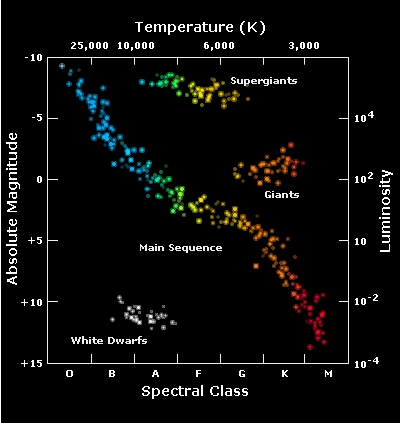
The amount of light that reaches your planet-moon system from its sun will depend on what kind of star it is. Stars come in different sizes and different temperatures. Most stars lie on what is known as the Main Sequence. Two notable exceptions are red giants and white dwarfs. The main sequence refers to the band of stars running diagonally through the Hertzsprung-Russell Diagram (HR diagram, previous links to two different images). Is basically a plot of how much light a star gives out (it's magnitude or luminosity) against it's colour or temperature. Stars are then divided into types (O, B, A, F, G, K, M) based on colour/temperature. Giant stars (other than blue giants) lie above the main sequence and white dwarfs lie below it. The sun is a G type star with temperature 5800 K (on the surface, that is; it's much hoter on the inside). K means Kelvin and is the standard unit of temperature. To convert from Kelvin and Celcius, you need to subtract 273, so the sun is 5500ºC (with rounding).

Using a star's temperature we can work out how much energy, in the form of light, reaches our planet. The first step is to assume that the star is a black body. This might sound conter-intuitive since the last word you're likely to use to describe the sun is "black", but from a physics perspective, a black body is something that absorbs all incident light and emits light based on its temperature. Well, I say "light", but really I mean electromagnetic radiation.

The Stefan-Boltzmann law tells us how much energy a black body emits based on its temperature. When we're talking about stars, this is called the luminosity. The formula for calculating luminosity is:

A stars luminosity, given it's radius, R, and temperature, T. σ = 5.67 × 10⁻⁸ is the Stefan-Boltzman constant and π = 3.14

The temperature has to be in Kelvin and the radius in meters to give luminosity in units of Watts (yes, like your light-bulbs) which is a measure of energy emitted per second. Radius and temperature are slightly trickier to come up with numbers for. If you're using a real star, you can just look it up on Wiki or Wolfram Alpha (Wiki even has a page listing the nearest stars to Earth). Otherwise you can make up a star with the characteristics you want such as temperature or class, then go to the second HR diagram I linked and look at the diagonal lines of radius. Whether you want a main sequence star, white dwarf or giant, this should give you an idea of radius (in units of the radius of the sun).

That's all well and good, but what we actually want to find is the light reaching a planet, not the total light emitted. Because stars emit light in all directions at once, their total energy output end up being diluted over an expanding sphere of light. Basically, not all the energy the sun produces hits our planet. It depends on how far away the planet is. This next formula will tell us how much energy hits the planet:

P is the energy per second hitting each square meter of the planet and D is the distance from the planet to its sun.

So P is the energy from the sun that hits a square meter of a planet which is D meters away from the sun. We're not quite there yet, but let's take a break and calculate some numbers. I'm going to work out the energy from the sun that hits the Earth/moon and Jupiter each second.
  • Earth/moon are about 1.5 × 10¹¹ m from the sun. The sun's radius is 6.955 × 10⁸ m and its temperature is 5800 K. The energy hitting a square meter of the Earth or moon each second is 1400 Joules.
  • Jupiter is 7.8 × 10¹¹ m from the sun. The energy hitting a square meter of Jupiter each second is 50 Joules, which is about 3.6% of the energy hitting the Earth. Jupiter's greater distance from the sun means that the sun's energy is about 30 times more spread out by the time it gets there. (As I calculate below, this is still about 14000 times brighter than the full moon as viewed from Earth.)

Planetshine

Light doesn't get completely absorbed by the planet, however. Some of it reflects back out into space and can illuminate other nearby objects. The property which determines how reflective something is (in this context) is called albedo. The average albedo of a planet is a number between 0 (non-reflective) and 1 (absolutely reflective), which represents the percentage of incident light that will be reflected.

In practice, it's fairly easy to implement albedo. The reflected energy is the incident energy multiplied by the albedo. Just multiply P above by albedo, A, and you get the power reflected off each square meter of planet. You can look up albedos for different planets/moons on Wiki and elsewhere. (But we all know Wiki's the easiest. It lists albedos in the summary box on the right of the relevant page. If more than one is given it's the Bond albedo, not the geometric albedo, that you want.)

What we actually care about, however, is how much of that reflected light goes on to reach the moon our colony is built on. In a way, we just reuse the equations I've already included above. Instead of putting L into the equation for P, use the P from the sun multiplied by albedo, radius becomes the radius of the planet, and distance is now the distance between planet and moon:


P is the energy per square meter per second hitting a moon, A is the albedo of the planet, R is the radius of their sun, r is the radius of the planet doing the reflecting, T is the temperature of their sun, d is the distance between planet and moon, D is the distance between planet/moon and sun. The last line is included because if you're using a real star, luminosity will probably be listed somewhere. Otherwise, the penultimate line is what you need to use.

OK, so this is getting increasingly more complicated looking, but remember that you only really have to do the last step. There rest are only there by way of explanation.

Now, one last thing before I calculate some more numbers. That last equation assumes that the primary planet appears full in the sky. If it's half full, you have to halve that number, if it's a quarter full you have to divide by four. Honestly? Just approximate.

  • The moon has an albedo of 0.136. The energy the full moon is reflecting at the earth is 0.0037 W/m2.
  • For the purposes of comparison, a 100 Watt light bulb from 10 meters away has a brightness of 0.02 W/m2.
  • The Earth has an albedo of 0.306. The energy Earth reflects at the moon is 0.12 W/m2. So because it's bigger and more reflective, the Earth as seen from the moon gives off about 32 times more energy per second. That means the full Earth in the lunar sky is roughly 32 times brighter than the full moon in Earth's sky and six times brighter than a 100 W light bulb.
  • Jupiter has an albedo of 0.343. Ganymede is 1.1 × 10⁹ m away. The brightness of full Jupiter in Ganymedean sky is 0.07 W/m2. That means Jupiter is almost twenty times brighter than the full moon. Not surprising given how big it is in the Ganymedean sky. A half-full Jupiter would be 10 times brighter than the full moon, a quarter-Jupiter about 5 times as bright and so-forth. The varying quantity here is what fraction of Jupiter's disk is illuminated (and that we're working under the assumption that Jupiter reflects evenly in all directions). A quarter-full Jupiter would be about as bright as a light bulb and a full Jupiter would be as bright as three and a half light bulbs 10 meters away.
  • Io is 4.2 × 10⁸ m from Jupiter. The brightness of full Jupiter in Io's sky is 0.48. So Jupiter is shining a whopping 130 times brighter than the full moon. By comparison, the sun as seen from Io is only about 100 times brighter than Jupiter. Light-bulb-wise, Jupiter would be as bright as 24 100W light bulbs 10 meters away.
  • For a bit of fun, the brightness of full Io (albedo 0.63) as seen from Ganymede varies from 1.2 × 10⁻⁴ W/m2 when it is at its closest point to Ganymede to 2.4 × 10⁻⁵ W/m2 when it is at its furthest. Neither of those are very bright, but it would still definitely be visible. It's about 0.6–3% the brightness of the full moon.
  • And finally, let's say we put Jupiter at the same distance from the sun as Earth is. Now Ganymede would get around the same amount of energy from the sun per square meter as Earth does and Jupiter would be a lot, lot brighter. How bright? 1.9 W/m2, which is 500 times more light that Earth gets from the moon and as bright as almost 100 light bulbs from a distance of 10 meters.

And there you have it. A method for approximating how much light you'd get reflected from a gas giant planet (or whatever planet/moon/asteroid you like). Unfortunately this post ended up being a little bit more complicated than I had initially anticipated (where complicated really means more maths), but it's a small price to pay for painstaking accuracy... Well, some semblance of accuracy, at any rate. There are a lot of approximations in the above (for example, the albedo varies for different types of terrain; so Earth's albedo is higher over clouds than over forest), but on average, it's close enough. Phew!

One last thing I came across after writing this post. I was looking for something else and came across this photo of Jupiter and Io. Notice how the line between Io's sun side and dark side (called the terminator) is very distinct and solid, whereas Jupiter has a bit more of a gradient going from light to dark? This is because Jupiter has an atmosphere (a very thick one, but the effect applies to Earth's atmosphere too) whereas Io's atmosphere is whispy and not really much to write home about. The atoms/molecules/particles in the atmosphere reflect light in all directions, allowing it to diffuse through a bit, giving us that gradient from light to dark. Io, on the other hand, only reflects light off its surface, leading to the solid terminator you can see in that image. Just something to think about when writing those realistic descriptive passages. ;-)

Update: I photoshopped some Jupiters into skies to give a size comparison with the full moon. You can see them here.

    Tuesday, April 5, 2011

    Introduction to Gravity

    I thought I'd do a series of posts on gravity because it's a huge topic and kind of important. I don't really want to do all of these in a row so if any of you have requests or suggestions for topics, please let me know in the comments. :-)


    Newton's law of gravity


    Almost everyone has heard the story of Newton sitting under an apple tree and being inspired towards understanding gravity thanks to a falling apple. You may have heard the version of that story where the apple falls on Newton's head but I recently read that it actually landed next to him. I am more inclined to believe this version of the story because I know that if an apple fell on my head I'd be too busy cursing the tree to have a flash of inspiration.

    What was the revelation Newton had about gravity? Well basically, he gave us a simple, universal description of gravity. The same force that causes the apple to fall towards the ground also keeps the moon orbiting the Earth and the Earth orbiting the sun. The mathematical expression for the force of gravity between two objects that Newton left us with is:


    F is the force of gravity between two objects of masses M and m kilograms, with their centres separated by distance r meters. G is the gravitational constant and is equal to 6.67 × 10⁻¹¹ km3 kg-1 s-2 .

    However, in our day-to-day experiences, it is not forces, per se, that we are most aware of but accelerations. For example, if you are on a train moving at a constant speed (not accelerating, that is; not slowing down or speeding up), you can't tell how fast you are going solely from its motion. The only thing that would give it away is the bumping up and down thanks to uneven tracks. However, it's easy to tell when the train is slowing down or speeding up because you are either pushed backwards or forwards in your seat (depending on which way you are facing).

    Although gravity is always pulling us towards the centre of the Earth, what we actually feel is the ground (or floor or chair or whatever) holding us up and preventing us from falling towards the centre of the Earth. It's gravity accelerating us into the floor that we experience as weight. If there was no floor and we were just falling, we would actually feel weightless (air resistance notwithstanding). The International Space Station is well within Earth's gravitational field but it is constantly falling, which is what makes the astronauts inside feel weightless. Luckily it's not just falling straight down; it also has a horizontal velocity which means that in the time it falls downwards a certain amount, the curvature of the Earth results in the ground also falling away by the same amount. This is called an orbit, and I will talk more about them in the next section.

    Back to the equation above. How do we turn this into what we experience every day on Earth and then into what we would experience if we were living on another planet. The important quantity to calculate is g, the acceleration due to gravity. Every force (or sum of forces) can be described as an acceleration acting on a mass. F = ma is the famous equation and is the mathematical representation of Newton's second law (side fact: Newton's law of gravitation didn't get a number, his three laws refer to more basic laws of mechanics). To find acceleration due to gravity on the surface of a planet, we equate F = mg (rather than F = ma, since g is the symbol we use for acceleration due to gravity) with Newton's law of gravity:

    Acceleration due to gravity, g, depends only on the mass of the body exerting a gravitational force and on the distance from the centre* of that body. All bodies, no matter what their mass, m, will accelerate at the same rate in the same gravitational field.

    To find g at the surface of the Earth, you need to substitute in the mass of the Earth for M and the radius of the Earth for r. On Earth, g = 9.8 meters per second per second, which means that, if we ignore air resistance, something that is falling will gain 9.8 m/s of speed each second. It also means that the force with which we are constantly pushed into the ground/chair/bed is equal to our mass times 9.8.

    On planets other than Earth which are smaller, larger, heavier or lighter, there are different accelerations due to gravity which we can find by throwing the right numbers into the equation above. Some examples from rocky† planets and moons in our solar system (where g is acceleration due to gravity on Earth's surface):
    • Moon: 1.7 m/s2 = 0.17 g (about a sixth of Earth's gravity, so you would feel a sixth as heavy.)
    • Mars: 3.7 m/s2 = 0.38 g (between a third and two fifths of Earth's gravity)
    • Mercury: 3.8 m/s2 = 0.39 g (coincidentally very close to Mars)
    • Ganymede: 1.5 m/s2 = 0.15 g (also about a sixth of Earth's gravity)

    And because this is easily applicable to extrasolar planets — that is, planets outside of our solar system — I have also calculated some surface accelerations due to gravity for a few known exoplanets (links below are to Wiki, but I got my values from the Exoplanet iOS app; see below).
    • Gliese 1214 b: 8.6 m/s2 = 0.88 g (Just under nine tenths that of Earth. However, it's just inside its host star's habitable zone (the star is called Gliese 1214) which means it'll probably be too hot for human habitation. It could even have a runaway greenhouse effect like Venus. It's also possible that this planet has a very thick atmosphere making it more similar to a small gas giant like Neptune than to Earth.)
    • CoRoT 7 b: 18.4 m/s2 = 1.9 g (Just under twice Earth gravity so you would feel almost twice as heavy and, more vitally, your organs would all press down on each other twice as strongly. According to NASA (pdf, sorry), this isn't terribly sustainable in the long term for humans as we are now. Personally, I don't think it would take an awful lot of genetic engineering to fix this for us (we are talking science fiction, after all). The bigger problem with this planet is that it's much to close to its sun for our comfort or survival.)
    • Kepler 11f: 3.4 m/s2 = 0.35 g (About a third of Earth's gravity. Compare with Mars or Mercury. Unfortunately, it's also slightly too close to its star to be habitable. Incidentally, the whole Kepler 11 system is quite interesting with six confirmed planets so far.)
    (If you have a hankering to include some real exoplanets in your story, I highly recommend this iOS app is an excellent resource. It is a frequently updated database of all the confirmed exoplanets that have been discovered, including their statistics (mass, distance from star, radius where available, whether it's in its star's habitable zone...) and you can even pan through and around a zoomable 3D map of the Milky Way. And when I say zoomable, I mean you can zoom right in to see the planets orbiting their stars at the correct distances and with the appropriate relative velocities. Even if you don't care about the specifics of the planets, that Milky Way map is worth the time it takes to click the free download link. For the record, I am in no way connected to this app, I just think it's awesome.)


    * Technically, the distance from the centre of mass, but for round or roundish things like planets the centre of mass is generally the centre of the planet.
    † Rocky because you can't stand on the surface of the gas giants. It's possible to calculate the acceleration due to gravity experienced by a hovering platform or similar, however.


    Orbits

    As we've established, gravity is what keeps things in orbit around other things. As such, we need to use what we know about gravity to work out how fast something has to orbit for different distances and masses of objects. In fact, Kepler had worked this out to some degree before Newton came along, but Kepler's third law was slightly less specific than could be calculated using Newton's law. Kepler realised that for orbits, the ratio between the cube of the semi-major axis and the square of the period was constant. The semi-major axis is the same as the distance to the larger body from the smaller (like r in the equations earlier) for circular orbits and half the length of the longest side of an ellipse (oval). the period, T, is the time taken to complete one orbit, so if we're talking about planets, then it's the length of a year. We can derive the constant part of Kepler's third law using Newton's law of gravity and the equation that describes centripetal force.

    As it happens, I talked about a lot of the ingredients for working out how fast a planet should orbit around its star in my recent post about space elevators. The set of equations below starts by equating the centripetal force (the force required to keep something of mass m moving around in a circle with radius r and at speed v) with the gravitational force (centripetal on the left, gravitational on the right of the equals sign), then shows the derivation of Kepler's third law (the second last line) and finally gives the period, T, of a planet orbiting around a star of mass M at a distance r. Feel free to let your eyes glaze over if maths isn't your thing. You have been warned.


    The final line gives us the period in seconds, which for most things isn't terribly helpful. To find out what the length of your planet's year is in days or Earth years you will need to divide your answer for the period by 86400 or 3.15 × 10⁷ respectively.

    The reason I chose to rearrange Kepler's law to solve for the period rather than for the semi-major axis is because for science fictional purposes, the distance from the star is more likely to be fixed for plot purposes. For example, an human-inhabited planet has to be in the habitable zone. Exactly what the habitable zone is will be, I think, the subject of a future blog post.

    I should also point out that these equations are completely applicable to man-made satellites or moons as well, you just need set the planet's mass to be M instead of the star's mass. Just remember that if your comms satellite is x km above the surface of the Earth/whatever planet, you have to add on the radius of the planet to find r to throw into the equations I've talked about today.

    Wednesday, March 16, 2011

    Living on a moon: Marking time

    There is a certain class of exotic location often used in science fiction and that is the surface of a moon.

    Most of what I'm going to say will apply to moons like Earth's but I'm going to focus on the moons of gas giant planets like Jupiter and Saturn partly because they're a little more interesting and partly because if you want to know about day and night on the moon, it's more trivial to look up.

    Planets orbiting a star

    First, let's talk about ordinary (Earth-like) planets orbiting a star. They will have a year defined by how long it takes them to do a complete orbit of their sun and a day defined by how long it takes them to spin on their axis. Actually, there are two possible definitions of a day:
    • the solar day, which is how long it takes the planet to rotate all the way around so that the sun returns to the same place in the sky (or more accurately, until it returns to the same point above the planet. On Earth, the meridian passing through Greenwich and the middle of the Pacific ocean is the reference point we use).
    • and the sidereal day, which is how long it takes the planet to rotate about its axis so that the stars return to the same position in the sky.
    On Earth, a sidereal day is slightly shorter than a solar day (only 23.9 hours) and this will be true of any planet that spins in the same direction as it orbits. So the Earth, looking down on the north pole, spins anti-clockwise and orbits the sun anticlockwise. Such a planet is in a prograde orbit. This is true of all the planets except Uranus, which is sideways, and most of their moons. It is in general going to be true of all systems if they formed together (thanks to conservation of angular momentum) and if a planet isn't prograde (that is, if it's particularly lopsided like Uranus or if it's retrograde meaning spins or orbits in the opposite direction) then it probably has a more interesting history. In the case of Uranus, it is thought that some collision knocked it sideways a long time ago. For retrograde planets, where one each of orbit and rotation are clockwise and anticlockwise, the implication is that they did not form where they are found, but are interlopers from elsewhere. Or there could also have been a collision, but it would have to be a very large collision in exactly the right place. It's interesting to note that all the planets orbit in the same direction as the sun rotates. This is strong evidence that they all formed from the same nebula at roughly the same time.

    Moons: Mostly tidally locked

    OK, enough background. On to the moons. Let's assume we have a rocky moon orbiting a gas giant planet. All the interesting moons in our solar system (which is to say, the ones I checked and generally most or all of the big ones) are tidally locked with their primary, including Earth's moon. What does tidally locked actually mean?

    I won't go into the details of the physics, but if a satellite is tidally locked with its primary, the same side will always face the primary. So on Earth, we always see the same side of the moon. If you go to the moon and land on the near side, Earth will always be in the same place in the sky (assuming you don't travel far from your landing place) varying only in how much of it is lit up by the sun. It's also possible to have planets tidally locked with their sun, but they have to be quite close to their sun for this to happen. Consequently, most of those planets wouldn't be habitable for humans, unless the star in question was a red dwarf, but that's a topic for another blog post.

    Back to our rocky moon orbiting a gas giant. Since it's tidally locked, you will need to decide where you want to place your colony/city. Directly under the primary planet so that it always sits high in the sky? On the side of the planet which never sees the primary? These choices will depend a bit on your whim and a bit on the purpose of the colony. For the latter, if it's a research installation studying the primary or a mining installation skimming gas from the primary's atmosphere, it makes the most sense to build it directly below the primary. On the other hand, if the research installation is built for astronomy observations, you'd want to put it on the non-planet side so that light from the sun reflected from the primary interferes with your telescopes less.

    Days and nights?

    Once you've made that decision, you probably want to know how long days and nights will be on your moon. This is where it gets a bit tricky. I'm going to use Ganymede, one of the larger moons of Jupiter, as an example. Thanks to its synchronous orbit (another way of saying that it's tidally locked), a sidereal day on Ganymede is the same as it's orbital period. Orbital period is the general term for how long it takes to orbit all they way around Jupiter. (I'd prefer to say "Jovian day", but unfortunately that term refers to one of Jupiter's solar days. :-/ ) So unless it orbits very quickly, orbital period would not be a useful measure of time to base diurnal cycles on. And if it did have a fast enough orbit, it probably wouldn't be very habitable since that would imply that it was very close to the primary like Io (the innermost Galilean moon of Jupiter), leading to a host of problems like extreme volcanism and earthquakes. As I hope the crude sketch I did below helps illustrate, a solar day on Ganymede (that is, the length of time it takes for the sun to move all the way across the sky and come back to its starting point) is also the same length as an orbital period.*


    Not to scale! Top right circle is the sun, orange circle is Jupiter with the lighter half the half that is illuminated by the sun and the darker brown half the dark side. The grey shadow is Jupiter eclipsing the sun and the rainbow circle is Ganymede, so coloured to illustrate that the same side is always pointing towards Jupiter. The thick black line shows its orbit around Jupiter and the light and dark semicircles inside Jupiter's orbit are to help guess how full/dark/crescent/gibbous Jupiter would appear in Ganymede's sky (if you're on the side of Ganymede facing Jupiter).

    We can also use that diagram to work out how much of Jupiter would be lit up by the sun if we're on a the side of Ganymede facing Jupiter. It should also be noted that, unlike the Earth being lit up by the moon and human lights at night and hence being visible from the moon even when it's not lit up by the sun, the dark side of Jupiter would be completely dark. Against the black sky of Ganymede (and the sky would always be black, even during the day, since Ganymede has no atmosphere to scatter photons with) it would just look like a black hole in the stars. A black hole about 15 full moons across.

    *Technically it would be slightly less thanks to Jupiter's orbit around the sun, but Jupiter is so far out from the sun and has such a large distance to travel that day to day we can ignore the small difference to the length of a Ganymedean solar day. If your gas giant is much closer to its star, it might become relevant, but this calculation is left as an exercise for the reader. ;-)

    Time moves forward

    Finally, it would be useful to work out how quickly Jupiter and the sun change in Ganymede's sky, especially if you're writing a story that involves spending longer than a day there. I will make this section more general so that you can use for any hypothetical moon orbiting an arbitrary gas giant.

    What you need to know or decide is the orbital period, let's call it T,  a piece of paper with your own approximation of the diagram above (without all the different positions of Ganymede drawn in yet), and a protractor (or a really good eye for angles). For Ganymede, T = 7.15 (Earth) days. If you're making up a planet-moon system of similar size, it's probably best you're numbers don't deviate too much. I think I might make the proper physics you need to consider when making up planets the subject of a future blog post.

    On your hand drawn diagram, choose a starting position for your planet and a location on the surface for your colony. I suggest putting your colony close to the equator because a) it will be more picturesque and b) Ganymede has some crazy magnetic fields and I suspect that radiation shielding would be easiest to achieving within about 30º latitude of the equator. This doesn't automatically apply to all moons in similar systems, but still, it can't hurt. Draw your moon in it's starting position and mark the location of your colony with a cross or something. Remember that looking down from above the north pole, the moon will probably be orbiting anticlockwise if it's in our solar system.

    Next, you need to do a small piece of maths. Decide how much time you want to pass before you mention what the gas giant is looking like in the sky again. Call this time t. Make sure T and t are in the same units (convert them both to days or both to hours, whichever is more convenient, if they don't match). To work out how many degrees, d, of a circle the moon has moved in this time, you need to use the following equation:
    d = 360*t/T

    In one Earth day, Ganymede will move d = 360*1/7.15 = 50.3º which is a bit more than an eight of a circle. On the diagram above, that's a little bit more than the distance between two consecutive rainbow Ganymedes (ignoring the two close together in Jupiter's shadow). Since T is so small for Ganymede, this means that Jupiter and the sun change quite dramatically in the sky (Earth) day to (Earth) day. Depending on how your planet-moon system is set up, your mileage may vary.

    Multiple moons

    And a quick bonus calculation: if your planetary system has multiple moons your feel like caring about, you can do the above calculation for each of them, choose starting points and then see how far each one moves in the span of time you're interested in. This doesn't need to be very hard at all. In the jovian system, Io completes four orbits in the time it takes Ganymede to complete one and Callisto completes two in the same time. This convenient state of events is thanks to the physical principle of resonance. Resonance happens in all sorts of places in nature and celestial mechanics, including Saturn's rings and Mercury, so feel free to implement it with impunity.

    Hopefully, I've given you enough information to convincingly set a story on a moon orbiting a gas giant planet. Well, in a colony at least, where you don't have to worry too much about external climate, so long as you stay away from Io.

    LinkWithin

    Related Posts Plugin for WordPress, Blogger...