Showing posts with label Mars. Show all posts

Sunday, October 21, 2012

Atmospherically Speaking

Today I have another Ask Tsana post.

Brookelin asked:
Hi again, Tsana.

I was wondering - in an alternate universe, what would it take for a species to survive on Mars?

I know that it has some atmosphere, but not a whole lot. With the pressure being below the Armstrong limit, could there feasibly be large creatures (between collie and bear size) that could survive would have higher thresholds and what would they need to do so?

If the water on a human's tongue boils in space, would an alien creature in these environments be able to have eyes and mouths?

What might these species' need to overcome the intense radiation caused by Mars' weak magnetosphere?

Could bio-genetically enhanced humans ever survive these conditions outside a space suit for periods of time upwards of an hour, but less than a day?

Are these too many questions? Do you know the answers to any of them, or is this more of a medical thing?
I don't have answers to all of these questions because, as Brookelin said, some are more medical/biological and that's not my area of expertise. I will say that what we generally know a lot about is life on Earth. There are some constraints that exist for life on other planets but there is nothing to say that it has to resemble Earth life. They could have eating and seeing organs completely different to what we're used to. Even on Earth there's a pretty wide variety. I'm not sure that merely genetically enhancing a human would be enough to let them walk around on Mars. Science fictions stories have gone there, but I'm not sure genetics is up to it. I could be wrong, I'm just guessing. Hopefully my comments below on atmospheres and life on smaller planets such as Mars will answer the rest of the questions, though.

Mars. Credit: NASA, ESA, and The Hubble Heritage Team
(STScI/AURA)
It's true that Mars has a very thin atmosphere; it's about 0.6% as dense as Earth's at their respective surfaces. Part of the reason for this is Mars's lower gravity. In general, gases will expand to evenly fill the container they're in. When the container is a planet's gravitational field, we get denser air closer to the ground and less dense air higher up. This is because the air higher up is pushing down on the lower air while having less air above it to push it down. More or less.

Air is made up of particles (atoms and molecules) which move around very quickly and bounce off each other. That's why a gas is a gas and not a liquid or solid: the particles in a liquid don't move quickly enough to completely overcome the forces attracting them to each other and the particles in a solid can't move more than vibrating on the spot because the forces holding them in place are so strong. The energy that makes the particles move, for all states of matter, depends on the temperature: the hotter, the faster. The other important consideration is particle mass. At the same temperature, oxygen and hydrogen molecules (O2 and H2) have the same energy. However, oxygen weighs sixteen times as much as hydrogen (because the atoms are larger and heavier) so it takes more energy to move oxygen molecules at the same speed as hydrogen molecules. The result is that at the same temperature, oxygen molecules move more slowly than hydrogen molecules. And it takes less energy for hydrogen molecules to reach escape velocity (the speed required to escape the gravitational pull of Earth/whatever planet) than oxygen. And that's why there is very little hydrogen in Earth's atmosphere despite it being the most abundant element on a cosmic scale — it escapes into space. It's also the reason only the gas giants, notably Jupiter and Saturn, have any significant about of hydrogen in their atmospheres — they have the strongest gravitational fields.

So, Mars. Mars is smaller than Earth, with about a third the acceleration due to gravity at its surface. Mars is made up of similar elements to Earth, most likely because they formed so closely together, so it's likely that the same sort of lighter elements could have made up Mars's atmosphere. However, due to the lower gravity, not only hydrogen but oxygen and nitrogen would also have escaped or never been captured by the planet. I would guess the main reason there's so much frozen carbon dioxide at the poles is because it has a relatively high melting point of -78ºC rather than the much colder melting points of oxygen (-219º C) and nitrogen (-210º C). For comparison, Mars's surface temperatures vary between -143º and +35º C. So basically, even if you imported or mined enough gas to raise the air pressure to human survivable levels, it would all be lost into space and would need constant replenishing which would get tedious and be difficult to sustain. You'd also, ideally, raise the surface temperature to more consistently human survivable levels — probably using some sort of greenhouse effect to trap more of the sun's energy — but that would just hasten the atmosphere's escape.

Titan's atmosphere as seen by Cassini. Credit: NASA
But all is not lost. Heavier molecules exist, particularly those made out of carbon. Titan, one of Saturn's moons, is smaller than Mars but has an atmospheric pressure greater than Earth's by about 45%. It's colder than Mars, which allows its atmosphere to condense a bit, but it's only got a surface gravity of around a seventh that of Earth's (less than half of Mars's). According to Wiki, its atmosphere is composed mainly of nitrogen (as is Earth's) and methane with some traces of heavier carbon molecules. It's a combination of the temperature, the distance from the sun, Saturn's magnetic field and some form of replenishing methane that keeps Titan's atmosphere thick and, well, full of methane. Distance from the sun is significant by itself because Titan is far enough that the ionising solar wind is weak enough to not completely ionise and destroy the top layers of its atmosphere. The same strategy probably wouldn't work on Mars to increase the atmospheric pressure permanently unless you could find some magically resistant to solar radiation molecule to populate the atmosphere with. There are two interesting theories for what keeps replenishing the methane on Titan (which should be destroyed even by the lowered energy it receives from the sun): cryovolcanoes — volcanoes shooting icy hydrocarbons instead of lava — or biological processes using/generating methane in place of water.

The high levels of ionising radiation on Mars are as much due to its lack of atmosphere as its lack of magnetic field. (Side note: there's evidence that there was a magnetic field on Mars in the past, though I don't think we know why it went away.) Earth's atmosphere absorbs a lot of the ionising and UV radiation the sun throws at us (part of the reason the ozone layer is important). Not all of it is deflected — and things like X-rays and gamma rays can't be deflected because they don't have an electric charge — especially near the magnetic poles where the aurorae are caused by charged particles, mostly from the sun, interacting with the atmosphere. However, giving Mars a magnetic field would definitely help. Earth's is generated by molten iron in its core so it's not outside the realm of over-dramatic science fiction to drill a hole into the centre and start the core spinning. Come to think of it, Hollywood's already done that, just with Earth not Mars. (For the record, the ridiculous issues with that movie include the structural integrity of the hole and the failure to correctly represent changes in gravity.) A more feasible way to avoid radiation on Mars would be to live underground so that the ground above you did the work of absorbing harmful radiation. The reason too much radiation is bad for all forms of life is that it destroys and changes molecules. In humans this is one of the causes of cancer. In microbial life, which might only have a few cells to begin with, it's more deadly. It's why sterilising things with UV light works.

So basically, the easiest way to get people living and wandering around on Mars is to have them live in airtight structures and give them suits for walking around outside it. The suits wouldn't have to be as extreme as space suits though, so that's something. I'm not saying it's completely impossible to walk around on the surface with less protection, just very difficult. And because someone will mention it in the comments if I don't, I've heard that Kim Stanley Robinson's Mars books, starting with Red Mars, do a good job of talking about the terraforming process, although I haven't read them. Ben Bova's Grand Tour of the solar system books (eg Mars or Saturn and Titan) explore alternative forms of life all over the solar system. If you can stomach a bit of sexism, some of them are worth a read.


Friday, October 21, 2011

Bunch of links, mostly outdated

First up, square Earth anyone? Forget realism, let's just have a think about what an Earthlike planet would be like if it were a cube. Puts me in mind of the planet builders in Hitchhikers' Guide to the Galaxy. Brought to you by Discovery News.

Second, the Planetary Habitability Laboratory talks about brightnesses of the various planets in the solar system and also of exoplanets. An interesting read, particularly if you enjoyed my old How Bright is the Night? post.

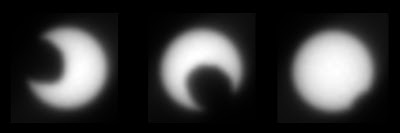
Martian moons eclipse the sun in these NASA photos from the Opportunity rover:
Credit: NASA/JPL/Cornell

Enceladus pics from Cassini. Enceladus is one of Saturn's moons, most famous for it's ice geysers.

Proposed space robot to cannibalise old satellites which have previously been boosted up to "graveyard" orbits. Many mentions of zombie satellites and grave robbing associated with this one ;-p . From New Scientist.

And finally, laser driven fusion in California. From New Scientist again.

Happy weekend, gentle readers!


Tuesday, April 5, 2011

Introduction to Gravity

I thought I'd do a series of posts on gravity because it's a huge topic and kind of important. I don't really want to do all of these in a row so if any of you have requests or suggestions for topics, please let me know in the comments. :-)


Newton's law of gravity


Almost everyone has heard the story of Newton sitting under an apple tree and being inspired towards understanding gravity thanks to a falling apple. You may have heard the version of that story where the apple falls on Newton's head but I recently read that it actually landed next to him. I am more inclined to believe this version of the story because I know that if an apple fell on my head I'd be too busy cursing the tree to have a flash of inspiration.

What was the revelation Newton had about gravity? Well basically, he gave us a simple, universal description of gravity. The same force that causes the apple to fall towards the ground also keeps the moon orbiting the Earth and the Earth orbiting the sun. The mathematical expression for the force of gravity between two objects that Newton left us with is:


F is the force of gravity between two objects of masses M and m kilograms, with their centres separated by distance r meters. G is the gravitational constant and is equal to 6.67 × 10⁻¹¹ km3 kg-1 s-2 .

However, in our day-to-day experiences, it is not forces, per se, that we are most aware of but accelerations. For example, if you are on a train moving at a constant speed (not accelerating, that is; not slowing down or speeding up), you can't tell how fast you are going solely from its motion. The only thing that would give it away is the bumping up and down thanks to uneven tracks. However, it's easy to tell when the train is slowing down or speeding up because you are either pushed backwards or forwards in your seat (depending on which way you are facing).

Although gravity is always pulling us towards the centre of the Earth, what we actually feel is the ground (or floor or chair or whatever) holding us up and preventing us from falling towards the centre of the Earth. It's gravity accelerating us into the floor that we experience as weight. If there was no floor and we were just falling, we would actually feel weightless (air resistance notwithstanding). The International Space Station is well within Earth's gravitational field but it is constantly falling, which is what makes the astronauts inside feel weightless. Luckily it's not just falling straight down; it also has a horizontal velocity which means that in the time it falls downwards a certain amount, the curvature of the Earth results in the ground also falling away by the same amount. This is called an orbit, and I will talk more about them in the next section.

Back to the equation above. How do we turn this into what we experience every day on Earth and then into what we would experience if we were living on another planet. The important quantity to calculate is g, the acceleration due to gravity. Every force (or sum of forces) can be described as an acceleration acting on a mass. F = ma is the famous equation and is the mathematical representation of Newton's second law (side fact: Newton's law of gravitation didn't get a number, his three laws refer to more basic laws of mechanics). To find acceleration due to gravity on the surface of a planet, we equate F = mg (rather than F = ma, since g is the symbol we use for acceleration due to gravity) with Newton's law of gravity:

Acceleration due to gravity, g, depends only on the mass of the body exerting a gravitational force and on the distance from the centre* of that body. All bodies, no matter what their mass, m, will accelerate at the same rate in the same gravitational field.

To find g at the surface of the Earth, you need to substitute in the mass of the Earth for M and the radius of the Earth for r. On Earth, g = 9.8 meters per second per second, which means that, if we ignore air resistance, something that is falling will gain 9.8 m/s of speed each second. It also means that the force with which we are constantly pushed into the ground/chair/bed is equal to our mass times 9.8.

On planets other than Earth which are smaller, larger, heavier or lighter, there are different accelerations due to gravity which we can find by throwing the right numbers into the equation above. Some examples from rocky† planets and moons in our solar system (where g is acceleration due to gravity on Earth's surface):
  • Moon: 1.7 m/s2 = 0.17 g (about a sixth of Earth's gravity, so you would feel a sixth as heavy.)
  • Mars: 3.7 m/s2 = 0.38 g (between a third and two fifths of Earth's gravity)
  • Mercury: 3.8 m/s2 = 0.39 g (coincidentally very close to Mars)
  • Ganymede: 1.5 m/s2 = 0.15 g (also about a sixth of Earth's gravity)

And because this is easily applicable to extrasolar planets — that is, planets outside of our solar system — I have also calculated some surface accelerations due to gravity for a few known exoplanets (links below are to Wiki, but I got my values from the Exoplanet iOS app; see below).
  • Gliese 1214 b: 8.6 m/s2 = 0.88 g (Just under nine tenths that of Earth. However, it's just inside its host star's habitable zone (the star is called Gliese 1214) which means it'll probably be too hot for human habitation. It could even have a runaway greenhouse effect like Venus. It's also possible that this planet has a very thick atmosphere making it more similar to a small gas giant like Neptune than to Earth.)
  • CoRoT 7 b: 18.4 m/s2 = 1.9 g (Just under twice Earth gravity so you would feel almost twice as heavy and, more vitally, your organs would all press down on each other twice as strongly. According to NASA (pdf, sorry), this isn't terribly sustainable in the long term for humans as we are now. Personally, I don't think it would take an awful lot of genetic engineering to fix this for us (we are talking science fiction, after all). The bigger problem with this planet is that it's much to close to its sun for our comfort or survival.)
  • Kepler 11f: 3.4 m/s2 = 0.35 g (About a third of Earth's gravity. Compare with Mars or Mercury. Unfortunately, it's also slightly too close to its star to be habitable. Incidentally, the whole Kepler 11 system is quite interesting with six confirmed planets so far.)
(If you have a hankering to include some real exoplanets in your story, I highly recommend this iOS app is an excellent resource. It is a frequently updated database of all the confirmed exoplanets that have been discovered, including their statistics (mass, distance from star, radius where available, whether it's in its star's habitable zone...) and you can even pan through and around a zoomable 3D map of the Milky Way. And when I say zoomable, I mean you can zoom right in to see the planets orbiting their stars at the correct distances and with the appropriate relative velocities. Even if you don't care about the specifics of the planets, that Milky Way map is worth the time it takes to click the free download link. For the record, I am in no way connected to this app, I just think it's awesome.)


* Technically, the distance from the centre of mass, but for round or roundish things like planets the centre of mass is generally the centre of the planet.
† Rocky because you can't stand on the surface of the gas giants. It's possible to calculate the acceleration due to gravity experienced by a hovering platform or similar, however.


Orbits

As we've established, gravity is what keeps things in orbit around other things. As such, we need to use what we know about gravity to work out how fast something has to orbit for different distances and masses of objects. In fact, Kepler had worked this out to some degree before Newton came along, but Kepler's third law was slightly less specific than could be calculated using Newton's law. Kepler realised that for orbits, the ratio between the cube of the semi-major axis and the square of the period was constant. The semi-major axis is the same as the distance to the larger body from the smaller (like r in the equations earlier) for circular orbits and half the length of the longest side of an ellipse (oval). the period, T, is the time taken to complete one orbit, so if we're talking about planets, then it's the length of a year. We can derive the constant part of Kepler's third law using Newton's law of gravity and the equation that describes centripetal force.

As it happens, I talked about a lot of the ingredients for working out how fast a planet should orbit around its star in my recent post about space elevators. The set of equations below starts by equating the centripetal force (the force required to keep something of mass m moving around in a circle with radius r and at speed v) with the gravitational force (centripetal on the left, gravitational on the right of the equals sign), then shows the derivation of Kepler's third law (the second last line) and finally gives the period, T, of a planet orbiting around a star of mass M at a distance r. Feel free to let your eyes glaze over if maths isn't your thing. You have been warned.


The final line gives us the period in seconds, which for most things isn't terribly helpful. To find out what the length of your planet's year is in days or Earth years you will need to divide your answer for the period by 86400 or 3.15 × 10⁷ respectively.

The reason I chose to rearrange Kepler's law to solve for the period rather than for the semi-major axis is because for science fictional purposes, the distance from the star is more likely to be fixed for plot purposes. For example, an human-inhabited planet has to be in the habitable zone. Exactly what the habitable zone is will be, I think, the subject of a future blog post.

I should also point out that these equations are completely applicable to man-made satellites or moons as well, you just need set the planet's mass to be M instead of the star's mass. Just remember that if your comms satellite is x km above the surface of the Earth/whatever planet, you have to add on the radius of the planet to find r to throw into the equations I've talked about today.

Sunday, March 20, 2011

Space Elevators: Where to put them

The purpose of this post is not to exhaustively describe what a space elevator is and how it is intended to work. There are many other sources for that information. Instead, I intend to focus on what planets are suitable for building a space elevator on and which aren't and why.

WARNING: This post contains maths that requires a proper calculator.

Briefly: What is a space elevator?

A space elevator is a proposed system for (mostly) getting things into orbit without using rockets. The idea is that once it's established, the cost for going into orbit drops dramatically because you no longer have to use rockets (which are expensive and generally involve some disposable element).

Many different types of space elevators have been proposed, not all of which necessarily reach the Earth's surface. Instead they start part way up or outside of the atmosphere. This has the benefit of avoiding annoying atmospheric effects (wind, drag) and makes them lighter. But I'll leave researching what type of space elevator best fits into the world being created as an exercise for the reader. What I am going to talk about is what and where is it physically possible to place an elevator and more or less ignore engineering constraints (set it far enough in the future and, as Arthur C Clarke said, you can have technology advanced enough to seem magical).

There are two ways of making a space elevator stay up. You can have a rotationally supported one or a gravitationally supported one. In the case of lifting payloads from Earth into orbit, a space elevator would almost certainly be rotationally supported. One designed for getting things to and from the surface of the moon, however, would more likely be gravitationally supported. What are the differences?

Rotationally supported space elevator

The principle for a rotationally supported space elevator is to have the force of gravity pulling it down to Earth exactly opposed by the centrifugal force of it spinning around in its orbit. Since we also generally want it to remain above above the same point on the surface of the Earth (so we can connect the ground to the top of the elevator with a cable, for example), the centre of mass of the elevator needs to be at the height of geostationary orbit. Geostationary orbit just means that it orbits at the same speed that the surface of the Earth rotates and hence it remains above the same surface point of the Earth all the time. Also, this point has to be along the equator or the stationary part of geostationary won't work. For example, a lot of communication satellites live in geostationary orbits which makes it easier for receivers on Earth to talk to them since they are always in the same place. And in the case of TV broadcasting, you generally only want to broadcast at a particular region, so there is the benefit of always being able to do so.

A quick note on how to calculate the height of geostationary orbit, since I want this guide to be generally applicable, not just for Earth. For geostationary orbits, the acceleration due to Earth's gravity, g,  (or the gravity of whatever body we're interested in) needs to cancel out the centripetal acceleration, ac, from the circular motion of orbit.


So r is the distance from the centre of the planet in kilometres (just subtract the radius of the planet at the end to find the height above the ground if that's what you want to know), G = 6.67 × 10⁻²⁰ km3 kg-1 s-2 is Newton's gravitational constant, M is the mass of the planet in kilograms, T is the length of a day in seconds and π = 3.14 is a constant. We can now rearrange this:


And it becomes just a matter of plugging in the right numbers. We can now calculate that the height of geostationary orbit for Earth is about 36 000 km. Out of interest, for Mars, the height would be only 17 000 km thanks mostly to Mars' small mass.

You might have noticed earlier that I said the centre of gravity of the space elevator needs to be at geostationary orbit. This just means that half the mass of the elevator needs to be below the geostationary height (so, mostly this would be in the cable since thirty-six thousand kilometres of cable, even if it's made of carbon nanotubes, is a non-trivial mass), and half needs to be past the geostationary height. The latter "counterweight" could consist of something like a docking station, space craft manufacturing plant or whatever you like.


Gravitationally supported space elevator

You probably wouldn't use a gravitationally supported space elevator to lift things off the surface of the Earth into space, but it would be ideal for lifting payloads from the moon. Because the moon is in a synchronous orbit (where it takes the same amount of time to complete a rotation as it does an orbit around the Earth), it spins too slowly for a sensible rotationally supported elevator. Plugging the numbers into the equation above, I get a geostationary height above the surface of about 87 000 km, more than twice the height for Earth. The moon's great and all, but it's probably not worth the price of twice the length of the cable just for getting rocks back to Earth. Not to mention any gravitational effects of the Earth on the elevator. For another example, let's work out the geostationary height for Ganymede, the largest moon of Jupiter. Plugging in all the numbers, I get about 43 000 km above the surface of Ganymede. Sure, this isn't a much longer cable than for Earth, but at the distance you start getting annoying gravitational effects from Jupiter and other planets screwing you over. Basically, you couldn't make it stable.

The solution to this dilemma is not to try to make a rotationally supported space elevator, but to go for a gravitationally supported one instead. A gravitationally supported space elevator has its centre of mass at a Lagrange point, usually L1, which is sort of a gravitationally neutral location. So for the moon, the centre of mass would go at the point where the force of Earth's gravity is exactly balanced by the force of the moon's gravity. This point is called first Lagrange point of the Earth-moon system (after the guy who worked out the maths).

Thanks to the moon's synchronous orbit, the point on its surface that is closest to Earth doesn't change. Hence, a gravitationally balanced space elevator would automatically remain stationary relative to the surface of the moon, which is handy when you're running a cable between them.

How do we calculate how far from the moon the Lagrange point we're interested in? Well, we want the point where the acceleration due to each Earth and moon cancel out BUT we also have to consider the rotational acceleration due to the circular motion of orbit. (Remember, even though the space elevator is attached to the moon, the fact that it's suspended between moon and Earth means that it's also going around the Earth).


r is the distance from the centre of the moon to the Lagrange point, m is the mass of the moon, M is the mass of the planet, d is the distance between the planet and the moon and T is the time it takes for the moon to complete an orbit (hence the time taken for the space elevator to complete an orbit since it's attached to the moon). It's not actually possible to rearrange this into something nice. If you really need to do this for a general planet, I suggest going to WolframAlpha.com and typing in:


Solve[-((G m)/r^2) + (G M)/(d - r)^2 == ((2*3.14)/T)^2 (d - r), r]

But with the appropriate values in place of all the constants (in km and kg if you use the G I gave above). I personally did the same in Mathematica (which is also made by Wolfram and has the same maths engine as Wolfram Alpha). However, if you're interested in doing a calculation yourself, with some approximations to simplify things, this website (which I came to via Google) seems to do a reasonable job. It also explains the maths a bit more than I have.

So anyway, throwing appropriate numbers and making a computer solve it, here are a few results:
  • For the moon, the distance from the surface to the first Lagrange point is about 56 000 km.
  • For Ganymede it is about 29 000 km from the surface. 
  • And because I feel like it, it's 8600 km for Io.
Clearly this is much more economical in terms of how much cable is used. And because you're taking advantage of the largest gravitational well in the vicinity, you don't have to worry too much about other effects mucking up your elevator. (OK, in the Jovian system you'd probably have some complications thanks to the other moons, so I'm not sure you'd necessarily want to go down that path, but it would work well for a gas giant with only one large moon and the rest small.)

You can also put a gravitationally supported space elevator on the far side of the moon at what is known as the second Lagrange point. This post is getting a bit too long to go into the details, but the height of such a space elevator would be approximately the same as if it was at the first Lagrange point so long as the satellite is much smaller than its primary. This isn't true of the moon (but is true of the Jovian moons) and it turns out that the height required for that space elevator's centre of gravity would be 67 000 km.

Summary

As we've learnt, there are a few considerations we need to take into account when placing a space elevator:
  • Location
  • Start and end points
  • Type of body it services
The last consideration ends up informing the first two to a great extent. So if we have a planet orbiting its sun in a similar way to the Earth, we will use a rotationally supported space elevator which will have to be placed along the planet's (rotational) equator. If we have a moon in a synchronous orbit, we want to use a gravitationally supported space elevator which will be placed along the straight line connecting the moon's planet and the moon.

Everything else is just a matter of engineering. ;-)

Tuesday, February 22, 2011

Foreign Skies

Living on Earth, we are used to seeing the moon in the sky. Other planets, real or imagined, are unlikely to have moons identical to the Earth (well, ok, the imagined ones might). Other moons will look different and will take up different amounts of the sky. Today, I calculated how big various celestial bodies would appear from the surface of other celestial bodies and compared this with the size of the moon as seen from Earth.

In case you want to try this yourself, I will briefly explain how I did it. First I found the angular diameter of the object in the sky using the equation below. For objects that are much smaller than the distance they are away (so if radius divided by diameter is less than about 0.1), you can also use the small angle approximation, in which you can ignore the tan part and the angular diameter is approximately 2r/d.

Here, r is the radius of the object in the sky and d is the distance it is away. Both r and d should be in the same units,  that is, both in km (or miles). If you have your calculator set to degrees, then α is the angular diameter of the object in the sky.
 Now, because angular diameter doesn't really mean much on an intuitive level, I then divided this angle by the angular diameter of the full moon which is about 0.5 degrees. This gives me the number of full moons you could line up across the middle of the object. If you're interested in the area of sky covered by the object (in units of the full moon), then just square this number.

The Earth seen from the moon

The Earth is a lot bigger than the moon, so naturally it would look bigger if you were standing on the moon. In fact, the Earth seen from the moon is 3.6 times the size of the full moon. APOD have a nice photo for us of this scenario.

Living on Ganymede

Ganymede is the largest moon of Jupiter, and the third furthest away of the four Galilean moons. Ganymede is about three times as far from Jupiter as the moon is from Earth. However, Jupiter is very large (the largest planet in the solar system, in fact) and if visible from Ganymede's surface, would dominate the sky. As in happens, Ganymede is tidally locked with Jupiter, putting it in a synchronous orbit and meaning that the same face is always turned towards Jupiter. Unlike our moon rising and setting in the sky, it you stood on a part of Ganymede facing Jupiter, the gas giant planet would not move in the sky at all. Also, you could use Jupiter to navigate (even if it was directly above you, although it would be a bit trickier in that case) because the bands in its atmosphere run from east to west (here is another nice photo from APOD, which also shows Ganymede in the distance).

So, standing on the surface of Ganymede, how big would Jupiter look? Very big. Fifteen full moons across big. It's a bit hard to imagine and if I find a nice photo of a full moon above a city or other recognisable landmark, I will photoshop Jupiter in and post it here. Jupiter looks so big that you could spread 225 full moons over it and only just cover it up. Yeah. That big.

I also worked out how big Io, the closest Galilean moon to Jupiter, would look from Ganymede. Io is covered in volcanoes and sulfur and looks yellow. When Io is lined up between Ganymede and Jupiter, it will be 0.6 times the size of the full moon; a bit more than half. I initially decided that when Io was on the far side of Jupiter, even if it wasn't behind the parent planet, it would be too small to be very exciting, but doing a quick calculation I found that it would be about a third of the size of the full moon, so probably still big enough to be noticeable.

Phobos for a bit of fun

For a bit of fun, I also worked out how big Mars would look if you were standing on Phobos, one of its asteroid-like moons. Before doing this calculation, I never really appreciated how close in Mars' moons orbited. Firstly, Phobos is only about two Martian radii above the surface of Mars. This means that the small angle approximating definitely won't work when calculating Mars' apparent size. So how big does Mars look? Its angular diameter is a whopping 140º. That's the width of 280 full moons lined up next to each other. In fact, Mars would take up nearly the whole sky on Phobos. I think that's big enough to feel like you're falling towards it, particularly since Phobos has a very puny gravitational field. Scary.

LinkWithin

Related Posts Plugin for WordPress, Blogger...