Showing posts with label rant. Show all posts

Thursday, November 10, 2011

Future Tech in Fiction

I thought this week I'd talk about some incorrect technology predictions in fiction. My aim is more to highlight ways in which authors can be wrong rather than mock them. I mean, you can't expect to be right all the time, but I think it's interesting to note exactly how they were wrong and why (from a somewhat philosophical point of view).

So I've chosen three books, all old (60ish years) and all containing some piece of technology which didn't quite work out as foreseen.

Second Foundation by Isaac Asimov

Second Foundation the final book in the original Foundation trilogy was first published in 1953 (although it was serialised in Astounding Magazine -- now known as Analog -- prior to that between 1948 and 1950). For those unfamiliar with the Foundation series, it is set in a post-galactic empire world as said galactic empire is crumbling. So a good thousand years or so in the future.

I remember quite clearly a passage where one of the characters, a teenage girl called Arkady, is writing an essay for school. These days, obviously, she would be typing it on a computer. In Second Foundation she was dictating to a typewriter that printed in nice calligraphy on pink (I think) scented paper. I don't think it was called a typewriter (but I don't have the book nearby to check) but it seems an apt label since I think when she mispronounced something she had to redo the page. Definitely no screen.

Asimov himself has said that he completely failed to predict a few major things, one of which was the miniaturisation of computers (up until the microchip was invented in the real world his future tech computers still had vacuum tubes). Does that make Asimov's work wrong or bad? No, it doesn't. A typewriter you can talk at is a possible evolution of writing hardware, just not the one we followed. It's not that we can't make a dictation-typewriter now, it's that we have better things, like editable text. (See, that story even pre-dated electric typewriters.)

Would Asimov's story been better if he had somehow foreseen laptops or smartphones and given his characters those instead of juiced up typewriters? I think not, for a couple of reasons:
  1. It was a fairly minor point in the story and stopping to explain a laptop to a 1950s audience would have taken several unnecessary pages and not added anything to the actual story (the point of the scene, from memory, is to build setting and to later show us how she grows throughout the story).
  2. Once you have something like a laptop, a lot of the other technology would need upgrading (no more vacuum tubes on spaceships either) which would lead to more needless explaining of concepts. It's not that there isn't a place for explaining future tech in stories -- it's what puts the "hard" in hard SF after all -- but I think you need to choose your battles in terms of what's most relevant to the story at hand.
This example reminds me of the quote by Henry Ford, who invented the car: "If I had asked customers what they wanted, they would have said a faster horse." But maybe sometimes we need a faster horse. I think that often what we really want the future to be like is more or less like now, but a bit better, faster and shinier. Unless you're dealing with dystopian SF, which Asimov assuredly was not.

Prelude to Space by Arthur C Clarke

This novel was written in 1947 but, according to Wiki, not published until 1951. It was set in the near future (relative to when it was written); the 1970s. It recounts the events leading up to the launch of the first manned mission to the moon in delightful detail. (If you're wondering, it's the British, launching from Woomera in Australia, who win this space race. Possibly unsurprising given Clarke's nationality.)

I am in no way faulting Clarke for getting the year wrong for the moon landing (and he wasn't that far off). I do think having the British achieve it was a bit optimistic on his part, but I don't have a problem with that either (and being set in Australia gets bonus points from me ;-p ). In fact I've included it here for pretty much just one flippant statement made by a character about the future of spaceflight.

At some point, one of the characters makes the remark that atomic rockets were necessary to get to the moon and that it would never have been possible with chemical rockets. The problem? Chemical rockets are exactly how we got to the moon, and just about everywhere else, at least in part. Some prototypes and a few probes have done more interesting things, but all manned missions used chemical rockets.

The problem isn't that the book had nuclear powered space flight, it was the sweeping generalisation that quickly dated it. OK, so the whole "we don't need to speculate about how we're going to get to the moon once we've been there and know how we got there" also contributed to that. Perhaps I should have said that the sweeping generalisation made me laugh when I read it.

My suggestion is not to make sweeping generalisations about future tech if you can avoid it, especially if you're writing something reasonably near-future. I think it might become less important in other sub-genres such as dystopian science fiction for example.

Step to the Stars by Lester del Rey
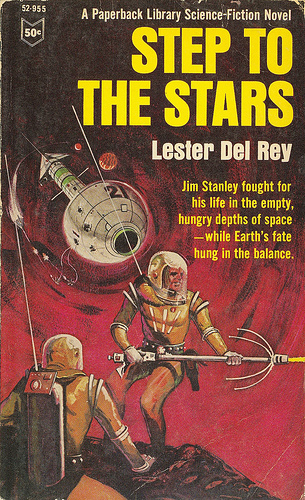
This one was published in 1954. Also, I don't recommend actually reading it because it is horribly racist and sexist.

(I think it's good that my formative SF-reading years were spent reading mostly Asimov, who isn't racist nor sexist*. I'm not sure what I would have made of the highly inflammatory and offensive preface to this book if I had read it at a more impressionable age. The preface, if you're curious, basically said that if We -- ie Americans, because no one else reads books in English, right? -- don't build a space station first, then They -- that is, the evil commies -- will kill Us all with space lasers. I'll admit I don't remember if space lasers were actually mentioned, but that was the gist. It might have been nukes, now that I come to think of it. Anyway...)

The premise is that in order to expand into space, the best approach is to build a space station and then launch ships to the moon and Mars and wherever from there. So the US government decides to build one in secret. Egads! There is no way that would have stayed secret as long as it did in the book. Sure, you might be able to put a few high-orbit military satellites up without your enemies noticing, but all the bits required for a space station? I think not. Not to mention that the actual space station would be reasonably noticeable (assuming you were looking for your enemies to do something, which given the context of the book, they would have been). But I am ranting about the wrong thing. (Also, gah! They recruited random engineers and mechanics to build the thing in space. What?! AND these people all kept quiet about the secret space station? OK, OK, moving on.)

I thought the descriptions of living in space were reasonable, particularly given that they were written before anyone had ever actually been in space. What I wanted to draw attention to was how del Rey portrayed rocket flight. The Loyal Citizens building the space station used small rocket-powered taxi ships (I hesitate to call them shuttles because of other connotations) to get around between the construction site and whatnot. (See how large this enterprise was? How could they think it would stay secret?) The way it was described, each little ship had just one largish rocket attached to it, so to break or turn, they had to point the rocket in another direction and fire. I believe gyroscopes were used to change orientation.

It's not so much that he got the physics wrong here (although rockets as we usually think of them would be much too powerful for these purposes, that is easily overcome), but the impracticality of the set up. Surely it would save time and training money to just put smaller rockets in for manoeuvring? This is what we do in the real world, more or less (the less being that the actual rockets used are nothing like the sort used to get off the ground because there's no gravity to overcome and no air-resistance either).

It's not just accurate science which is necessary -- del Rey was as accurate as he could be, from memory -- but practicality. Yes, you can use a gyroscope to flip your ship around and change direction, but think of how disorienting that would be for the pilot with all the spinning stars.


* I mean, Asimov's books aren't overfilled with female characters or anything, and they are in many ways a product of their times, but he had some competent women who were more than secretaries or love interests to the male characters. For example Susan Calvin in some of the robot stories, Arkady who was mentioned above, and several secondary characters whose names escape me. And he wasn't racist.


Saturday, October 1, 2011

Eureka & Terra Nova pilots: Sciencefail rant

You know what I really hate? Big budget productions with characters who are supposed to be geeky/nerdy/knowledgeable that say things that are wrong. When you have spent piles of money on special effects, isn't it in your best interests to make sure the dialogue isn't made of fail? As I'm sure you've probably guessed, this really annoys me. And, unfortunately, I've come across two pilot TV episodes in as many days that had a "smart" character explain something erroneously (where the fact it was an error wasn't part of the plot).

Lunacy

First up was Terra Nova, a show where colonists from a over-polluted future travel back in time 85 million years to where the air is fresh and dinosaurs roam the Earth. One of the important characters is a geeky girl whose main function so far has been to explain backstory in a sciencey and geeky way. Fine.

The moon looked bigger 85 million years ago because it was closer to the Earth. True story.
(Screen capture from pilot of Terra Nova.)
So back in 85 million years ago, they look up at the night sky and are amazed to see the moon because in their time the sky is too smoggy. The one of the parents says something like, "Was it always this big?" And geeky girl answers, "No, it moves two centimetres further from the Earth each year." So far so good. But then she says that it's because of the expansion of the universe.

That was when I died a little bit inside. The expansion of the universe is a large scale effect. Over cosmologically small distances gravity dominates. Like a lot. I touched on this in one of my galaxy posts when I said that the Milky Way and Andromeda will eventually merge. Basically, yes the universe is expanding, but it's only really far away things that are moving away from us. Even the nearby galaxies are being pulled gravitationally closer to us. Galaxies are made up of stars. Stars have planets around them and planets have moons. Our moon is much to close to the Earth for the expansion of the universe to pull it away.

So what is really causing the moon to drift away? Tidal forces, something else I've mentioned in the past. The moon causes tides on Earth by pulling water in the oceans towards it slightly, making it bulge out (and a bulge also forms on the opposite side to balance it). However, the Earth is rotating faster than the moon is orbiting it, so the bulge gets dragged along with the ground as it spins and in turn exerts a slightly different gravitational pull on the moon, pulling it forwards along its orbit. This causes an angular momentum exchange between Earth and moon--the Earth's rotation is slowing down and the moon's orbit is becoming wider (it's actually moving more slowly though...). Fun fact, that means tides would have been a bit higher back in the day, too.

There you have it. 85 million years ago, the moon was closer to the Earth because it hadn't had as much time to steal angular momentum from the Earth and hence widen its orbit. It has nothing to do with with the expansion of the universe.

Speaking of the expanding universe...

In the beginning there was the big bang. We don't know what caused it and for the purposes of my next rant, it doesn't really matter. At one point, everything was in the same place. Then it exploded.

I am going to digress slightly and talk about everyday explosions. (Well, hopefully things don't explode in your everyday life, but you know what I mean.) When something explodes, for simplicity let's say a bomb, then a sudden burst of energy--be it chemical or nuclear--pushes the material of the bomb (the outer casing or what have you) away from the centre. Depending on location and conditions, this material will fly through the air or water or whatever. In this sense, the big bang wasn't an explosion.

Matter, the stuff the universe is made of, did not explode out from a single location. It did not explode into anything because the universe is everything. There is nothing physically accessible outside it (M-brane theory notwithstanding). A common metaphor is this: imagine an un-inflated balloon with a bunch of galaxy clusters stuck onto its surface. The balloon part of the balloon is the universe. When you inflate it, the universe-balloon stretches and the galaxy clusters all move further away from each other. It's the space between the clusters that's expanding. You could make the balloon very small in its un-inflated form to get everything coming from one point. Then, at that point, everything was in the same place; all the space was together at the origin. Then it expanded. There is no single point that was once the origin, all the points were at the origin.

Imagine my frustration, then, when a genius scientist in the pilot episode of Eureka is looking for the origin point of the universe. It made me very angry. The fact that the MacGuffin of the plot hinged on his research was also a bit annoying. That he was trying to use an optical telescope to look for the beginning of the universe is just hilariously ridiculous (he would need to use very long wavelength radio waves, not visible light to do that--but I'll write a proper blog post about telescopes some time soon). It also really, really didn't help that the genius in question was a massively arrogant prick, but would it have killed the writers to make him a scientifically accurate prick? That would have mitigated my annoyance somewhat (not that much because the show is more sexist than it should be, but that's not a rant for this blog).

The moral of the story

If you don't take the time to get someone to check your facts (or if you do--and I know many Hollywood studios do--and then ignore the expert), you will piss geeks off. If you are making science fiction and geeks are a chuck of your target audience, why would you want to annoy them?

(And if you're wondering, I did actually like Terra Nova, it was just one line that irritated me. Eureka on the other hand, continued to annoy me with episode 2, even if irritating scientist prick wasn't in it.)

End rant.

PS You can read a bit more about the Terra Nova part of this (with more science and slightly less rant) in this post.

Wednesday, September 21, 2011

Responsible world-building

Something a little different this time. Despite my usual spiel about getting the science right and then attempting to elucidate said science, sometimes you just gotta make stuff up. Sometimes you really just need some FTL* spaceships or your whole plot falls over. There are only so many times you can write a story about slow space travel — or even relativistic space travel. All that I ask is a little consistency. So I'm not going to talk about building worlds in the sense of planets (there will be many other posts about that), I'm going to talk about making up convenient science in a sensible and coherent manner.

World building: not just about worlds.
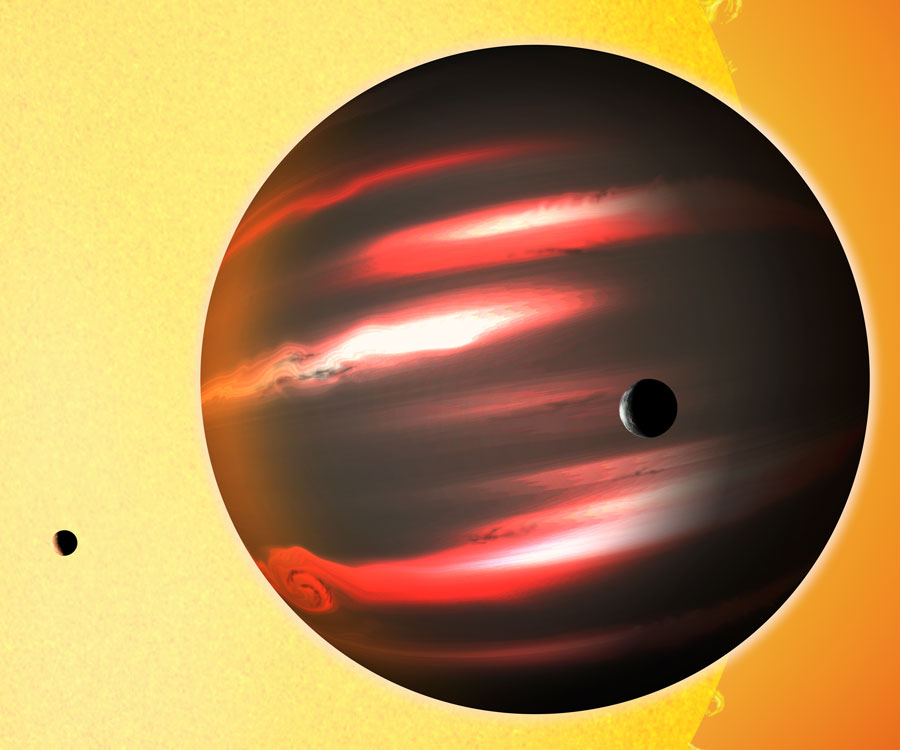
Snagged from APOD.
Illustration Credit: David A. Aguilar (CfA), TrES, Kepler, NASA
Some things are physically impossible. Some impossibilities are standard science fiction tropes, and that's OK. I've mentioned FTL, there's also telepathy (which, as Asimov masterfully showed, doesn't actually require space opera or science fantasy to operate) and worm holes. I am a bit more suspicious of inertial dampeners and hyperspace, but it does sort of depend on the story. I'd lump teleportation into the former list too, but that's a good example of something that we thought was impossible that we can sort of kind of almost start to do. Scientists have teleported photons across a lab and, more recently, I remember reading about a Bose-Einstein condensate (a small collection of atoms) being teleported, but I can't find a link right now so I'm hoping I didn't imagine it.

What they're actually doing with the teleportation at the moment is teleporting the quantum state of the photons/atoms. (I say this because I'm going to talk a little bit more about it shortly.) But that doesn't really matter. If you want to have people using teleports instead of lifts, then go right ahead. But you'd better have a good reason for them to have spaceships. Or a reason, at the very least, or pedants like me will whinge about your inconsistencies on their blogs and no one wants that.

The other thing with teleportation is that at some point you are somehow going to transfer a human-sized pile of data from point A to point B. I don't really care how you do it, but it's going to be a large pile (the upper limit, if you're curious, is about 1045 bits) of data that does somehow have to be encoded and then travel. I guess the teleportation part is implying that the travelling is instantaneous (you can invoke quantum entanglement, for example). But what about the encoding? How long is it going to take to encode that sheer quantity of information? (Actually, I did a bit of rough approximating and I got about 1029 bytes** for an average-sized person because the upper bound is, well, the upper bound.)

I assume you are going to let your encoding travel at the speed of plot. That's fine, if you're going to have some arbitrary reason, plot is better than most. However, if you're encoding people so that they can teleport, say, within a building in the space of a few seconds, then you had better not have them waiting a long time for their email to download. The speed of plot is the speed of plot, but really, you can't have different speeds of plot to suit your whim. It's sloppy and it annoys people like me. If you really must have them wait for their email, you had better have a damned good pseudo-scientific explanation.

To emphasise my point:
  • So let's say a person is worth around 1029 bytes (if you want to pick a higher number, knock yourself out; it will only make your data speeds more magically fast).
  • If it takes them 5 seconds to teleport from A to B (and assuming it shouldn't matter how far apart A and B are) then that's 2.5 seconds to encode the data and 2.5 seconds to decode it at the other end. Or maybe decoding is faster. Whatever. Order of magnitude is close enough.
  • So if it takes 2 seconds to decode 1029 bytes...
  • ...that's really fast. 
  • I mean, have you ever tried to copy a gigabyte-sized movie from your computer to your memory stick? (and assuming you weren't using Vista...) A gigabyte is 109 bytes so a person is 1019 gigabytes.
  • And don't get me started on storing that much data.
But this is science fiction, so those aren't insurmountable obstacles. But they are obstacles that, once surmounted,  have vast-reaching ramifications. Like email. Or hacking into an enemy's database. So if you need slow transfer rates somewhere else, ask yourself why similar technology to what enables teleportation can't be used.

Obviously, these ideas apply more broadly than just teleportation, but that's the example I've run with. And with that I'll close this slightly sleep-deprived post.

Remember: build worlds responsibly.


* Faster Than Light, which is currently physically impossible.
**1 byte = 8 bits


Sunday, June 19, 2011

Solar eclipse: when TV gets it wrong

During dinner this evening, I caught part of Robin Hood on the ABC. (My internet-fu and ABC's handy iView tells me it was episode 1 of season 3, if you're interested.) Part of this episode involved a solar eclipse. I don't have a problem with solar eclipses. I don't object to them often having mystical significance or being used as a plot device.

What I do object to is the creators investing all their efforts into the CGI-ing of the eclipse (link to screen-cap) and not stopping to think about the immediate consequences. What am I talking about? Not five minutes after the eclipse has passed, we see Robin Hood standing on the battlements doing some heroic arrow firing with a backdrop of blue sky and a half-moon over his left shoulder.

A half moon. Right after a solar eclipse. What. The.

If you're feeling slightly lost at this point, allow me to explain. A solar eclipse occurs when the moon passes directly between the Earth and the sun. By a happy coincidence, the angular size of the moon in the sky is approximately the same as the size of the sun. This means that the moon, when passing in front of the sun, can cover it neatly and completely.

Anyone who has stared at the moon for any reasonable length of time will have noticed that it doesn't move around the sky all that quickly. More quickly than stars, maybe, but certainly not halfway across the sky in the space of five minutes. Five minutes after the moon has passed in front of the sun, it's still going to be near the sun in the sky. This means that, since it's day time, it will cease to be visible as the illuminated side of the moon—the part facing the sun—is most certainly not facing the Earth since it just passed between sun and Earth. For there to be a half-full moon in the sky, it needs to be about 90ยบ away from the sun which amounts to about halfway across the sky.

Would it really have been so hard to photoshop (or whatever the movie equivalent is) the moon out of that shot? Really?

People not thinking these sorts of things through make me angry. Especially since lots of people must have been paid to think about the solar eclipse and they all apparently forgot about the mundane moon in the sky.

LinkWithin

Related Posts Plugin for WordPress, Blogger...