Tuesday, April 14, 2015

Want to get your science checked?

Those of you who follow this blog will have undoubtedly noticed that I don't post much any more. The number one reason for that is I've been in the throes of a PhD with very little desire to write about science/astronomy/astrophysics outside of work. Basically, blogging here stopped feeling like something fun to do and started to feel like more work, which is not what I wanted.

Defying Doomsday, an upcoming anthology
If you've been paying close attention, you may have seen my book blog, which I have been maintaining because talking about books is entirely unlike talking about science, even if they are science fiction and fantasy books. If you haven't already checked it out, you can do so here. I'm also editing an anthology, Defying Doomsday, which is currently being crowdfunded. You can read more about it here.

However, I still feel strongly about getting the science right (or at least, not horribly wrong) in fiction. To that end, I am selling five science checks as part of the crowdfunding for Defying Doomsday. If you've always wanted a professional astrophysicist to look over your story and tell you which sciencey bits are done well and which aren't so good, now's your chance! Here's what it says on our Pozible page:

Story Science Check
Tsana Dolichva, whose day job is astrophysics, will provide a professional science check of your work, assessing and critiquing the scientific validity of a piece of your fiction (up to 10,000 words) PLUS a limited edition hardcover copy of Defying Doomsday (exclusive to Pozible backers) PLUS the ebook edition of Defying Doomsday (all formats) AND your name in the book with our thanks

(For longer pieces please contact us and we can sort something out!)

I am more than happy to make arrangements to look at longer work if that's what you would prefer. It's a pretty good deal; not only do you get to have your science checked, you also get to support an awesome anthology! And if you're wondering, I have done some science checking before, including for professional authors.

Here's a bit more about Defying Doomsday:

Defying Doomsday is an anthology of apocalypse-survival fiction with a focus on disabled characters, which will be edited by Tsana Dolichva and Holly Kench, and published by Twelfth Planet Press in mid 2016.

Apocalypse fiction rarely includes characters with disability, chronic illness and other impairments. When these characters do appear, they usually die early on, or are secondary characters undeveloped into anything more than a burden to the protagonist. Defying Doomsday will be an anthology showing that disabled characters have far more interesting stories to tell in post-apocalyptic/dystopian fiction.

The anthology will be varied, with characters experiencing all kinds of disability from physical impairments, chronic illnesses, mental illnesses and/or neurodiverse characters. There will also be a variety of stories, including those that are fun, sad, adventurous and horrific.

The stories in Defying Doomsday will look at periods of upheaval from new and interesting perspectives. The anthology will share narratives about characters with disability, characters with chronic illnesses and other impairments, surviving the apocalypse and contending with the collapse of life as they know it.

Sunday, September 21, 2014

An infographic

I am a great believer in science for the sake of science. But a lot of politicians people aren't and need to be convinced of the merits of things like space travel and telescopes. To that end, here is an info graphic you can throw at the next person who tells you science is a waste of money. It's probably safer than throwing a punch.

NASA
Source: GreatBusinessSchools.org

Friday, July 12, 2013

The Colours of Space (and Currents)

I recently read (well, listened to) The Colours of Space by Marion Zimmer Bradley. You can read my proper review over at my book blog,  but here I wanted to discuss some of the science that popped up in the book.

The title of the novel — The Colours of Space — refers to the stars being much more brightly coloured when seen in space, as compared with when seen from inside the Earth's atmosphere. (There's another reference there to plot elements as well, which I won't spoil, but I read the main reference as being to the multi-coloured stars.) The thing is, the phenomenon, as described in the story, is not entirely real. Yes, stars come in different colours, but those colours range from red to yellow, white and blue. There are no green stars. 

Interestingly enough, this isn't the first time I've encountered the idea of green stars in old science fiction. I understand where the misconception comes from — wanting to move through the optical spectrum with increasing temperature — but that's not quite how it works. Have you ever seen something glow "green-hot"? No. That's because green is in the middle of the visible spectrum and when it's the peak wavelength of a black body, the object is still emitting strongly in the neighbouring red and blue wavelengths which, when they're all combined, appear white. Similarly, blue stars (and red stars) aren't blue like the sky; they look pretty white because the star is still emitting strongly in the other visible wavelengths.

The Orion Nebula. Image credit: NASA/ESA
On the other hand, it's not unreasonable to think that Earth's atmosphere would bleach out the "real" colours of objects in space. After all, hills and whatnot in the distance often look paler than up close (because of water and often pollution in the atmosphere). But we can still see distinct colours of stars even from Earth and even, if you have binoculars or a good camera, the colours of nebulae (which are entirely prettier than mere stars). The constellation of Orion is a good example. Betelgeuse is a red giant (down the bottom of Orion if you're in the Good Southern Hemisphere), the Orion Nebula looks purplish (on the "handle" of the bit that looks like a saucepan from the south), the Horsehead Nebula (in Orion's Belt) is on the pink side, and the rest of the stars are yellow, white and blue but all look fairly white (from Earth AND space).

This reminds of another old book in which the underlying premise is based on now-outdated and hilariously erroneous science: The Currents of Space by Isaac Asimov. In that book a rather important plot element is that supernovae are caused by clouds of gas (the titular currents) drifting around space and every now and then changing the elemental makeup of stars enough to make them explode. (I think specifically it was clouds of carbon, but I don't have the book nearby to check.) We now know that this is mostly nothing like what causes supernovae.

There are two types of supernovae: core-collapse and Type Ia. Core-collapse supernovae occur when a massive star (more than around ten times the mass of our sun) runs out of fuel in its core and can no longer maintain its size and collapses in on itself and explodes. To put it very simply. Type Ia supernovae occur when a white dwarf (the corpse of a star originally like our sun) has another star nearby feeding it matter. When the white dwarf gets too massive to maintain its fundamental (proton and electron) structure, it will collapse in on itself and explode (and become a neutron star).

Just because these books are based on science we now know not to be true, doesn't mean they're not worth reading (although I suspect it contributes to them being out of print). Have you read any other books with science that was reasonable when they were written, but doesn't stand up to the test of time and progress?

Sunday, April 28, 2013

Friction in space and on Earth

This post is in response to a comment I got on my previous post "More thoughts on the importance of science in science fiction" where Shannon commented/asked (I'm only quoting the question-y part of her comment):
It really is a hard concept to grasp, the no-friction-in-space thing. I don't think I really get it - I'm not sure how to visualise it, for a start - but I don't understand how a space ship - of the super-advanced, sci-fi kind - can't slow down. I mean, it's mechanical and computerised and runs on fuel; on Earth anything we build for transportation will slow down especially if there's a mechanical failure etc. I know in space you can't "stop", you'd only drift, right? I'm hoping you can explain this a bit more to me because I really do want to understand!

(The more time I have to let this concept dwell in my brain, the more I'm starting to get it. So what does happen when you, in sci-fi, go from "warp speed" or whatever they like to call it, to, well, not?)

On Earth (or really, anywhere that isn't the empty vacuum of space) moving objects slow down because they lose energy through friction — rubbing against other objects. Commonly on Earth, the source of friction would be land, water and/or air.

Some examples:
  • The motor of a boat needs to stay on to keep the boat moving, because if the motor is turned off, the boat will be slowed down by the water pushing back against it.
  • If you ski straight down a hill (let's say a small hill for safety reasons) you will accelerate (get faster) while you're going down hill, but once you reach the flat bit at the bottom you will eventually slow down and stop without having to stop yourself. This is because of the friction between the snow and your skis. Generally, skiing works because there's much less friction between snow and skis than, say, between shoes and dirt, but there isn't zero friction. When you were going down the hill and getting faster, there was still friction, but at that point gravity pulling you downwards was stronger.
  • If you drop something from a great height (tall building, aeroplane), gravity will make it accelerate as it falls down. However, the air pushes back on it, upwards (or more generally, in the opposite direction to the movement) and eventually will prevent the object falling any faster. (With air, the friction is directly related to the size and shape of the object and how fast it's going, but I won't get into the maths.) The maximum speed the object can reach while falling is called terminal velocity.
  • On the other hand, if there is no air — for example on the moon — there will of course be no friction from air and things like feathers which normally fall very slowly (because of all the little fuzzy bits catching on the air) will fall at the same speed and acceleration as a lead ball (or whatever). This will also work in a vacuum chamber where all the air has been removed. Here is a video of an astronaut on the last Apollo mission dropping a hammer and a feather at the same time:

    And a gif of the same if you can't be bothered watching and listening to the 47 second clip:

  • Brakes on cars and whatnot work by intentionally increasing the friction on the axle to slow down the spinning speed of the wheels
Now let's talk about how spaceships slow down in space. I want to emphasis that my complaint with Across the Universe wasn't that the spaceship was slowing down, but that it was slowing down by itself. Things can only slow down by themselves if there is friction around (so really they're not slowing down by themselves but because of friction, but we don't usually think about or notice friction so it seems like its happening by itself).

In real life, spaceships slow down (and manoeuvre) by firing their engines in the other direction. It might be a bit easier to picture on a smaller scale. Consider an astronaut on a spacewalk. Let's pretend they're not tethered to their ship and that the ship is out in deep space away from the gravitational influence of any planets. To be able to move around, the astronaut will have a gas tank (or similar) that will allow them to press a button to move forward. The gas will shoot out backwards for a couple of seconds, and the astronaut will move forwards. At this point, if the astronaut does nothing, they will continue moving in a straight line indefinitely. Basically until they run into something. The same thing happens with a spaceship: gravity and obstacles not withstanding, after it fires its engines for a bit to accelerate, it will keep going in a straight line at the same speed until something else happens to stop it. This clip from WALL-E is a good example (thanks to Shaheen for the suggestion). Also note that once they start spinning, things will continue spinning until something else makes them change, which you can see a bit of in that clip.

That doesn't mean things can't stop or slow down in space. Our astronaut — assuming they're not unconscious — can fire their gas in the opposite direction (to manoeuvre properly they'd have to have several directional options, six for complete manoeuvrability) to slow down. The spaceship can also fire thrusters in the opposite direction to slow down (either by having two sets or by rotating the main ones). Coming to an absolute complete stop is a bit tricky because a) you would have to balance forces very exactly and b) there's not much to use as a reference for how fast you're going out in space, but matching speeds with another ship is doable. And the astronaut slowing down enough to not break a wrist colliding with his ship is also useful. My older post about turning around in space addresses some issues with why just stopping and going in the opposite direction isn't the most efficient way of doing it.

The very last part of the question was:
So what does happen when you, in sci-fi, go from "warp speed" or whatever they like to call it, to, well, not?

The short answer to this is, whatever you want. Warp speed and hyperspace and other "let's cheat to go faster than the speed of light devices" aren't real. They're generally not based on real physics, or if they are, it's very extrapolated and speculative and could well turn out to be just as implausible. That said, faster than light travel is a staple of science fiction and I'm not suggesting we should eliminate it because it's implausible. If all science fiction stories used only slow or relativistic (which means close to the speed of light, when weird things happen. My post about it) then there'd be a lot of very slow stories which would get boring. Variety is nice.

As long as the rest of the science is plausible, then I don't have a problem with a bit of faster than light travel and faster than light communication. If the writer doesn't feel up to making up a semi-plausible sciencey explanation, then my personal preference is not to try explaining how the FTL works at all. Because they usually stuff up some minor point which annoys me disproportionately.

Monday, March 25, 2013

More thoughts on the importance of science in science fiction

Today I was directed to a blog post about how important science is in science fiction using the hideous crime against science example of Beth Revis's Across the Universe, which I blogged about here. (From the sound of it, the blog author may have read my post or someone else's similar reaction to the book.) The blog author asks how important is accurate science really, and is there a line? The rest of this post is based on my comment over there.

I think there is definitely a line. Stuff like faster than light travel, teleportation, artificial gravity (in some circumstances) are fair game to use in fiction with no or only hand-wavey explanations. (In fact, sometimes trying to be too specific with them can be detrimental.) Everyone either knows that stuff isn't real or can very easily google it to find out. And it has a distinct plot-based purpose: if everyone wrote relativistically accurate science fiction (no faster than light travel), it would be very boring. When getting from A to B isn't the point of the story, using an accepted trope to speed things up is totally fine. Same with power sources for spaceships. That's an area where there will definitely be heaps of progress in the future that we can't necessarily predict and so hand-waving is fine.

What isn't fine is getting basic and fundamental concepts wrong like the ship slowing down in space that Revis did. Note that she also had a hand-wavey power source in said spaceship and THAT is fine. But thinking there's friction in space? No. It's a popular book for teens and it's actively confounding a concept that's actually quite difficult to teach. Pretty much no one (and certainly no teen) has been in space and so books and movies are all most of us have to base our intuition on when it comes to how stuff in space works. For things on Earth, it's easy to think about our everyday experiences and predict (from a basic physics point of view) what will happen. On Earth, stuff DOES gradually slow down. In space it doesn't and that's a concept that some kids, when learning physics for the first time, find difficult to grasp. It's a disservice to further confuse the issue.

And for the record, usually if an author tries to do their research, it's obvious in the writing.

~

Now, when I was searching for a link to something Revis said in an interview about her research for this book (or lack there of), I came across the FAQ on her website. One of the questions and responses is:
Q: WAIT A MINUTE. I think I found a scientific error in Across the Universe.
A: Well–there’s a chance I messed up. BUT if you’re one of the ones who noticed the REALLY BIG scientific error…well, I’ll just say that there IS a sequel, and it DOES address this, and maybe it’s not that the book is wrong, but that the characters have the wrong idea…
I can only assume the "REALLY BIG" scientific error is the friction in space thing that's made me so angry. I'm not 100% convinced that it and associated sciencefails are properly addressed. I can think of one scenario that would make it "the characters are wrong but the science isn't", and from the plot of book one and the hints I've seen around the web for the events in books two and three, it doesn't seem likely.

Have any of my readers actually read the second book? Is it worth my time (and money) reading it just so I can blog about the problems in it? So far the answer to the second question has been "no" and picking up the second book in a shop and flicking through it didn't exactly fill be with the desire to jump back into that world.

Saturday, December 15, 2012

Review: Blue Silence by Michelle Marquardt

This  review is posted as part of my Australian Women Writers Challenge. I have cross-posted it from my review blog. I have now completed the Australian Women Writers Challenge for 2012, and you can read my de-brief here.

Blue Silence by Michelle Marquardt was originally published in 2002 and is sadly now out of print. Although I see it's in stock at Infinitas as of this writing. It was a winner of the George Turner Prize (as my edition proclaims on the cover).

The story opens when a mysterious ship docks with one of the space stations in orbit around Earth. The ship is, on the outside, an exact replica of one that was sent out into deep space 180 years ago, and then never heard from again. The difference? This ship has new drive technology which was only invented a couple of years ago. And instead of the seven original crew members, it's full of stasis pods and five hundred creatures, half of whom look human, half of whom look almost human.

None of the aliens know where they came from or why — they have no memories before waking up docked with the space station — and the authorities on the space station don't really know what to do with them either.

Senator Maya Russini is the leader of the group of people who first board the ship. A mission which one of the group does not return from alive. Are the aliens dangerous? What do they mean for the various political machinations happening within the space station's government and between them and other governments?

I liked Maya. She was an excellent example of a female character that doesn't need to run around kicking people in the head to gain power. She's also secretly a telepath (secret because she didn't register when she turned 21), but in a nice twist, she's the weakest kind of telepath, only able to read emotions, not thoughts. I think Marquardt has done a good job of portraying a society in which women are equal without making a big deal of it. (There are, in the end, more male characters, but that's mostly because the two main aliens are male.)

Her friend Ienne, the Minister for Foreign Affairs, also gets involved with the aliens. Unlike Maya who mostly regards them as suspicious and dangerous, Ienne is always looking for a way to use them to his advantage (there's a treaty they and another space station are wrestling over). He also goes out of his way to be rude to everyone with the occasional exception of Maya.

As I noticed when I was past half-way, Blue Silence is a very character driven story, unusually so for science fiction. The world does not need saving, nor does any war break out. Instead the action comes directly from the interactions between the characters, including two of the aliens who I don't think I can say much about without spoiling key elements. There is excitement and there's no missing the climax, but it's not like a plot driven story where all the action was building up to an inevitable climax and world-saving event. In the end, we know more about the aliens, but we don't know everything. Some answers are only hinted at or presented as speculation. In a way, this was slightly annoying because I like to know all the answers (arguably why I'm a scientist in real life), but it worked for the book. The story wasn't about the people trying to study the aliens, it was about people whose paths happened to cross theirs.

Also, the science, which I feel obliged to comment on, was well done. It wasn't a technology-oriented story, but having been published ten years ago, there was a risk the technology would feel a bit dated now. It didn't. They didn't have smart phones, but they did have pagers which were functionally mobile phones and received the equivalent of email on ubiquitous computers. There was also a discussion on the merits of different kinds of space stations (mimicking Earth versus giant building floating in space) which was interesting.

I highly recommend Blue Silence to anyone looking for something a bit different in their science fiction. It also emphasises the variety we have in the Australian science fiction field, something you might miss if you only looked at the most recent few releases.

4.5 / 5 stars

Friday, December 7, 2012

Year-long days and living in them

This blog post was inspired by an email conversation with someone regarding the possibility of a planet having year-long (or half-year long) day/night cycles. The original question was whether this is even possible and whether such a planet would be habitable.

From a purely astronomical point of view, this is definitely possible. There's no reason why you couldn't have a slowly rotating planet at around the same distance from it's sun as Earth is (well any reasons that do exist are fairly theoretical so we can ignore them). That said, if the planet is similar to Earth and its sun is similar to ours, then you kind of have to have the same length year because the length of the year (ie how long it takes to orbit the star) depends only on the mass of the star and the distance from it. This is due to Kepler's Laws, which I have previously discussed here. If you made no changes to star/planet distance, the year length would have to be the same.

Image nicked from Wiki here. The little red line
represents the same point on the surface of
Mercury. The numbers are the order in which
the positions happen: 6, 1, 2 are night for
the red line and 3, 4, 5 are day, roughly.

You could also have something similar to Mercury which has three rotations (called "sidereal days" which are measured relative to the stars, not the sun) to two years. Because it rotates so slowly, weird stuff happens with its solar days (the light/dark periods, completely ignoring the positions of stars) so that in one year it experiences half a solar day. Mercury is like this because it's so close to the sun. It could have been tidally locked (the same side always facing the sun – discussed further, including for Mercury in particular, here) but the gravitational effects of the other planets in the solar system caused this more unusual resonance.

However, if we're talking a planet as distant from the sun as Earth is, there's no danger of it becoming tidally locked in the sort of cosmological time frame we're currently living in. The time taken for the angular momentum between planet and star to be distributed into the tidally locked configuration takes longer the further apart they are (and the less massive when they're close enough). The Earth-moon system will eventually become more tidally locked: the moon already faces the same side towards us all the time, and eventually the same side of Earth will always point towards the moon.

But that's a bit of a tangent, back to planets with long days and nights. You could have a planet rotating as slowly/quickly as you like, but you should be mindful that the people living there would almost certainly have a way of distinguishing between sidereal and solar days. Ancient people on Earth already had this worked out (the difference between sidereal and solar days is why the stars move across the sky with the seasons).

Living there

Uranus: almost completely sideways.
If you did have a planet with a year-long day, the periods of day and night would be roughly equal in the same way they are on Earth, just scaled up. It could vary a bit depending on the planet's axial tilt (how much the line between the poles is tilted relative to the plane of it's orbit — Earth's is around 23º and changes slightly when earthquakes occur) so the more inclined the axis, the more extreme the seasons. If there was no or very little axial tilt, there wouldn't be seasons. The other variable in day/night lengths is the latitude. Further away from the equator sunrise and sunset would last longer and the shortness of winter days and length of summer days would be more extreme (as on Earth, but a different axial tilt could make this more so). If there was no axial tilt, the poles would be in a state of twilight permanently. The other extreme is something like Uranus which has a 90º-ish axial tilt so that during a southern summer the south pole points towards the sun and during a southern winter the south pole gets no sun at all. Spring and Autumn are the transition period. The equator is in twilight during summer and winter and has more "normal" days, like what we're used to, during spring and autumn.

Also, astronomical plausibility aside, I'm not convinced complicated life could naturally arise on a planet with a super-long day/night cycle, due to the long periods of boiling (day) and freezing (night). In terms of temperature-stability, probably only the twilight areas would be habitable. I suppose you could have migrating species (but that also has problems because in staying in permanent twilight they'd need sufficient landmasses connecting the two poles). Also, you'd probably get some sort of storms around the twilight zone, since the temperature would be in in a state of flux. I'm not an expert on atmospheres or meteorology, though, so that's a (-n educated) guess and I can't be too specific. But in short: our 24 hour days are what keeps Earth's temperature relatively temperate and suitable for life.

There's be fewer issues for microbial life to arise but I don't know that anything larger would be viable. Maybe at the poles: if the planet was slightly closer to its star than Earth is, there could be non-migratory life living near the poles and with a stable orbit and rotational period, it should survive. Since the non-polar regions wouldn't have naturally arising complex life, there could be with completely different ecosystems/forms of life at either pole with only something like microbial ancestors connecting them.

Sunday, October 21, 2012

Atmospherically Speaking

Today I have another Ask Tsana post.

Brookelin asked:
Hi again, Tsana.

I was wondering - in an alternate universe, what would it take for a species to survive on Mars?

I know that it has some atmosphere, but not a whole lot. With the pressure being below the Armstrong limit, could there feasibly be large creatures (between collie and bear size) that could survive would have higher thresholds and what would they need to do so?

If the water on a human's tongue boils in space, would an alien creature in these environments be able to have eyes and mouths?

What might these species' need to overcome the intense radiation caused by Mars' weak magnetosphere?

Could bio-genetically enhanced humans ever survive these conditions outside a space suit for periods of time upwards of an hour, but less than a day?

Are these too many questions? Do you know the answers to any of them, or is this more of a medical thing?
I don't have answers to all of these questions because, as Brookelin said, some are more medical/biological and that's not my area of expertise. I will say that what we generally know a lot about is life on Earth. There are some constraints that exist for life on other planets but there is nothing to say that it has to resemble Earth life. They could have eating and seeing organs completely different to what we're used to. Even on Earth there's a pretty wide variety. I'm not sure that merely genetically enhancing a human would be enough to let them walk around on Mars. Science fictions stories have gone there, but I'm not sure genetics is up to it. I could be wrong, I'm just guessing. Hopefully my comments below on atmospheres and life on smaller planets such as Mars will answer the rest of the questions, though.

Mars. Credit: NASA, ESA, and The Hubble Heritage Team
(STScI/AURA)
It's true that Mars has a very thin atmosphere; it's about 0.6% as dense as Earth's at their respective surfaces. Part of the reason for this is Mars's lower gravity. In general, gases will expand to evenly fill the container they're in. When the container is a planet's gravitational field, we get denser air closer to the ground and less dense air higher up. This is because the air higher up is pushing down on the lower air while having less air above it to push it down. More or less.

Air is made up of particles (atoms and molecules) which move around very quickly and bounce off each other. That's why a gas is a gas and not a liquid or solid: the particles in a liquid don't move quickly enough to completely overcome the forces attracting them to each other and the particles in a solid can't move more than vibrating on the spot because the forces holding them in place are so strong. The energy that makes the particles move, for all states of matter, depends on the temperature: the hotter, the faster. The other important consideration is particle mass. At the same temperature, oxygen and hydrogen molecules (O2 and H2) have the same energy. However, oxygen weighs sixteen times as much as hydrogen (because the atoms are larger and heavier) so it takes more energy to move oxygen molecules at the same speed as hydrogen molecules. The result is that at the same temperature, oxygen molecules move more slowly than hydrogen molecules. And it takes less energy for hydrogen molecules to reach escape velocity (the speed required to escape the gravitational pull of Earth/whatever planet) than oxygen. And that's why there is very little hydrogen in Earth's atmosphere despite it being the most abundant element on a cosmic scale — it escapes into space. It's also the reason only the gas giants, notably Jupiter and Saturn, have any significant about of hydrogen in their atmospheres — they have the strongest gravitational fields.

So, Mars. Mars is smaller than Earth, with about a third the acceleration due to gravity at its surface. Mars is made up of similar elements to Earth, most likely because they formed so closely together, so it's likely that the same sort of lighter elements could have made up Mars's atmosphere. However, due to the lower gravity, not only hydrogen but oxygen and nitrogen would also have escaped or never been captured by the planet. I would guess the main reason there's so much frozen carbon dioxide at the poles is because it has a relatively high melting point of -78ºC rather than the much colder melting points of oxygen (-219º C) and nitrogen (-210º C). For comparison, Mars's surface temperatures vary between -143º and +35º C. So basically, even if you imported or mined enough gas to raise the air pressure to human survivable levels, it would all be lost into space and would need constant replenishing which would get tedious and be difficult to sustain. You'd also, ideally, raise the surface temperature to more consistently human survivable levels — probably using some sort of greenhouse effect to trap more of the sun's energy — but that would just hasten the atmosphere's escape.

Titan's atmosphere as seen by Cassini. Credit: NASA
But all is not lost. Heavier molecules exist, particularly those made out of carbon. Titan, one of Saturn's moons, is smaller than Mars but has an atmospheric pressure greater than Earth's by about 45%. It's colder than Mars, which allows its atmosphere to condense a bit, but it's only got a surface gravity of around a seventh that of Earth's (less than half of Mars's). According to Wiki, its atmosphere is composed mainly of nitrogen (as is Earth's) and methane with some traces of heavier carbon molecules. It's a combination of the temperature, the distance from the sun, Saturn's magnetic field and some form of replenishing methane that keeps Titan's atmosphere thick and, well, full of methane. Distance from the sun is significant by itself because Titan is far enough that the ionising solar wind is weak enough to not completely ionise and destroy the top layers of its atmosphere. The same strategy probably wouldn't work on Mars to increase the atmospheric pressure permanently unless you could find some magically resistant to solar radiation molecule to populate the atmosphere with. There are two interesting theories for what keeps replenishing the methane on Titan (which should be destroyed even by the lowered energy it receives from the sun): cryovolcanoes — volcanoes shooting icy hydrocarbons instead of lava — or biological processes using/generating methane in place of water.

The high levels of ionising radiation on Mars are as much due to its lack of atmosphere as its lack of magnetic field. (Side note: there's evidence that there was a magnetic field on Mars in the past, though I don't think we know why it went away.) Earth's atmosphere absorbs a lot of the ionising and UV radiation the sun throws at us (part of the reason the ozone layer is important). Not all of it is deflected — and things like X-rays and gamma rays can't be deflected because they don't have an electric charge — especially near the magnetic poles where the aurorae are caused by charged particles, mostly from the sun, interacting with the atmosphere. However, giving Mars a magnetic field would definitely help. Earth's is generated by molten iron in its core so it's not outside the realm of over-dramatic science fiction to drill a hole into the centre and start the core spinning. Come to think of it, Hollywood's already done that, just with Earth not Mars. (For the record, the ridiculous issues with that movie include the structural integrity of the hole and the failure to correctly represent changes in gravity.) A more feasible way to avoid radiation on Mars would be to live underground so that the ground above you did the work of absorbing harmful radiation. The reason too much radiation is bad for all forms of life is that it destroys and changes molecules. In humans this is one of the causes of cancer. In microbial life, which might only have a few cells to begin with, it's more deadly. It's why sterilising things with UV light works.

So basically, the easiest way to get people living and wandering around on Mars is to have them live in airtight structures and give them suits for walking around outside it. The suits wouldn't have to be as extreme as space suits though, so that's something. I'm not saying it's completely impossible to walk around on the surface with less protection, just very difficult. And because someone will mention it in the comments if I don't, I've heard that Kim Stanley Robinson's Mars books, starting with Red Mars, do a good job of talking about the terraforming process, although I haven't read them. Ben Bova's Grand Tour of the solar system books (eg Mars or Saturn and Titan) explore alternative forms of life all over the solar system. If you can stomach a bit of sexism, some of them are worth a read.


Monday, October 1, 2012

Turning around in space


Another ask Tsana question today. (And a relatively shortish response, sort of. Gasp!) Keep 'em coming, guys :-)

Anon asked:

How hard would it be to turn around in space... Say for some reason, Curiosity needed to turn around midflight and return to earth. Would BURNING fuel on some sort of reverse thruster work or would it have to make the trip to Mars, orbit the planet and break orbit to return
This is for a picture book that I feel impelled to be at least somewhat based in reality... which may be dumb.

Hi Anon,

It's absolutely NOT dumb to try to make picture books or any sort of books for kids plausible or semi-plausible. Especially when it comes to these sorts of areas where they can't possibly have any hands-on experience. Hollywood bombards them (and all of us) with so much inaccuracy that any little bit of truth helps. If they remember your book when they come to learn about these things later on, it will help the science stick. If all they have to go on are poorly researched movies which have given them wrong "intuition" about these things, it makes it a lot harder for them since they have to unlearn the rubbish first.

On to the actual question part!

It's pretty tricky to turn around in space. Because there's no friction, you have to use the same amount of energy it took to speed up to slow down by the same amount (so to come to a stop, say). This is a huge waste of fuel. Changing course more subtly isn't as difficult, however.

Apollo 13 Movie poster. (Nabbed from Wiki)
For something specifically like Curiosity: an unmanned probe sent to another planet, I can't think of a reason they'd try to get it back to Earth (unless a sample return was specifically part of the mission plan, but I don't think that's what you're asking). If something went wrong, they'd be more likely to cut their losses and abandon it. Also, almost all of that kind of probe's fuel is used up during take off, leaving only enough for minor course corrections and landing. In that case, plausibility would dictate that attempting a gravitational slingshot around Mars would be the only way to maybe get it back. You'd also have the issue of how to collect it from Earth's orbit since a) Earth would have moved a lot while it was travelling and b) if you were lucky enough to get it to pass close to Earth, it would be travelling quite fast and probably wouldn't have enough fuel to go into orbit around Earth for collection. It would definitely be tricky.

A very good example of a scenario relating to your question is the movie Apollo 13. If you haven't seen it, I recommend that you do. As far as I can remember (and I freely admit it's been many years since I watched it, so don't hold me to this), the physics in it was pretty accurate. In that, things go wrong with the (real life) 70s moon mission and, among other fixes, the astronauts have to slingshot around the moon to get safely back to Earth.

In the end, I'd say it depends on the nature of your mission as to what would be done. If it was a manned mission to Mars, for example, they might try harder to bring them back early, but physics would not be on their side.

Hope that answers your question!

Friday, September 21, 2012

Gravity and atmospheric pressure

I have another response to an "Ask Tsana" question today.

Brookelin asked:
I was wondering... with planets like Europa and possibly Ganymede, who possible have oceans, if humans made future settlements under said oceans, would the pressure from the water above counteract the effects of reduced gravity on the human body?

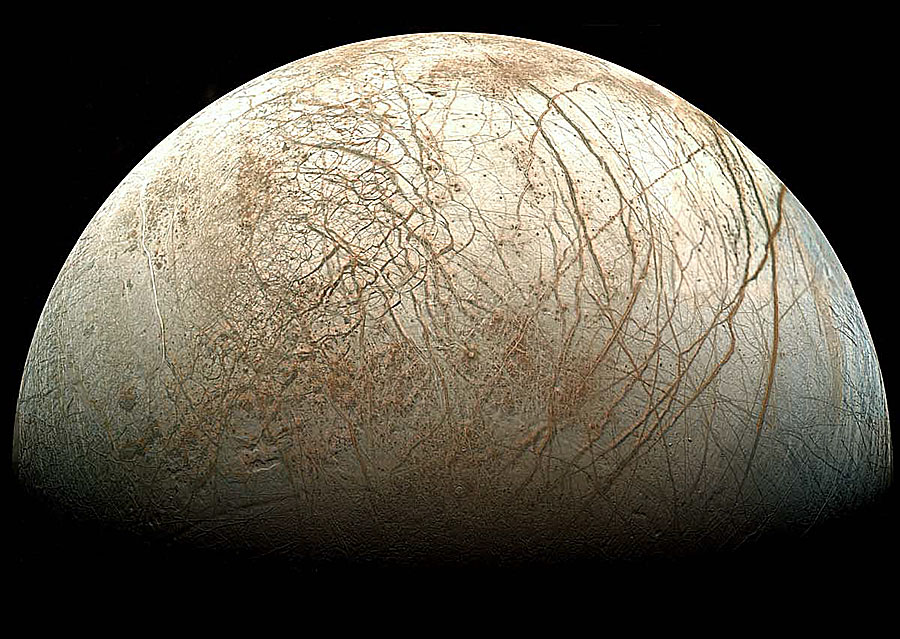
Interesting question. A preliminary point: it's Jupiter's moons Europa and Callisto that probably have sub-surface oceans (especially Europa), not Ganymede which is a solid rocky moon.

Europa, one of Jupiter's moons, has a vast ocean beneath
its surface. Credit: Galileo Project, JPL, NASA;
reprocessed by Ted Stryk
So, how do pressure and gravity work? In this context, gravity is the force that holds a planet/moon/star together and which attracts other objects to it. So we're all being pressed into the surface of Earth due to Earth's gravity. Pressure is the force a surrounding fluid (air, water, etc) exerts on something. So the atmospheric pressure we feel on Earth is pushing at us from all sides (well, OK, not out from the ground) and is due to all the air in Earth's atmosphere.

When you go swimming, the further you dive down, the higher the water pressure around you gets. This is because the deeper you are, the more water is above you to press down on you and the more water is above the bits of water on either side of you, also pressing into you. If you've ever been snorkelling (or scuba diving, I suppose but I can't vouch for that due to lack of experience) you might have noticed that it gets harder to breath the deeper you go (assuming a long enough snorkel). This is due to the water pressing down on your chest. Air does the same thing, but we're used to it, so we don't notice. The other thing that happens under water is that the water underneath you pushes up on you: this is called the buoyancy force and it's why things (people, tennis balls, icebergs, etc) float.

The higher up you go from sea level on Earth, the thinner the atmosphere gets (basically, the less atmosphere left above you). To halve the atmospheric pressure you experience, you need to go 5 km above sea level. (On the other hand, to double the pressure, you only need to be about 10 metres under water.) At that height, gravity is still pretty much the same as at sea level (the difference is about an eighth of a percent) and your main problems are getting enough oxygen (not a huge problem if your lung capacity is OK) and possibly altitude sickness (potentially a problem).

We need some amount of air pressure around us to survive which is part of the reason astronauts wear space suits. However, there is a range at which we can still function and that range increases if we have extra oxygen (and don't get altitude sickness). People have climbed Mt Everest (8.8 km above sea level) which has an atmospheric pressure of about a third that at sea level at it's peak without oxygen, but even doing it with oxygen requires training and acclimatisation and isn't something anyone can just decide to do one morning (well, unless they also decide to put in all the training).

On the surface of Europa or Callisto, there is no atmosphere and hence no atmospheric pressure. The ground is frozen water (probably not pure water, if only due to meteorite bombardment, but that's beside the point), but let's suppose we somehow got under the surface and set up a habitat. Since we're human and breathe air (a particular mix of mostly nitrogen, with some oxygen, carbon dioxide and misc) we'd have to have some sort of bubble habitat under the sea. But it's not just the air part that we need, we also need it to be around one (Earth) atmosphere of pressure. So we build a habitat with solid walls and fill it with the right amount of air... and then we're inside an air bubble and the water outside the bubble is having no effect on our bodies directly. The only way it would is if we went out into the water without pressure suits. Which probably wouldn't be the best idea in the world for a variety of health and safety reasons that don't necessarily have to do with the water pressure.

Now let's talk about gravity. The main way we detect small changes in pressure is though our ears, for example when they pop on taking off and landing in aeroplanes. The main way we detect changes in apparent gravity (which is the same as changes in acceleration) is when we feel lighter or heavier. If you're standing, this might manifest as extra strain on your legs, if the apparent gravity has increased, or a feeling like your stomach is moving upwards (possibly accompanied by nausea), if the apparent gravity has decreased. You don't experience the same feeling underwater or up a tall mountain because the gravity doesn't change in those places although the pressure does.

So what I'm ultimately trying to say is that the effects of gravity and atmospheric pressure are different. You can't compensate for a decrease in gravity by increasing pressure. Pressure is a force applied from all directions simultaneously, while gravity acts in just one direction. We know about the effects of Earth gravity, high gravity (from fighter pilots for example) and zero/microgravity (like on the space station) on people but much less about the effects of gravitational fields less than Earth's and more than zero. Europa's and Callisto's accelerations due gravity at the surface are about 13% Earth's and for comparison, the moon's is about 17% Earth's) so while we have had some experience with the moon landings during the Apollo missions, we don't really know how serious the health problems associated with spending prolonged periods at such low accelerations would be. There almost certainly would be some, but they probably wouldn't be as severe as zero gees. So while we can't use water pressure to compensate for gravity, it's not impossible for people to live on one of the moon's of Jupiter. We just don't know enough about what long term problems might arise.


Wednesday, July 25, 2012

Quick note on terraforming Galilean moons

This post comes from an "Ask Tsana" comment.

Sam Keola asked:
Aloha from Hawai'i again Tsana! I have a hypothetical question. If in the very distant future we had the technology to terraform, would it be best to terraform Callisto and Ganymede or set up domed bases? Ganymede is suppose to have an ocean similar to Europa, but I'm not sure if that's "world wide". Your thoughts on terraforming!
The main problem with terraforming either of those moons is their gravity isn't large enough to keep any atmospheric gases for long after they're introduced. Ganymede, which is larger, has a surface gravity of close to a seventh of Earth's which is less than half of Mars's and Mars has difficulty keeping much of an atmosphere itself. Purely from that point of view, domes or something else sealed would be better.
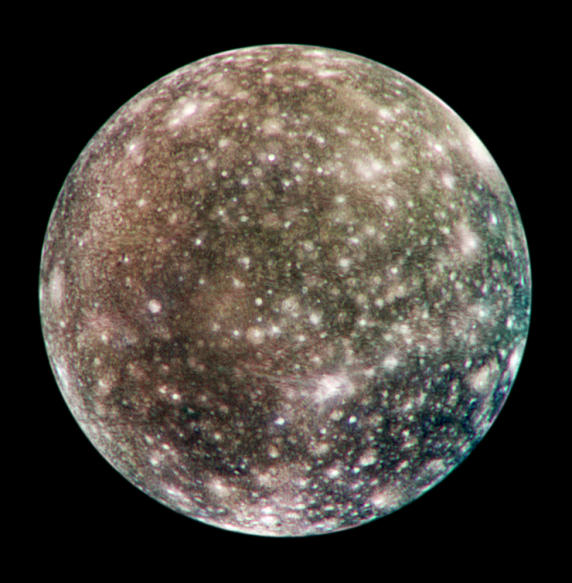
Callisto.
Credit: Galileo Project, Voyager Project, JPL, NASA

Once you've decided to build something sealed, then it would be better for colonists to build on Ganymede, as opposed to the other Galilean moons, for a few reasons:
  • It has the highest surface gravity, not by much but every little bit would prevent colonist's bodies from degrading. Actually, because the Galilean moons are less dense than Earth's moon, they have a lower surface gravity, despite being larger in volume. You're going to have low gravity-related heath problems in any case, however.
  • It's not as close to Jupiter as Europa (and Io!) is. The phenomenon responsible for keeping Europa's interior liquid is tidal friction thanks to its proximity to Jupiter. It's the sort of thing that also makes the surface more unstable (prone to volcanoes -- not as much as Io, of course -- and quakes) and less hospitable to people. You can read more about it here.
On the other hand, if what you're doing is mining and the minerals etc you're interested in are found on both Ganymede and Callisto, then Callisto is the place to put your colony. It's gravity slightly lower and, more importantly, it's further from Jupiter, meaning that when you're exporting your rocks, there's less gravitational pull from Jupiter to overcome.

In terms of finding water to mine, all three moons in question (ie, not Io) have water on them, so that shouldn't be too much of a problem, especially if you're already planning to mine other things.

Of course, there are also reasons why Europa would be a desirable place for a colony, especially for scientific reasons, exploring it's subsurface ocean primary among them. There's a good chance there's microbial life there.

So there you have it, if you're going to colonise the larger Galilean moons, it's better to build a close structure on them rather than try to impart an atmosphere. It would be even harder than giving Earth's moon a permanent atmosphere.

Thursday, June 7, 2012

Review: Polymer by Sally Rogers-Davidson

This  review is posted as part of my Australian Women Writers Challenge. I have cross-posted it on my review blog.

Polymer by Sally Rogers-Davidson is a science fiction story which I would categorise as adventure. Apart from being in first person, it reminded me of pulpy SF adventure stories from way back when. Except with a female protagonist and, like, more female issues than would ever have come up in those books.

The main story takes place within the pages of a long-lost journal written by Polly Meridian (aka Polymer). On the night of her graduation ceremony, her space station home is invaded by aliens. (Aliens, in this book, pretty much means "people not from the same place as me who might be human or could be blue aliens".) She almost dies in the invasion but is "lucky" enough to be taken prisoner and enslaved instead.

Without spoiling any plot, a lot of things happen to her. Some of them are externally driven (like being taken prisoner) and some are on her own initiative. Either way, the book is full of action (although I thought there was a bit of a slump shortly after the invasion, it definitely picked up later on).

Unlike Spare Parts, the other Sally Rogers-Davidson book I've read, I wouldn't call this one YA. Sometimes the writing felt like it could be and the main character is horribly naïve as isn't uncommon in YA, but ultimately the book dealt with more grown-us issues. I wouldn't stop a teenager reading it — it's not very M rated (there's sex and a bit of rape but it's mostly off screen or not described in detail) — but I wouldn't call it YA. Also, I think the main character is right on the cusp of the YA protagonist age range.

There were some problematic elements in the book. I don't want to spoil anything, but I felt a bit uncomfortable by Polly's shifting attitudes towards one of her captors. Given earlier events, it just didn't sit well with me, even though I could understand it from her point of view.

I would recommend Polymer to anyone who enjoys a SF adventure story. I think Rogers-Davidson's writing style improved in Spare Parts, but that's understandable since Polymer was published four years earlier and I think it was her debut novel. If you enjoyed Spare Parts, give Polymer a go. It's a very different setting, but there are some similarities in outlook (relatively cheery). From a science point of view, it's fairly soft. There's hyperspace and FTL comms but it's not trying to be realistic, so the lack of rigour is in no way abrasive.

If you're wondering about the different covers, the top is the recently released ebook cover (which is the version I have), the middle is the original paperback cover, now out of print, and the bottom is the re-released paperback. I think the bottom is my favourite.

You can currently purchase Polymer from Lulu in paper or ebook formats. Hopefully the ebook will be coming to Smashwords and other retailers soon.

3.5 / 5 stars

Saturday, June 2, 2012

Other Foreign Skies

This post is a response to a question I got on my Ask Tsana page.

Sam Keola asked:
Love the views of Jupiter from Ganymede and Io. How large would it appear from Europa or Callisto? And how large exactly would the sun appear? (I know tiny as hell, but another lovely picture would be amazing.)
The mathematical answer to that is explained in this old post. And my first set of Jupiter images (Io and Ganymede's skies) can be found here.

Jupiter

This time around, I used a different image of Jupiter so if you're wondering why it's rotated relative to the old pictures, that's why. For the Jovian images, I've used the same starting image because in the year since I last did this, I haven't managed to take a more suitable photo. Such is life.


The original photo with a full moon in Earth's sky.
So. Europa is the second Galilean moon out from Jupiter. It's made mostly of ice, is the smallest of the Galilean moons and might harbour life in its subsurface liquid ocean. The diameter of Jupiter as it would appear in the Europan sky is almost 24 full moons across. Remember that Europa's sky wouldn't actually look blue either since it doesn't have an atmosphere but I don't have a decent night skyline to work with. I'll do a night version eventually.

The size Jupiter would appear in Europa's sky. Or in Earth's sky if you swapped it with Europa.

You might be wondering whether Jupiter would actually be oriented the way it appears in these images. Well it depends. The direction the bands run relative to the moon's horizon would depend on where on the moon you were. Close to the equator, the bands would be vertical (although if Jupiter was high in the sky, it would be pretty difficult to tell. Perhaps better to say east-west). If you were near a pole, they'd be horizontal as in these images. And remember, the Galilean moons are all tidally locked, so Jupiter would never move, just change how much of it was illuminated by the sun.

And Callisto, the most distant of the Galilean moons. Callisto's Jupiter would appear "only" about 8.5 full moons across.

The size Jupiter would appear from Callisto. If Callisto had an Earth-like atmosphere and gum trees.

The Sun
 
The second part of Sam's question was how large would the sun appear from Jupiter. Well, on Earth, the sun and the moon appear to be approximately the same size (there's a little bit of a difference when the sun is at its closest and the moon at its furthest and vice versa). So the sun from Earth is about one full moon in diameter.

From Jupiter (or its moons) the sun would appear about 0.4 full moons across which is a little bit less than a sixth of the area of the sun as seen from Earth (remember, the moon and sun seen from Earth are on average the same size).

I cheated a little bit with these next two sun photos. They're actually two separate photos and I made the sun smaller in one of them. The reason the rest of the photo looks darker for the Jovian sun is because I was fiddling with settings on my camera. And if you're wondering why I chose sunsets, it's because those (and sunrises) are pretty much the only kinds of photos where the disc of the sun is properly visible.

Ordinary sunset on Earth:
Sunset. A little bit more than half the sun is below the horizon.
Sunset if Earth was at the same distance as Jupiter (but yet still warm enough to have liquid water. And plants. By the way, with these two, it's probably clearer if you click on the images to enlarge and compare the sun side by side.
A more diminutive sun, less than a sixth of the area of Earth's.
And there you have it. Photoshopped images (well, actually, I used Pixelmator) depicting the sizes of Jupiter and the sun from the Galilean moons and the Jovian system, respectively.

Monday, May 21, 2012

Cool article

Browsing the internets, I came across this rather neat article about Earth's final solar eclipse (many, many years hence). Check it out here. It talks about the moon moving away from the Earth until one day it will be too small to completely cover the sun in our sky.

If that sounds familiar, it might be because of this post I wrote about the moon being closer to the Earth in the (now cancelled) TV show Terra Nova. (Hint: not for the reasons they said in the show.)

Monday, May 14, 2012

Review: When We Have Wings by Claire Corbett

This review is part of my Science Fiction Australian Women Writers Challenge. You can check my progress here and about the challenge in general here. Since starting the challenge, I have started a review-only blog and this review is cross-posted there.

When We Have Wings by Claire Corbett is set in a vaguely near future Sydney where the rich can fly thanks to having wings implanted on their backs.

Before I get into talking about the story, I want to point out that, from a physics point of view, Corbett has described a very plausible situation. The wings people get are quite large (the impression I got was comparable to the height of the person) and they also get treatments to change the physiology to make their bones lighter (carbon fibre was involved) and their muscles stronger. And, of course, to grow the new muscles needed to control their wings. (For the record, the fictional wings were larger and more interestingly-coloured than on the cover, although it’s a nice cover despite that.)

I have little idea of how plausible the biology was, but assuming those biological modifications were possible, the physics seemed to check out (y’know, without actually writing out equations or anything). The descriptions of flight and weather patterns were also quite rigorous and I commend Corbett on her dedicated research. Those details made the book all the more realistic and helped with the suspension of disbelief so we could focus on the social issues surrounding flight.

The story follows two characters: Zeke, a PI investigating a nanny kidnapping the child of a flyer couple, and Peri, the nanny on the run. The mystery of why and where the nanny took the baby is not the real mystery, however — especially since about half the story is told from her point of view. The real mysteries become apparent when Zeke digs a little deeper and when events get away from everyone.

The setting isn’t a dystopia. Similar to what I said about Spare Parts, just because there is a widening gap between haves and have nots, doesn’t make it a dystopia. Especially when, other than the size of the gap, there aren’t many social or political differences to our world. It’s a commentary on where our world could go, given enough scientific progress. And it doesn’t make the assumption that the medical developments are inherently a bad thing, either. Partly, this is explored through Zeke having to make a choice as to whether to give his toddler son wings from an early age (it’s easier when they’re children) or whether to deprive him of flight and bar entrance into the elite flyer society.

In many ways, flight is a metaphor in When We Have Wings. However, it’s not just a metaphor, as evidenced by the rigorous world building and the real exploration of social issues surrounding flight. What makes us human? How much of a disadvantage is not being able to afford wings? Is being an ordinary human (in their world), without modification, edging towards being a disability since they can’t fly? There was a lot of background political discussion about equality and quotas (of non-modified humans) and equal access. In a world where everyone is expected to choose the most favourable characteristics for their unborn children and concerns like baldness are trivial to “fix” where do you draw the line? If you want an unadulterated genome, where does that leave you (other than as a member of the conservative anti-modification cult)?

Progress marches on.

When We Have Wings was an excellent read. I highly recommend it to fans of science fiction, fantasy and anything in between. I suspect it’s being at least partially marketed as main stream, so hey, all readers of fiction, go out and buy it!

4.5 / 5 stars

Thursday, April 26, 2012

Review: Black Glass by Meg Mundell

This review is part of my Australian Women Writers Challenge (see banner at side). Since starting the challenge, I've started a dedicated review blog (with fantasy as well as SF books reviewed) here. This post is cross posted from said other blog.

Black Glass, debut novel by Meg Mundell, caught my eye because it was shortlisted for Aurealis Awards in both the SF and YA categories. (And being written by a woman, hence counting towards my SF Aussie Women Writers Challenge also helped.)

The narrative style and presentation of the story and characters is exactly the sort I usually dislike. The scenes, as well as presenting the two most central characters in a reasonably conventional narrative, alternate scenic mood scenes (sometimes with a temporary character as a focus), often (always?) in present tense, and dialogue without any framing.

I’ve stopped reading books written like this in the past because they annoyed me. But you know what? Mundell pulls it off really well. I was captivated from the start, never bored and the ending packed an unexpected punch.

The setting is Melbourne, a depressing near future. A dystopia but a plausible one, scarily close to our world now. Just a little bit more technology, regulation and surveillance than today. Unlike certain other YA dystopias I could mention like The Hunger Games, Uglies or Divergent, there is no bizarre disconnect between our world and the world of Black Glass. (Infinitely so when you compare with Divergent — good book, but I found the back story mind-bogglingly implausible. You’re unsatisfied with the world so you sort yourselves into factions resembling Hogwarts houses? REALLY?) Also, it’s set in Australia, so it gets bonus setting points for not being doomed-US.

The most science fictiony element, and my second favourite part of the world building (my favourite being that it was set in Melbourne and I enjoy visiting home vicariously), was the side story of Milk the mood engineer. He uses scents and subtle changes in lighting to evoke moods and emotions in whoever is in range of his devices. His mission is to artistically make the spaces he works with more harmonious and the people in them happier. I thought it was a fascinating concept and explored with surprising depth in the relatively short novel.

The central-most characters, Tally 13 and Grace 16, are sisters who, up until the first chapter or so, have spent their lives following their deadbeat father around small Australian towns, often leaving town at a moment’s notice. The story starts when an accident kills their father and separates the sisters. They had been planning to run away to the city (Melbourne) “soon” but now they are forced to make their way there separately.

We follow the girls, the city and a few miscellaneous characters, sometimes obliquely, as they make ends meet, get by and wonder where their lives are going. By the time I was reading the climax, I was sceptical of a satisfactory ending but by golly, I was not disappointed. On the other hand, without spoilers, I can understand other people not feeling the same way.

I’m not sure I’d call Black Glass YA. The other characters are mostly adults and a lot of the concepts explored are things you don’t necessarily want kids to have to worry about. Of course, the reality is that many kids today do worry about similar things to Tally and Grace. I wouldn’t stop a twelve year old from reading it, but I would also encourage them to wait a few years. I could see it as the sort of book that might be studied in year 11 or 12, though.

In any case, it’s an excellent piece of writing. I highly recommend Back Glass to not only science fiction fans but everyone. Even if you think you don’t like science fiction, science fictional element in Black Glass is so minor you’ll barely notice.

4.5 / 5 stars

Thursday, March 22, 2012

Destroying the Earth

This post is inspired by a question I got on my Ask Tsana page. Katrina asked:
I'm trying to come up with a simple (haha) and plausible way to destroy a planet to kick things off for a story but am having trouble getting the science right.

One of the first sites I visited to figure this out was this Geocide site: http://qntm.org/geocide

Under the Geocide in fiction page (http://qntm.org/fictional), the author says, "The Sun Crusher is a relatively small ship which carries a small number of missiles, each of which is tough enough to shoot into the centre of a star and cause it to go nova, which would certainly annihilate any nearby Earthlike planet."

My question is, don't stars that get massive enough to go nova have brief lives and thus not live long enough for a habitable planet to develop? I'm just basing that on Wikipedia (http://en.wikipedia.org/wiki/Planetary_habitability#Massive_stars), though, so I was wondering if you could tell me more. Can the habitable zones of massive stars ever actually be inhabited (and then later die in a supernova)?
Excellent question!

The answer depends a bit on to what extent you want to destroy your planet. Geocide pretty much defines "destroy the Earth" as "annihilate in the particle physics sense, or dismantle/tear apart on either a macroscopic (large) or microscopic scale". He doesn't count Earth as destroyed if there's still a planet-like object there. However, for many narrative purposes, rendering the Earth entirely uninhabitable will do the trick.

So, leaving the dismantling and annihilation to Geocide (the website is amusing, although be warned that some of the details of physics are slightly off, but close enough), what are some ways of rendering Earth unfit for life?

Destroy all humans

So maybe what you want is not so much to destroy the planet as to destroy all the people on it. That's not really that hard. Or, at least, destroying most of the people isn't that hard. Some methods, which generally don't require elaboration:
  • Widespread nuclear holocaust
  • Some sort of plague
  • Climate change. No, really, melt the icecaps and raise the temperature enough so that it is too hot and humid to survive without air-conditioning and eventually you'll run out of people. Or throw in some crazy weather disasters too. The Rhesus Factor by Sonny Whitelaw touches on this a bit (see my review here), also on the plague scenario.
  • Very large volcano eruption. This is one of the things thought to have caused at least one of the prehistoric dinosaur(ish)-era extinctions. A less epically large volcano (actually, a few of them probably contributed) in 1816 caused the Northern Hemisphere (or Europe and America at least, not sure that Asia was affected as strongly, but google it if you're interested) to not thaw out in the summer. This was "the year without a summer". (And now I have that Rasputina song stuck in my head. Click the link and you will too.)
  • Asteroid -- this one's a toss up between destroying all (most) humans and destroying all life. Ultimately, I suppose it's a matter of scale. Let's say this asteroid kills human life but not necessarily all the microbes. It would be somewhat similar to the volcano in the throwing dust and rubbish into the atmosphere, blocking out light and generalised doom.
  • Magnetic field of the Earth turning off in the process of flipping. This is something that happens spontaneously every so often. It's bad because a whole bunch of ionising radiation (miscellaneous charged particles) from space is kept at bay thanks to our nifty magnetic field. Taking it away would give us a lot more cancer and sterility and could wipe out a large chunk of humanity. Microbes and probably a lot of (some?) sea life would be OK. Good luck artificially killing the magnetic field, though.
All of those methods probably won't wipe out all life and, frankly, it's possible/likely that some tenacious dregs of humanity will hold on. Generally, evacuation is the surest way to avoid these apocalypses. Or prevention, but that's only really applicable in two or three of those scenarios.

Destroy all life

Why aim low? Bugger humanity and everything else with one of these sterilising scenarios:
  • Self-replicating nanobots (von Neumann machines) which consume all the [insert important chemical here -- carbon is popular]. This is also know as the grey goo scenario. Depending on the nanobots, this is likely to render the Earth inhospitable to life while they're still doing their thing.
  • Large asteroid/comet or small moon colliding with Earth. Where a small impact would cause natural disasters (earthquakes, tsunamis) and potentially block out the sun with dust, a large impact could do many detrimental things. It could change the Earth's rotation, knock it into a slightly different orbit (or send it spiralling into the sun, but that would require a particularly large body), it could smash the Earth into chucks (which, thanks to gravity, would probably later re-collide to form Earth 2.0), render an appreciable fraction of the surface molten... Actually, I now have a brilliant mental picture of two or six asteroids hitting the Earth simultaneously from opposite sides and sort of turning it into molten goop... Not actually sure that would work with two, but six seems faintly plausible in a hand-waving way. Anyway, point is, hit Earth with something big enough and bye-bye life. Depending on conditions, it's possible life could spontaneously arise again, depending on how reliably life arises and how long it takes (before, for example, the sun goes red giant).
  • Supernova/nearby gamma ray burst. The main problem with this notion is the lack of suitable supernovaing stars nearby, as Geocide mentions. However, you mentioned destroying a planet, not specifically Earth. A planet orbiting a star when it went supernova would be toast. Probably, it would be fairly inhospitable before the actual explosion, if Eta Carinae is anything to go by. A planet orbiting a non-explosive star near another star that went supernova could well end up sterilised, which is what I talked about in my post about the galactic habitable zone (and near in the astronomical sense isn't that close by). And, actually, if we're talking about Type Ia (which is to say not core-collapse supernovae; not the death throes of a large star) supernovae, which involve white dwarfs and (probably) ordinary stars going through their red giant stage, we might not even see the supernova coming. That's a slightly unsettling thought.
  • Some sort of implausible doomsday device. Really, you can make up whatever rubbish you want for this one if you're so inclined. (But if you do, I don't promise not to tear your science apart if I read/see/whatever it.)

A few words on supernovae and novae

Supernovae are how stars bigger than about 8 solar masses end their lives. Novae are not small supernovae. I know, that's what I originally learnt as a child/teenager by osmosis from SF novels. I think the connection between the words nova and supernova are primarily historic; a star suddenly appeared or became much brighter and acquired the label (nova meaning new), but the different causes weren't understood until much more recently.

Stars smaller than around 8 solar masses don't explode. They expand relatively slowly (well, y'know, compared with a supernova explosion) when they run out of hydrogen to fuse in their cores, then contract then expand again when they run out of helium. At this point, a large star going through the stages much more rapidly would collapse again under its own gravity and then kaboom supernova. Smaller stars aren't massive enough to collapse again under their own gravity. Instead, after the helium is used up, leaving either carbon or oxygen (or a combination) in the star's core, what was once the stellar atmosphere will keep expanding indefinitely. Initially, it forms a planetary nebula (not actually anything to do with planets), but eventually it will all dissipate and be undetectable. What's left behind is a white dwarf; basically a small, hot star which was once the core of the red giant star.

Suppose there were two stars near each other, and one went through the red giant to white dwarf steps before the other. When the companion star undergoes its red giant phase, maybe it expands enough that some of it's outer atmosphere is close enough to the white dwarf to accrete onto it. The reason these stars didn't supernova is because they were too small. There is a very definite upper limit to how massive a white dwarf can be before it collapses in on itself and explodes. That limit is 1.4 solar masses (but remember, most of the original star's mass is lost when it's doing the expanding thing, which is why the original star can be up to 8 solar masses). If the companion star accretes too much matter onto the white dwarf, the white dwarf will go over the 1.4 solar mass limit and explode. This is a Type Ia supernova. For the record, the alternative explanation for Type Ia supernovae, which is presently gaining more traction, is two white dwarfs colliding.

Since white dwarfs are small (1.4 solar masses in a volume roughly the size of Earth), they're not very visible, especially once they start to cool down. See how we might not see that kind of supernova coming? It could potentially not be that difficult to artificially orchestrate, either, if you have enough spare matter to throw at a conveniently placed white dwarf. Well, y'know, sort of easier than some large-scale astro-engineering projects could be.

 Back to the point

 If you recall the original question, Katrina asked:
My question is, don't stars that get massive enough to go nova have brief lives and thus not live long enough for a habitable planet to develop? Can the habitable zones of massive stars ever actually be inhabited (and then later die in a supernova)?
In general, the bigger the star, the shorter its life. Our sun's total lifespan is something like 10 billion years, a blue giant could live only 10 million years, and a red dwarf's lifespan is in the trillions of years. The current theory is that it took a couple of billion years for (very basic) life to arise on Earth. It then took a long time to progress to where we are now (Earth's age is 4.6 billion years, from memory). If we see this as typical, it seems like there isn't enough time for life to arise around a much larger star. On the other hand, if there was a planet at a suitable distance from the star, it could be inhabited by sufficiently motivated humans with spaceships. They wouldn't be able to stay there indefinitely, but even a few million years is more than ages on human scales, so that's OK.

The other issue is metallicity. Planets like Earth have rocky cores, which means they have high metallicity. Remember, metallicity in an astronomical sense refers to the abundance of elements heavier than helium, not necessarily just the things chemists/sane people identify as metals. Very massive stars generally form in metal-poor environments and are metal-poor themselves. This makes the presence of heavier elements as requires for rocky planet building less likely. Not necessarily impossible, but much less likely.

So yes, you can potentially have planets around the sort of stars that go supernova and, while native life probably won't get very complex if it arises at all, said planets could be inhabited by plucky humans.


LinkWithin

Related Posts Plugin for WordPress, Blogger...