Showing posts with label Io. Show all posts

Saturday, June 2, 2012

Other Foreign Skies

This post is a response to a question I got on my Ask Tsana page.

Sam Keola asked:
Love the views of Jupiter from Ganymede and Io. How large would it appear from Europa or Callisto? And how large exactly would the sun appear? (I know tiny as hell, but another lovely picture would be amazing.)
The mathematical answer to that is explained in this old post. And my first set of Jupiter images (Io and Ganymede's skies) can be found here.

Jupiter

This time around, I used a different image of Jupiter so if you're wondering why it's rotated relative to the old pictures, that's why. For the Jovian images, I've used the same starting image because in the year since I last did this, I haven't managed to take a more suitable photo. Such is life.


The original photo with a full moon in Earth's sky.
So. Europa is the second Galilean moon out from Jupiter. It's made mostly of ice, is the smallest of the Galilean moons and might harbour life in its subsurface liquid ocean. The diameter of Jupiter as it would appear in the Europan sky is almost 24 full moons across. Remember that Europa's sky wouldn't actually look blue either since it doesn't have an atmosphere but I don't have a decent night skyline to work with. I'll do a night version eventually.

The size Jupiter would appear in Europa's sky. Or in Earth's sky if you swapped it with Europa.

You might be wondering whether Jupiter would actually be oriented the way it appears in these images. Well it depends. The direction the bands run relative to the moon's horizon would depend on where on the moon you were. Close to the equator, the bands would be vertical (although if Jupiter was high in the sky, it would be pretty difficult to tell. Perhaps better to say east-west). If you were near a pole, they'd be horizontal as in these images. And remember, the Galilean moons are all tidally locked, so Jupiter would never move, just change how much of it was illuminated by the sun.

And Callisto, the most distant of the Galilean moons. Callisto's Jupiter would appear "only" about 8.5 full moons across.

The size Jupiter would appear from Callisto. If Callisto had an Earth-like atmosphere and gum trees.

The Sun
 
The second part of Sam's question was how large would the sun appear from Jupiter. Well, on Earth, the sun and the moon appear to be approximately the same size (there's a little bit of a difference when the sun is at its closest and the moon at its furthest and vice versa). So the sun from Earth is about one full moon in diameter.

From Jupiter (or its moons) the sun would appear about 0.4 full moons across which is a little bit less than a sixth of the area of the sun as seen from Earth (remember, the moon and sun seen from Earth are on average the same size).

I cheated a little bit with these next two sun photos. They're actually two separate photos and I made the sun smaller in one of them. The reason the rest of the photo looks darker for the Jovian sun is because I was fiddling with settings on my camera. And if you're wondering why I chose sunsets, it's because those (and sunrises) are pretty much the only kinds of photos where the disc of the sun is properly visible.

Ordinary sunset on Earth:
Sunset. A little bit more than half the sun is below the horizon.
Sunset if Earth was at the same distance as Jupiter (but yet still warm enough to have liquid water. And plants. By the way, with these two, it's probably clearer if you click on the images to enlarge and compare the sun side by side.
A more diminutive sun, less than a sixth of the area of Earth's.
And there you have it. Photoshopped images (well, actually, I used Pixelmator) depicting the sizes of Jupiter and the sun from the Galilean moons and the Jovian system, respectively.

Wednesday, June 29, 2011

Weird Worlds: KOI 730

Before I get onto the main part of the post, I'd like to apologise for the lack of short posts over the weekend but life's been hectic. Part of the reason for this is that I'm going to be away at a conference next week. I plan to queue up a post to automatically go live next Wednesday since I'm not sure how reliable my internet access will be (also because I'm not taking my laptop and will be relying on Blogger's willingness to talk to my iPad, another thing of which I am not confident). On the other hand, said conference should give me lots of fodder for short, if not long, posts. So that's something to look forward to.

On to the topic of the week! Today I am going to be writing about another crazy exoplanetary system. However, unlike Kepler 11, this one isn't quite confirmed yet. KOI stands for Kepler Object of Interest and means that it's a system that the Kepler mission has identified as potentially containing some planets (four in this case) but they haven't been confirmed by other supporting data. Because science is all about the independent evidence. Nevertheless, this is a blog about science fiction, so we are quite at home to a little speculation. As such, please remember that all of the facts I state below about planets are as yet unconfirmed and haven't quite passed into official scientific cannon.

Kepler Object of Interest 730

First, some basic facts about the system. The star has designations KOI 730 or KIC #10227020 (one of these is easier to remember than the other, so guess which I'll be using). It is similar to the sun, but slightly larger and slightly cooler (by a couple of hundred degrees). It is more than 4200 light years away. The four planets are all very close in to the star, much closer than even Mercury's orbit in the solar system, making them conclusively uninhabitable to life as we know it.

Here is a screenshot illustrating the system from this Kepler Candidates Exoplanet app (not to be confused with the other one I've referenced before which was of confirmed planets, albeit otherwise pretty much identical).

The KOI 730 system side on (as would be seen by the Kepler telescope itself). Three of the four planets are visible in this illustration. The white line indicates the plane of the orbit (actually, it's a bit of a trail/track following each planet, but that doesn't come across too well side on). The planets are to scale relative to each other but not relative to their sun. Also, I don't think they get smaller when their on the opposite side of the star to the observer.


Resonating

That's OK, because that's not the particularly interesting thing about this system. The scientifically interesting thing is that this system is locked in an orbital resonance. An orbital resonance is when two planets (or moons) orbit in such a way that they both complete an integer number of orbits in the same length of time. (An integer is a whole number such as 1, 2, 3, etc.) Some examples from the solar system are the Jovian moons Io, Europa and Ganymede, which are locked in a 1:2:4 resonance of orbital periods. This means that Ganymede's and Europa's periods (how long it takes them to complete one orbit around Jupiter) are respectively four times and twice the period of Io. (Sometimes this might be written 4:2:1 indicating that Io makes completes four orbits in the time it takes Europa to complete two and Ganymede to complete one. It depends on the convention being used.) Another example is Neptune and Pluto locked in a 2:3 period orbital resonance (so Neptune completes three orbits in the time it takes Pluto to complete two). A different sort of resonance is that experienced by Mercury, which completes two orbits in the time it takes to make three revolutions (so three Mercurian days are equal to two Mercurian years).

Orbital resonances can either make the system, or more specifically, the bodies involved in the resonance, stable or unstable. Yep, I know that sounds like they don't do anything because both possible outcomes are covered, but that's not true. What I mean is that if the resonance is unstable, you get things like gaps in the rings of Saturn (caused by some of Saturn's moons). On the other hand, the Jovian moons I mentioned before are in a stable resonance and Mercury is in its spin-orbit resonance rather than being tidally locked thanks to the gravitational tugs of other planets.

Which brings me to some of the effects of orbital resonance. Bodies locked in an orbital resonance exert a greater gravitational influence on each other than they otherwise would. For example, when Ganymede, Io and Europa are all lined up (Io and Ganymede on one side, Europa on the opposite side of Jupiter), they all experience a heightened tidal effect as the gravitational pulls of the other two planets add directly to the pull of Jupiter, causing additional friction in the planet interiors (and, for example, contributing to Io's volcanism).

Back to KOI 730

So I mentioned that KOI 730 has four planets and that these are locked in an orbital resonance. According to the first articles I read about it (in New Scientist and somewhere else I can't recall) and the original paper (section 5.3 is specifically about KOI 730) the resonance scheme for KOI 730 is 6:4:4:3. Notice the two fours there? That is why there were a spate of pop science articles about this system. Those two fours indicate that two of the planets are in the same orbit since orbital periods depend only on the star's mass and the distance of the planet from the star.

Two planets in the same orbit. They're located at two of the Lagrange points you might remember me mentioning a while back. Due to their positioning, they are known as trojan planets after the trojan asteroids that follow and precede Jupiter and Saturn in these same Lagrange points. The two planets are 118º apart along their orbit and are slowly, over millions of years, edging towards each other (at least; the authors of the paper speculate that they might last billions of years).

But yes, eventually they will collide.

The configuration of these two planets, KOI 730.02 and KOI 730.03, is such that they form an equilateral triangle with the star as the third point. Unfortunately, this puts the second planet as far away from the first as the sun, making it about a quarter of the height of the full moon as seen in Earth's sky. It would also always be about two-thirds illuminated and it wouldn't move around in the sky relative to the stars. If the planets were tidally locked to their sun then the other planet would stay locked in the same position in the sky while the stars moved around it, which would be fairly cool to observer. (Just think of the mythology that could arise surrounding that set up!)

It also bears mentioning that one of the theories of Earth's creation has two proto-planets forming at Lagrange points like these trojan planets. The other proto-planet, usually labelled Theia, and proto-Earth, inched towards each other and eventually collided, merging and splashing, so to speak, to form Earth and moon as we now know them.

Later, when I googled this again in preparation for writing this blog post, I found this article from Sky & Telescope, which features one of the authors of the original paper saying that further analysis of the data suggests a 8:6:4:3 resonance might be more fitting. This turns one of the trojan planets into a different orbit, farther out, and makes the system less exciting. I mean, a system in which all the planets are in resonance with each other is still pretty notable, but it's just not quite as imagination-grabbing as TWO PLANETS IN THE SAME ORBIT. Although, there's still potential for interesting story-science there when the planets line up and whatnot.

Oh well, co-orbiting planets in KOI 730 or not, the concept was around before this paper was written and there's no firm reason to not suppose we couldn't have trojan planets somewhere else. Maybe a gas giant with, instead of trojan asteroids following/leading it around, a full-sized terrestrial planet. Or two terrestrial planets sharing a habitable orbit...

The possibilities are endless. And science is cool even when it's speculative.

Friday, May 27, 2011

Foreign Skies: Daytime


When I wrote my first post on this blog, I wanted to include some photoshopped images of to-scale Jupiter hanging in the sky as it would above Ganymede and Io. At the time, I didn't have any good photos of the moon to compare with and paste over and I didn't want to steal something from Google Image Search so I put it off. I still don't have any good, cloudless photos of the moon at night with a suitably urban back drop. Instead, I decided to put my (very average) photoshopping skills to use and make a daytime Jupiter in the sky.

A caveat: Ganymede and Io both lack atmospheres that even remotely resemble Earth's. As a result, you wouldn't get a blue sky on either, even under a biodome of some sort (there wouldn't be enough air in the dome to have that effect). Instead the sky would be black outside of the giant orb of Jupiter (which, when full, would definitely be bright enough to make it hard to see stars).

So you shouldn't treat these images as "what the sky would look like on Ganymede/Io" more as an indication of how large Jupiter would be in the Earth's sky if you put it in Ganymede's/Io's place.

First! The original photo with the Earth's natural moon left in (taken with my phone, so it could be awesomer, but it served its purpose):

Unlike Earth, Ganymede and Io are unlikely ever have gum trees. Just saying. (Click to enlarge.)

For the remaining compositions, this APOD image is the shot of Jupiter I used. Credit to NASA, ESA, and E. Karkoschka (U. Arizona).

Next up, Jupiter as seen from Ganymede. I left the moon in for the first one, just so you can visually compare sizes better:

To scale, albeit physically unrealistic. I don't think Jupiter would quite be that colour either (particularly the edges wouldn't be so dark, but I couldn't fix it) and of course the lighting is all wrong. (Click to enlarge.)


Just Jupiter alone in the Ganymedian sky:

Jupiter in Earth's sky if Earth was in Ganymede's orbit around the gas giant. (Click to enlarge.)


And, last one, the size of Jupiter in Io's sky. Large doesn't really cover it.

Jupiter looming as though over the Io skyline. Of course, Io is even less likely than Ganymede to have apartment buildings on it, but shh! (Click to enlarge.)

And there you have it. Once I have a decent night skyline with the moon in it, I will repeat this but at night. It will be significantly awesomer. I just have to get some night photography in first.

EDIT: I have made some similar images for Jupiter from Europa and Callisto and the sun as seen from the Jovian system. See my new post here.

Wednesday, May 25, 2011

Conquering the Horizon

And now for something completely different. The horizon; how far away is it? How different would it look on another planet? We're used to horizons on Earth but if we're writing a story set on an asteroid or on a small moon or planet the horizon will be closer because the planet's surface falls away more quickly.

Distance to the Horizon

When I talk about the distance to the horizon, what I mean is if you're somewhere flat, what's the furthest you can see (including with the aid of binoculars or a telescope etc)? On Earth a good example of this would be how far away the point where the sea meets the sky is, when you're standing on a jetty. Once we have trees and buildings in the way it can get a bit more complicated. Luckily, the sort of extraterrestrial locales where the horizon is going to be most different to Earth's are least likely to have a large abundance of trees. Convenient.

Working out how far away the horizon is takes a little bit of trigonometry. I've drawn a sketch below of all the relevant distances and whatnot.

R is the radius of the planet/moon, h is the height of your person (well, of their eyes) or if they're in a building, it can be how high up they are, d is the straight line distance to the horizon, s is the distance along the surface of the planet/moon and θ is an angle that will be useful in some calculations.
The important thing to that you need to know about your non-Earth planet is how big it is or, more specifically, it's radius which is labelled R in the image above. It's a reasonable assumption that you'll have at least a rough idea of how tall your characters are. If you don't, it doesn't really matter, you can just guess something close since there's not going to be much difference between a tall person's horizon and a short person's (the differences really come into play in non-horizon situations, such as crowds). For the purposes of my calculations later on, I'm going to set h = 1.7 meters. Because I can.

Now, that's a right angle between the line I've labelled d and the left hand radius line. Since we know R and h we can now use Pythagoras's Theorem to work out the distance d. Don't worry if you don't remember any maths, I'm just going to tell you the answer.


Chances are, your planet is significantly larger than your person, so you will usually be able to ignore the h2 but not always (if on a small asteroid, for example). If in doubt, leave it in. It won't make your answer worse.

This is not an unhelpful result. However, I can't help but feel that when people stand in a tall tower and say things like "They're ten miles away but gaining ground!" they don't mean ten miles from their eyes, but ten miles from the bottom of the tower (if nothing else, they'd probably be estimating based on land marks and those are definitely relative to the ground distance).

So how do we find the distance along the ground, s? Unsurprisingly, with more maths. We use the fact that s = Rθ and then work out θ so we can substitute for it and not have to actually calculate it directly. Using the same triangle as before, we can find s in two different ways:

If you're wondering, cos and tan are trigonometric functions all scientific calculators (including the ones hiding in all your computers) can do. The -1 indicates that's it's the inverse of the function which you can usually access by pressing shift/2nd or something like that, depending on the calculator.

For planets/moons which are much, much larger than a person, s and d will be very close; it's the tiny, tricksy moons or asteroids are where it'll really make a difference.

So how far?

Some examples now for a person 170 cm tall and for a ten storey building (30 metres high):
  •  On Earth, ignoring atmospheric effects which actually extend the apparent horizon thanks to bending light, the horizon is 4.7 km away. From a ten storey building it's 19.7 km.
  • On the moon or Io, which are similar in size, a standing horizon is just under 2.5 km and the ten storey building horizon is about 10 km.
  • Ganymede and Titan (moons of Jupiter and Saturn, respectively) are a bit bigger than those two, with standing and ten storey building horizons of 3 km and 12.5 km.
  • Mars is about one and a half times the size of Ganymede and a bit more than half the size of  Earth. It has horizons 3.3 km and 14 km for standing and building respectively.
  • Deimos, Mars's moon, is rounder than Mars's other moon, Phobos, but still not that round. If you stand on a fortuitously round bit, the horizon will be 140 meters away (that's right, metres not kilometres—Deimos is actually an oblong with dimensions only 15⨉12.2⨉10.4 km across. Its average radius is 6.2 km). If you somehow managed to put a 10 storey building on it... well you'd see about 600 meters away.
  • Ceres is a large, round asteroid (or dwarf planet) in the asteroid belt. It was one of the bodies that, when Pluto's planethood was called into question, was up for being classified as a planet if Pluto got to stay. (If you're wondering, it is considerably larger than Deimos, with a radius of 471 km.) A person would see the horizon 1.3 km away (pretty close if you think about how far a kilometre looks when you're driving, for example) and a ten storey building would see the horizon drop off 5.3 km away.
  • And speaking of Pluto, Pluto's largest moon (it also has two tiny ones), Charon, is a bit bigger than Ceres and has a standing horizon of 1.4 km and a building horizon of 6 km.

Seeing things beyond the horizon

The horizons I've talked about above are the limiting distances for seeing things on (or close to) the ground. Things are a little bit different if we want to work out from how far away we can start to see the top of a tall building, for example.

The diagram below shows that although my little stick figure can only see the ground up to d distance away, s/he can see the top of a building which is d+b distance away. Huzzah!

My drawing skillz know no bounds. Close up of previous diagram with a building of height H, that the stick figure can just start to see the top of, added in. The building is b distance further away than the ground point being cut off by the curvature of the planet.
So what if we want to work out how from how far away we start to see the top of a building/monument/spaceport/volcano? Easy. All we have to do is work out the distances to the horizon for both the person and the building/monument/spaceport/volcano and add them together. The distance, D, from which the person starts to see the top of the building/whatever is then approximately given by:


You may have noticed that if we want to work out the distance from which someone can start to see a ten storey building, all we have to do is add the horizons I worked out above together. How convenient! Just quickly, the distances at which the building will start looming out of the ground are:
  • Earth: 25.5 km (assuming you can find an isolated ten storey building in the middle of a 25 km circle of flat ground...)
  • Moon/Io: 12.5 km
  • Ganymede/Titan: 15.5 km
  • Mars: 17 km
  • Deimos: 740 meters if you can manage an ideal situation (I strongly suspect that you can't, but these calculations do give you a good idea of how small Deimos is... the edge of Deimos would look so close!)
  • Ceres: 6.6 km
  • Charon: 7.4 km
There you have it. Note that with Earth being the largest rocky body in the solar system, it by far has the widest plains (or planes, if you prefer to be mathematical about it) around. The larger-but-not-as-bit-as-Earth planets and moons (Mars, the moon, Io, Ganymede and Titan) give us similar results for their horizons, which suggests to me that someone travelling between them wouldn't notice much of a difference. Our small-but-still-roundish bodies (Ceres, Charon) both give results about half that of the larger bodies (and hence a quarter that of Earth). I only included Deimos for fun, but it is important to remember that standing (or floating, as the case may be) on or near the surface of this moon (or any similarly sized asteroid, of course) would, visually, be a very different experience to any other body I discussed.

Monday, May 23, 2011

A couple of cool Io animations

So I was browsing around NASA's photo archive looking for a nice high-res image of Io and I came across this little movie of Jupiter-shine on Io. It's a time-lapse movie in which you can see the Io moving so that the sun is on its far side — it starts off behind and to the left which is why you can see a bright crescent at first. As the sun moves behind Io from the camera's point of view, Jupiter, which is behind the camera becomes more fully illuminated. The sunlight bouncing off Jupiter in turn more brightly illuminates Io's surface which is why the night side of Io gets darker as the crescent of Io gets smaller. Pretty cool, eh?

You can read more about planetshine in this post, which also talks about how much light you'd get from the sun at different distances.

Another cool little movie on the same site is this one, which shows some interesting happenings on Io's dark side. The bright spots away from the edges are volcanoes, whereas the two blue glows on the edges are similar to aurorae on Earth. Except those aren't the poles, but rather at the equator where charged particles are colliding with the tenuous wisps of Io's atmosphere. The thin atmosphere itself is only existent because it's constantly being replenished by volcanic gases. Nifty.

Wednesday, May 18, 2011

Ringing Tides

Saturn has rings. So do all the other gas giants in the solar system. Although we have no ability to confirm whether extra solar gas giants also have rings, chances are some do. Where do these rings come from? Why doesn't Earth have any?

Terrible Tides

The answer to the first question, as you may have guessed from the title of this post, is tides. Last week I talked about tides causing satellites to be locked in synchronous orbits around their primaries (recommended reading if you haven't already). The thing to remember now is that the side of a satellite closest to its primary experiences a stronger gravitational pull than the far side. The difference in forces depends on the mass of the primary, the distance of the satellite from the primary and the size if the satellite.

If you recall from the introduction to gravity post, the force of gravity exerted on a mass, m, a distance, r, from another mass, M, is given by:


If we take M to be the mass of the primary and then consider two smaller masses m1 and m2, one of which is located at r1 on the near side of the satellite, and the other at r2, the far side of the satellite. If we assume our two small masses are equal (you can think of it as considering a kilogram of moon rock in two different locations), then the ratio of the forces experienced by them will be:


That equation might seem a bit abstract, so let's look at it in the context of a few real examples.
  • Io is 4.217⨉108 m from Jupiter, on average, and has a radius of 1.8⨉106 m. The pull of Jupiter's gravity on the far side is just 99.15% that on the near side.
  • Doing a similar calculation for the moon (orbiting the Earth), we find far side gravity 99.10% that of near side.
  • Mercury orbiting the sun has far side gravity 99.99% that of the near side since, even though it's very close to the sun, it's a lot further away than the moons are from their primaries.
  • Let's look at Saturn now. Not one of Saturn's moons, but Saturn's rings. The main rings, according to Wiki, extend between 66 900 km and 480 000 km above the centre of Saturn. The gravitational pull from Saturn on the far edge is 83.6% that of the near edge. Compared with the solid bodies discussed above, that's a much more significant difference.

It is now possible to come up with a scenario where the pull of the primary on the near side of the satellite is bigger than the pull of its own gravity. Let's look at one of Saturn's tiny moonlets. Pan orbits inside Saturn's A ring (towards the outer edge of the ring system). It's radius is only 14.2 km and it weighs 5⨉1015 kg, making it's surface acceleration due to gravity 0.0016 m/s2 (less than a ten thousandth of a percent that of Earth's). By comparison, the acceleration due to gravity from Saturn at that distance is 2.12 m/s2, more than 1300 times greater. Clearly, Pan could not have formed where it now orbits since it's very much held together by chemical forces, not gravitational.

EDIT: Correction made to the above paragraph. Previously I had stated that if you stood on the Saturn-side of Pan you would fall up into Saturn. This is not true. The more accurate statement I should've made was that if you were floating around in the vicinity of Pan's orbit and Pan came past you, its gravity would not be strong enough to pull you in over Saturn's gravity. No matter how close to it you were (even if you could touch the surface), if you were not already moving along with it (and hence had enough centripetal acceleration to balance Saturn's gravitational acceleration), then Saturn's gravity would win out and you would fall towards Saturn, rather than towards Pan.

Making rings

Even further out than the point at which the primary's gravity becomes stronger than the satellite's gravity, the primary's gravity will start to deform the satellite. This effect is not dissimilar to the tidal bulge the moon causes on Earth. It is also part of the reason the Galilean moons of Jupiter are tidally locked.

(Interesting fact: over time, the tidal bulge of the Earth is causing the Earth to slow down its period of rotation since the change in shape (which isn't constant, remember, as the moon's orbit is much slower than the Earth's day) alters the way it rotates (catch phrase: conservation of angular momentum). The drag of the water in the tidal bulge is also pushing the moon back, slightly, in its orbit. Eventually (and we're talking a pretty long eventually) the Earth-moon system will settle into a mutually tidally locked rotation with the moon significantly further away than it is now. Here is an interesting article about it from Space.com.)

In the case of a satellite which is reasonably fluid and only being held together by its own gravitational pull (called self-gravity), then there is no reason for it to stay together as one lump. It will disintegrate because the part closer to the primary wants to orbit faster than the part further away. A disintegrated satellite will turn into a system of rings around the planet. The point at which this happens is called the Roche limit and the equation which tells us the distance from the primary of the Roche limit is:

d is the distance of the Roche limit from the centre of the primary,  R is the radius of the primary and M and m are the densities of the primary and the satellite respecively.

You'll notice that there are densities in the above formula. The density of the satellite is relevant because it's a measure of both mass and gravity (since we're talking satellites that are only held together by their self gravity and not chemical bonds). The density of the primary comes into it because we need to know the mass (which is proportional to radius cubed times density and R will becomes cubed if you move it inside the brackets) but the radius is also relevant because if the Roche limit is inside the primary, we can pretty much ignore it.

Of course, most satellite aren't balls of dust but are held together by other chemical forces (like Pan is). For example a rock on Earth isn't held together by gravity, it's held together by the chemical bonds between the different atoms and molecules inside (slightly different bonds depending on it's composition). Similarly, once a satellite has formed (outside of the Roche limit), then it probably goes through other experiences (such as tidal heating) which fuse it into a more solid lump. If it then wanders inside the Roche limit, it's not going to dissolve just because it couldn't've formed there. Pan and a handful of other moons in Saturn's rings prove this point. So what's the Roche limit for satellites held together by more than just gravitational forces? It sort of depends on the forces, but Roche himself derived an approximation for fluid satellites which deform a bit before they break up due to the tidal forces:


If you're wondering whether rock counts as fluid, it does. Everything will deform a bit under sufficiently strong forces.

So this last equation is the point at which a satellite will start to break up if it spirals in too close to its primary. For Earth-moon system, the moon will disintegrate if it wanders within 11 000 km. Luckily for the moon, this isn't likely to happen until the sun end's it's main sequence life.

Wednesday, May 11, 2011

Tides and their locks

Gravity causes tides. On Earth, a planet with a whole bunch of wet stuff sloshing around on the surface, this leads to the sort of sea and ocean tides that most of you have probably encountered at some point.

Tidal interactions

Tides on Earth are mainly caused by the gravitational force of the moon pulling on the Earth. Water, unlike the rock making up most of the surface of the Earth, is able to move a little bit towards the moon in response. Obviously, it's not a massive effect—we're not talking about losing chunks of ocean into space—but it's significant for the sea level to rise a few meters in certain places. The sun also has a similar effect on the Earth so if we didn't have a moon, we'd still have some tides, just on a smaller scale and rather more regularly. As it is, the reason tides are so irregular is because moon and sun aren't in sync (this is also why lunar calendars and solar calendars are so different).

I should also add that while the water on the side of the Earth closest to the moon becomes deeper due to the gravitational pull of the moon, it is conservation of angular momentum which causes the water on the side of the Earth furthest from the moon to also bulge out. I won't go into the specifics unless someone asks in the comments, but the short version is that that opposite bulge of water is require to "balance out" the bulge formed by the gravitational pull of the moon.

OK, so the only thing that really sloshes around on the Earth is water, but what would happen if the moon was bigger or the Earth was closer to the sun and had no water? Or what if we had a rocky moon orbiting close to a gas giant? Well, instead of water sloshing about, it's possible that the gravitational pull of the large planet would pull on the moon strongly enough to deform rock. This is exactly what happens with Io and Europa, Jupiter's two innermost (Galilean) moons (although Europa is more ice than rock). The tidal tug of gravity on Io is what keeps its core molten and causes so many volcanoes on its surface. It's what keeps the interior of Europa liquid (or at least, what keeps some water in liquid form below the surface) and it's also what keeps Earth's core molten (because of our moon's tidal forces). Without these tidal interactions, there would have been more than enough time for these planets and moons to cool enough for their cores to solidify. In the case of Io, I believe the smaller gravitational tugs of the other Galilean satellites, particularly Europa and Ganymede, may also play a small part in its tidal heating.

The take home message is: tidal forces cause volcanoes. It's an important point to remember if you're situating your planet/moon close to its star/primary.

Locked with tides

Let's move away from the Earth and the Jovian satellites for a moment and think about a miscellaneous rocky planet, close to it's star. Like Mercury, for example. For a long time, it was thought that Mercury was tidally locked, meaning that the same side always faces towards the sun. It turns out this isn't quite true thanks to gravitational tugs from some of the other, bigger planets. So let's ignore the other planets. We have a star and a planet forms in place around it. I've mentioned before that conservation of momentum dictates which direction planets and moons will initially rotate and orbit. Any deviations from this will be a result of later collisions. So the planet will form orbiting in the same direction that its star rotates and also rotating in this same direction. (If you're a bit confused about how an orbit and a rotation can be in the same direction, stick your thumb out and curl your fingers around. Your thumb is pointing in the direction of angular velocity of something rotating in the direction your fingers are curling. You could make a looser curl with your fingers to represent an orbit and, so long as your thumb continued pointing in the same direction, that orbit would be in the same direction as the previous rotation.)

The angular momentum of the star-planet system has to be conserved. (Angular) Momentum is mass multiplied by (angular) velocity for each body and then summed. Since the mass of the system isn't going to change much (ignore comets and spare dust/gas that might accrete), then for the planet's rotation to change (that is, get faster or slower) one of the other angular velocities has to change to compensate. This is exactly what happens when a planet becomes tidally locked around its star or when a moon becomes tidally locked around its primary (example: the Galilean moons of Jupiter); rotational angular momentum is slowly converted into orbital angular momentum resulting in a slightly faster orbit but a slower period of rotation. Given enough time, the planet will become locked in a synchronous orbit (the same side always facing its sun). This is where the "tidal" part of "tidally locked" comes from.

Now, it's possible to work out how long this process takes or, for a given time frame, what the "tidal lock radius" is; that is, the distance from the star inside of which planets will be tidally locked after that time period has elapsed. The general equation for this, as given by von Bloh et al. (2007) (and Kastings (1993), pdf sorry) is:

This isn't the most helpful equation ever. And the units are confusing
Where P0 is the original period of the planet, Q is a factor to do with the rotational properties of the planet and M* is the mass of the star. As the caption says, this isn't super useful and they use somewhat baffling units. Subbing in the values they assume for P0 and Q and assuming the same time they assume which is 4.5 Gyr (the G stands for giga—yes, just like in your computer—and means 4.5 billion years or 4 500 000 000 years), I get something close to:

See, isn't that nicer to deal with? And now we have rT in AU and M* in solar masses—yay!
So if you put in the mass of your star in units of solar masses (or the mass of your gas giant, but you still have to use solar masses) then you will learn the tidal lock radius in AU for systems which have had 4.5 Gyr in which to evolve. I think 4.5 Gyr was chosen because that's roughly the age of the Earth/solar system (actually, it's more like 4.6 Gyr, but close enough).

If you want to read more about orbital mechanics, I found a review written by the guy who originally worked this stuff out in 1977: Peale (1999) (pdf again, sorry). I haven't had the chance to read through all of it yet, and it's a bit heavy on the maths, but it looks interesting.

There is more that I want to say about tides, but I feel this post has gotten long enough so I'll leave it for a future blog. Coming up soon: the Roche limit and why Saturn has rings (and all the other gas giants too). Stay tuned!

Wednesday, April 13, 2011

Living on a moon: How bright is the night?

Let's say you've stuck a colony on the moon of a gas giant. I've already talked about the unusual way in which the sun and the primary planet move (or don't move) across the sky. As you might recall, there will be times in the moon's orbit when, depending on where you are on its surface, the only natural illumination comes from its primary planet. the question this post addresses is: just how much illumination can we expect?
There are two things we need to know to work out how much illumination the primary is giving the moon:
  1. How bright and far away is the sun?
  2. How reflective is the primary?

EDIT: I've added in some comparisons with light bulbs thanks to Patty Jansen pointing out that the human eye can adapt to see in lighting conditions much dimmer than the sun


Star light, star bright?

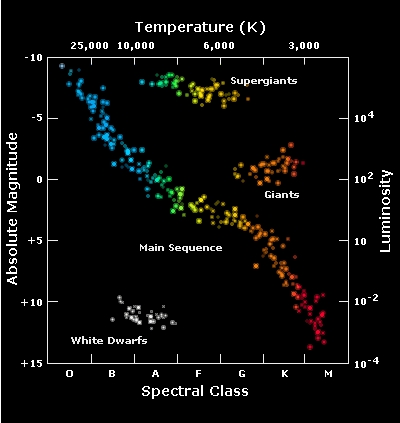
The amount of light that reaches your planet-moon system from its sun will depend on what kind of star it is. Stars come in different sizes and different temperatures. Most stars lie on what is known as the Main Sequence. Two notable exceptions are red giants and white dwarfs. The main sequence refers to the band of stars running diagonally through the Hertzsprung-Russell Diagram (HR diagram, previous links to two different images). Is basically a plot of how much light a star gives out (it's magnitude or luminosity) against it's colour or temperature. Stars are then divided into types (O, B, A, F, G, K, M) based on colour/temperature. Giant stars (other than blue giants) lie above the main sequence and white dwarfs lie below it. The sun is a G type star with temperature 5800 K (on the surface, that is; it's much hoter on the inside). K means Kelvin and is the standard unit of temperature. To convert from Kelvin and Celcius, you need to subtract 273, so the sun is 5500ºC (with rounding).

Using a star's temperature we can work out how much energy, in the form of light, reaches our planet. The first step is to assume that the star is a black body. This might sound conter-intuitive since the last word you're likely to use to describe the sun is "black", but from a physics perspective, a black body is something that absorbs all incident light and emits light based on its temperature. Well, I say "light", but really I mean electromagnetic radiation.

The Stefan-Boltzmann law tells us how much energy a black body emits based on its temperature. When we're talking about stars, this is called the luminosity. The formula for calculating luminosity is:

A stars luminosity, given it's radius, R, and temperature, T. σ = 5.67 × 10⁻⁸ is the Stefan-Boltzman constant and π = 3.14

The temperature has to be in Kelvin and the radius in meters to give luminosity in units of Watts (yes, like your light-bulbs) which is a measure of energy emitted per second. Radius and temperature are slightly trickier to come up with numbers for. If you're using a real star, you can just look it up on Wiki or Wolfram Alpha (Wiki even has a page listing the nearest stars to Earth). Otherwise you can make up a star with the characteristics you want such as temperature or class, then go to the second HR diagram I linked and look at the diagonal lines of radius. Whether you want a main sequence star, white dwarf or giant, this should give you an idea of radius (in units of the radius of the sun).

That's all well and good, but what we actually want to find is the light reaching a planet, not the total light emitted. Because stars emit light in all directions at once, their total energy output end up being diluted over an expanding sphere of light. Basically, not all the energy the sun produces hits our planet. It depends on how far away the planet is. This next formula will tell us how much energy hits the planet:

P is the energy per second hitting each square meter of the planet and D is the distance from the planet to its sun.

So P is the energy from the sun that hits a square meter of a planet which is D meters away from the sun. We're not quite there yet, but let's take a break and calculate some numbers. I'm going to work out the energy from the sun that hits the Earth/moon and Jupiter each second.
  • Earth/moon are about 1.5 × 10¹¹ m from the sun. The sun's radius is 6.955 × 10⁸ m and its temperature is 5800 K. The energy hitting a square meter of the Earth or moon each second is 1400 Joules.
  • Jupiter is 7.8 × 10¹¹ m from the sun. The energy hitting a square meter of Jupiter each second is 50 Joules, which is about 3.6% of the energy hitting the Earth. Jupiter's greater distance from the sun means that the sun's energy is about 30 times more spread out by the time it gets there. (As I calculate below, this is still about 14000 times brighter than the full moon as viewed from Earth.)

Planetshine

Light doesn't get completely absorbed by the planet, however. Some of it reflects back out into space and can illuminate other nearby objects. The property which determines how reflective something is (in this context) is called albedo. The average albedo of a planet is a number between 0 (non-reflective) and 1 (absolutely reflective), which represents the percentage of incident light that will be reflected.

In practice, it's fairly easy to implement albedo. The reflected energy is the incident energy multiplied by the albedo. Just multiply P above by albedo, A, and you get the power reflected off each square meter of planet. You can look up albedos for different planets/moons on Wiki and elsewhere. (But we all know Wiki's the easiest. It lists albedos in the summary box on the right of the relevant page. If more than one is given it's the Bond albedo, not the geometric albedo, that you want.)

What we actually care about, however, is how much of that reflected light goes on to reach the moon our colony is built on. In a way, we just reuse the equations I've already included above. Instead of putting L into the equation for P, use the P from the sun multiplied by albedo, radius becomes the radius of the planet, and distance is now the distance between planet and moon:


P is the energy per square meter per second hitting a moon, A is the albedo of the planet, R is the radius of their sun, r is the radius of the planet doing the reflecting, T is the temperature of their sun, d is the distance between planet and moon, D is the distance between planet/moon and sun. The last line is included because if you're using a real star, luminosity will probably be listed somewhere. Otherwise, the penultimate line is what you need to use.

OK, so this is getting increasingly more complicated looking, but remember that you only really have to do the last step. There rest are only there by way of explanation.

Now, one last thing before I calculate some more numbers. That last equation assumes that the primary planet appears full in the sky. If it's half full, you have to halve that number, if it's a quarter full you have to divide by four. Honestly? Just approximate.

  • The moon has an albedo of 0.136. The energy the full moon is reflecting at the earth is 0.0037 W/m2.
  • For the purposes of comparison, a 100 Watt light bulb from 10 meters away has a brightness of 0.02 W/m2.
  • The Earth has an albedo of 0.306. The energy Earth reflects at the moon is 0.12 W/m2. So because it's bigger and more reflective, the Earth as seen from the moon gives off about 32 times more energy per second. That means the full Earth in the lunar sky is roughly 32 times brighter than the full moon in Earth's sky and six times brighter than a 100 W light bulb.
  • Jupiter has an albedo of 0.343. Ganymede is 1.1 × 10⁹ m away. The brightness of full Jupiter in Ganymedean sky is 0.07 W/m2. That means Jupiter is almost twenty times brighter than the full moon. Not surprising given how big it is in the Ganymedean sky. A half-full Jupiter would be 10 times brighter than the full moon, a quarter-Jupiter about 5 times as bright and so-forth. The varying quantity here is what fraction of Jupiter's disk is illuminated (and that we're working under the assumption that Jupiter reflects evenly in all directions). A quarter-full Jupiter would be about as bright as a light bulb and a full Jupiter would be as bright as three and a half light bulbs 10 meters away.
  • Io is 4.2 × 10⁸ m from Jupiter. The brightness of full Jupiter in Io's sky is 0.48. So Jupiter is shining a whopping 130 times brighter than the full moon. By comparison, the sun as seen from Io is only about 100 times brighter than Jupiter. Light-bulb-wise, Jupiter would be as bright as 24 100W light bulbs 10 meters away.
  • For a bit of fun, the brightness of full Io (albedo 0.63) as seen from Ganymede varies from 1.2 × 10⁻⁴ W/m2 when it is at its closest point to Ganymede to 2.4 × 10⁻⁵ W/m2 when it is at its furthest. Neither of those are very bright, but it would still definitely be visible. It's about 0.6–3% the brightness of the full moon.
  • And finally, let's say we put Jupiter at the same distance from the sun as Earth is. Now Ganymede would get around the same amount of energy from the sun per square meter as Earth does and Jupiter would be a lot, lot brighter. How bright? 1.9 W/m2, which is 500 times more light that Earth gets from the moon and as bright as almost 100 light bulbs from a distance of 10 meters.

And there you have it. A method for approximating how much light you'd get reflected from a gas giant planet (or whatever planet/moon/asteroid you like). Unfortunately this post ended up being a little bit more complicated than I had initially anticipated (where complicated really means more maths), but it's a small price to pay for painstaking accuracy... Well, some semblance of accuracy, at any rate. There are a lot of approximations in the above (for example, the albedo varies for different types of terrain; so Earth's albedo is higher over clouds than over forest), but on average, it's close enough. Phew!

One last thing I came across after writing this post. I was looking for something else and came across this photo of Jupiter and Io. Notice how the line between Io's sun side and dark side (called the terminator) is very distinct and solid, whereas Jupiter has a bit more of a gradient going from light to dark? This is because Jupiter has an atmosphere (a very thick one, but the effect applies to Earth's atmosphere too) whereas Io's atmosphere is whispy and not really much to write home about. The atoms/molecules/particles in the atmosphere reflect light in all directions, allowing it to diffuse through a bit, giving us that gradient from light to dark. Io, on the other hand, only reflects light off its surface, leading to the solid terminator you can see in that image. Just something to think about when writing those realistic descriptive passages. ;-)

Update: I photoshopped some Jupiters into skies to give a size comparison with the full moon. You can see them here.

    Sunday, March 20, 2011

    Space Elevators: Where to put them

    The purpose of this post is not to exhaustively describe what a space elevator is and how it is intended to work. There are many other sources for that information. Instead, I intend to focus on what planets are suitable for building a space elevator on and which aren't and why.

    WARNING: This post contains maths that requires a proper calculator.

    Briefly: What is a space elevator?

    A space elevator is a proposed system for (mostly) getting things into orbit without using rockets. The idea is that once it's established, the cost for going into orbit drops dramatically because you no longer have to use rockets (which are expensive and generally involve some disposable element).

    Many different types of space elevators have been proposed, not all of which necessarily reach the Earth's surface. Instead they start part way up or outside of the atmosphere. This has the benefit of avoiding annoying atmospheric effects (wind, drag) and makes them lighter. But I'll leave researching what type of space elevator best fits into the world being created as an exercise for the reader. What I am going to talk about is what and where is it physically possible to place an elevator and more or less ignore engineering constraints (set it far enough in the future and, as Arthur C Clarke said, you can have technology advanced enough to seem magical).

    There are two ways of making a space elevator stay up. You can have a rotationally supported one or a gravitationally supported one. In the case of lifting payloads from Earth into orbit, a space elevator would almost certainly be rotationally supported. One designed for getting things to and from the surface of the moon, however, would more likely be gravitationally supported. What are the differences?

    Rotationally supported space elevator

    The principle for a rotationally supported space elevator is to have the force of gravity pulling it down to Earth exactly opposed by the centrifugal force of it spinning around in its orbit. Since we also generally want it to remain above above the same point on the surface of the Earth (so we can connect the ground to the top of the elevator with a cable, for example), the centre of mass of the elevator needs to be at the height of geostationary orbit. Geostationary orbit just means that it orbits at the same speed that the surface of the Earth rotates and hence it remains above the same surface point of the Earth all the time. Also, this point has to be along the equator or the stationary part of geostationary won't work. For example, a lot of communication satellites live in geostationary orbits which makes it easier for receivers on Earth to talk to them since they are always in the same place. And in the case of TV broadcasting, you generally only want to broadcast at a particular region, so there is the benefit of always being able to do so.

    A quick note on how to calculate the height of geostationary orbit, since I want this guide to be generally applicable, not just for Earth. For geostationary orbits, the acceleration due to Earth's gravity, g,  (or the gravity of whatever body we're interested in) needs to cancel out the centripetal acceleration, ac, from the circular motion of orbit.


    So r is the distance from the centre of the planet in kilometres (just subtract the radius of the planet at the end to find the height above the ground if that's what you want to know), G = 6.67 × 10⁻²⁰ km3 kg-1 s-2 is Newton's gravitational constant, M is the mass of the planet in kilograms, T is the length of a day in seconds and π = 3.14 is a constant. We can now rearrange this:


    And it becomes just a matter of plugging in the right numbers. We can now calculate that the height of geostationary orbit for Earth is about 36 000 km. Out of interest, for Mars, the height would be only 17 000 km thanks mostly to Mars' small mass.

    You might have noticed earlier that I said the centre of gravity of the space elevator needs to be at geostationary orbit. This just means that half the mass of the elevator needs to be below the geostationary height (so, mostly this would be in the cable since thirty-six thousand kilometres of cable, even if it's made of carbon nanotubes, is a non-trivial mass), and half needs to be past the geostationary height. The latter "counterweight" could consist of something like a docking station, space craft manufacturing plant or whatever you like.


    Gravitationally supported space elevator

    You probably wouldn't use a gravitationally supported space elevator to lift things off the surface of the Earth into space, but it would be ideal for lifting payloads from the moon. Because the moon is in a synchronous orbit (where it takes the same amount of time to complete a rotation as it does an orbit around the Earth), it spins too slowly for a sensible rotationally supported elevator. Plugging the numbers into the equation above, I get a geostationary height above the surface of about 87 000 km, more than twice the height for Earth. The moon's great and all, but it's probably not worth the price of twice the length of the cable just for getting rocks back to Earth. Not to mention any gravitational effects of the Earth on the elevator. For another example, let's work out the geostationary height for Ganymede, the largest moon of Jupiter. Plugging in all the numbers, I get about 43 000 km above the surface of Ganymede. Sure, this isn't a much longer cable than for Earth, but at the distance you start getting annoying gravitational effects from Jupiter and other planets screwing you over. Basically, you couldn't make it stable.

    The solution to this dilemma is not to try to make a rotationally supported space elevator, but to go for a gravitationally supported one instead. A gravitationally supported space elevator has its centre of mass at a Lagrange point, usually L1, which is sort of a gravitationally neutral location. So for the moon, the centre of mass would go at the point where the force of Earth's gravity is exactly balanced by the force of the moon's gravity. This point is called first Lagrange point of the Earth-moon system (after the guy who worked out the maths).

    Thanks to the moon's synchronous orbit, the point on its surface that is closest to Earth doesn't change. Hence, a gravitationally balanced space elevator would automatically remain stationary relative to the surface of the moon, which is handy when you're running a cable between them.

    How do we calculate how far from the moon the Lagrange point we're interested in? Well, we want the point where the acceleration due to each Earth and moon cancel out BUT we also have to consider the rotational acceleration due to the circular motion of orbit. (Remember, even though the space elevator is attached to the moon, the fact that it's suspended between moon and Earth means that it's also going around the Earth).


    r is the distance from the centre of the moon to the Lagrange point, m is the mass of the moon, M is the mass of the planet, d is the distance between the planet and the moon and T is the time it takes for the moon to complete an orbit (hence the time taken for the space elevator to complete an orbit since it's attached to the moon). It's not actually possible to rearrange this into something nice. If you really need to do this for a general planet, I suggest going to WolframAlpha.com and typing in:


    Solve[-((G m)/r^2) + (G M)/(d - r)^2 == ((2*3.14)/T)^2 (d - r), r]

    But with the appropriate values in place of all the constants (in km and kg if you use the G I gave above). I personally did the same in Mathematica (which is also made by Wolfram and has the same maths engine as Wolfram Alpha). However, if you're interested in doing a calculation yourself, with some approximations to simplify things, this website (which I came to via Google) seems to do a reasonable job. It also explains the maths a bit more than I have.

    So anyway, throwing appropriate numbers and making a computer solve it, here are a few results:
    • For the moon, the distance from the surface to the first Lagrange point is about 56 000 km.
    • For Ganymede it is about 29 000 km from the surface. 
    • And because I feel like it, it's 8600 km for Io.
    Clearly this is much more economical in terms of how much cable is used. And because you're taking advantage of the largest gravitational well in the vicinity, you don't have to worry too much about other effects mucking up your elevator. (OK, in the Jovian system you'd probably have some complications thanks to the other moons, so I'm not sure you'd necessarily want to go down that path, but it would work well for a gas giant with only one large moon and the rest small.)

    You can also put a gravitationally supported space elevator on the far side of the moon at what is known as the second Lagrange point. This post is getting a bit too long to go into the details, but the height of such a space elevator would be approximately the same as if it was at the first Lagrange point so long as the satellite is much smaller than its primary. This isn't true of the moon (but is true of the Jovian moons) and it turns out that the height required for that space elevator's centre of gravity would be 67 000 km.

    Summary

    As we've learnt, there are a few considerations we need to take into account when placing a space elevator:
    • Location
    • Start and end points
    • Type of body it services
    The last consideration ends up informing the first two to a great extent. So if we have a planet orbiting its sun in a similar way to the Earth, we will use a rotationally supported space elevator which will have to be placed along the planet's (rotational) equator. If we have a moon in a synchronous orbit, we want to use a gravitationally supported space elevator which will be placed along the straight line connecting the moon's planet and the moon.

    Everything else is just a matter of engineering. ;-)

    Wednesday, March 16, 2011

    Living on a moon: Marking time

    There is a certain class of exotic location often used in science fiction and that is the surface of a moon.

    Most of what I'm going to say will apply to moons like Earth's but I'm going to focus on the moons of gas giant planets like Jupiter and Saturn partly because they're a little more interesting and partly because if you want to know about day and night on the moon, it's more trivial to look up.

    Planets orbiting a star

    First, let's talk about ordinary (Earth-like) planets orbiting a star. They will have a year defined by how long it takes them to do a complete orbit of their sun and a day defined by how long it takes them to spin on their axis. Actually, there are two possible definitions of a day:
    • the solar day, which is how long it takes the planet to rotate all the way around so that the sun returns to the same place in the sky (or more accurately, until it returns to the same point above the planet. On Earth, the meridian passing through Greenwich and the middle of the Pacific ocean is the reference point we use).
    • and the sidereal day, which is how long it takes the planet to rotate about its axis so that the stars return to the same position in the sky.
    On Earth, a sidereal day is slightly shorter than a solar day (only 23.9 hours) and this will be true of any planet that spins in the same direction as it orbits. So the Earth, looking down on the north pole, spins anti-clockwise and orbits the sun anticlockwise. Such a planet is in a prograde orbit. This is true of all the planets except Uranus, which is sideways, and most of their moons. It is in general going to be true of all systems if they formed together (thanks to conservation of angular momentum) and if a planet isn't prograde (that is, if it's particularly lopsided like Uranus or if it's retrograde meaning spins or orbits in the opposite direction) then it probably has a more interesting history. In the case of Uranus, it is thought that some collision knocked it sideways a long time ago. For retrograde planets, where one each of orbit and rotation are clockwise and anticlockwise, the implication is that they did not form where they are found, but are interlopers from elsewhere. Or there could also have been a collision, but it would have to be a very large collision in exactly the right place. It's interesting to note that all the planets orbit in the same direction as the sun rotates. This is strong evidence that they all formed from the same nebula at roughly the same time.

    Moons: Mostly tidally locked

    OK, enough background. On to the moons. Let's assume we have a rocky moon orbiting a gas giant planet. All the interesting moons in our solar system (which is to say, the ones I checked and generally most or all of the big ones) are tidally locked with their primary, including Earth's moon. What does tidally locked actually mean?

    I won't go into the details of the physics, but if a satellite is tidally locked with its primary, the same side will always face the primary. So on Earth, we always see the same side of the moon. If you go to the moon and land on the near side, Earth will always be in the same place in the sky (assuming you don't travel far from your landing place) varying only in how much of it is lit up by the sun. It's also possible to have planets tidally locked with their sun, but they have to be quite close to their sun for this to happen. Consequently, most of those planets wouldn't be habitable for humans, unless the star in question was a red dwarf, but that's a topic for another blog post.

    Back to our rocky moon orbiting a gas giant. Since it's tidally locked, you will need to decide where you want to place your colony/city. Directly under the primary planet so that it always sits high in the sky? On the side of the planet which never sees the primary? These choices will depend a bit on your whim and a bit on the purpose of the colony. For the latter, if it's a research installation studying the primary or a mining installation skimming gas from the primary's atmosphere, it makes the most sense to build it directly below the primary. On the other hand, if the research installation is built for astronomy observations, you'd want to put it on the non-planet side so that light from the sun reflected from the primary interferes with your telescopes less.

    Days and nights?

    Once you've made that decision, you probably want to know how long days and nights will be on your moon. This is where it gets a bit tricky. I'm going to use Ganymede, one of the larger moons of Jupiter, as an example. Thanks to its synchronous orbit (another way of saying that it's tidally locked), a sidereal day on Ganymede is the same as it's orbital period. Orbital period is the general term for how long it takes to orbit all they way around Jupiter. (I'd prefer to say "Jovian day", but unfortunately that term refers to one of Jupiter's solar days. :-/ ) So unless it orbits very quickly, orbital period would not be a useful measure of time to base diurnal cycles on. And if it did have a fast enough orbit, it probably wouldn't be very habitable since that would imply that it was very close to the primary like Io (the innermost Galilean moon of Jupiter), leading to a host of problems like extreme volcanism and earthquakes. As I hope the crude sketch I did below helps illustrate, a solar day on Ganymede (that is, the length of time it takes for the sun to move all the way across the sky and come back to its starting point) is also the same length as an orbital period.*


    Not to scale! Top right circle is the sun, orange circle is Jupiter with the lighter half the half that is illuminated by the sun and the darker brown half the dark side. The grey shadow is Jupiter eclipsing the sun and the rainbow circle is Ganymede, so coloured to illustrate that the same side is always pointing towards Jupiter. The thick black line shows its orbit around Jupiter and the light and dark semicircles inside Jupiter's orbit are to help guess how full/dark/crescent/gibbous Jupiter would appear in Ganymede's sky (if you're on the side of Ganymede facing Jupiter).

    We can also use that diagram to work out how much of Jupiter would be lit up by the sun if we're on a the side of Ganymede facing Jupiter. It should also be noted that, unlike the Earth being lit up by the moon and human lights at night and hence being visible from the moon even when it's not lit up by the sun, the dark side of Jupiter would be completely dark. Against the black sky of Ganymede (and the sky would always be black, even during the day, since Ganymede has no atmosphere to scatter photons with) it would just look like a black hole in the stars. A black hole about 15 full moons across.

    *Technically it would be slightly less thanks to Jupiter's orbit around the sun, but Jupiter is so far out from the sun and has such a large distance to travel that day to day we can ignore the small difference to the length of a Ganymedean solar day. If your gas giant is much closer to its star, it might become relevant, but this calculation is left as an exercise for the reader. ;-)

    Time moves forward

    Finally, it would be useful to work out how quickly Jupiter and the sun change in Ganymede's sky, especially if you're writing a story that involves spending longer than a day there. I will make this section more general so that you can use for any hypothetical moon orbiting an arbitrary gas giant.

    What you need to know or decide is the orbital period, let's call it T,  a piece of paper with your own approximation of the diagram above (without all the different positions of Ganymede drawn in yet), and a protractor (or a really good eye for angles). For Ganymede, T = 7.15 (Earth) days. If you're making up a planet-moon system of similar size, it's probably best you're numbers don't deviate too much. I think I might make the proper physics you need to consider when making up planets the subject of a future blog post.

    On your hand drawn diagram, choose a starting position for your planet and a location on the surface for your colony. I suggest putting your colony close to the equator because a) it will be more picturesque and b) Ganymede has some crazy magnetic fields and I suspect that radiation shielding would be easiest to achieving within about 30º latitude of the equator. This doesn't automatically apply to all moons in similar systems, but still, it can't hurt. Draw your moon in it's starting position and mark the location of your colony with a cross or something. Remember that looking down from above the north pole, the moon will probably be orbiting anticlockwise if it's in our solar system.

    Next, you need to do a small piece of maths. Decide how much time you want to pass before you mention what the gas giant is looking like in the sky again. Call this time t. Make sure T and t are in the same units (convert them both to days or both to hours, whichever is more convenient, if they don't match). To work out how many degrees, d, of a circle the moon has moved in this time, you need to use the following equation:
    d = 360*t/T

    In one Earth day, Ganymede will move d = 360*1/7.15 = 50.3º which is a bit more than an eight of a circle. On the diagram above, that's a little bit more than the distance between two consecutive rainbow Ganymedes (ignoring the two close together in Jupiter's shadow). Since T is so small for Ganymede, this means that Jupiter and the sun change quite dramatically in the sky (Earth) day to (Earth) day. Depending on how your planet-moon system is set up, your mileage may vary.

    Multiple moons

    And a quick bonus calculation: if your planetary system has multiple moons your feel like caring about, you can do the above calculation for each of them, choose starting points and then see how far each one moves in the span of time you're interested in. This doesn't need to be very hard at all. In the jovian system, Io completes four orbits in the time it takes Ganymede to complete one and Callisto completes two in the same time. This convenient state of events is thanks to the physical principle of resonance. Resonance happens in all sorts of places in nature and celestial mechanics, including Saturn's rings and Mercury, so feel free to implement it with impunity.

    Hopefully, I've given you enough information to convincingly set a story on a moon orbiting a gas giant planet. Well, in a colony at least, where you don't have to worry too much about external climate, so long as you stay away from Io.

    Tuesday, February 22, 2011

    Foreign Skies

    Living on Earth, we are used to seeing the moon in the sky. Other planets, real or imagined, are unlikely to have moons identical to the Earth (well, ok, the imagined ones might). Other moons will look different and will take up different amounts of the sky. Today, I calculated how big various celestial bodies would appear from the surface of other celestial bodies and compared this with the size of the moon as seen from Earth.

    In case you want to try this yourself, I will briefly explain how I did it. First I found the angular diameter of the object in the sky using the equation below. For objects that are much smaller than the distance they are away (so if radius divided by diameter is less than about 0.1), you can also use the small angle approximation, in which you can ignore the tan part and the angular diameter is approximately 2r/d.

    Here, r is the radius of the object in the sky and d is the distance it is away. Both r and d should be in the same units,  that is, both in km (or miles). If you have your calculator set to degrees, then α is the angular diameter of the object in the sky.
     Now, because angular diameter doesn't really mean much on an intuitive level, I then divided this angle by the angular diameter of the full moon which is about 0.5 degrees. This gives me the number of full moons you could line up across the middle of the object. If you're interested in the area of sky covered by the object (in units of the full moon), then just square this number.

    The Earth seen from the moon

    The Earth is a lot bigger than the moon, so naturally it would look bigger if you were standing on the moon. In fact, the Earth seen from the moon is 3.6 times the size of the full moon. APOD have a nice photo for us of this scenario.

    Living on Ganymede

    Ganymede is the largest moon of Jupiter, and the third furthest away of the four Galilean moons. Ganymede is about three times as far from Jupiter as the moon is from Earth. However, Jupiter is very large (the largest planet in the solar system, in fact) and if visible from Ganymede's surface, would dominate the sky. As in happens, Ganymede is tidally locked with Jupiter, putting it in a synchronous orbit and meaning that the same face is always turned towards Jupiter. Unlike our moon rising and setting in the sky, it you stood on a part of Ganymede facing Jupiter, the gas giant planet would not move in the sky at all. Also, you could use Jupiter to navigate (even if it was directly above you, although it would be a bit trickier in that case) because the bands in its atmosphere run from east to west (here is another nice photo from APOD, which also shows Ganymede in the distance).

    So, standing on the surface of Ganymede, how big would Jupiter look? Very big. Fifteen full moons across big. It's a bit hard to imagine and if I find a nice photo of a full moon above a city or other recognisable landmark, I will photoshop Jupiter in and post it here. Jupiter looks so big that you could spread 225 full moons over it and only just cover it up. Yeah. That big.

    I also worked out how big Io, the closest Galilean moon to Jupiter, would look from Ganymede. Io is covered in volcanoes and sulfur and looks yellow. When Io is lined up between Ganymede and Jupiter, it will be 0.6 times the size of the full moon; a bit more than half. I initially decided that when Io was on the far side of Jupiter, even if it wasn't behind the parent planet, it would be too small to be very exciting, but doing a quick calculation I found that it would be about a third of the size of the full moon, so probably still big enough to be noticeable.

    Phobos for a bit of fun

    For a bit of fun, I also worked out how big Mars would look if you were standing on Phobos, one of its asteroid-like moons. Before doing this calculation, I never really appreciated how close in Mars' moons orbited. Firstly, Phobos is only about two Martian radii above the surface of Mars. This means that the small angle approximating definitely won't work when calculating Mars' apparent size. So how big does Mars look? Its angular diameter is a whopping 140º. That's the width of 280 full moons lined up next to each other. In fact, Mars would take up nearly the whole sky on Phobos. I think that's big enough to feel like you're falling towards it, particularly since Phobos has a very puny gravitational field. Scary.

    LinkWithin

    Related Posts Plugin for WordPress, Blogger...