Showing posts with label space travel. Show all posts

Sunday, April 28, 2013

Friction in space and on Earth

This post is in response to a comment I got on my previous post "More thoughts on the importance of science in science fiction" where Shannon commented/asked (I'm only quoting the question-y part of her comment):
It really is a hard concept to grasp, the no-friction-in-space thing. I don't think I really get it - I'm not sure how to visualise it, for a start - but I don't understand how a space ship - of the super-advanced, sci-fi kind - can't slow down. I mean, it's mechanical and computerised and runs on fuel; on Earth anything we build for transportation will slow down especially if there's a mechanical failure etc. I know in space you can't "stop", you'd only drift, right? I'm hoping you can explain this a bit more to me because I really do want to understand!

(The more time I have to let this concept dwell in my brain, the more I'm starting to get it. So what does happen when you, in sci-fi, go from "warp speed" or whatever they like to call it, to, well, not?)

On Earth (or really, anywhere that isn't the empty vacuum of space) moving objects slow down because they lose energy through friction — rubbing against other objects. Commonly on Earth, the source of friction would be land, water and/or air.

Some examples:
  • The motor of a boat needs to stay on to keep the boat moving, because if the motor is turned off, the boat will be slowed down by the water pushing back against it.
  • If you ski straight down a hill (let's say a small hill for safety reasons) you will accelerate (get faster) while you're going down hill, but once you reach the flat bit at the bottom you will eventually slow down and stop without having to stop yourself. This is because of the friction between the snow and your skis. Generally, skiing works because there's much less friction between snow and skis than, say, between shoes and dirt, but there isn't zero friction. When you were going down the hill and getting faster, there was still friction, but at that point gravity pulling you downwards was stronger.
  • If you drop something from a great height (tall building, aeroplane), gravity will make it accelerate as it falls down. However, the air pushes back on it, upwards (or more generally, in the opposite direction to the movement) and eventually will prevent the object falling any faster. (With air, the friction is directly related to the size and shape of the object and how fast it's going, but I won't get into the maths.) The maximum speed the object can reach while falling is called terminal velocity.
  • On the other hand, if there is no air — for example on the moon — there will of course be no friction from air and things like feathers which normally fall very slowly (because of all the little fuzzy bits catching on the air) will fall at the same speed and acceleration as a lead ball (or whatever). This will also work in a vacuum chamber where all the air has been removed. Here is a video of an astronaut on the last Apollo mission dropping a hammer and a feather at the same time:

    And a gif of the same if you can't be bothered watching and listening to the 47 second clip:

  • Brakes on cars and whatnot work by intentionally increasing the friction on the axle to slow down the spinning speed of the wheels
Now let's talk about how spaceships slow down in space. I want to emphasis that my complaint with Across the Universe wasn't that the spaceship was slowing down, but that it was slowing down by itself. Things can only slow down by themselves if there is friction around (so really they're not slowing down by themselves but because of friction, but we don't usually think about or notice friction so it seems like its happening by itself).

In real life, spaceships slow down (and manoeuvre) by firing their engines in the other direction. It might be a bit easier to picture on a smaller scale. Consider an astronaut on a spacewalk. Let's pretend they're not tethered to their ship and that the ship is out in deep space away from the gravitational influence of any planets. To be able to move around, the astronaut will have a gas tank (or similar) that will allow them to press a button to move forward. The gas will shoot out backwards for a couple of seconds, and the astronaut will move forwards. At this point, if the astronaut does nothing, they will continue moving in a straight line indefinitely. Basically until they run into something. The same thing happens with a spaceship: gravity and obstacles not withstanding, after it fires its engines for a bit to accelerate, it will keep going in a straight line at the same speed until something else happens to stop it. This clip from WALL-E is a good example (thanks to Shaheen for the suggestion). Also note that once they start spinning, things will continue spinning until something else makes them change, which you can see a bit of in that clip.

That doesn't mean things can't stop or slow down in space. Our astronaut — assuming they're not unconscious — can fire their gas in the opposite direction (to manoeuvre properly they'd have to have several directional options, six for complete manoeuvrability) to slow down. The spaceship can also fire thrusters in the opposite direction to slow down (either by having two sets or by rotating the main ones). Coming to an absolute complete stop is a bit tricky because a) you would have to balance forces very exactly and b) there's not much to use as a reference for how fast you're going out in space, but matching speeds with another ship is doable. And the astronaut slowing down enough to not break a wrist colliding with his ship is also useful. My older post about turning around in space addresses some issues with why just stopping and going in the opposite direction isn't the most efficient way of doing it.

The very last part of the question was:
So what does happen when you, in sci-fi, go from "warp speed" or whatever they like to call it, to, well, not?

The short answer to this is, whatever you want. Warp speed and hyperspace and other "let's cheat to go faster than the speed of light devices" aren't real. They're generally not based on real physics, or if they are, it's very extrapolated and speculative and could well turn out to be just as implausible. That said, faster than light travel is a staple of science fiction and I'm not suggesting we should eliminate it because it's implausible. If all science fiction stories used only slow or relativistic (which means close to the speed of light, when weird things happen. My post about it) then there'd be a lot of very slow stories which would get boring. Variety is nice.

As long as the rest of the science is plausible, then I don't have a problem with a bit of faster than light travel and faster than light communication. If the writer doesn't feel up to making up a semi-plausible sciencey explanation, then my personal preference is not to try explaining how the FTL works at all. Because they usually stuff up some minor point which annoys me disproportionately.

Monday, October 1, 2012

Turning around in space


Another ask Tsana question today. (And a relatively shortish response, sort of. Gasp!) Keep 'em coming, guys :-)

Anon asked:

How hard would it be to turn around in space... Say for some reason, Curiosity needed to turn around midflight and return to earth. Would BURNING fuel on some sort of reverse thruster work or would it have to make the trip to Mars, orbit the planet and break orbit to return
This is for a picture book that I feel impelled to be at least somewhat based in reality... which may be dumb.

Hi Anon,

It's absolutely NOT dumb to try to make picture books or any sort of books for kids plausible or semi-plausible. Especially when it comes to these sorts of areas where they can't possibly have any hands-on experience. Hollywood bombards them (and all of us) with so much inaccuracy that any little bit of truth helps. If they remember your book when they come to learn about these things later on, it will help the science stick. If all they have to go on are poorly researched movies which have given them wrong "intuition" about these things, it makes it a lot harder for them since they have to unlearn the rubbish first.

On to the actual question part!

It's pretty tricky to turn around in space. Because there's no friction, you have to use the same amount of energy it took to speed up to slow down by the same amount (so to come to a stop, say). This is a huge waste of fuel. Changing course more subtly isn't as difficult, however.

Apollo 13 Movie poster. (Nabbed from Wiki)
For something specifically like Curiosity: an unmanned probe sent to another planet, I can't think of a reason they'd try to get it back to Earth (unless a sample return was specifically part of the mission plan, but I don't think that's what you're asking). If something went wrong, they'd be more likely to cut their losses and abandon it. Also, almost all of that kind of probe's fuel is used up during take off, leaving only enough for minor course corrections and landing. In that case, plausibility would dictate that attempting a gravitational slingshot around Mars would be the only way to maybe get it back. You'd also have the issue of how to collect it from Earth's orbit since a) Earth would have moved a lot while it was travelling and b) if you were lucky enough to get it to pass close to Earth, it would be travelling quite fast and probably wouldn't have enough fuel to go into orbit around Earth for collection. It would definitely be tricky.

A very good example of a scenario relating to your question is the movie Apollo 13. If you haven't seen it, I recommend that you do. As far as I can remember (and I freely admit it's been many years since I watched it, so don't hold me to this), the physics in it was pretty accurate. In that, things go wrong with the (real life) 70s moon mission and, among other fixes, the astronauts have to slingshot around the moon to get safely back to Earth.

In the end, I'd say it depends on the nature of your mission as to what would be done. If it was a manned mission to Mars, for example, they might try harder to bring them back early, but physics would not be on their side.

Hope that answers your question!

Friday, September 21, 2012

Gravity and atmospheric pressure

I have another response to an "Ask Tsana" question today.

Brookelin asked:
I was wondering... with planets like Europa and possibly Ganymede, who possible have oceans, if humans made future settlements under said oceans, would the pressure from the water above counteract the effects of reduced gravity on the human body?

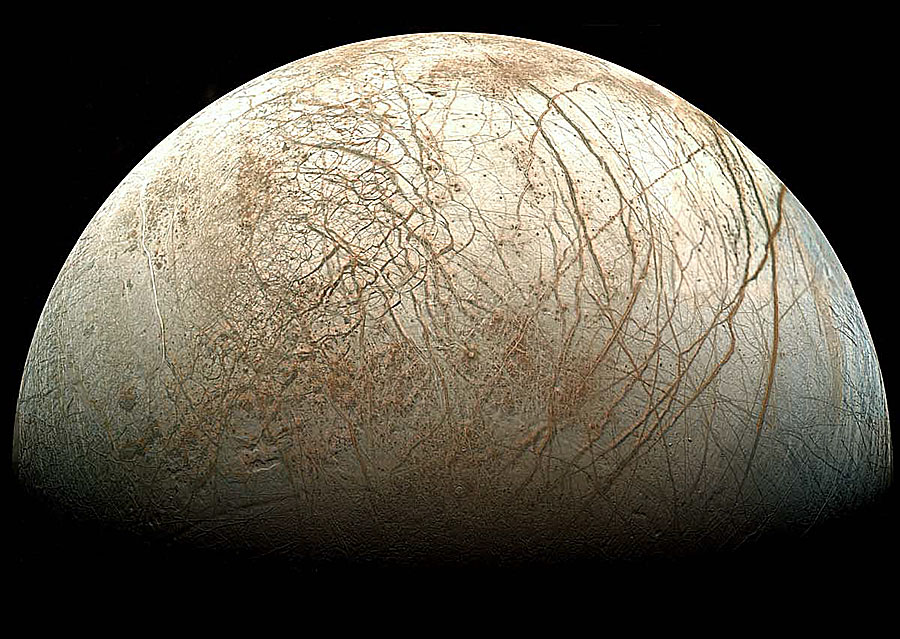
Interesting question. A preliminary point: it's Jupiter's moons Europa and Callisto that probably have sub-surface oceans (especially Europa), not Ganymede which is a solid rocky moon.

Europa, one of Jupiter's moons, has a vast ocean beneath
its surface. Credit: Galileo Project, JPL, NASA;
reprocessed by Ted Stryk
So, how do pressure and gravity work? In this context, gravity is the force that holds a planet/moon/star together and which attracts other objects to it. So we're all being pressed into the surface of Earth due to Earth's gravity. Pressure is the force a surrounding fluid (air, water, etc) exerts on something. So the atmospheric pressure we feel on Earth is pushing at us from all sides (well, OK, not out from the ground) and is due to all the air in Earth's atmosphere.

When you go swimming, the further you dive down, the higher the water pressure around you gets. This is because the deeper you are, the more water is above you to press down on you and the more water is above the bits of water on either side of you, also pressing into you. If you've ever been snorkelling (or scuba diving, I suppose but I can't vouch for that due to lack of experience) you might have noticed that it gets harder to breath the deeper you go (assuming a long enough snorkel). This is due to the water pressing down on your chest. Air does the same thing, but we're used to it, so we don't notice. The other thing that happens under water is that the water underneath you pushes up on you: this is called the buoyancy force and it's why things (people, tennis balls, icebergs, etc) float.

The higher up you go from sea level on Earth, the thinner the atmosphere gets (basically, the less atmosphere left above you). To halve the atmospheric pressure you experience, you need to go 5 km above sea level. (On the other hand, to double the pressure, you only need to be about 10 metres under water.) At that height, gravity is still pretty much the same as at sea level (the difference is about an eighth of a percent) and your main problems are getting enough oxygen (not a huge problem if your lung capacity is OK) and possibly altitude sickness (potentially a problem).

We need some amount of air pressure around us to survive which is part of the reason astronauts wear space suits. However, there is a range at which we can still function and that range increases if we have extra oxygen (and don't get altitude sickness). People have climbed Mt Everest (8.8 km above sea level) which has an atmospheric pressure of about a third that at sea level at it's peak without oxygen, but even doing it with oxygen requires training and acclimatisation and isn't something anyone can just decide to do one morning (well, unless they also decide to put in all the training).

On the surface of Europa or Callisto, there is no atmosphere and hence no atmospheric pressure. The ground is frozen water (probably not pure water, if only due to meteorite bombardment, but that's beside the point), but let's suppose we somehow got under the surface and set up a habitat. Since we're human and breathe air (a particular mix of mostly nitrogen, with some oxygen, carbon dioxide and misc) we'd have to have some sort of bubble habitat under the sea. But it's not just the air part that we need, we also need it to be around one (Earth) atmosphere of pressure. So we build a habitat with solid walls and fill it with the right amount of air... and then we're inside an air bubble and the water outside the bubble is having no effect on our bodies directly. The only way it would is if we went out into the water without pressure suits. Which probably wouldn't be the best idea in the world for a variety of health and safety reasons that don't necessarily have to do with the water pressure.

Now let's talk about gravity. The main way we detect small changes in pressure is though our ears, for example when they pop on taking off and landing in aeroplanes. The main way we detect changes in apparent gravity (which is the same as changes in acceleration) is when we feel lighter or heavier. If you're standing, this might manifest as extra strain on your legs, if the apparent gravity has increased, or a feeling like your stomach is moving upwards (possibly accompanied by nausea), if the apparent gravity has decreased. You don't experience the same feeling underwater or up a tall mountain because the gravity doesn't change in those places although the pressure does.

So what I'm ultimately trying to say is that the effects of gravity and atmospheric pressure are different. You can't compensate for a decrease in gravity by increasing pressure. Pressure is a force applied from all directions simultaneously, while gravity acts in just one direction. We know about the effects of Earth gravity, high gravity (from fighter pilots for example) and zero/microgravity (like on the space station) on people but much less about the effects of gravitational fields less than Earth's and more than zero. Europa's and Callisto's accelerations due gravity at the surface are about 13% Earth's and for comparison, the moon's is about 17% Earth's) so while we have had some experience with the moon landings during the Apollo missions, we don't really know how serious the health problems associated with spending prolonged periods at such low accelerations would be. There almost certainly would be some, but they probably wouldn't be as severe as zero gees. So while we can't use water pressure to compensate for gravity, it's not impossible for people to live on one of the moon's of Jupiter. We just don't know enough about what long term problems might arise.


Saturday, March 10, 2012

Sciencefail rant: Across the Universe by Beth Revis

First things first: sorry it's been a while between posts. Life has been busier of late and I haven't quite had the brain space to devote to writing a serious sciencey blog post. Until now. I was reading Across the Universe by Beth Revis, a recent YA science fiction book set on a generation ship and just as I got up to the "ooh, things are getting interesting" plot-thickening part, I was smacked in the face by an epic science fail. This is what I am now going to rant about.

There will be spoilers. Many crucial spoilers. If you'd rather read a spoiler-free review and live in science fail ignorance, then you can read my ordinary review here.

~

I mentioned spoiler-warning, right?

~

Don't read on if you don't want to be spoiled.

~

The Fail of the Science

Some background

In Across the Universe we have two main characters: an American teenage girl and the future leader of the generation ship. The girl gets frozen and loaded onto the ship as cargo because her parents are part of the colonisation mission on the new planet they're going to. For reasons unimportant to science fail (and which I hence won't spoil), she is accidentally unfrozen early, supposedly 50 years before they're due to land. The entire journey was supposed to take 300 years.

When she wakes up, she finds herself in a very different world to the Earth she left behind. Blah, blah, dystopia -- if you're interested in that aspect, go read my proper review. In the course of events, the two main characters discover that among all the secrets and lies aboard ship is the secret of what's going on with the ship's engine.

The parts I don't have a problem with is that the engine nuclear and they have some sort of process which is supposed to recycle the uranium so that it keeps running long enough. I mean, I'm sceptical of the whole re-enriching uranium part -- entropy, conservation of energy, the lack of a particle accelerator on board, etc -- but I'm willing to buy future technology with fancy engines. If we didn't have future tech with better stuff than our present tech, then science fiction would be a little dull.

Unfortunately for the residents (and cryo-residents, I suppose) of the generation ship, there is something wrong with the engine. It is losing efficiency. Given the magic physics that was making it run in the first place, this isn't surprising either. Do you know what is surprising? The fact that the engine failing is somehow slowing the ship down.

SPACE IS NOT AN OCEAN!

I know, I know, I don't usually actually scream when I'm ranting, but this blatant disregard for one of the most basic and fundamental ideas in physics infuriated me. I shouted, in real life, and bashed the book on the couch in my frustration* at this neglect of research. Ask anyone who's taken a first year university physics subject, gosh, even anyone who passed high school physics, and they should be able to tell you what happens on a spaceship when the engines fail.

It keeps going in a straight line until it hits something.

IT DOES NOT SLOW DOWN.

Galileo, who lived way back in the 1500s–1600s, worked out that an object will continue to move in a straight line. Newton, in 1687, appropriated this concept and dubbed it his first law of motion:
A body in motion will continue moving with a constant velocity unless an external force is applied to it.
On Earth, friction is usually that external force. Your car's engine has to keep running while you drive because if it doesn't, you're car will eventually roll to a stop as the friction between the axle holding the wheel in and whatever's on the other end of the axle. A boat slows down because of the drag force of the water around it -- drag force being a type of friction. Your bike might roll down a hill, but if you don't pedal, friction in the axles will eventually bring you to a stop. An aeroplane needs to keep firing its engines because of the drag force of the air slowing it down (they can sometimes coast down to a landing if the engines fail, but they need to over come the drag to maintain a constant speed so that they can stay in the air because of other physics I'm not going to go into right now).

You get the idea.

The drag force happens because something -- air particles, water molecules, etc -- collide with the moving object and push it slightly in the opposite direction. If only one particle hit the much larger object, it wouldn't make a difference, but there are very many particles in the air around you right now. There are even more surrounding a boat (or person) in water. That's why it's harder to move underwater than in air. The fewer particles around to collide with an object down, the less it will be slowed down.

Space, unlike the surface and atmosphere of Earth, is characterised by its vacuum. It's lack of anything substantial. There is no air in space. Sure, there are a few stray molecules and atoms floating around but, except in the densest of nebulae/molecular clouds, they are far sparser than even the best industrial vacuum we can create on Earth.

In space, there is no drag force. There is nothing to slow you down. If your engine failed, you wouldn't slow down, you would just keep going, indefinitely, until you collided with something, or came close enough to a gravitational field (of a star, for example) to change direction. Then you would keep going in that direction unless you were particularly well aimed to go into orbit around that star.

So when the engine of the generation ship in Across the Universe starts to fail, their problem isn't that it will take them longer to reach their destination. If it fails completely, they will not be "dead in the water". There is no water. It might be called a spaceship, but that doesn't mean it shares the same watery drag force as an ocean liner.

Their problems are more likely to be related to not being able to land or go into orbit around their destination, or not being able to make course corrections, or not being able to slow down and zooming straight past their destination.

By a similar token, people or things ejected out of the airlock wouldn't get left behind. Again, space is not an ocean. Once the airlock is opened and the air rushes out (pushing any lose objects out with it, perhaps), the ejected objects would appear to float close to the ship, continuing to move in the same direction along with the ship. If someone was thrown out an airlock, their body would only stop shadowing the ship when the ship did one of: speed up, slow down or change direction.

I grant that if the ship has magic artificial gravity (which the generation ship in Across the Universe does), some strange things might happen to throw the body further away from the ship, or make it somehow react unusually with the artificial gravitational field, but there was absolutely no indication of that being the case in this book.
 
* Don't worry, the book was unharmed.

Acceleration?

My first thought, in my brain's desperate attempt to fix the gaping science fail hole in Across the Universe, was that maybe the ship was accelerating and that's why they needed the engine to maintain efficiency and why things thrown out of the air lock got left behind.

Unfortunately, it can't have been.

According to the original mission plan (which the book gives us no reason to believe is a trick), the voyage is supposed to take 300 years. Also, their destination is called Centauri-Earth (and our world is referred to as Sol-Earth). This could refer to Alpha Centauri, the closest star, but given the fact that the planet they're headed for is supposed to be habitable, that doesn't seem likely (Alpha Centauri is a triple star system and the chances of conveniently habitable planet being there are slim). So it must be another star with Centauri in the name. There are lots. Here is Wiki's list of stars in the Centaurus constellation. If you sort that list by distance, you see that there aren't that many stars within 300 light years.

Since no relativistic effects are ever mentioned (see this blog about travelling close to the speed of light, and this one about accelerating up to fractions of the speed of light), it seems fair to assume that they never reach an appreciable fraction of the speed of light. Let's say that means less than around five percent time dilation goes on (see aforementioned links for previous posts if you're lost at this point). Well, travelling at a third of the speed of light gives us six percent time dilation, so close enough. So the maximum speed we're allowing is 0.33c. If we ignore acceleration, that limits us to stars within 100 light years. Habitability is probably limited to F, G, K and maybe M stars. Within 100 light years in the Centaurus constellation, that leaves us with... 14 viable stars (11 of which don't actually have Centauri in their name...). The furthest with Centauri in the name (not an unreasonable requirement, given the context of the book. If they were going to a star with a dull designation, surely they would have given it their own name?) is about 60 light years away.

If we assume they're accelerating until they get half way, then decelerating the rest of the way (the fastest way of getting there and also the main way to require the engine running the entire time), that requires a very low acceleration of 0.0013g or 1.3 cm/s2. Which at least explains why a uranium engine might be the fuel source of choice. (For the record, if their destination was Alpha Centauri, then this value wouldn't change appreciably - it would be about 0.05 cm/s2 less. Furthermore, for Alpha Centauri it would make much more sense to accelerate a bit and then spend most of the journey coasting until they needed to slow down at the other end.) The maximum velocity the ship would reach would be 0.37c, so that's not too far above my imposed limit of 0.33.

This low acceleration means that my point about bodies not being left behind when ejected from the airlock still stands. They still wouldn't appear to drift away that quickly.

The final piece of information we're given in the book is that the engine started failing when they were about halfway through their journey. What does this mean? It means that they wouldn't be able to decelerate, would reach their destination faster not slower and would zoom straight past it too quickly to go into orbit. Pretty much the exact opposite of the problems described in the book.

Over-reaction?

No. For two reasons. The first is just it's bad writing -- the science fail error jolted me completely out of the story and undermined my suspension of disbelief and plausibility of the whole setting. To achieve the same plot-mandated end, the author could have had the engine start to fail while accelerating or, without much consequence to the plot (as far as book 1 in the trilogy goes, at any rate) the ship could be unable to slow down, unable to correct its course or they could have found out that the planet wasn't as viable as they originally thought. Each of these things would have got the job done, but no, the author chose to not check physics.

The second reason is twofold. From a personal point of view, when learning physics for the first time, in high school or university, it's usual to relate everyday situations to the concepts you learn. In this way, you can intuitively predict basic mechanics based on experience. However, everyday situations tend to take place on the surface of Earth, so when trying to predict the mechanics of what happens in space (which, yes, does come up in physics classes -- take some if you don't believe me) the situations the student has to fall back on are what's portrayed in various media -- books, movies, perhaps computer games. However, thanks to the the generalised scientific illiteracy of most of society, half of these portrayals are plain wrong. They're why I have this blog, in fact. Honestly, having taught physics to new students, I have seen a lot of evidence for this sort of thing contributing to poor understanding and requiring a lot of unlearning.

Hollywood, poorly researched books, and other media undermine what little science education kids get. At least if the media surrounding us strived for some semblance of accuracy, perhaps people would pick up some science by osmosis. Then the climate debate wouldn't be so controversial, US presidential candidates wouldn't think a moon colony in 20 years was a viable idea, and we wouldn't have an anti-vaccination movement. Scientific literacy is important and, really, science fiction as a genre is uniquely positioned to encourage an interest in science. Sure, this wasn't a hard SF tech-centric book, but it was a giant spaceship. That's the sort of thing that can capture an imagination and ingraining wrong science while doing so is just irresponsible.

And it makes me angry.

(Other than the science fail aspect, this isn't a terrible book. I give it 3.5 / 5 stars -- half a star subtracted for the science fail. For a less science-oriented discussion of the book -- y'know, an actual review -- see my book reviews blog.)


Saturday, February 11, 2012

Relatively Faster

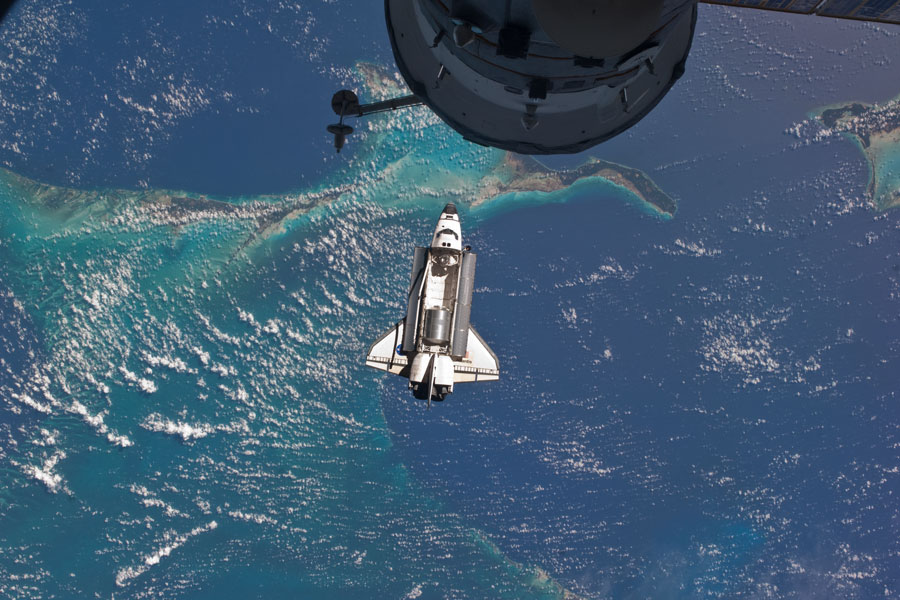
Space shuttle moves pretty slowly and stays close to Earth.
Image credit: ISS Expedition 28 Crew, NASA
Following on from my last blog, in which I talked about travelling at an appreciable fraction of the speed of light, today I'm going to add acceleration into the mix. But first, a few other funky consequences and transformations that apply when travelling close to the speed of light.

To recap last week's post, when travelling close to the speed of light, time dilates and length contracts. That means time moves more slowly and distance shrinks. The factor which dictates how much is called the Lorentz factor and is denoted by the Greek letter gamma:

Here v is the speed of your rocket or whatever and c = 3 x 10⁸ m/s is the speed of light.
The rate at which time appears to pass (to an outside observer) in a rocket travelling at v is given by the time that passes for the observer multiplied by gamma (which is always greater than or equal to 1). This is also called the proper time for the people inside the rocket. The apparent distance between A and B for a moving observer is given by the distance between A and B as seen by an observer at rest with respect to the two points (so that A and B don't seem to be moving) divided by gamma.

Moving on

Another funky thing that changes with speed is mass -- it increases proportionally with gamma. Well, it's sort of more accurate to say momentum, and it doesn't mean that you'll feel heavier when you're in a fast-moving rocket, but that it will take more energy or force to accelerate you further. Basically, what this boils down to is the faster you're going, the harder it is to go faster.

What about if we have two rockets, travelling in opposite directions at 0.75c (that is, three quarters of the speed of light)? The apparent speed of one rocket as seen from the other must be less than the speed of light (all speeds of massive objects are less than the speed of light in all inertial reference frames). So we need to use another transformation to work it out. Without going into too much mathematical detail, the equation we need is:

See below for slightly complicated explanation of values.
The tricky part is that now we're talking about three frames of reference, not two. There's a frame of reference for each of our moving spaceships, and the third frame which is dictating how quickly the two spaceships are travelling (in their own frame, of course, each spaceship is stationary and we don't have a problem to work out). This third frame we're going to call the rest frame. We want to work out u, which is how fast spaceship A appears to be travelling from spaceship B's point of view. U is the velocity of spaceship A from the rest frame, v is the velocity of spaceship B from the rest frame. For the equation to make sense, one of U or v has to be negative (to account for the opposite directions part) c remains the speed of light (3x10⁸ m/s).

Whew, OK, bit complicated to keep track of things there.


Getting faster

Next up, let's talk about acceleration when travelling at relativistic speeds. So far, we've only considered things moving at a constant speed. Accelerating frames are, by definition, not inertial (since an inertial frame is defined as not accelerating), so we can't quite apply all the same assumptions to them. When you are accelerating, you are moving into a different inertial frame for each instant that your speed is changing. (Of course, when you stop accelerating, you'll stay in your last frame unless you decelerate.)

If you're in an inertial frame and a relativistic spaceship accelerates past, what acceleration does it appear to have? Well, the following formula will tell us and, it's interesting to note, the apparent acceleration changes with the ship's velocity, even though, from on board the ship, the acceleration feels constant.

I was going to include the equation, but upon further consideration, it's not terribly useful or relevant. Moving on to more practical relativistic space travel, I'd like to point you in the direction of this excellent website. The set of rocket equations as explained on that site are as follows:

Equations taken (and re-typeset) from this excellent website.

So these equations assume that the ship is travelling at a constant acceleration, a. The velocity, v, is the speed it reaches, as measured from a "stationary" reference frame -- which for the sake of brevity I'll call Earth* -- after a t-long period of acceleration. The distance over which the acceleration takes place is d and τ (pronounced tau) is the time that passes for the rocket and the people inside it (generally speaking, less time will pass inside the rocket than for people on Earth).

That inverse cosh function (also called arccosh) in the last equation is a bit of an odd one. It's short for inverse hyperbolic cosine. A good scientific calculator should have the appropriate function (you'd probably have to use the shift key to get to it) and failing that, there's always WolframAlpha.com.

There are a few ways to use these equations, depending on the circumstances of your spaceship.

Accelerate constantly until the half way mark, then decelerate until destination

  • So, acceleration is good for us. It maintains things like muscle mass and bone density. It's broadly a good idea to maintain Earth acceleration (9.8 m/s2 is the acceleration due to gravity).
  • If we accelerate the whole way, we'll go splat at our destination. The sensible thing, if we want to accelerate the whole time, is to accelerate constantly to the half way mark, flip the ship and then decelerate the rest of the way. (Flipping the ship is so that the floor doesn't turn into the ceiling. Obviously you'd have to stop the accelerating to do the flipping.)
  • So we use the time taken equation (the first one) but put in half the distance (because we're only accelerating 'til the halfway mark), then double the resultant time to include the time taken to decelerate (conveniently, these things are symmetric).
In general, it's easier to deal with light years (rather than meters) and years (rather than seconds) when we're talking about interstellar distances. However, to get a sensible answer out, we need to put acceleration into years and light years as well. Skipping the maths, 1g = 9.8 m/s2 = 1.03 ly/yr2 so you can use that value for a. You can also just multiply by a factor if you decide you'd like to save fuel by accelerating at only 0.5g or 0.75g. Or save time by going at 1.5g (which humans might be able to adapt to). Also, remember that the speed of light in these units is 1 ly/yr.

To work out the time taken, follow the same procedure as above, but using the time equation (whichever one you're interested in). Again, put in half the distance then double the result.

Accelerate up to a set velocity

Because accelerating for an indefinite period of time might get a bit silly and use up an unrealistic amount of fuel. Also, you'd be smashing into atoms pretty hard and starlight (and the cosmic background radiation if you end up going fast enough) would get blueshifted to higher frequencies. Both of these phenomena would require extra radiation shielding, which adds extra mass and requires extra fuel. So, let's accelerate just up to a set velocity, travel at that velocity for the bulk of the journey and then decelerate again.
  • First we need to know the distance required to reach our desired velocity (and potentially also the time). The procedure isn't too different to the first case. We do need to rearrange the velocity equation a little first. Using c = 1 ly/yr we get:
  • Throw in our final velocity and the desired acceleration and we get the time taken (from an Earthly reference frame). Throw the time into the distance equation and we get out how far we've come when we stop accelerating. Double this to account for the distance and/or time taken decelerating again, subtract that from the total distance and we're left with the distance spent travelling at a constant velocity.
  • You can work out the time that section of travel takes from last time's blog (here).

And there you have it, journey times at relativistic speeds with accelerations. Huzzah!


* Technically not inertial, but it'll do if you ignore the gravity and the motion around the sun. Theoretically we should take the sun as our standard rest frame, so you can pretend I really mean the sun when I say Earth if that makes you feel better. 


Sunday, January 22, 2012

Rapid slow space travel

Credit: Craig Crawford on APoD
I have posted in the past about mundane space travel such as might be used with the solar system (or another star system if we're talking aliens or whatnot). However, with speeds that slow, it would take an extremely long time to reach another star, even the closest. To have any hope of reaching another star, we need to be able to travel much faster.

Right now, we aren't technologically equipped to do so and that's not what this post is about. What I'm going to talk about is what happens when we (or rabbits or clocks or whatever) travel at high speeds. Because strange and interesting things do happen. Welcome to the weird and wonderful world of Einstein's special relativity.

Immutable

We live in a world with three spatial dimensions and one time dimension. All this really means is that we can define a co-ordinate system (for example x-, y- and z-axes) which can define any point in space by listing three numbers (the x, y, z co-ordinates) and which can define any point in time with a single number (although it doesn't look like a single number, that's how we can think of "11:00 am on 21 January 2012"). Any point in spacetime (that is to say, our universe, past and present) can be defined by combining those two co-ordinate systems to give four numbers, unique to each point.

Now, say you're in a long corridor. There are several ways you might try to measure how long it is. You might walk along it and count steps or use a measuring tape. You might jog or walk at a know speed and time how long it takes to get to the other end. If you were particularly eager and the corridor sufficiently long, you could bounce light (or radio waves) off the far end and time how long it takes to complete a round trip.

Of these three options, I'd hazard that most people would use a length-based measurement as per the first option.

Now suppose your room is actually a space ship traveling close to the speed of light with you inside it. (For now we're ignoring how it got up to that speed.) You can still use the same three methods to measure it. Remember, when you're moving at a constant speed, you don't feel the movement. Aside from bumpiness due to uneven roads/train tracks/turbulence, the only sort of movement you can detect without looking out a window are the periods of acceleration and deceleration. So, if you're traveling at a constant velocity in a spaceship with no windows, you would have no way of checking how fast you're going, but other than that, nothing weird would seem to be happening.

On the other hand, if you were outside the spaceship watching it go past, how could you measure how long it was? Being on the outside rules out walking along it with a tape measure (unless it's stationary, but then it's not going past, is it?), but the other two methods more or less work. If you know how fast it's going, you can time how long it takes to go past. If you know how long it is, you can time how long it takes to go past and work out how fast it's going.

Intuitively, we might expect that spaceship length doesn't change and that the speed of the spaceship is the only thing that determines the time taken for it to go past. This isn't strictly true.

The one immutable quantity when we're talking about moving objects in a vacuum (that is, spaceships in space) is not how long they are or, strictly speaking, how fast they're going. It is, in fact, the speed of light. The old mantra of special relativity is:

The speed of light is constant in all inertial reference frames.

A definition before I go on: inertial reference frame is a set of co-ordinates which isn't accelerating. If you are in an inertial reference frame, you can define your spacetime position with respect to those co-ordinates.

Also, an important point is that it's not possible for any object with mass to move at the speed of light (or faster). The only reason light gets away with it is because photons, particles of light, are massless.


Goin' fast

Say your fancy long spaceship is constantly going at half the speed of light. Because the speed of light is constant in all inertial reference frames, light from a torch you shine inside the spaceship will still travel at the same speed of light as it would anywhere else. Furthermore, just because you're traveling at half the speed of light doesn't mean the light from your torch will appear to travel at one and a half times the speed of light to someone outside your spaceship who can look inside.

Sounds paradoxical, doesn't it?

To make up for the apparent paradox, two things happen. Remember that speed or velocity is basically the amount of distance covered in a stretch of time. To keep the speed of light constant, both distance and time change, depending on how fast you're observing from.

A fast moving object appears to be shorter than it would were both object and observer in the same reference frame (that is, traveling at the same speed in the same direction). This applies to the outside distance for a fast-moving spaceship -- the distance traveled/left to go appears shorter than if the spaceship was stationary with respect to it. This is called length contraction.

Quick side note: this means that all distance is relative and there is no such thing as being truly stationary, just stationary with respect to some other reference frame.

The faster your spaceship goes, the more slowly time passes for you. Well, actually, to you it would seem that between starting your journey and ending it, time passed more quickly planetside than it did for you. (It's all relative, see?) This is called time dilation.

The amount by which time slows down or distance shrinks is dictated by the relative speed of your spaceship. There's a mathematical quantity called the Lorentz factor, represented by the Greek letter gamma, which tells us how much.

Gamma, the squiggle on the left, is the Lorentz factor, v is the speed the spaceship or whatever is traveling, and c is the speed of light, equal to 3 x 10⁸ metres per second.


So if you're traveling at half the speed of light, gamma would be equal to about 1.15, so time would pass 1.15 times more slowly. An hour on the spaceship would take about 69 minutes to pass on Earth. The length of the spaceship, to someone on Earth, would be 1.15 times shorter. One metre would appear to be about 87 cm long.

Some other values of gamma for speeds which are significant fractions of the speed of light are:
  • Speed: 0.75c, gamma =1.51
  • Speed: 0.867c, gamma = 2
  • Speed: 0.9c, gamma = 2.3
  • Speed: 0.95c, gamma = 3.2
  • Speed: 0.99c, gamma =7.1
  • Speed: 0.9999c, gamma =70.7
To work out the time dilation, multiply by gamma, to work out the length contraction, divide by gamma.

This isn't quite all there is to know. For example, objects traveling at relativistic velocities (at an appreciable fraction of the speed of light) also increase in mass by the same factor of gamma and accelerating up to high speeds is also a bit strange. More on that next week.

And in case you're wondering how fast you have to go for these relativistic effects to kick in, or even how we know they're real... well, they exist no matter how fast you're going, it's just that at the sort of speeds we experience on a day to day basis, the time differences are entirely negligible. We have been able to test relativity, however, in a couple of ways. Flying super-precise atomic clocks around on aeroplanes has shown that time passes more slowly for them relative to us. The same has been shown for GPS and possibly other satellites. On a much larger scale, measurements of binary pulsars have also confirmed Einstein's theory of special relativity.

Stay tuned for more next week.


Wednesday, October 19, 2011

Propulsion: Not just rocket science

Spaceships: something's gotta make them go. Even if you have made up a nice way of going faster than light -- wormholes, warpdrives, hyperspace, improbability drives -- there are going to be bits when your characters have to travel more mundanely. You can't go into orbit when you're travelling faster than light. Unless you happen to be inside the event horizon of a black hole, but then you have other problems.

This post is about relatively non-relativistic (yeah, I did that on purpose, so shoot me) methods of propulsion. To be used in local space only (or if you want to throw your characters into suspended animation or trap them on a generation ship, or something).

Rockets!

OK, it's pretty much mandatory that I start with rockets since they are what got us into space in the first place. Specifically chemical rockets, since the term has come to be used more broadly in some circles.

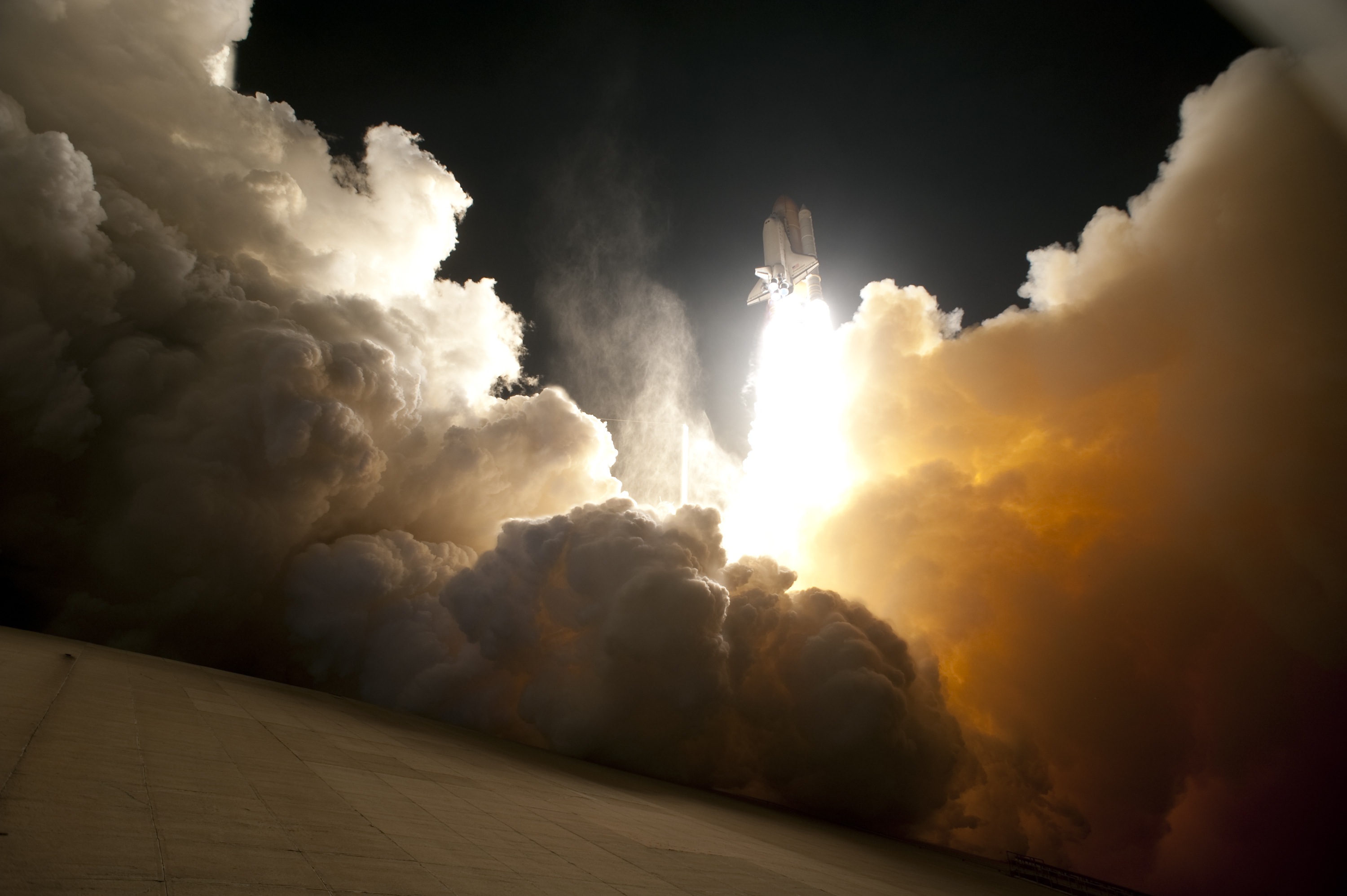
Space shuttle Endeavour taking off.
Credit: NASA
The basic premise is: set things on fire explosively, direct the explosion away from where you want to go, and conservation of momentum does the rest. Why conservation of momentum? In the greater scheme of the universe, momentum must be conserved. It cannot be created spontaneously and it cannot be destroyed. It's one of those immutable laws. So, the only way to move is by exchanging momentum with something else. Say you sit on a particularly good wheeled chair. If you throw your heavy, laptop-filled bag away in front of you, the chair will move backwards a bit. Assuming you were stationary to begin with, when you threw the bag, you imparted it with momentum. (Momentum, by the way, is just the product of mass and speed, nothing too mysterious.) But momentum has to be conserved, so to compensate, you and your chair moved backwards with momentum exactly equal and in the opposite direction to that of the bag. Of course, this example isn't perfect since the wheels of the chair are also slowed down through friction, but ideally, your mass plus the chairs mass, multiplied by how quickly you moved backwards, would be equal to the mass of the bag multiplied by the speed at which you threw it.

In a frictionless environment, such as space, throwing something as small as an apple (also, congrats on smuggling an apple onto your space station) would propel you backwards noticeably. This is what most fuels do, in essence. They throw something backwards as hard as they can so that they can go forwards.

Commonly, rockets (that take off from Earth) have two tanks, one filled with liquid oxygen and one with liquid hydrogen. When combined they react very quickly and exothermically* which leads to a rapid release of energy and water. Because water is what you get when you put a lot of hydrogen near a lot of oxygen. (Really, putting a lot of hydrogen near a little bit of oxygen also ends explosively.) And water is what you get when you burn hydrogen (and if you're wondering "burning" something is just a colloquial way of saying "oxidise rapidly" or "react with oxygen"). The good news is that launching rockets doesn't have a large carbon footprint (because no carbon is involved in the actual launch process); building them is another matter.

Back to the point, oxygen/hydrogen are used as propellants because they give off the most energy of any practical combination of chemicals. Somewhere, probably on the internet, I once came across a table of effectiveness of different fuels. I would love to link to it now, but that was several years ago and I could not find it again. The closest I got was this table in Wiki, which is more a table of different propulsion methods.

* Exothermic reactions are reactions that release energy. Conversely, endothermic reactions consume energy.

Ion drives

Ion drives are a term that gets bandied around in both science fiction and "future of science" type discussions every now and then. There are actually a few different ways to build an ion drive (see aforementioned table in Wiki for details). The basic premise is that instead of using a chemical reaction to push something out the back of the spacecraft, you use electric fields to push ions (atoms with either a positive or negative charge; positive one are being pushed out, usually) away from the spacecraft. (Which you might have ionised with a laser or similar.)

The main downside is that the accelerations generated are fairly low, so it would take a long time to get anywhere. Unlike chemical rockets, however, ion drives would generally take a lot longer to run out of fuel. It might also be possible to scoop up stray atoms from space, ionise those and use them as propellant (this part, completely untested right now; ion drives in principle have been constructed though). So, although you start off slowly, if you keep accelerating constantly over a long period of time, the ion drive could leave you with considerable speed by the time you arrive. On the other hand, now that I think about it, they probably wouldn't work for decelerating suddenly, nor for manoeuvring.

Really, ion drives are just another way of throwing things backwards to make you go faster.

To read more, go look at the NASA Deep Space 1 page, a mission powered by an ion drive.

Solar sails

Solar sails, on the other hand, work on a slightly different principle. Instead of bringing fuel along on the trip and throwing it out, a solar sail works, well, similarly to a sail on a boat. You throw your fuel at it to make it go forwards.

Just as wind pushes boats along by the sails, so does light push solar sails along.

Light can't push things! I hear you exclaim. (Or is that the sleep deprivation talking?) Actually, yes it can. Photons, particles of light, have a momentum associated with them. It is calculated a little differently to momentum for objects/particles which do have mass; instead of mass times velocity it's Planck's constant divided by wavelength (exactly why is a bit complicated. Quantum is involved).

So a solar sail works by "collecting" the momentum of the light that hits it. The source of that light could be the sun or it could be a giant laser. The advantage of the sun is that it's free, but the disadvantage is that sunlight is a little dilute from an Earth's distance away so the acceleration would be fairly slow. A laser would start off more concentrated and impart a lot more initial acceleration, but once the sail was out of range you'd be left with a giant laser and nothing to point it at. (I suppose some people wouldn't see this as a disadvantage.) Perhaps some combination of the two would be best, but in the real world, we're not up to that sort of testing.

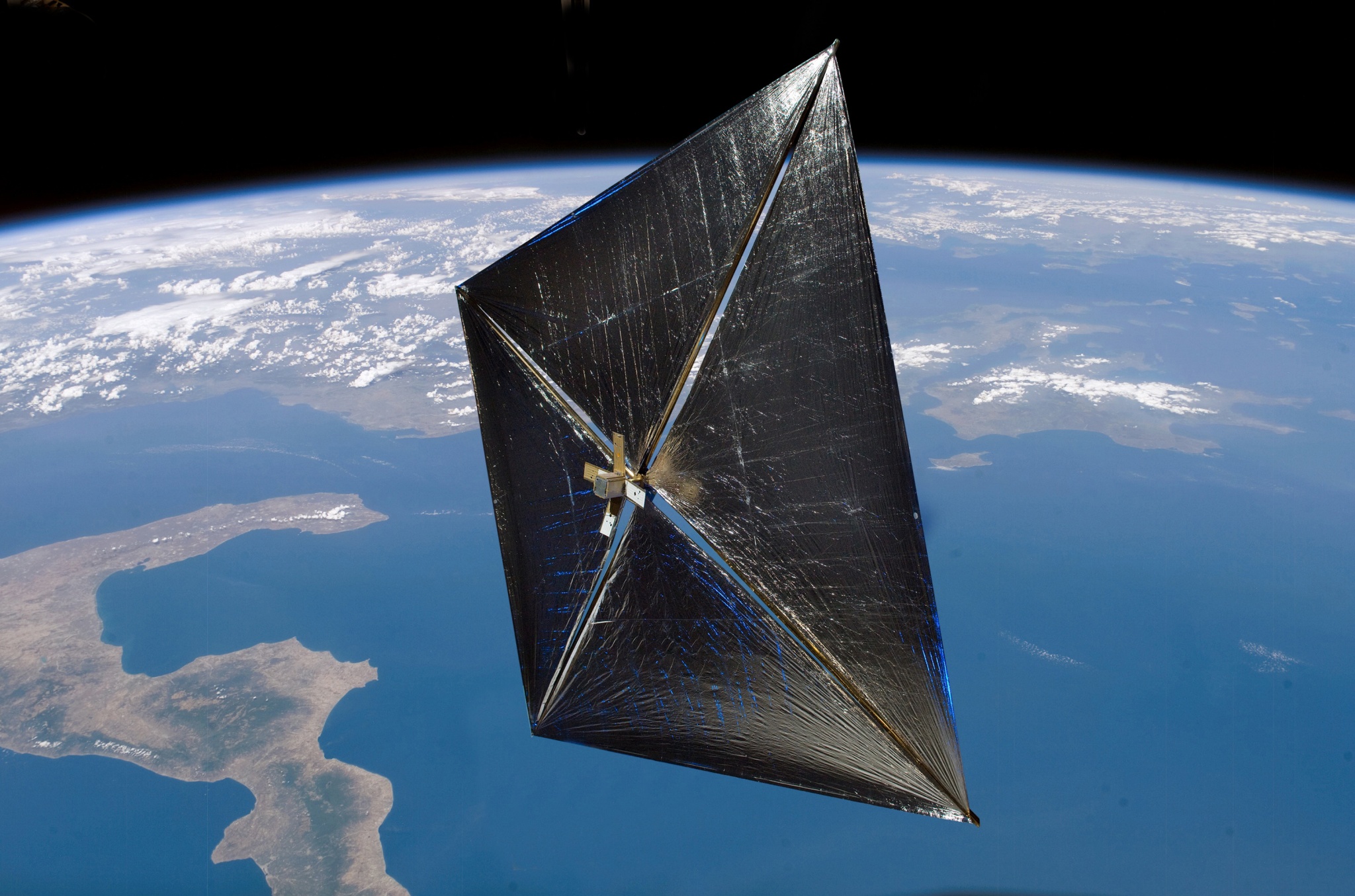
Below is a picture (CGI sadly. I so wanted this to be a photo taken from the ISS or something) of NASA's NanoSail-D which they recently deployed. From memory, there was a bit of trouble getting the thing to unfurl properly (definitely can't launch with those sails fully extended) and then after a few days it magically worked. Here is more info from NASA.

NanoSail-D. Pic from NASA via APoD.


So there you have it, a few ways for your characters to travel mundanely, mainly within a system.


Wednesday, October 12, 2011

Astronavigation

Rimmer from Red Dwarf. He went mad in his
astronavigation exam and wrote "I am a fish"
four hundred times. It's not actually that hard.
If you want to include space travel in your story, then at some point, some of your characters will need to know about navigating through space. Even if a computer/AI does the actual controlling of the ship, someone probably needs to know the basics. Unless, of course, you want all your characters to fail astronavigation (repeatedly) like Rimmer from Red Dwarf. Not to mention, computerfail is a common plot device.

To the stars and beyond*!

*Not actually very far beyond.

The Stars

The first, conceptually basic method is by looking at the positions of the stars. This is a bit different to sailors navigating by the stars.

The Earth rotates about its axis once ever 24 hours. That means over the course of a night, stars appear to move across the sky; the stars aren't actually moving, it's the planet. But if you know the time and where the stars should be at that time, you can use that information to navigate fairly accurately. Even if you don't have precise instruments, the Southern Cross or the North Star can point you in the general direction of south and north. (These two point to or are located close to the southern and northern celestial poles, respectively. The celestial poles are located along the line where the Earth's rotational axis extends into space. As stars move across the sky at night, they will appear to circle one of these points. Unless you're at the equator, in which case they will move straight from east to west.)

If you're in interstellar space, the rotation of the Earth is supremely irrelevant. However, if you know the exact locations (in the galaxy) of at least three stars and can measure their directions relative to you with precision, then you can use that information to triangulate your position.

The tri in "triangulate" gives you the hint that you only need three stars to be able to pinpoint your position but, because there's only so much accuracy with which directions can be measured, the more stars you use, the more accurately you can determine your location. Another good reason to have more than three reference stars is so that you (or, y'know, the computer) can still navigate when you're on the other side of the galaxy and can't see them any more.

As far as re-identifying stars goes, the spectra of normal regular stars are a bit unique. That is, the temperature of the star combined with the exact concentrations of various elements that make up the outer layers of a star are like a fingerprint and (usually) don't change very rapidly. So if you find yourself coming out of a mysterious wormhole, and you have a spectrograph on board, you could take some spectra, find enough reference stars and get the computer to work out your location for you. Yay.

(One final note: you would want a computer to take all the spectra and do the comparisons. Really, you would. I mean, the calculations of stellar positions are at least possible by hand but if you don't already know what stars you're looking at, there is no way you want to be comparing those squiggly lines by hand. Trust me on this.)

Astronavigation 101, unit 1: pass.

Speeding stars

OK, so what if you know more or less where you are, but you're not sure how fast you're going? First, I need to point out that speed is entirely relative. It is impossible to determine an absolute speed for anything. On Earth, we tend to measure speed relative to the ground or, sometimes, relative to the wind. However, the Earth is spinning and hurtling around the sun at about 30 km/s. The sun is, in turn, careening around the centre of the galaxy at about 220 km/s. The galaxy is streaking through space at about 550 km/s relative to the CMB (cosmic microwave background radiation).

And yet, here we sit in front of our computers/smartphones/iPads and (with the possible exception of those of you reading this on your phone on public transport) it feels like we're sitting still.

The moral of the story is that we can't feel speed. What we can feel when we're on a moving train, or taking off in an aeroplane, or in a car going around a corner is actually acceleration. And it's not just us, Einstein's equivalence principle tells us that (assuming there isn't some window for us to look out of) there is no possible way to tell the difference between sitting still and hurtling through space at eight hundred kilometres per second. We can make devices that detect acceleration (those of you who have ever had a smartphone or a camera change the LCD image when you turned it sideways have experienced this). What we can't do is build a device to determine absolute speed. Because speed is relative.

The good news is, there are lots of ways to determine speed if we can see where we're going. On a train, for example, you might look out the window and get an idea. In space, at reasonably non-relativistic speeds, the stars don't stream past you like they do in that old Windows screen-saver. The distances between them are so vast that they would not appear to be moving at all.

This is where your trusty spectrograph comes in handy again. All stars have some recognisable elements in them. Notably hydrogen, helium, maybe oxygen and carbon but depending on the star, these may not be present in sufficient quantities for our purposes. Every element has a unique set of emission/absorption lines. The wavelengths at which these lines are found are based on quantum mechanics and immutable. However, when you're moving towards or away from the source of the lines (ie, a star), the Doppler effect will come into play. The Doppler effect makes the wavelength of light that you (or your spectrograph) see appear to be slightly longer or slightly shorter, depending on whether you're moving away from or towards the source. So you can take a spectrum, compare the wavelength of the hydrogen (for example) lines with what they should be, then you can work out how fast you're moving relative to that star.

Incidentally, this wouldn't be a particularly tedious calculation to do by hand, assuming you had reference tables at hand and maybe some sort of (basic scientific) calculator. Also, if you remembered the equation.

So there you have it. Your characters can now work out where they are, and how fast they're going. Don't worry, though; they won't violate Heisenberg's uncertainty principle. They're not quantum particles. (And the uncertainty on the position will be too big.)

Astronavigation 101, unit 2: pass.


Wednesday, June 22, 2011

Artificial Gravity: Space Stations

So if you've paid any attention at all to the International Space Station (ISS)—or, really, Mir and/or Skylab—you will have noticed that the astronauts and cosmonauts up there float around in microgravity. Effectively, they're in free-fall and, although Earth is still exerting a gravitational pull on them, they can't feel it because they and the space station are falling around the Earth all at the same time (also known as orbiting).

However, in books and movies we see (on screen or in our mind's eye) people on space stations walking around and generally acting gravitationally enabled. A notable hard SF example that springs to mind is Clarke and Kubrick's 2001: A Space Odessey. (I say hard SF because soft SF isn't necessarily going to stick to physics as rigorously.) How do they get away with this? The short answer is by spinning them up. The long answer follows.

Spinning Around

You may have been to some sort of theme park which has a ride called the Gravitron or something along those lines. The ride I'm talking about is a flat cylinder where you get it, stand along one of the curved walls and then it spins up and, once it's at full spin, the floor falls away or something, and you discover that you are somehow being held to the wall. It's the fictitious centripetal force, combined with friction that is holding you up. Why is it fictitious? Long story, but the short version is: there are only four real forces (two if you count electroweak as only one, but let's not go into that today) and gravity is the only one we care about for today.

In our Gravitron ride, gravity is still pulling you downwards but the tendency of things to want to keep travelling in a straight line rather than around in a circle means that you are constantly accelerating and where there's acceleration, there's a force. There are a few technical details here about exactly which way the force is pointing and whether we should call it centrifugal or centripetal. The centripetal force is whatever force is keeping you going around in a circle. In the Gravitron, the wall pushing on you stops you from flying out of the ride. In space, the Earth's gravity keeps you in orbit and stops you from drifting off. The centripetal force is the force that's pushing you outward; it's the force pushing you into the wall and the force that gravity needs to balance to keep you in orbit. It's easy to see why these two are often confused or used interchangeably.

When something is travelling around in a circle, the acceleration it feels is given the square of the velocity divided by the radius of the circle:

And if you recall, we were able to characterise gravity on the surface of a planet by the acceleration due to gravity. On Earth, acceleration due to gravity, g = 9.8 m/s2. So if we equate these, we can work out how fast we have to spin something to make it feel like we're standing on Earth.

Knowing the velocity, how fast the edge of our space station is moving around, isn't that helpful for getting an idea of how much we have to spin it up. The period, how quickly it completes a full revolution, is more helpful:

T is the period.

So now, let's suppose we have two bits of space station joined by a kilometre-long cable and we want to set it up so that we have Earth-strength gravity in the two end capsules when they spin about the centre of the joining capsule. How fast would it need to spin? Plugging the numbers in, and remembering that there are 1000 metres in a kilometre we get... a period of 63 seconds. The whole thing would have to complete an entire revolution in just over a minute which, considering the distance each capsule travels in that time is about 6.3 km (the circumference of the circle is 2πr) is incredibly fast. At any given time it's linear velocity would be almost 100 metres per second which is more than 350 km/h. Whoosh!

Admittedly, once we got up to that speed it would be much easier to maintain it, but it would still be difficult to access the capsules. A better setup would be to have a tube or tunnel connecting them. That way, spaceships could dock at the centre where to match (angular) velocities with the eye they would only need to rotate once a minute (since the period is 63 seconds everywhere because it's all connected). Spinning a ship around once in a minute is much easier than a kilometre-long space station.

Of course, if you look at the last equation there, the bigger the radius of the circle, the longer the period but even then we quickly run into engineering problems. Not that our two capsules aren't engineering problem enough.

Reducing the gravity requirements doesn't help enough either. If you only require half Earth gravity, then our capsules still have to complete a revolution in a minute and a half and the speed becomes 250 km/h . Moon gravity? Two and a half minutes and 150 km/h. Maybe that last one is manageable, but are the health benefits great enough to justify the cost of setting it up as compared with a non-spun space station? (I have no idea; no one's lived on the moon for a significant amount of time yet to find out.)

Another practical problem is maintenance. On the outer edge of one of the capsules (or giant ring, as Clarke used in 2001), a maintenance worker would feel as though they were hanging from the capsule with their feet hanging down into open space. Same thing on the sides except that they'd be falling towards the outside or "bottom" side. This sets up some pretty dangerous working conditions. Add to that the fact that the space station is hurtling so fast the stars would be a spinning blur and I know what job I wouldn't want to have.

Reiterating: Why doesn't the ISS spin?

A few reasons, mostly technological:
  1. It would have to spin pretty damn fast, and we just don't have the technology to do that well yet
  2. It's powered by solar power and the panels are set up so that they're always facing the sun. This is harder to do if the whole thing is spinning; another technological limitation
  3. Even if we could get it spinning fast enough, ignoring the above, we only just finished assembling it which means we would only just now be spinning it up anyway (it would be a lot harder to assemble a space station that was constantly rotating.

Wednesday, June 1, 2011

Lifting life off Earth

A friend suggested I blog about getting a biosphere off Earth and onto another planet (within the solar system). This is a bit of a challenge for me since, if I am anything, then I am not a biologist. As a result, I am going to focus on the transportation logistics more than what, specifically, we would need to get to said other planet.

However, if you are interested in the what and how to maintain it once there, I strongly suggest reading these two posts by Patty Jansen: So you want to be a space farmer (part 1) and Growing crops in space (part 2). She has a background in agricultural science and hence is significantly more knowledgeable than I on the matter.

Getting off the ground

Lifting anything off Earth into orbit requires a large chunk of energy. Exactly how much depends mainly on the weight (and a little bit on the size, in the sense of how big—and hence heavy—the spaceship doing the lifting needs to be). To get something off Earth (pretty much to anywhere further away than the moon, though it's not that different for the moon either), we need to give it enough energy to overcome the energy of Earth's gravitational pull.

Some basic terminology first:
  • Kinetic energy is the energy something has due to its movement. It mostly depends on how fast the object is moving, but also on its mass. A faster object will have more kinetic energy, but of two objects moving at the same speed, the heavier one will have more kinetic energy. The formula for kinetic energy is
  • Potential energy is stored energy that has the potential to turn into a more directly useful form of energy. For example, if you lift a brick off the ground, you're giving it the potential to turn gain kinetic energy when you drop it. In fact, thanks to conservation of energy, the amount of potential energy you add to it when you lift it up will be equal to the kinetic energy it gains as it falls and just before it hits the ground. What we are interested in is gravitational potential energy. You can have other types, like spring potential energy, which is the energy stored in a spring when it is stretched or compressed. The general formula for gravitational potential energy is
  • Conservation of energy is the law that says energy cannot be created or destroyed but can only change forms. Hence, potential energy can be transformed into kinetic energy and vice versa, but neither can appear out of nothing. (On a macroscopic level. Things get a little bit more complicated on a quantum scale, but that's not relevant here.)
  • Escape velocity is the velocity required to get something off the surface of a planet. It's basically the amount of kinetic energy required to overcome the potential energy stored between your object and the planet. It's found by equating the kinetic and potential energies above (ignore the minus sign, it's just a convention). Doing that, the mass for the object, m, cancels out and we find a common escape velocity depending only on the mass of the planet, M, and the radius of the planet, R. (This is assuming we're trying to get off the surface. For other distances, replace radius with distance from the centre of the planet.) Incidentally, Earth's escape velocity is about 11 kilometres per second (more than 40 000 km/h). The general formula for escape velocity is


OK, so that's the basics. To get something off the ground and into space, we need to make it go pretty fast to overcome Earth's gravitational pull. However, we don't do it all in one go; it's just not logistically a brilliant idea. Among other things, the faster you go within Earth's atmosphere, the greater air resistance (the friction air exerts on the spaceship) is. This is why rockets usually have stages. The space shuttles, for instance, had two initial boosters to get it off the ground, another large rocket to get them out of the atmosphere, then some small rockets which stay attached to the shuttle (the others are discarded when the fuel is used up) for orbital manoeuvring and coming back down to Earth. Here is an infographic from Wiki.

The tricky thing, when we're talking about getting the elements of an ecosystem off the ground, is how much they weigh. I don't know of any reason why crops wouldn't be transported as seeds which, compared with plants weigh a lot less and take up a lot less room. Depending on where you're taking them, giving them enough water and the right kind of soil is likely to be much more of a problem. In most cases, I think it would be best to mine the necessary water from whatever nearby source you can (the rings of Saturn, mayhaps?) and possibly ditto with the minerals needed for soil, but see Patty's posts linked to up top because I'm far from an expert.

Animals, however, would be a lot harder. With our current technology, we can't really transport a bunch of animals in foetus form and then grow them when we get to wherever like we can with plant seeds. Animals weigh a lot and eat a lot and produce a lot of waste products. That sort of thing (while making good fertiliser for our off-world plants) would be very difficult to transport.

To put this in a bit of perspective, let's look at the weight and lifting capacity of the space shuttle (which have almost all been decommissioned now with only Atlantis having one mission left). According to Wiki, an empty space shuttle weighs close to 70 000 kg, has a maximum payload weight of 25 000 kg and the payload bay is 4.6 times 18.3 metres (doesn't say how tall, but let's assume tall enough for cows). Twenty-five thousand kilograms may seem like a lot, but remember that the shuttles have been used to lift several bits of International Space Station into orbit. So a cow weighs around 500 kg, depending on the type, but let's run with this number because it's round and convenient. That means theoretically, we could squish 500 cows into a space shuttle and lift them into orbit. Well, that's not very helpful because we're ignoring all the food and water they'd need. I also think they wouldn't quite actually fit into the payload bay. Let's say cows need a metre by two metres of space to stand around in. That leaves us with only around 70 cows in our cargo bay. Well, OK, that means we could use the rest of the space for that pesky food and water I keep mentioning...

Let's say a cow eats 50 kg of hay a day... WolframAlpha tells me that hay weighs around 380 kg for a cubic metre (when pressed, because anything else would be silly in this context...) Our 70 cows would eat more than nine cubic metres of pressed hay a day and since getting to anywhere other than the moon takes at least months... we quickly run into problems being able to carry enough, even without worrying about the water.

It's fair, at this point, to mention that the space shuttles were obviously not designed to carry cows anywhere. They were designed to carry bits of ISS and other space-based equipment into orbit and not further. But in terms of lifting power they and the Soyuz rockets are all we've currently got. Also, cows probably aren't the best thing to start off carrying to other planets, I was just trying to make a point.

It takes a lot of energy to launch anything into space, let alone an ecosystem. Unlike the ISS which was built by launching bits up in manageable chunks, it's not really practical to do that with live animals. Flora poses less of a challenge and the difficult part becomes setting it up sensibly on the other end. Also the part where we haven't actually sent people on very long space flights yet.

More on this topic at a later date.

Sunday, March 20, 2011

Space Elevators: Where to put them

The purpose of this post is not to exhaustively describe what a space elevator is and how it is intended to work. There are many other sources for that information. Instead, I intend to focus on what planets are suitable for building a space elevator on and which aren't and why.

WARNING: This post contains maths that requires a proper calculator.

Briefly: What is a space elevator?

A space elevator is a proposed system for (mostly) getting things into orbit without using rockets. The idea is that once it's established, the cost for going into orbit drops dramatically because you no longer have to use rockets (which are expensive and generally involve some disposable element).

Many different types of space elevators have been proposed, not all of which necessarily reach the Earth's surface. Instead they start part way up or outside of the atmosphere. This has the benefit of avoiding annoying atmospheric effects (wind, drag) and makes them lighter. But I'll leave researching what type of space elevator best fits into the world being created as an exercise for the reader. What I am going to talk about is what and where is it physically possible to place an elevator and more or less ignore engineering constraints (set it far enough in the future and, as Arthur C Clarke said, you can have technology advanced enough to seem magical).

There are two ways of making a space elevator stay up. You can have a rotationally supported one or a gravitationally supported one. In the case of lifting payloads from Earth into orbit, a space elevator would almost certainly be rotationally supported. One designed for getting things to and from the surface of the moon, however, would more likely be gravitationally supported. What are the differences?

Rotationally supported space elevator

The principle for a rotationally supported space elevator is to have the force of gravity pulling it down to Earth exactly opposed by the centrifugal force of it spinning around in its orbit. Since we also generally want it to remain above above the same point on the surface of the Earth (so we can connect the ground to the top of the elevator with a cable, for example), the centre of mass of the elevator needs to be at the height of geostationary orbit. Geostationary orbit just means that it orbits at the same speed that the surface of the Earth rotates and hence it remains above the same surface point of the Earth all the time. Also, this point has to be along the equator or the stationary part of geostationary won't work. For example, a lot of communication satellites live in geostationary orbits which makes it easier for receivers on Earth to talk to them since they are always in the same place. And in the case of TV broadcasting, you generally only want to broadcast at a particular region, so there is the benefit of always being able to do so.

A quick note on how to calculate the height of geostationary orbit, since I want this guide to be generally applicable, not just for Earth. For geostationary orbits, the acceleration due to Earth's gravity, g,  (or the gravity of whatever body we're interested in) needs to cancel out the centripetal acceleration, ac, from the circular motion of orbit.


So r is the distance from the centre of the planet in kilometres (just subtract the radius of the planet at the end to find the height above the ground if that's what you want to know), G = 6.67 × 10⁻²⁰ km3 kg-1 s-2 is Newton's gravitational constant, M is the mass of the planet in kilograms, T is the length of a day in seconds and π = 3.14 is a constant. We can now rearrange this:


And it becomes just a matter of plugging in the right numbers. We can now calculate that the height of geostationary orbit for Earth is about 36 000 km. Out of interest, for Mars, the height would be only 17 000 km thanks mostly to Mars' small mass.

You might have noticed earlier that I said the centre of gravity of the space elevator needs to be at geostationary orbit. This just means that half the mass of the elevator needs to be below the geostationary height (so, mostly this would be in the cable since thirty-six thousand kilometres of cable, even if it's made of carbon nanotubes, is a non-trivial mass), and half needs to be past the geostationary height. The latter "counterweight" could consist of something like a docking station, space craft manufacturing plant or whatever you like.


Gravitationally supported space elevator

You probably wouldn't use a gravitationally supported space elevator to lift things off the surface of the Earth into space, but it would be ideal for lifting payloads from the moon. Because the moon is in a synchronous orbit (where it takes the same amount of time to complete a rotation as it does an orbit around the Earth), it spins too slowly for a sensible rotationally supported elevator. Plugging the numbers into the equation above, I get a geostationary height above the surface of about 87 000 km, more than twice the height for Earth. The moon's great and all, but it's probably not worth the price of twice the length of the cable just for getting rocks back to Earth. Not to mention any gravitational effects of the Earth on the elevator. For another example, let's work out the geostationary height for Ganymede, the largest moon of Jupiter. Plugging in all the numbers, I get about 43 000 km above the surface of Ganymede. Sure, this isn't a much longer cable than for Earth, but at the distance you start getting annoying gravitational effects from Jupiter and other planets screwing you over. Basically, you couldn't make it stable.

The solution to this dilemma is not to try to make a rotationally supported space elevator, but to go for a gravitationally supported one instead. A gravitationally supported space elevator has its centre of mass at a Lagrange point, usually L1, which is sort of a gravitationally neutral location. So for the moon, the centre of mass would go at the point where the force of Earth's gravity is exactly balanced by the force of the moon's gravity. This point is called first Lagrange point of the Earth-moon system (after the guy who worked out the maths).

Thanks to the moon's synchronous orbit, the point on its surface that is closest to Earth doesn't change. Hence, a gravitationally balanced space elevator would automatically remain stationary relative to the surface of the moon, which is handy when you're running a cable between them.

How do we calculate how far from the moon the Lagrange point we're interested in? Well, we want the point where the acceleration due to each Earth and moon cancel out BUT we also have to consider the rotational acceleration due to the circular motion of orbit. (Remember, even though the space elevator is attached to the moon, the fact that it's suspended between moon and Earth means that it's also going around the Earth).


r is the distance from the centre of the moon to the Lagrange point, m is the mass of the moon, M is the mass of the planet, d is the distance between the planet and the moon and T is the time it takes for the moon to complete an orbit (hence the time taken for the space elevator to complete an orbit since it's attached to the moon). It's not actually possible to rearrange this into something nice. If you really need to do this for a general planet, I suggest going to WolframAlpha.com and typing in:


Solve[-((G m)/r^2) + (G M)/(d - r)^2 == ((2*3.14)/T)^2 (d - r), r]

But with the appropriate values in place of all the constants (in km and kg if you use the G I gave above). I personally did the same in Mathematica (which is also made by Wolfram and has the same maths engine as Wolfram Alpha). However, if you're interested in doing a calculation yourself, with some approximations to simplify things, this website (which I came to via Google) seems to do a reasonable job. It also explains the maths a bit more than I have.

So anyway, throwing appropriate numbers and making a computer solve it, here are a few results:
  • For the moon, the distance from the surface to the first Lagrange point is about 56 000 km.
  • For Ganymede it is about 29 000 km from the surface. 
  • And because I feel like it, it's 8600 km for Io.
Clearly this is much more economical in terms of how much cable is used. And because you're taking advantage of the largest gravitational well in the vicinity, you don't have to worry too much about other effects mucking up your elevator. (OK, in the Jovian system you'd probably have some complications thanks to the other moons, so I'm not sure you'd necessarily want to go down that path, but it would work well for a gas giant with only one large moon and the rest small.)

You can also put a gravitationally supported space elevator on the far side of the moon at what is known as the second Lagrange point. This post is getting a bit too long to go into the details, but the height of such a space elevator would be approximately the same as if it was at the first Lagrange point so long as the satellite is much smaller than its primary. This isn't true of the moon (but is true of the Jovian moons) and it turns out that the height required for that space elevator's centre of gravity would be 67 000 km.

Summary

As we've learnt, there are a few considerations we need to take into account when placing a space elevator:
  • Location
  • Start and end points
  • Type of body it services
The last consideration ends up informing the first two to a great extent. So if we have a planet orbiting its sun in a similar way to the Earth, we will use a rotationally supported space elevator which will have to be placed along the planet's (rotational) equator. If we have a moon in a synchronous orbit, we want to use a gravitationally supported space elevator which will be placed along the straight line connecting the moon's planet and the moon.

Everything else is just a matter of engineering. ;-)

LinkWithin

Related Posts Plugin for WordPress, Blogger...