Showing posts with label Saturn. Show all posts

Friday, October 21, 2011

Bunch of links, mostly outdated

First up, square Earth anyone? Forget realism, let's just have a think about what an Earthlike planet would be like if it were a cube. Puts me in mind of the planet builders in Hitchhikers' Guide to the Galaxy. Brought to you by Discovery News.

Second, the Planetary Habitability Laboratory talks about brightnesses of the various planets in the solar system and also of exoplanets. An interesting read, particularly if you enjoyed my old How Bright is the Night? post.

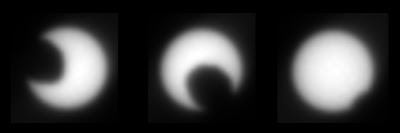
Martian moons eclipse the sun in these NASA photos from the Opportunity rover:
Credit: NASA/JPL/Cornell

Enceladus pics from Cassini. Enceladus is one of Saturn's moons, most famous for it's ice geysers.

Proposed space robot to cannibalise old satellites which have previously been boosted up to "graveyard" orbits. Many mentions of zombie satellites and grave robbing associated with this one ;-p . From New Scientist.

And finally, laser driven fusion in California. From New Scientist again.

Happy weekend, gentle readers!


Sunday, July 17, 2011

A correction: You can't fall off Pan.

While writing a story which happens to be set on Pan, one of Saturn's moons, I realised that I had made an erroneous statement in a past blog post. Of course, I had to correct it.

In that post I made a passing comment that on Pan, the gravitational force of Saturn is greater than that of the moon itself. That statement was true. However, I went on to say that on the Saturn-side of Pan, you'd fall off because the gravity of Pan wasn't strong enough to overcome Saturn's gravity. This last part isn't quite true.

If you were on Pan, despite its weak gravity, you would be hurtling around Saturn at the same speed that Pan does, which means that you would automatically be going fast enough to stay in orbit (your centripetal acceleration would be balancing Saturn's acceleration due to gravity), no matter which side of Pan you were on. Admittedly, the low escape velocity (about 25 km/h) and the slight difference in gravitational pull from Saturn between the near and far ends would make it easy to fall off the planet and slowly spiral in towards Saturn, but you certainly wouldn't be falling upwards.

The more accurate statement I should've made was that if you were floating around in the vicinity of Pan's orbit and Pan came past you, its gravity would not be strong enough to pull you in over Saturn's gravity. No matter how close to it you were (even if you could touch the surface), if you were not already moving along with it, then Saturn's gravity would win out and you would fall towards Saturn, rather than towards Pan.

The original post has been amended to reflect the above correction.

Wednesday, June 29, 2011

Weird Worlds: KOI 730

Before I get onto the main part of the post, I'd like to apologise for the lack of short posts over the weekend but life's been hectic. Part of the reason for this is that I'm going to be away at a conference next week. I plan to queue up a post to automatically go live next Wednesday since I'm not sure how reliable my internet access will be (also because I'm not taking my laptop and will be relying on Blogger's willingness to talk to my iPad, another thing of which I am not confident). On the other hand, said conference should give me lots of fodder for short, if not long, posts. So that's something to look forward to.

On to the topic of the week! Today I am going to be writing about another crazy exoplanetary system. However, unlike Kepler 11, this one isn't quite confirmed yet. KOI stands for Kepler Object of Interest and means that it's a system that the Kepler mission has identified as potentially containing some planets (four in this case) but they haven't been confirmed by other supporting data. Because science is all about the independent evidence. Nevertheless, this is a blog about science fiction, so we are quite at home to a little speculation. As such, please remember that all of the facts I state below about planets are as yet unconfirmed and haven't quite passed into official scientific cannon.

Kepler Object of Interest 730

First, some basic facts about the system. The star has designations KOI 730 or KIC #10227020 (one of these is easier to remember than the other, so guess which I'll be using). It is similar to the sun, but slightly larger and slightly cooler (by a couple of hundred degrees). It is more than 4200 light years away. The four planets are all very close in to the star, much closer than even Mercury's orbit in the solar system, making them conclusively uninhabitable to life as we know it.

Here is a screenshot illustrating the system from this Kepler Candidates Exoplanet app (not to be confused with the other one I've referenced before which was of confirmed planets, albeit otherwise pretty much identical).

The KOI 730 system side on (as would be seen by the Kepler telescope itself). Three of the four planets are visible in this illustration. The white line indicates the plane of the orbit (actually, it's a bit of a trail/track following each planet, but that doesn't come across too well side on). The planets are to scale relative to each other but not relative to their sun. Also, I don't think they get smaller when their on the opposite side of the star to the observer.


Resonating

That's OK, because that's not the particularly interesting thing about this system. The scientifically interesting thing is that this system is locked in an orbital resonance. An orbital resonance is when two planets (or moons) orbit in such a way that they both complete an integer number of orbits in the same length of time. (An integer is a whole number such as 1, 2, 3, etc.) Some examples from the solar system are the Jovian moons Io, Europa and Ganymede, which are locked in a 1:2:4 resonance of orbital periods. This means that Ganymede's and Europa's periods (how long it takes them to complete one orbit around Jupiter) are respectively four times and twice the period of Io. (Sometimes this might be written 4:2:1 indicating that Io makes completes four orbits in the time it takes Europa to complete two and Ganymede to complete one. It depends on the convention being used.) Another example is Neptune and Pluto locked in a 2:3 period orbital resonance (so Neptune completes three orbits in the time it takes Pluto to complete two). A different sort of resonance is that experienced by Mercury, which completes two orbits in the time it takes to make three revolutions (so three Mercurian days are equal to two Mercurian years).

Orbital resonances can either make the system, or more specifically, the bodies involved in the resonance, stable or unstable. Yep, I know that sounds like they don't do anything because both possible outcomes are covered, but that's not true. What I mean is that if the resonance is unstable, you get things like gaps in the rings of Saturn (caused by some of Saturn's moons). On the other hand, the Jovian moons I mentioned before are in a stable resonance and Mercury is in its spin-orbit resonance rather than being tidally locked thanks to the gravitational tugs of other planets.

Which brings me to some of the effects of orbital resonance. Bodies locked in an orbital resonance exert a greater gravitational influence on each other than they otherwise would. For example, when Ganymede, Io and Europa are all lined up (Io and Ganymede on one side, Europa on the opposite side of Jupiter), they all experience a heightened tidal effect as the gravitational pulls of the other two planets add directly to the pull of Jupiter, causing additional friction in the planet interiors (and, for example, contributing to Io's volcanism).

Back to KOI 730

So I mentioned that KOI 730 has four planets and that these are locked in an orbital resonance. According to the first articles I read about it (in New Scientist and somewhere else I can't recall) and the original paper (section 5.3 is specifically about KOI 730) the resonance scheme for KOI 730 is 6:4:4:3. Notice the two fours there? That is why there were a spate of pop science articles about this system. Those two fours indicate that two of the planets are in the same orbit since orbital periods depend only on the star's mass and the distance of the planet from the star.

Two planets in the same orbit. They're located at two of the Lagrange points you might remember me mentioning a while back. Due to their positioning, they are known as trojan planets after the trojan asteroids that follow and precede Jupiter and Saturn in these same Lagrange points. The two planets are 118ยบ apart along their orbit and are slowly, over millions of years, edging towards each other (at least; the authors of the paper speculate that they might last billions of years).

But yes, eventually they will collide.

The configuration of these two planets, KOI 730.02 and KOI 730.03, is such that they form an equilateral triangle with the star as the third point. Unfortunately, this puts the second planet as far away from the first as the sun, making it about a quarter of the height of the full moon as seen in Earth's sky. It would also always be about two-thirds illuminated and it wouldn't move around in the sky relative to the stars. If the planets were tidally locked to their sun then the other planet would stay locked in the same position in the sky while the stars moved around it, which would be fairly cool to observer. (Just think of the mythology that could arise surrounding that set up!)

It also bears mentioning that one of the theories of Earth's creation has two proto-planets forming at Lagrange points like these trojan planets. The other proto-planet, usually labelled Theia, and proto-Earth, inched towards each other and eventually collided, merging and splashing, so to speak, to form Earth and moon as we now know them.

Later, when I googled this again in preparation for writing this blog post, I found this article from Sky & Telescope, which features one of the authors of the original paper saying that further analysis of the data suggests a 8:6:4:3 resonance might be more fitting. This turns one of the trojan planets into a different orbit, farther out, and makes the system less exciting. I mean, a system in which all the planets are in resonance with each other is still pretty notable, but it's just not quite as imagination-grabbing as TWO PLANETS IN THE SAME ORBIT. Although, there's still potential for interesting story-science there when the planets line up and whatnot.

Oh well, co-orbiting planets in KOI 730 or not, the concept was around before this paper was written and there's no firm reason to not suppose we couldn't have trojan planets somewhere else. Maybe a gas giant with, instead of trojan asteroids following/leading it around, a full-sized terrestrial planet. Or two terrestrial planets sharing a habitable orbit...

The possibilities are endless. And science is cool even when it's speculative.
Wednesday, May 18, 2011

Ringing Tides

Saturn has rings. So do all the other gas giants in the solar system. Although we have no ability to confirm whether extra solar gas giants also have rings, chances are some do. Where do these rings come from? Why doesn't Earth have any?

Terrible Tides

The answer to the first question, as you may have guessed from the title of this post, is tides. Last week I talked about tides causing satellites to be locked in synchronous orbits around their primaries (recommended reading if you haven't already). The thing to remember now is that the side of a satellite closest to its primary experiences a stronger gravitational pull than the far side. The difference in forces depends on the mass of the primary, the distance of the satellite from the primary and the size if the satellite.

If you recall from the introduction to gravity post, the force of gravity exerted on a mass, m, a distance, r, from another mass, M, is given by:


If we take M to be the mass of the primary and then consider two smaller masses m1 and m2, one of which is located at r1 on the near side of the satellite, and the other at r2, the far side of the satellite. If we assume our two small masses are equal (you can think of it as considering a kilogram of moon rock in two different locations), then the ratio of the forces experienced by them will be:


That equation might seem a bit abstract, so let's look at it in the context of a few real examples.
  • Io is 4.217⨉108 m from Jupiter, on average, and has a radius of 1.8⨉106 m. The pull of Jupiter's gravity on the far side is just 99.15% that on the near side.
  • Doing a similar calculation for the moon (orbiting the Earth), we find far side gravity 99.10% that of near side.
  • Mercury orbiting the sun has far side gravity 99.99% that of the near side since, even though it's very close to the sun, it's a lot further away than the moons are from their primaries.
  • Let's look at Saturn now. Not one of Saturn's moons, but Saturn's rings. The main rings, according to Wiki, extend between 66 900 km and 480 000 km above the centre of Saturn. The gravitational pull from Saturn on the far edge is 83.6% that of the near edge. Compared with the solid bodies discussed above, that's a much more significant difference.

It is now possible to come up with a scenario where the pull of the primary on the near side of the satellite is bigger than the pull of its own gravity. Let's look at one of Saturn's tiny moonlets. Pan orbits inside Saturn's A ring (towards the outer edge of the ring system). It's radius is only 14.2 km and it weighs 5⨉1015 kg, making it's surface acceleration due to gravity 0.0016 m/s2 (less than a ten thousandth of a percent that of Earth's). By comparison, the acceleration due to gravity from Saturn at that distance is 2.12 m/s2, more than 1300 times greater. Clearly, Pan could not have formed where it now orbits since it's very much held together by chemical forces, not gravitational.

EDIT: Correction made to the above paragraph. Previously I had stated that if you stood on the Saturn-side of Pan you would fall up into Saturn. This is not true. The more accurate statement I should've made was that if you were floating around in the vicinity of Pan's orbit and Pan came past you, its gravity would not be strong enough to pull you in over Saturn's gravity. No matter how close to it you were (even if you could touch the surface), if you were not already moving along with it (and hence had enough centripetal acceleration to balance Saturn's gravitational acceleration), then Saturn's gravity would win out and you would fall towards Saturn, rather than towards Pan.

Making rings

Even further out than the point at which the primary's gravity becomes stronger than the satellite's gravity, the primary's gravity will start to deform the satellite. This effect is not dissimilar to the tidal bulge the moon causes on Earth. It is also part of the reason the Galilean moons of Jupiter are tidally locked.

(Interesting fact: over time, the tidal bulge of the Earth is causing the Earth to slow down its period of rotation since the change in shape (which isn't constant, remember, as the moon's orbit is much slower than the Earth's day) alters the way it rotates (catch phrase: conservation of angular momentum). The drag of the water in the tidal bulge is also pushing the moon back, slightly, in its orbit. Eventually (and we're talking a pretty long eventually) the Earth-moon system will settle into a mutually tidally locked rotation with the moon significantly further away than it is now. Here is an interesting article about it from Space.com.)

In the case of a satellite which is reasonably fluid and only being held together by its own gravitational pull (called self-gravity), then there is no reason for it to stay together as one lump. It will disintegrate because the part closer to the primary wants to orbit faster than the part further away. A disintegrated satellite will turn into a system of rings around the planet. The point at which this happens is called the Roche limit and the equation which tells us the distance from the primary of the Roche limit is:

d is the distance of the Roche limit from the centre of the primary,  R is the radius of the primary and M and m are the densities of the primary and the satellite respecively.

You'll notice that there are densities in the above formula. The density of the satellite is relevant because it's a measure of both mass and gravity (since we're talking satellites that are only held together by their self gravity and not chemical bonds). The density of the primary comes into it because we need to know the mass (which is proportional to radius cubed times density and R will becomes cubed if you move it inside the brackets) but the radius is also relevant because if the Roche limit is inside the primary, we can pretty much ignore it.

Of course, most satellite aren't balls of dust but are held together by other chemical forces (like Pan is). For example a rock on Earth isn't held together by gravity, it's held together by the chemical bonds between the different atoms and molecules inside (slightly different bonds depending on it's composition). Similarly, once a satellite has formed (outside of the Roche limit), then it probably goes through other experiences (such as tidal heating) which fuse it into a more solid lump. If it then wanders inside the Roche limit, it's not going to dissolve just because it couldn't've formed there. Pan and a handful of other moons in Saturn's rings prove this point. So what's the Roche limit for satellites held together by more than just gravitational forces? It sort of depends on the forces, but Roche himself derived an approximation for fluid satellites which deform a bit before they break up due to the tidal forces:


If you're wondering whether rock counts as fluid, it does. Everything will deform a bit under sufficiently strong forces.

So this last equation is the point at which a satellite will start to break up if it spirals in too close to its primary. For Earth-moon system, the moon will disintegrate if it wanders within 11 000 km. Luckily for the moon, this isn't likely to happen until the sun end's it's main sequence life.

LinkWithin

Related Posts Plugin for WordPress, Blogger...