Showing posts with label stars. Show all posts

Friday, July 12, 2013

The Colours of Space (and Currents)

I recently read (well, listened to) The Colours of Space by Marion Zimmer Bradley. You can read my proper review over at my book blog,  but here I wanted to discuss some of the science that popped up in the book.

The title of the novel — The Colours of Space — refers to the stars being much more brightly coloured when seen in space, as compared with when seen from inside the Earth's atmosphere. (There's another reference there to plot elements as well, which I won't spoil, but I read the main reference as being to the multi-coloured stars.) The thing is, the phenomenon, as described in the story, is not entirely real. Yes, stars come in different colours, but those colours range from red to yellow, white and blue. There are no green stars. 

Interestingly enough, this isn't the first time I've encountered the idea of green stars in old science fiction. I understand where the misconception comes from — wanting to move through the optical spectrum with increasing temperature — but that's not quite how it works. Have you ever seen something glow "green-hot"? No. That's because green is in the middle of the visible spectrum and when it's the peak wavelength of a black body, the object is still emitting strongly in the neighbouring red and blue wavelengths which, when they're all combined, appear white. Similarly, blue stars (and red stars) aren't blue like the sky; they look pretty white because the star is still emitting strongly in the other visible wavelengths.

The Orion Nebula. Image credit: NASA/ESA
On the other hand, it's not unreasonable to think that Earth's atmosphere would bleach out the "real" colours of objects in space. After all, hills and whatnot in the distance often look paler than up close (because of water and often pollution in the atmosphere). But we can still see distinct colours of stars even from Earth and even, if you have binoculars or a good camera, the colours of nebulae (which are entirely prettier than mere stars). The constellation of Orion is a good example. Betelgeuse is a red giant (down the bottom of Orion if you're in the Good Southern Hemisphere), the Orion Nebula looks purplish (on the "handle" of the bit that looks like a saucepan from the south), the Horsehead Nebula (in Orion's Belt) is on the pink side, and the rest of the stars are yellow, white and blue but all look fairly white (from Earth AND space).

This reminds of another old book in which the underlying premise is based on now-outdated and hilariously erroneous science: The Currents of Space by Isaac Asimov. In that book a rather important plot element is that supernovae are caused by clouds of gas (the titular currents) drifting around space and every now and then changing the elemental makeup of stars enough to make them explode. (I think specifically it was clouds of carbon, but I don't have the book nearby to check.) We now know that this is mostly nothing like what causes supernovae.

There are two types of supernovae: core-collapse and Type Ia. Core-collapse supernovae occur when a massive star (more than around ten times the mass of our sun) runs out of fuel in its core and can no longer maintain its size and collapses in on itself and explodes. To put it very simply. Type Ia supernovae occur when a white dwarf (the corpse of a star originally like our sun) has another star nearby feeding it matter. When the white dwarf gets too massive to maintain its fundamental (proton and electron) structure, it will collapse in on itself and explode (and become a neutron star).

Just because these books are based on science we now know not to be true, doesn't mean they're not worth reading (although I suspect it contributes to them being out of print). Have you read any other books with science that was reasonable when they were written, but doesn't stand up to the test of time and progress?

Wednesday, October 12, 2011

Astronavigation

Rimmer from Red Dwarf. He went mad in his
astronavigation exam and wrote "I am a fish"
four hundred times. It's not actually that hard.
If you want to include space travel in your story, then at some point, some of your characters will need to know about navigating through space. Even if a computer/AI does the actual controlling of the ship, someone probably needs to know the basics. Unless, of course, you want all your characters to fail astronavigation (repeatedly) like Rimmer from Red Dwarf. Not to mention, computerfail is a common plot device.

To the stars and beyond*!

*Not actually very far beyond.

The Stars

The first, conceptually basic method is by looking at the positions of the stars. This is a bit different to sailors navigating by the stars.

The Earth rotates about its axis once ever 24 hours. That means over the course of a night, stars appear to move across the sky; the stars aren't actually moving, it's the planet. But if you know the time and where the stars should be at that time, you can use that information to navigate fairly accurately. Even if you don't have precise instruments, the Southern Cross or the North Star can point you in the general direction of south and north. (These two point to or are located close to the southern and northern celestial poles, respectively. The celestial poles are located along the line where the Earth's rotational axis extends into space. As stars move across the sky at night, they will appear to circle one of these points. Unless you're at the equator, in which case they will move straight from east to west.)

If you're in interstellar space, the rotation of the Earth is supremely irrelevant. However, if you know the exact locations (in the galaxy) of at least three stars and can measure their directions relative to you with precision, then you can use that information to triangulate your position.

The tri in "triangulate" gives you the hint that you only need three stars to be able to pinpoint your position but, because there's only so much accuracy with which directions can be measured, the more stars you use, the more accurately you can determine your location. Another good reason to have more than three reference stars is so that you (or, y'know, the computer) can still navigate when you're on the other side of the galaxy and can't see them any more.

As far as re-identifying stars goes, the spectra of normal regular stars are a bit unique. That is, the temperature of the star combined with the exact concentrations of various elements that make up the outer layers of a star are like a fingerprint and (usually) don't change very rapidly. So if you find yourself coming out of a mysterious wormhole, and you have a spectrograph on board, you could take some spectra, find enough reference stars and get the computer to work out your location for you. Yay.

(One final note: you would want a computer to take all the spectra and do the comparisons. Really, you would. I mean, the calculations of stellar positions are at least possible by hand but if you don't already know what stars you're looking at, there is no way you want to be comparing those squiggly lines by hand. Trust me on this.)

Astronavigation 101, unit 1: pass.

Speeding stars

OK, so what if you know more or less where you are, but you're not sure how fast you're going? First, I need to point out that speed is entirely relative. It is impossible to determine an absolute speed for anything. On Earth, we tend to measure speed relative to the ground or, sometimes, relative to the wind. However, the Earth is spinning and hurtling around the sun at about 30 km/s. The sun is, in turn, careening around the centre of the galaxy at about 220 km/s. The galaxy is streaking through space at about 550 km/s relative to the CMB (cosmic microwave background radiation).

And yet, here we sit in front of our computers/smartphones/iPads and (with the possible exception of those of you reading this on your phone on public transport) it feels like we're sitting still.

The moral of the story is that we can't feel speed. What we can feel when we're on a moving train, or taking off in an aeroplane, or in a car going around a corner is actually acceleration. And it's not just us, Einstein's equivalence principle tells us that (assuming there isn't some window for us to look out of) there is no possible way to tell the difference between sitting still and hurtling through space at eight hundred kilometres per second. We can make devices that detect acceleration (those of you who have ever had a smartphone or a camera change the LCD image when you turned it sideways have experienced this). What we can't do is build a device to determine absolute speed. Because speed is relative.

The good news is, there are lots of ways to determine speed if we can see where we're going. On a train, for example, you might look out the window and get an idea. In space, at reasonably non-relativistic speeds, the stars don't stream past you like they do in that old Windows screen-saver. The distances between them are so vast that they would not appear to be moving at all.

This is where your trusty spectrograph comes in handy again. All stars have some recognisable elements in them. Notably hydrogen, helium, maybe oxygen and carbon but depending on the star, these may not be present in sufficient quantities for our purposes. Every element has a unique set of emission/absorption lines. The wavelengths at which these lines are found are based on quantum mechanics and immutable. However, when you're moving towards or away from the source of the lines (ie, a star), the Doppler effect will come into play. The Doppler effect makes the wavelength of light that you (or your spectrograph) see appear to be slightly longer or slightly shorter, depending on whether you're moving away from or towards the source. So you can take a spectrum, compare the wavelength of the hydrogen (for example) lines with what they should be, then you can work out how fast you're moving relative to that star.

Incidentally, this wouldn't be a particularly tedious calculation to do by hand, assuming you had reference tables at hand and maybe some sort of (basic scientific) calculator. Also, if you remembered the equation.

So there you have it. Your characters can now work out where they are, and how fast they're going. Don't worry, though; they won't violate Heisenberg's uncertainty principle. They're not quantum particles. (And the uncertainty on the position will be too big.)

Astronavigation 101, unit 2: pass.


Wednesday, September 28, 2011

Day/Night (super) Stars

A supernova is the explosion of a large star that has fused all its hydrogen into helium (and other, heavier, elements). Well, actually, there are two types of supernovae. The first sentence describes a core-collapse supernova, which is all supernova types other than Type Ia. Ia supernovae occur when a white dwarf sucks so much matter from a red giant companion that it collapses under the weight and explodes. This blog is not about the differences between types of supernovae.

This blog post is about how supernovae affect civilisations. I've mentioned them before in the context of sterilising planets and hence halting the development of life. Today, I talk about supernovae that are distant enough to not kill everything while still being clearly visible to the unaided eye.

Historically

In the past millennium, there have been several (obviously non-sterilising) supernovae visible from Earth. We know about them thanks to various historical records, which tend to get more scientific as they become more recent. Don't think that being distant enough not to kill us means that they aren't bright. Most of them have been brighter than all the other objects in the night sky (other than the moon) and some were even still visible during the day.

Some comments on the Milky Way's historical supernovae:
  • Lupus is now the remnant of a supernova which exploded in 1006. It is 2.2 kpc away (kpc = kiloparsecs; that distance is 7200 light years). It was visible during the day and apparently illuminated the landscape at night. (Interesting fact: if you take out the moon, it was brighter than the rest of the night sky put together.) It was recorded by Chinese, Arabic and European astronomers of the day.
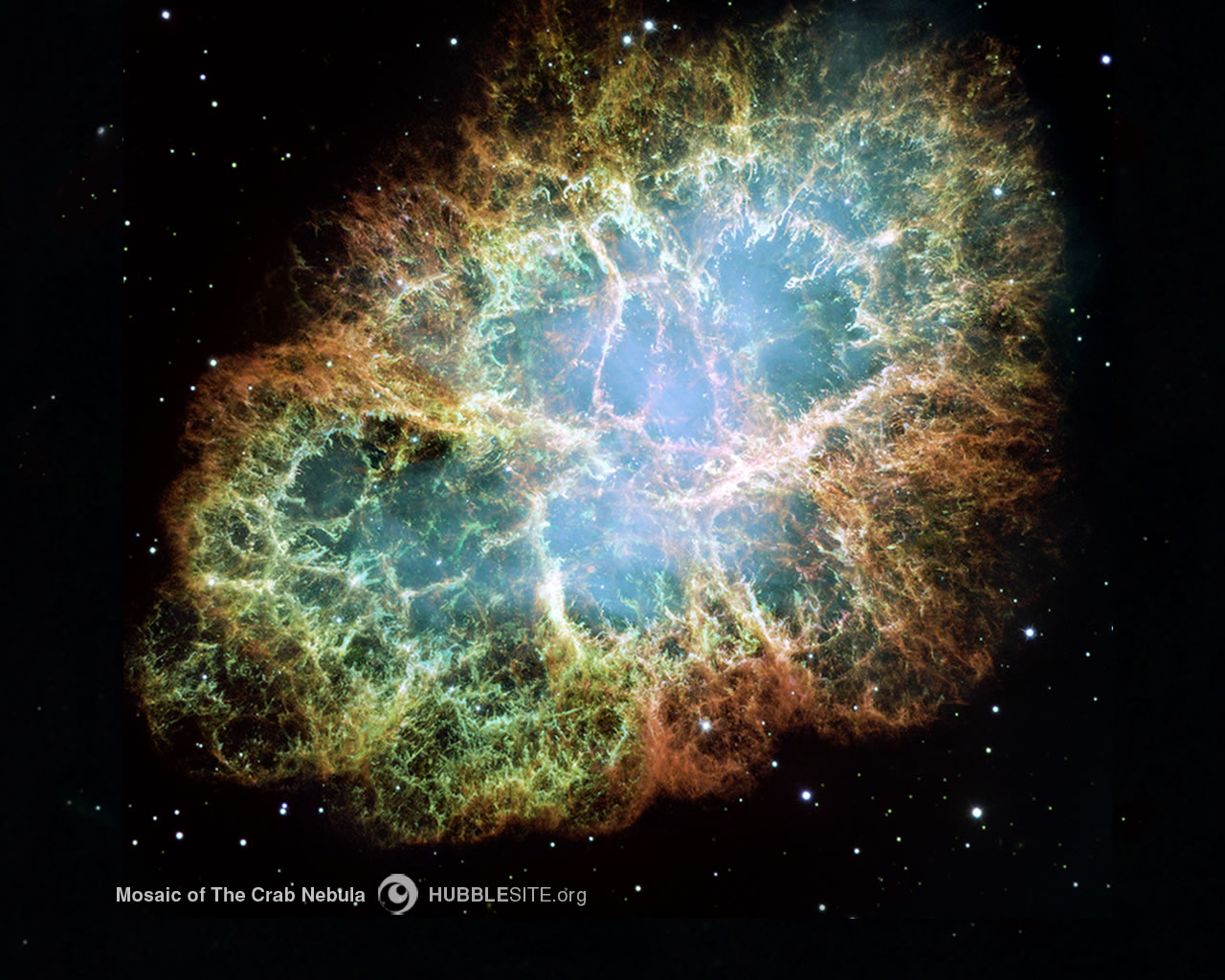
  • Crab, as in the Crab Nebula and the Crab pulsar, is the remnant of the supernova that exploded in 1054. It is about 2 kpc (= 6500 light years) away and was well documented throughout Asia and the Middle East. It was visible in the sky for two years, though it was less bright than Lupus (due to there being more dust obscuring its light in that direction), it was very much visible during the day.
    Crab Nebula Mosaic from HST
    Image Credit: NASA, ESA, J. Hester, A. Loll (ASU)
    Acknowledgement: Davide De Martin (Skyfactory)
  • 3C 58 is one of the less inspiring names for a supernova remnant (pre-dominantly pulsar in this case). It was seen in 1181 by Chinese and Japanese astronomers and was only visible a night albeit as the brightest star in the sky. It's possible that the pulsar in that direction is older than the supernova event, but its hard to know for certain. It is 3.1 kpc (= 10 000 light years) away.
  • Tycho is the next supernova on the list. It exploded in 1572 and is named after Tycho Brahe not because he discovered it (how can you "discover" something that everyone can see, even during the day) but because he studied it extensively (some have said obsessively). It inspired him (and others) to revolutionise the astronomy of the day.
  • Kepler came next, with his supernova which was first observed in 1604. (4.8 kpc = 15 600 light years away.) It was bright enough to be visible during the day, but not when the sun was high. As with Tycho, Kepler didn't discover it but he wrote a book about it, which led to it being named after him. Wiki says this was the most recent observed supernova in the Milky Way, but there are two more about which less fuss was made because they were less glaringly obvious.
  • Cassiopeia A probably exploded in 1680 but that date uncertain. It was noted down in a routine sky catalogue by the first Astronomer Royal, John Flamsteed, then later erased as an erroneous entry because there was no long a star at that location. The modern remnant wasn't discovered until 1947, after which it was linked to the erroneous catalogue entry. Although the remnant is 3.4 kpc (= 11 000 light years) away, it wasn't easily visible because of the large amount of dust in that direction.
  • Speaking of dust, this last supernova is an interesting case. It doesn't have a nice name, merely one based on its galactic co-ordinates: G1.9+0.3, or G1.9 for short. No one saw it explode. there is a lot of dust in that direction. Most of the dust in the Milky Way lies in the plane of the disc and, looking towards G1.9, we are looking right through that disc of dust. From the speed of the remnant expansion, we predict that it exploded around 1868. Anyway, this one is less relevant to the thrust of this post, I just thought it was cool.
You may have also heard of supernova 1987a (which exploded in 1987, hence the moniker), but that was actually in the Large Magellanic Cloud, not the Milky Way.

Because I can, here is a little graphic showing the various directions of these supernovae:
Image credit: NASA/CXC/M.Weiss


Auspicious portent?

So supernovae are pretty cool (or incredibly hot, if you want to be literal about it) and now it's time to tie it back into stories.

Before we, as civilisations, knew what supernovae really were (and to be fair, that occurred relatively recently, compared with all those historical supernovae), they were seen as new stars, visiting stars. In fact that's what the "nova" part indicates: newness.

Lacking a physical explanation, imagine what those people must have thought when a new light appeared in the sky and then, incredibly, was visible during the day. It's the sort of thing that, these days, might make someone less abreast of astronomy think of aliens. What would it have been back then? Portents?

We know that comets were often hailed as portentous, so why not an auspicious supernova? Supernovae are even rarer which, one would think, would make them even more significant, mythologically speaking. In a world of myth and legend, what might the appearance of a bright new star lead people to do? I hesitate to suggest that people would panic (unless goats with two heads were born at the same time, maybe) but it would surely affect their lives. Especially if it lit up the night enough to see by (like Lupus probably did).

In a world of myth and legend, what might someone do if a new star lit up the day sky? Would they, perhaps, set out on a quest to follow it? What would their reaction be to whatever they found beneath it on their journey?


Wednesday, May 4, 2011

Stars in their Skies

My intention had been to write another gravity post, this time about tides, tidal locking and Saturn's rings, but unfortunately I've been too busy to fully cover the scope I wanted to. Instead of a half-hearted post on the above, I bring you: stars! Stay tuned for tidal forces next week.

It's full of stars!

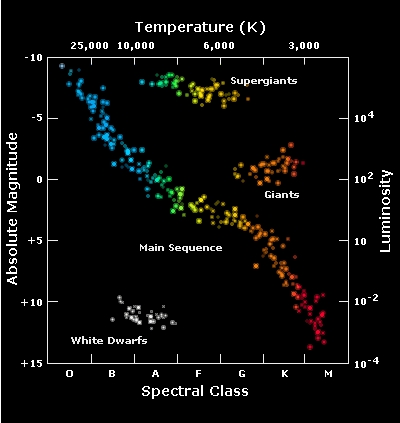
There are many different types of stars, as you may recall from the HR diagrams I've discussed previously (I've also drawn a rather crude, annotated HR diagram below). Stars come in a whole spectrum of colours, based on their (surface) temperatures, and these are loosely correlated with their masses. In general (for the main sequence), small stars are red and hence cool (only 3700 Kelvin) and large stars are blue and hence very hot (more than 33 000 Kelvin).

These large blue stars are sometimes called blue giants and small red stars are often called red dwarfs. In terms of mass, these stars can range from over 100 times the mass of the sun for blue giants down to about a tenth of the mass of the sun for red dwarfs. The sun, by the way, is on the cooler and smaller end of the middle of the main sequence.

Aside from descriptive words, stars are also separated into lettered classes based on their temperature. The hottest stars are designated O type, then it goes B, A, F, G (the sun is a G-type star), K and the coolest red dwarfs are M type. I'm not terribly fond of the mnemonic I use to remember them, so if you can think of a good one, please leave it in the comments. ;-)

Main sequence stars generate energy by fusing hydrogen and helium in their cores. They need to generate enough energy to over come the pressure of gravity trying to pull them into their central point. This means that bigger stars burn their hydrogen faster because they need to produce more energy to prevent gravitational collapse. Well, technically it's increased gravitational pressure that drives faster fusion in the core. Smaller stars don't have as much gravitational pressure acting on them, so the hydrogen nuclei in their cores are pushed as close together, meaning that their fusion reactions happen much more slowly and it takes longer for them to burn through all their fuel. So big stars burn bright and fast and die young. Small stars burn more conservatively and lead much longer lives. For reference, the lifetime for the hottest blue stars is around a million years whereas red dwarfs can expect to live a lengthy fifty billion years or so (the universe is currently only 13.4 billion years old). Our sun has been around for four and a half billion years and can expect to keep going for another five billion or so.

A very crude representation of where different types of stars fall on the HR diagram.

Stellar life

Talking about how long stars last is all well and good, but where do they come from and where do they go?

Nebulae (singular: nebula) are giant clouds of dust and gas in space. Even though the particles in a nebula are fairly spread out, over enough time gravity pulls them together into clumps. When these clumps get big enough that the gravitational pressure holding them together is great enough for fusion to start in the core, they "turn on" and switch from warm balls of gas into blazing young stars. The rest of the gas and dust that didn't make it into the protostar before it turned into a star proper either get blasted away by the new stellar wind unless they already clumped together enough to form planets.

After that, the star lands on the main sequence, based on its mass. What happens when it uses up all its fuel and reaches the end of its main sequence life varies depending on its mass. Smaller stars, like our sun, will throw off their outer layers and swell up into a red giant. The star will eventually eject all its outer layers and all that will be left is the star's exposed core; a white dwarf. A white dwarf no longer fuses hydrogen or helium or anything else. Instead it just slowly radiates away all of its heat until it eventually (over trillions of years) cools. White dwarfs are basically just spheres of carbon or oxygen or a mix of the two, depending on the initial star. Those news stories you might have seen about the "largest diamond in the universe"? Those are talking about carbon white dwarfs.

If we start with a larger star—big enough that after the star has ejected all its outer layers the core that's left behind is more than 1.4 times the mass of the sun—then the core will be too massive to remain merely a white dwarf. Instead it will collapse in a giant explosion known as a supernova. In the immense pressures exerted in the supernova, the protons in the old stellar core combine with the electrons to form neutrons (atoms are usually made of protons, neutrons and electrons). This type of star, composed entirely of neutrons and not found on an HR diagram, is called a neutron star. A really massive star can, after a supernova, collapse into a black hole, an even denser object (previously mentioned here).

Life elsewhere

Since the sun is a G type star and has a life-bearing planet, of course G type stars elsewhere could have life-bearing planets too. There is also a reasonable chance that F and K type stars, which are fairly similar to our sun, could also harbour life. The biggest problem is when we look at very massive stars. When we're talking about stellar lifetimes in the millions of years, then there probably isn't enough time for life to form. It took four or so billion years for life on Earth to get to the stage it is now. If the sun had only lasted for ten million years before exploding, then we wouldn't be here.

What about red dwarf stars then? They live for a very, very long time, so there's certainly ample time for life to develop. However, because the habitable zone is so close in to the star (because the star is so dim and cool), there are two issues:
  1. The planet will probably be tidally locked, meaning that one side is always facing its sun while the other never gets any direct heat or light. It's likely in this case that both the day side and the night side will be permanently too hot or cold. The ring of the terminator (the boundary between the day side and the night side) would probably be the best bet for life developing, temperature-wise.
  2. Small stars seem to have more flares than larger stars. Flares aren't terribly conducive to life, particularly at such close proximity. This is still an active area of research, however.
But, theoretically, in optimal conditions life could develop on a planet orbiting a red dwarf. Also, both of those issues are things I will probably blog about in the future.

As I mentioned last week, just because life can't develop there, doesn't mean humans can't try to colonise planets around different and interesting stars. Of course, colonies with a five or so million year time-limit might be a bit sort sighted, but if there are planets in suitable places, it could be good for a laugh.

Wednesday, April 27, 2011

The humanly habitable zone

If you want your little book people (otherwise known as characters) living on the surface of a planet that isn't Earth and without constant artificial support, you probably want the planet to be habitable. This is where the habitable zone (and hence this blog post) comes in.

Why is it a zone?

First let's talk about what we need from a planet. Earth is great; it gives us lots of handy life-sustaining conditions; air, water, the right amount of gravity, sunlight and radiation... Of course, the reason the Earth is so well-tuned to keeping us alive is that we evolved on Earth. It's not tuned to us, we're tuned to it. There is no reason that aliens couldn't evolve in very different conditions to those found on Earth. Even on Earth there are many forms of life such as extremophiles which live in conditions we humans couldn't survive in. There's also a good chance that life is possible on Europa or Titan (moons of Jupiter and Saturn respectively), but on the former it would have to be in a subsurface ocean and the latter has a very different atmosphere and composition to Earth, meaning that life couldn't be water-based.

Aliens are all well and good, but if we're interested in what conditions humans can live unsupported on a planet's surface, we need to be much more specific.

The things I mentioned earlier (air, water, heat, etc) depend on two things:
  1. Planetary properties such as size and composition, and
  2. Planetary location.
The first of those is most easily summarised as having to be similar to Earth to sustain unaided human life. The latter is the subject of this blog post.

You see, although the planet needs to be similar to Earth, its sun doesn't have to be that similar to our sun. Different stars output different amounts of light and energy (previously discussed in terms of how bright they are). If we were to pick Earth up and put it in orbit around a larger, hotter star then, if we didn't want to be burnt to a crisp while all our water boiled, we would have to put Earth in a further out orbit to compensate for the extra energy coming off the star. Similarly, if we put Earth around a smaller, cooler star, we'd need to put it in a closer orbit to stop it turning into a snowball.

The optimal region in which to put a habitable planet is called the habitable zone. It's a zone because there's no reason for life to have not evolved on Earth if it had been slightly closer or further away from the sun. I'll get back to life evolving on other planets at the end of the post, though.

There are a few different ways of defining what constitutes a habitable zone. Some definitions involve the region in which liquid water is possible, temperature-wise (since our biochemistry depends heavily on liquid water), other definitions go a bit further and include things like carbon cycles and the greenhouse effect (pdf link, sorry). For the purposes of the habitable zone calculations which follow, I'm going to use the definitions given in Selsis et al. (2007).

Before that, though, let's work out how warm a planet is based on how far from its sun it is. I am using a formula adapted from a Melbourne Uni 3rd year physics lab manual because it's simpler than the one given in Selsis et al. (2007), although they both give the same results. The approximate temperature of a planet, given a stellar temperature and radius and ignoring complex atmospheric effects (but assuming that an atmosphere exists) is:

T is the approximate temperature of the planet in Kelvin, T* is the temperature of the star in Kelvin, A is the albedo of the planet (for reference, Earth's is 0.306, according to wiki), R* is the radius of the star and d is the distance of the planet from the star.
The only tricky thing here is that both R* and d have to be in the same units, so either both kilometres, or both AU etc.

According to Selsis et al. (2007), life is possible in the range where the temperature is between 277 K and 394 K. Rearranging the above equation then with these values and substituting R* in annoying units for solar radii (the HR diagram I linked to a few weeks ago can help you estimate this much more easily than in km or AU), we find that the habitable zone for any main sequence star in AU is given by:

Quantities as above. R is solar radii (multiples of the radius of the sun) and d now must be in AU.
So all you have to do now is work out what kind of star you want, find out it's general properties (easily googleable if you're using a real star) and throw in the numbers. Unless you have plans to make your planet unusual, it's probably best to keep A as the Earth's albedo. That said, habitable distance will change with albedo so the only reason not to change it is because albedo reflects the planetary composition (and we probably want to keep a similar composition to Earth...).

For reference, Selsis et al. (2007) find the sun's habitable zone to be between 0.95 and 2.4. (Note that they use a different albedo for the Earth.) Wiki lists some other numbers which seem to vary mostly in the outer edge prediction.

I should also point out that all of this assumes that there aren't any other stars near our planet. Things get a bit more complicated with multiple stars around, something I will definitely address in a later post.

Evolving elsewhere

As well as the habitable zone, there is something known as the continuously habitable zone (or CHZ). This is the region around a star which remains habitable throughout the star's (main sequence) lifetime. (Main sequence lifetime because different stars end their main sequence lives in different ways, mist of which make the continued survival of planets complicated at best. More on this in a future post, I think.) The reason we need to worry about different times in a star's life is that stars tend to increase their rate of energy output as they age and use up fuel (because as more fuel is used up, hotter core temperatures are required to sustain fusion which leads to an increase in luminosity). The CHZ is narrower than the habitable zone calculated at any given time during the star's lifetime and it is possible that as the star's luminosity changes, the habitable zone could shift so that the planet moves into or out of it over (astronomical) time.

Of course, this doesn't matter so much if we just want to find a planet to throw humans at. Continuous habitability becomes more relevant when we're talking about life evolving. Evolution from scratch takes a long time, but human civilisation to date has lasted an insignificant amount of time, on an astronomical scale.

Wednesday, April 13, 2011

Living on a moon: How bright is the night?

Let's say you've stuck a colony on the moon of a gas giant. I've already talked about the unusual way in which the sun and the primary planet move (or don't move) across the sky. As you might recall, there will be times in the moon's orbit when, depending on where you are on its surface, the only natural illumination comes from its primary planet. the question this post addresses is: just how much illumination can we expect?
There are two things we need to know to work out how much illumination the primary is giving the moon:
  1. How bright and far away is the sun?
  2. How reflective is the primary?

EDIT: I've added in some comparisons with light bulbs thanks to Patty Jansen pointing out that the human eye can adapt to see in lighting conditions much dimmer than the sun


Star light, star bright?

The amount of light that reaches your planet-moon system from its sun will depend on what kind of star it is. Stars come in different sizes and different temperatures. Most stars lie on what is known as the Main Sequence. Two notable exceptions are red giants and white dwarfs. The main sequence refers to the band of stars running diagonally through the Hertzsprung-Russell Diagram (HR diagram, previous links to two different images). Is basically a plot of how much light a star gives out (it's magnitude or luminosity) against it's colour or temperature. Stars are then divided into types (O, B, A, F, G, K, M) based on colour/temperature. Giant stars (other than blue giants) lie above the main sequence and white dwarfs lie below it. The sun is a G type star with temperature 5800 K (on the surface, that is; it's much hoter on the inside). K means Kelvin and is the standard unit of temperature. To convert from Kelvin and Celcius, you need to subtract 273, so the sun is 5500ºC (with rounding).

Using a star's temperature we can work out how much energy, in the form of light, reaches our planet. The first step is to assume that the star is a black body. This might sound conter-intuitive since the last word you're likely to use to describe the sun is "black", but from a physics perspective, a black body is something that absorbs all incident light and emits light based on its temperature. Well, I say "light", but really I mean electromagnetic radiation.

The Stefan-Boltzmann law tells us how much energy a black body emits based on its temperature. When we're talking about stars, this is called the luminosity. The formula for calculating luminosity is:

A stars luminosity, given it's radius, R, and temperature, T. σ = 5.67 × 10⁻⁸ is the Stefan-Boltzman constant and π = 3.14

The temperature has to be in Kelvin and the radius in meters to give luminosity in units of Watts (yes, like your light-bulbs) which is a measure of energy emitted per second. Radius and temperature are slightly trickier to come up with numbers for. If you're using a real star, you can just look it up on Wiki or Wolfram Alpha (Wiki even has a page listing the nearest stars to Earth). Otherwise you can make up a star with the characteristics you want such as temperature or class, then go to the second HR diagram I linked and look at the diagonal lines of radius. Whether you want a main sequence star, white dwarf or giant, this should give you an idea of radius (in units of the radius of the sun).

That's all well and good, but what we actually want to find is the light reaching a planet, not the total light emitted. Because stars emit light in all directions at once, their total energy output end up being diluted over an expanding sphere of light. Basically, not all the energy the sun produces hits our planet. It depends on how far away the planet is. This next formula will tell us how much energy hits the planet:

P is the energy per second hitting each square meter of the planet and D is the distance from the planet to its sun.

So P is the energy from the sun that hits a square meter of a planet which is D meters away from the sun. We're not quite there yet, but let's take a break and calculate some numbers. I'm going to work out the energy from the sun that hits the Earth/moon and Jupiter each second.
  • Earth/moon are about 1.5 × 10¹¹ m from the sun. The sun's radius is 6.955 × 10⁸ m and its temperature is 5800 K. The energy hitting a square meter of the Earth or moon each second is 1400 Joules.
  • Jupiter is 7.8 × 10¹¹ m from the sun. The energy hitting a square meter of Jupiter each second is 50 Joules, which is about 3.6% of the energy hitting the Earth. Jupiter's greater distance from the sun means that the sun's energy is about 30 times more spread out by the time it gets there. (As I calculate below, this is still about 14000 times brighter than the full moon as viewed from Earth.)

Planetshine

Light doesn't get completely absorbed by the planet, however. Some of it reflects back out into space and can illuminate other nearby objects. The property which determines how reflective something is (in this context) is called albedo. The average albedo of a planet is a number between 0 (non-reflective) and 1 (absolutely reflective), which represents the percentage of incident light that will be reflected.

In practice, it's fairly easy to implement albedo. The reflected energy is the incident energy multiplied by the albedo. Just multiply P above by albedo, A, and you get the power reflected off each square meter of planet. You can look up albedos for different planets/moons on Wiki and elsewhere. (But we all know Wiki's the easiest. It lists albedos in the summary box on the right of the relevant page. If more than one is given it's the Bond albedo, not the geometric albedo, that you want.)

What we actually care about, however, is how much of that reflected light goes on to reach the moon our colony is built on. In a way, we just reuse the equations I've already included above. Instead of putting L into the equation for P, use the P from the sun multiplied by albedo, radius becomes the radius of the planet, and distance is now the distance between planet and moon:


P is the energy per square meter per second hitting a moon, A is the albedo of the planet, R is the radius of their sun, r is the radius of the planet doing the reflecting, T is the temperature of their sun, d is the distance between planet and moon, D is the distance between planet/moon and sun. The last line is included because if you're using a real star, luminosity will probably be listed somewhere. Otherwise, the penultimate line is what you need to use.

OK, so this is getting increasingly more complicated looking, but remember that you only really have to do the last step. There rest are only there by way of explanation.

Now, one last thing before I calculate some more numbers. That last equation assumes that the primary planet appears full in the sky. If it's half full, you have to halve that number, if it's a quarter full you have to divide by four. Honestly? Just approximate.

  • The moon has an albedo of 0.136. The energy the full moon is reflecting at the earth is 0.0037 W/m2.
  • For the purposes of comparison, a 100 Watt light bulb from 10 meters away has a brightness of 0.02 W/m2.
  • The Earth has an albedo of 0.306. The energy Earth reflects at the moon is 0.12 W/m2. So because it's bigger and more reflective, the Earth as seen from the moon gives off about 32 times more energy per second. That means the full Earth in the lunar sky is roughly 32 times brighter than the full moon in Earth's sky and six times brighter than a 100 W light bulb.
  • Jupiter has an albedo of 0.343. Ganymede is 1.1 × 10⁹ m away. The brightness of full Jupiter in Ganymedean sky is 0.07 W/m2. That means Jupiter is almost twenty times brighter than the full moon. Not surprising given how big it is in the Ganymedean sky. A half-full Jupiter would be 10 times brighter than the full moon, a quarter-Jupiter about 5 times as bright and so-forth. The varying quantity here is what fraction of Jupiter's disk is illuminated (and that we're working under the assumption that Jupiter reflects evenly in all directions). A quarter-full Jupiter would be about as bright as a light bulb and a full Jupiter would be as bright as three and a half light bulbs 10 meters away.
  • Io is 4.2 × 10⁸ m from Jupiter. The brightness of full Jupiter in Io's sky is 0.48. So Jupiter is shining a whopping 130 times brighter than the full moon. By comparison, the sun as seen from Io is only about 100 times brighter than Jupiter. Light-bulb-wise, Jupiter would be as bright as 24 100W light bulbs 10 meters away.
  • For a bit of fun, the brightness of full Io (albedo 0.63) as seen from Ganymede varies from 1.2 × 10⁻⁴ W/m2 when it is at its closest point to Ganymede to 2.4 × 10⁻⁵ W/m2 when it is at its furthest. Neither of those are very bright, but it would still definitely be visible. It's about 0.6–3% the brightness of the full moon.
  • And finally, let's say we put Jupiter at the same distance from the sun as Earth is. Now Ganymede would get around the same amount of energy from the sun per square meter as Earth does and Jupiter would be a lot, lot brighter. How bright? 1.9 W/m2, which is 500 times more light that Earth gets from the moon and as bright as almost 100 light bulbs from a distance of 10 meters.

And there you have it. A method for approximating how much light you'd get reflected from a gas giant planet (or whatever planet/moon/asteroid you like). Unfortunately this post ended up being a little bit more complicated than I had initially anticipated (where complicated really means more maths), but it's a small price to pay for painstaking accuracy... Well, some semblance of accuracy, at any rate. There are a lot of approximations in the above (for example, the albedo varies for different types of terrain; so Earth's albedo is higher over clouds than over forest), but on average, it's close enough. Phew!

One last thing I came across after writing this post. I was looking for something else and came across this photo of Jupiter and Io. Notice how the line between Io's sun side and dark side (called the terminator) is very distinct and solid, whereas Jupiter has a bit more of a gradient going from light to dark? This is because Jupiter has an atmosphere (a very thick one, but the effect applies to Earth's atmosphere too) whereas Io's atmosphere is whispy and not really much to write home about. The atoms/molecules/particles in the atmosphere reflect light in all directions, allowing it to diffuse through a bit, giving us that gradient from light to dark. Io, on the other hand, only reflects light off its surface, leading to the solid terminator you can see in that image. Just something to think about when writing those realistic descriptive passages. ;-)

Update: I photoshopped some Jupiters into skies to give a size comparison with the full moon. You can see them here.

    LinkWithin

    Related Posts Plugin for WordPress, Blogger...