Showing posts with label links. Show all posts

Monday, May 21, 2012

Cool article

Browsing the internets, I came across this rather neat article about Earth's final solar eclipse (many, many years hence). Check it out here. It talks about the moon moving away from the Earth until one day it will be too small to completely cover the sun in our sky.

If that sounds familiar, it might be because of this post I wrote about the moon being closer to the Earth in the (now cancelled) TV show Terra Nova. (Hint: not for the reasons they said in the show.)

Friday, October 21, 2011

Bunch of links, mostly outdated

First up, square Earth anyone? Forget realism, let's just have a think about what an Earthlike planet would be like if it were a cube. Puts me in mind of the planet builders in Hitchhikers' Guide to the Galaxy. Brought to you by Discovery News.

Second, the Planetary Habitability Laboratory talks about brightnesses of the various planets in the solar system and also of exoplanets. An interesting read, particularly if you enjoyed my old How Bright is the Night? post.

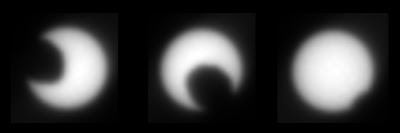
Martian moons eclipse the sun in these NASA photos from the Opportunity rover:
Credit: NASA/JPL/Cornell

Enceladus pics from Cassini. Enceladus is one of Saturn's moons, most famous for it's ice geysers.

Proposed space robot to cannibalise old satellites which have previously been boosted up to "graveyard" orbits. Many mentions of zombie satellites and grave robbing associated with this one ;-p . From New Scientist.

And finally, laser driven fusion in California. From New Scientist again.

Happy weekend, gentle readers!


Friday, September 30, 2011

Chatter

Well, today saw the launch of the CSFG anthology Winds of Change, with my story "Time Capsule" in it. Unfortunately, being on the other side of the world, I wasn't able to be there, but Twitter tells me it all went well. Cover art on the left and I'll post some links on how you can get your hands on it when I have them. (I believe the most reliable way to get a copy right now is from the Conflux 7 convention which is happening in Canberra this weekend. ;-) )

On a completely unrelated note, New Scientist have this neat article about detecting life on other planets. Unfortunately, it requires a free registration to read (and is only going to be freely available for 5 more days). Which is unfortunate for those of us who lack subscriptions. On the other hand, here is a link (pdf) to a poster that accompanies their article (jpeg here). I don't think you need to sign in or anything to see it.

And in the inane memes department, I made a word chart thingy with Wordle. I think it just used the first page-worth of blog posts, so it's a bit skewed. Still, word chart thingies are cool.

Click to enbiggen.

Sunday, September 25, 2011

Two links. Because I can

First, cells made out of metal, or at least, research heading in that direction. New Scientist has the story.

And here's a picture to capture your imagination: a supermassive black hole at the centre of a galaxy... stars flit around it in tight orbits. Some of those stars have planets. Some had planets but they were ripped from their orbits by the black hole's gravity. Starless planets, hurtling around erratically, if not being pulled apart, then smashing into each other. Their deaths leaving behind a dusty shroud. New Scientist. ArXiv.

It's posts like these that make me think that Tumblr might be a good idea. (Of course, my usual weekly posts are much less Tumblresque.)

Friday, September 2, 2011

Some Links!

Some interesting sciencey links, presented in the order in which I came across them (which I think is the order they were published anyway).

First up! This New Scientist article is about how the wakes of ships (the white "trail" they leave behind as they plough through the ocean) temporarily increases the albedo of the Earth—how much light from the sun it reflects. This would be good news for climate change (that is, enacting a more positive change and less the "oh gods we're all going to die in a tropical hell" sort) if not for all the greenhouse gases those ships also produce...

Next! This arXiv paper, "Kepler Exoplanet Candidate Host Stars are Preferentially Metal Rich", seems to back up some of the assumptions made in the paper I discussed a short while ago about the galactic habitable zone. In that paper they assumed that sufficient metallicity would be required to form planets and it looks like Kepler has confirmed that.

Penultimately! Forget about Martian meteorites containing fossilised life, simulations have shown that life from Earth may have made it off world and could be set to land on another planet. Could it be that when we finally get around to drilling through the Europan ice, we find Earthly extremophiles instead of aliens? Cosmos magazine have the full story.

Finally! National Geographic have an article about a newly discovered planet which has the potential to be Earth-like. Seems that it gets less energy from its sun than Venus does from Sol, but more than Earth receives. It's habitability thus depends on the appropriate weather conditions but with surface gravity 1.4 times Earth's it should be more or less possible to walk on the surface.

Monday, May 23, 2011

A couple of cool Io animations

So I was browsing around NASA's photo archive looking for a nice high-res image of Io and I came across this little movie of Jupiter-shine on Io. It's a time-lapse movie in which you can see the Io moving so that the sun is on its far side — it starts off behind and to the left which is why you can see a bright crescent at first. As the sun moves behind Io from the camera's point of view, Jupiter, which is behind the camera becomes more fully illuminated. The sunlight bouncing off Jupiter in turn more brightly illuminates Io's surface which is why the night side of Io gets darker as the crescent of Io gets smaller. Pretty cool, eh?

You can read more about planetshine in this post, which also talks about how much light you'd get from the sun at different distances.

Another cool little movie on the same site is this one, which shows some interesting happenings on Io's dark side. The bright spots away from the edges are volcanoes, whereas the two blue glows on the edges are similar to aurorae on Earth. Except those aren't the poles, but rather at the equator where charged particles are colliding with the tenuous wisps of Io's atmosphere. The thin atmosphere itself is only existent because it's constantly being replenished by volcanic gases. Nifty.

Friday, April 22, 2011

An interesting link and some housekeeping

Alien plantlife

Red Suns and Black Trees: Shedding a New Light on Alien Plants is a Universe Today article about how chlorophyll (the stuff that makes plants green) works well on Earth because of the colour of our sun. [Edit: link down as of posting because they're hosted on Amazon's servers... sorry. Edit 2: Here is an article from Astrobiology Magazine along the same lines, thanks to Patty Jansen.] On other planets, particularly those with different coloured suns, it's possible that the vegetation could evolve to be a different colour to better take advantage of the different light.

It reminded me of the red edge, which is a feature of the reflectivity of plant life. It has been proposed as a possible extraterrestrial biomarker (a way of determining if there is plant life like ours on other planets. I wonder if plants which don't use chlorophyll exhibit the same spectral properties in the infrared? That said, not overheating is a useful property, so on worlds with bluer suns, maybe the effect would be more extreme? This is pure speculation, of course.

Housekeeping

I have decided that I am going to aim to write one long, sciencey post a week and, for the time being, the plan is to have that post go up on Wednesdays. (That's Australian Wednesdays, for those of you in less progressive time-zones. ;-) ) I may also post some shorter blogs throughout the week, such as this one, but that's less guaranteed. Sometimes I may also write posts about the science (good or bad) in books I've read.

I know more frequent blog posts are meant to be a way of keeping readers interested, but this one proper post a week is all I can really commit to, time-wise, for the moment.

LinkWithin

Related Posts Plugin for WordPress, Blogger...