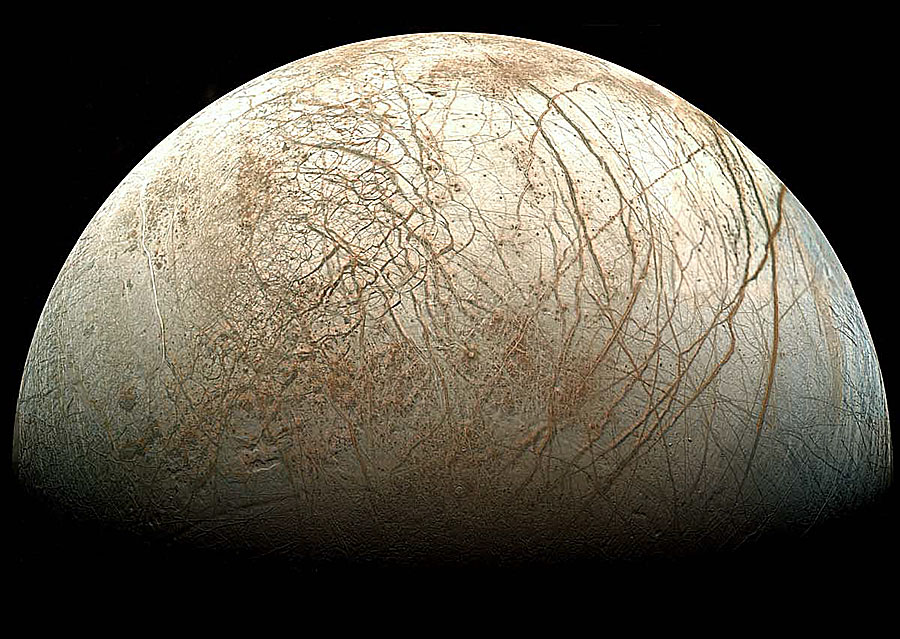
Showing posts with label planets. Show all posts

Friday, December 7, 2012

Year-long days and living in them

This blog post was inspired by an email conversation with someone regarding the possibility of a planet having year-long (or half-year long) day/night cycles. The original question was whether this is even possible and whether such a planet would be habitable.

From a purely astronomical point of view, this is definitely possible. There's no reason why you couldn't have a slowly rotating planet at around the same distance from it's sun as Earth is (well any reasons that do exist are fairly theoretical so we can ignore them). That said, if the planet is similar to Earth and its sun is similar to ours, then you kind of have to have the same length year because the length of the year (ie how long it takes to orbit the star) depends only on the mass of the star and the distance from it. This is due to Kepler's Laws, which I have previously discussed here. If you made no changes to star/planet distance, the year length would have to be the same.

Image nicked from Wiki here. The little red line
represents the same point on the surface of
Mercury. The numbers are the order in which
the positions happen: 6, 1, 2 are night for
the red line and 3, 4, 5 are day, roughly.

You could also have something similar to Mercury which has three rotations (called "sidereal days" which are measured relative to the stars, not the sun) to two years. Because it rotates so slowly, weird stuff happens with its solar days (the light/dark periods, completely ignoring the positions of stars) so that in one year it experiences half a solar day. Mercury is like this because it's so close to the sun. It could have been tidally locked (the same side always facing the sun – discussed further, including for Mercury in particular, here) but the gravitational effects of the other planets in the solar system caused this more unusual resonance.

However, if we're talking a planet as distant from the sun as Earth is, there's no danger of it becoming tidally locked in the sort of cosmological time frame we're currently living in. The time taken for the angular momentum between planet and star to be distributed into the tidally locked configuration takes longer the further apart they are (and the less massive when they're close enough). The Earth-moon system will eventually become more tidally locked: the moon already faces the same side towards us all the time, and eventually the same side of Earth will always point towards the moon.

But that's a bit of a tangent, back to planets with long days and nights. You could have a planet rotating as slowly/quickly as you like, but you should be mindful that the people living there would almost certainly have a way of distinguishing between sidereal and solar days. Ancient people on Earth already had this worked out (the difference between sidereal and solar days is why the stars move across the sky with the seasons).

Living there

Uranus: almost completely sideways.
If you did have a planet with a year-long day, the periods of day and night would be roughly equal in the same way they are on Earth, just scaled up. It could vary a bit depending on the planet's axial tilt (how much the line between the poles is tilted relative to the plane of it's orbit — Earth's is around 23º and changes slightly when earthquakes occur) so the more inclined the axis, the more extreme the seasons. If there was no or very little axial tilt, there wouldn't be seasons. The other variable in day/night lengths is the latitude. Further away from the equator sunrise and sunset would last longer and the shortness of winter days and length of summer days would be more extreme (as on Earth, but a different axial tilt could make this more so). If there was no axial tilt, the poles would be in a state of twilight permanently. The other extreme is something like Uranus which has a 90º-ish axial tilt so that during a southern summer the south pole points towards the sun and during a southern winter the south pole gets no sun at all. Spring and Autumn are the transition period. The equator is in twilight during summer and winter and has more "normal" days, like what we're used to, during spring and autumn.

Also, astronomical plausibility aside, I'm not convinced complicated life could naturally arise on a planet with a super-long day/night cycle, due to the long periods of boiling (day) and freezing (night). In terms of temperature-stability, probably only the twilight areas would be habitable. I suppose you could have migrating species (but that also has problems because in staying in permanent twilight they'd need sufficient landmasses connecting the two poles). Also, you'd probably get some sort of storms around the twilight zone, since the temperature would be in in a state of flux. I'm not an expert on atmospheres or meteorology, though, so that's a (-n educated) guess and I can't be too specific. But in short: our 24 hour days are what keeps Earth's temperature relatively temperate and suitable for life.

There's be fewer issues for microbial life to arise but I don't know that anything larger would be viable. Maybe at the poles: if the planet was slightly closer to its star than Earth is, there could be non-migratory life living near the poles and with a stable orbit and rotational period, it should survive. Since the non-polar regions wouldn't have naturally arising complex life, there could be with completely different ecosystems/forms of life at either pole with only something like microbial ancestors connecting them.

Sunday, October 21, 2012

Atmospherically Speaking

Today I have another Ask Tsana post.

Brookelin asked:
Hi again, Tsana.

I was wondering - in an alternate universe, what would it take for a species to survive on Mars?

I know that it has some atmosphere, but not a whole lot. With the pressure being below the Armstrong limit, could there feasibly be large creatures (between collie and bear size) that could survive would have higher thresholds and what would they need to do so?

If the water on a human's tongue boils in space, would an alien creature in these environments be able to have eyes and mouths?

What might these species' need to overcome the intense radiation caused by Mars' weak magnetosphere?

Could bio-genetically enhanced humans ever survive these conditions outside a space suit for periods of time upwards of an hour, but less than a day?

Are these too many questions? Do you know the answers to any of them, or is this more of a medical thing?
I don't have answers to all of these questions because, as Brookelin said, some are more medical/biological and that's not my area of expertise. I will say that what we generally know a lot about is life on Earth. There are some constraints that exist for life on other planets but there is nothing to say that it has to resemble Earth life. They could have eating and seeing organs completely different to what we're used to. Even on Earth there's a pretty wide variety. I'm not sure that merely genetically enhancing a human would be enough to let them walk around on Mars. Science fictions stories have gone there, but I'm not sure genetics is up to it. I could be wrong, I'm just guessing. Hopefully my comments below on atmospheres and life on smaller planets such as Mars will answer the rest of the questions, though.

Mars. Credit: NASA, ESA, and The Hubble Heritage Team
(STScI/AURA)
It's true that Mars has a very thin atmosphere; it's about 0.6% as dense as Earth's at their respective surfaces. Part of the reason for this is Mars's lower gravity. In general, gases will expand to evenly fill the container they're in. When the container is a planet's gravitational field, we get denser air closer to the ground and less dense air higher up. This is because the air higher up is pushing down on the lower air while having less air above it to push it down. More or less.

Air is made up of particles (atoms and molecules) which move around very quickly and bounce off each other. That's why a gas is a gas and not a liquid or solid: the particles in a liquid don't move quickly enough to completely overcome the forces attracting them to each other and the particles in a solid can't move more than vibrating on the spot because the forces holding them in place are so strong. The energy that makes the particles move, for all states of matter, depends on the temperature: the hotter, the faster. The other important consideration is particle mass. At the same temperature, oxygen and hydrogen molecules (O2 and H2) have the same energy. However, oxygen weighs sixteen times as much as hydrogen (because the atoms are larger and heavier) so it takes more energy to move oxygen molecules at the same speed as hydrogen molecules. The result is that at the same temperature, oxygen molecules move more slowly than hydrogen molecules. And it takes less energy for hydrogen molecules to reach escape velocity (the speed required to escape the gravitational pull of Earth/whatever planet) than oxygen. And that's why there is very little hydrogen in Earth's atmosphere despite it being the most abundant element on a cosmic scale — it escapes into space. It's also the reason only the gas giants, notably Jupiter and Saturn, have any significant about of hydrogen in their atmospheres — they have the strongest gravitational fields.

So, Mars. Mars is smaller than Earth, with about a third the acceleration due to gravity at its surface. Mars is made up of similar elements to Earth, most likely because they formed so closely together, so it's likely that the same sort of lighter elements could have made up Mars's atmosphere. However, due to the lower gravity, not only hydrogen but oxygen and nitrogen would also have escaped or never been captured by the planet. I would guess the main reason there's so much frozen carbon dioxide at the poles is because it has a relatively high melting point of -78ºC rather than the much colder melting points of oxygen (-219º C) and nitrogen (-210º C). For comparison, Mars's surface temperatures vary between -143º and +35º C. So basically, even if you imported or mined enough gas to raise the air pressure to human survivable levels, it would all be lost into space and would need constant replenishing which would get tedious and be difficult to sustain. You'd also, ideally, raise the surface temperature to more consistently human survivable levels — probably using some sort of greenhouse effect to trap more of the sun's energy — but that would just hasten the atmosphere's escape.

Titan's atmosphere as seen by Cassini. Credit: NASA
But all is not lost. Heavier molecules exist, particularly those made out of carbon. Titan, one of Saturn's moons, is smaller than Mars but has an atmospheric pressure greater than Earth's by about 45%. It's colder than Mars, which allows its atmosphere to condense a bit, but it's only got a surface gravity of around a seventh that of Earth's (less than half of Mars's). According to Wiki, its atmosphere is composed mainly of nitrogen (as is Earth's) and methane with some traces of heavier carbon molecules. It's a combination of the temperature, the distance from the sun, Saturn's magnetic field and some form of replenishing methane that keeps Titan's atmosphere thick and, well, full of methane. Distance from the sun is significant by itself because Titan is far enough that the ionising solar wind is weak enough to not completely ionise and destroy the top layers of its atmosphere. The same strategy probably wouldn't work on Mars to increase the atmospheric pressure permanently unless you could find some magically resistant to solar radiation molecule to populate the atmosphere with. There are two interesting theories for what keeps replenishing the methane on Titan (which should be destroyed even by the lowered energy it receives from the sun): cryovolcanoes — volcanoes shooting icy hydrocarbons instead of lava — or biological processes using/generating methane in place of water.

The high levels of ionising radiation on Mars are as much due to its lack of atmosphere as its lack of magnetic field. (Side note: there's evidence that there was a magnetic field on Mars in the past, though I don't think we know why it went away.) Earth's atmosphere absorbs a lot of the ionising and UV radiation the sun throws at us (part of the reason the ozone layer is important). Not all of it is deflected — and things like X-rays and gamma rays can't be deflected because they don't have an electric charge — especially near the magnetic poles where the aurorae are caused by charged particles, mostly from the sun, interacting with the atmosphere. However, giving Mars a magnetic field would definitely help. Earth's is generated by molten iron in its core so it's not outside the realm of over-dramatic science fiction to drill a hole into the centre and start the core spinning. Come to think of it, Hollywood's already done that, just with Earth not Mars. (For the record, the ridiculous issues with that movie include the structural integrity of the hole and the failure to correctly represent changes in gravity.) A more feasible way to avoid radiation on Mars would be to live underground so that the ground above you did the work of absorbing harmful radiation. The reason too much radiation is bad for all forms of life is that it destroys and changes molecules. In humans this is one of the causes of cancer. In microbial life, which might only have a few cells to begin with, it's more deadly. It's why sterilising things with UV light works.

So basically, the easiest way to get people living and wandering around on Mars is to have them live in airtight structures and give them suits for walking around outside it. The suits wouldn't have to be as extreme as space suits though, so that's something. I'm not saying it's completely impossible to walk around on the surface with less protection, just very difficult. And because someone will mention it in the comments if I don't, I've heard that Kim Stanley Robinson's Mars books, starting with Red Mars, do a good job of talking about the terraforming process, although I haven't read them. Ben Bova's Grand Tour of the solar system books (eg Mars or Saturn and Titan) explore alternative forms of life all over the solar system. If you can stomach a bit of sexism, some of them are worth a read.


Friday, September 21, 2012

Gravity and atmospheric pressure

I have another response to an "Ask Tsana" question today.

Brookelin asked:
I was wondering... with planets like Europa and possibly Ganymede, who possible have oceans, if humans made future settlements under said oceans, would the pressure from the water above counteract the effects of reduced gravity on the human body?

Interesting question. A preliminary point: it's Jupiter's moons Europa and Callisto that probably have sub-surface oceans (especially Europa), not Ganymede which is a solid rocky moon.

Europa, one of Jupiter's moons, has a vast ocean beneath
its surface. Credit: Galileo Project, JPL, NASA;
reprocessed by Ted Stryk
So, how do pressure and gravity work? In this context, gravity is the force that holds a planet/moon/star together and which attracts other objects to it. So we're all being pressed into the surface of Earth due to Earth's gravity. Pressure is the force a surrounding fluid (air, water, etc) exerts on something. So the atmospheric pressure we feel on Earth is pushing at us from all sides (well, OK, not out from the ground) and is due to all the air in Earth's atmosphere.

When you go swimming, the further you dive down, the higher the water pressure around you gets. This is because the deeper you are, the more water is above you to press down on you and the more water is above the bits of water on either side of you, also pressing into you. If you've ever been snorkelling (or scuba diving, I suppose but I can't vouch for that due to lack of experience) you might have noticed that it gets harder to breath the deeper you go (assuming a long enough snorkel). This is due to the water pressing down on your chest. Air does the same thing, but we're used to it, so we don't notice. The other thing that happens under water is that the water underneath you pushes up on you: this is called the buoyancy force and it's why things (people, tennis balls, icebergs, etc) float.

The higher up you go from sea level on Earth, the thinner the atmosphere gets (basically, the less atmosphere left above you). To halve the atmospheric pressure you experience, you need to go 5 km above sea level. (On the other hand, to double the pressure, you only need to be about 10 metres under water.) At that height, gravity is still pretty much the same as at sea level (the difference is about an eighth of a percent) and your main problems are getting enough oxygen (not a huge problem if your lung capacity is OK) and possibly altitude sickness (potentially a problem).

We need some amount of air pressure around us to survive which is part of the reason astronauts wear space suits. However, there is a range at which we can still function and that range increases if we have extra oxygen (and don't get altitude sickness). People have climbed Mt Everest (8.8 km above sea level) which has an atmospheric pressure of about a third that at sea level at it's peak without oxygen, but even doing it with oxygen requires training and acclimatisation and isn't something anyone can just decide to do one morning (well, unless they also decide to put in all the training).

On the surface of Europa or Callisto, there is no atmosphere and hence no atmospheric pressure. The ground is frozen water (probably not pure water, if only due to meteorite bombardment, but that's beside the point), but let's suppose we somehow got under the surface and set up a habitat. Since we're human and breathe air (a particular mix of mostly nitrogen, with some oxygen, carbon dioxide and misc) we'd have to have some sort of bubble habitat under the sea. But it's not just the air part that we need, we also need it to be around one (Earth) atmosphere of pressure. So we build a habitat with solid walls and fill it with the right amount of air... and then we're inside an air bubble and the water outside the bubble is having no effect on our bodies directly. The only way it would is if we went out into the water without pressure suits. Which probably wouldn't be the best idea in the world for a variety of health and safety reasons that don't necessarily have to do with the water pressure.

Now let's talk about gravity. The main way we detect small changes in pressure is though our ears, for example when they pop on taking off and landing in aeroplanes. The main way we detect changes in apparent gravity (which is the same as changes in acceleration) is when we feel lighter or heavier. If you're standing, this might manifest as extra strain on your legs, if the apparent gravity has increased, or a feeling like your stomach is moving upwards (possibly accompanied by nausea), if the apparent gravity has decreased. You don't experience the same feeling underwater or up a tall mountain because the gravity doesn't change in those places although the pressure does.

So what I'm ultimately trying to say is that the effects of gravity and atmospheric pressure are different. You can't compensate for a decrease in gravity by increasing pressure. Pressure is a force applied from all directions simultaneously, while gravity acts in just one direction. We know about the effects of Earth gravity, high gravity (from fighter pilots for example) and zero/microgravity (like on the space station) on people but much less about the effects of gravitational fields less than Earth's and more than zero. Europa's and Callisto's accelerations due gravity at the surface are about 13% Earth's and for comparison, the moon's is about 17% Earth's) so while we have had some experience with the moon landings during the Apollo missions, we don't really know how serious the health problems associated with spending prolonged periods at such low accelerations would be. There almost certainly would be some, but they probably wouldn't be as severe as zero gees. So while we can't use water pressure to compensate for gravity, it's not impossible for people to live on one of the moon's of Jupiter. We just don't know enough about what long term problems might arise.


Thursday, March 22, 2012

Destroying the Earth

This post is inspired by a question I got on my Ask Tsana page. Katrina asked:
I'm trying to come up with a simple (haha) and plausible way to destroy a planet to kick things off for a story but am having trouble getting the science right.

One of the first sites I visited to figure this out was this Geocide site: http://qntm.org/geocide

Under the Geocide in fiction page (http://qntm.org/fictional), the author says, "The Sun Crusher is a relatively small ship which carries a small number of missiles, each of which is tough enough to shoot into the centre of a star and cause it to go nova, which would certainly annihilate any nearby Earthlike planet."

My question is, don't stars that get massive enough to go nova have brief lives and thus not live long enough for a habitable planet to develop? I'm just basing that on Wikipedia (http://en.wikipedia.org/wiki/Planetary_habitability#Massive_stars), though, so I was wondering if you could tell me more. Can the habitable zones of massive stars ever actually be inhabited (and then later die in a supernova)?
Excellent question!

The answer depends a bit on to what extent you want to destroy your planet. Geocide pretty much defines "destroy the Earth" as "annihilate in the particle physics sense, or dismantle/tear apart on either a macroscopic (large) or microscopic scale". He doesn't count Earth as destroyed if there's still a planet-like object there. However, for many narrative purposes, rendering the Earth entirely uninhabitable will do the trick.

So, leaving the dismantling and annihilation to Geocide (the website is amusing, although be warned that some of the details of physics are slightly off, but close enough), what are some ways of rendering Earth unfit for life?

Destroy all humans

So maybe what you want is not so much to destroy the planet as to destroy all the people on it. That's not really that hard. Or, at least, destroying most of the people isn't that hard. Some methods, which generally don't require elaboration:
  • Widespread nuclear holocaust
  • Some sort of plague
  • Climate change. No, really, melt the icecaps and raise the temperature enough so that it is too hot and humid to survive without air-conditioning and eventually you'll run out of people. Or throw in some crazy weather disasters too. The Rhesus Factor by Sonny Whitelaw touches on this a bit (see my review here), also on the plague scenario.
  • Very large volcano eruption. This is one of the things thought to have caused at least one of the prehistoric dinosaur(ish)-era extinctions. A less epically large volcano (actually, a few of them probably contributed) in 1816 caused the Northern Hemisphere (or Europe and America at least, not sure that Asia was affected as strongly, but google it if you're interested) to not thaw out in the summer. This was "the year without a summer". (And now I have that Rasputina song stuck in my head. Click the link and you will too.)
  • Asteroid -- this one's a toss up between destroying all (most) humans and destroying all life. Ultimately, I suppose it's a matter of scale. Let's say this asteroid kills human life but not necessarily all the microbes. It would be somewhat similar to the volcano in the throwing dust and rubbish into the atmosphere, blocking out light and generalised doom.
  • Magnetic field of the Earth turning off in the process of flipping. This is something that happens spontaneously every so often. It's bad because a whole bunch of ionising radiation (miscellaneous charged particles) from space is kept at bay thanks to our nifty magnetic field. Taking it away would give us a lot more cancer and sterility and could wipe out a large chunk of humanity. Microbes and probably a lot of (some?) sea life would be OK. Good luck artificially killing the magnetic field, though.
All of those methods probably won't wipe out all life and, frankly, it's possible/likely that some tenacious dregs of humanity will hold on. Generally, evacuation is the surest way to avoid these apocalypses. Or prevention, but that's only really applicable in two or three of those scenarios.

Destroy all life

Why aim low? Bugger humanity and everything else with one of these sterilising scenarios:
  • Self-replicating nanobots (von Neumann machines) which consume all the [insert important chemical here -- carbon is popular]. This is also know as the grey goo scenario. Depending on the nanobots, this is likely to render the Earth inhospitable to life while they're still doing their thing.
  • Large asteroid/comet or small moon colliding with Earth. Where a small impact would cause natural disasters (earthquakes, tsunamis) and potentially block out the sun with dust, a large impact could do many detrimental things. It could change the Earth's rotation, knock it into a slightly different orbit (or send it spiralling into the sun, but that would require a particularly large body), it could smash the Earth into chucks (which, thanks to gravity, would probably later re-collide to form Earth 2.0), render an appreciable fraction of the surface molten... Actually, I now have a brilliant mental picture of two or six asteroids hitting the Earth simultaneously from opposite sides and sort of turning it into molten goop... Not actually sure that would work with two, but six seems faintly plausible in a hand-waving way. Anyway, point is, hit Earth with something big enough and bye-bye life. Depending on conditions, it's possible life could spontaneously arise again, depending on how reliably life arises and how long it takes (before, for example, the sun goes red giant).
  • Supernova/nearby gamma ray burst. The main problem with this notion is the lack of suitable supernovaing stars nearby, as Geocide mentions. However, you mentioned destroying a planet, not specifically Earth. A planet orbiting a star when it went supernova would be toast. Probably, it would be fairly inhospitable before the actual explosion, if Eta Carinae is anything to go by. A planet orbiting a non-explosive star near another star that went supernova could well end up sterilised, which is what I talked about in my post about the galactic habitable zone (and near in the astronomical sense isn't that close by). And, actually, if we're talking about Type Ia (which is to say not core-collapse supernovae; not the death throes of a large star) supernovae, which involve white dwarfs and (probably) ordinary stars going through their red giant stage, we might not even see the supernova coming. That's a slightly unsettling thought.
  • Some sort of implausible doomsday device. Really, you can make up whatever rubbish you want for this one if you're so inclined. (But if you do, I don't promise not to tear your science apart if I read/see/whatever it.)

A few words on supernovae and novae

Supernovae are how stars bigger than about 8 solar masses end their lives. Novae are not small supernovae. I know, that's what I originally learnt as a child/teenager by osmosis from SF novels. I think the connection between the words nova and supernova are primarily historic; a star suddenly appeared or became much brighter and acquired the label (nova meaning new), but the different causes weren't understood until much more recently.

Stars smaller than around 8 solar masses don't explode. They expand relatively slowly (well, y'know, compared with a supernova explosion) when they run out of hydrogen to fuse in their cores, then contract then expand again when they run out of helium. At this point, a large star going through the stages much more rapidly would collapse again under its own gravity and then kaboom supernova. Smaller stars aren't massive enough to collapse again under their own gravity. Instead, after the helium is used up, leaving either carbon or oxygen (or a combination) in the star's core, what was once the stellar atmosphere will keep expanding indefinitely. Initially, it forms a planetary nebula (not actually anything to do with planets), but eventually it will all dissipate and be undetectable. What's left behind is a white dwarf; basically a small, hot star which was once the core of the red giant star.

Suppose there were two stars near each other, and one went through the red giant to white dwarf steps before the other. When the companion star undergoes its red giant phase, maybe it expands enough that some of it's outer atmosphere is close enough to the white dwarf to accrete onto it. The reason these stars didn't supernova is because they were too small. There is a very definite upper limit to how massive a white dwarf can be before it collapses in on itself and explodes. That limit is 1.4 solar masses (but remember, most of the original star's mass is lost when it's doing the expanding thing, which is why the original star can be up to 8 solar masses). If the companion star accretes too much matter onto the white dwarf, the white dwarf will go over the 1.4 solar mass limit and explode. This is a Type Ia supernova. For the record, the alternative explanation for Type Ia supernovae, which is presently gaining more traction, is two white dwarfs colliding.

Since white dwarfs are small (1.4 solar masses in a volume roughly the size of Earth), they're not very visible, especially once they start to cool down. See how we might not see that kind of supernova coming? It could potentially not be that difficult to artificially orchestrate, either, if you have enough spare matter to throw at a conveniently placed white dwarf. Well, y'know, sort of easier than some large-scale astro-engineering projects could be.

 Back to the point

 If you recall the original question, Katrina asked:
My question is, don't stars that get massive enough to go nova have brief lives and thus not live long enough for a habitable planet to develop? Can the habitable zones of massive stars ever actually be inhabited (and then later die in a supernova)?
In general, the bigger the star, the shorter its life. Our sun's total lifespan is something like 10 billion years, a blue giant could live only 10 million years, and a red dwarf's lifespan is in the trillions of years. The current theory is that it took a couple of billion years for (very basic) life to arise on Earth. It then took a long time to progress to where we are now (Earth's age is 4.6 billion years, from memory). If we see this as typical, it seems like there isn't enough time for life to arise around a much larger star. On the other hand, if there was a planet at a suitable distance from the star, it could be inhabited by sufficiently motivated humans with spaceships. They wouldn't be able to stay there indefinitely, but even a few million years is more than ages on human scales, so that's OK.

The other issue is metallicity. Planets like Earth have rocky cores, which means they have high metallicity. Remember, metallicity in an astronomical sense refers to the abundance of elements heavier than helium, not necessarily just the things chemists/sane people identify as metals. Very massive stars generally form in metal-poor environments and are metal-poor themselves. This makes the presence of heavier elements as requires for rocky planet building less likely. Not necessarily impossible, but much less likely.

So yes, you can potentially have planets around the sort of stars that go supernova and, while native life probably won't get very complex if it arises at all, said planets could be inhabited by plucky humans.


Sunday, December 18, 2011

Weird Worlds: Kepler 22b

It's what all the cool kids are (still) talking about, so why not a post on it? In the glut of Kepler mission transiting planets, a new planet has risen to the fore as the possibly most Earthlike extrasolar planet. Huzzah! (And in a few months yet another new planet will take its place. Just watch).

Credit: NASA/Ames/JPL-Caltech

What we know

Kepler 22 is a star very similar to our sun. It is slightly smaller (0.98 times the radius of the sun) and slightly smaller (0.97 times the mass of the sun). It is 587.1 light years away, so it's not something we're going to be visiting soon.

So far, it only has one known planet, dubbed -- as these things go -- Kepler 22b. This planet is smack bang in the habitable zone ...on the inner edge, so OK, maybe not that smack bang... BUT. The part people are getting exciting about is that it's the smallest planet we've found in the habitable zone thus far.

How small? 2.38 Earth radii. For comparison, Neptune, the next biggest solar planet after Earth, is 3.88 times Earth's radius. That puts Kepler 22b just on the smaller side of halfway between Earth and Neptune. In terms of size.

What we don't know is how massive it is. The way the Kepler satellite detects exoplanets is by looking at stars and measuring how much dimmer they get when (if) a planet passes between the star and us. By knowing how much light the star gives out usually, and how far away it is, it's possible to work out how large the planet is. (And, actually, even if you don't know how far away the star is, you could still work out how big the planet has to be as a fraction of the size of the star.)

We know how long its year is, basically by measuring how often it passes in front of the star. Yeah. It's that simple (particularly since there seems to be just one planet in this system at the moment). So Kepler 22b's year is 290 days long, not drastically different to Earth's. That and its position in the habitable zone have lead people to suppose that maybe it's not so different to Earth.

Based on how far it is from its star etc, the average surface temperature would be about -11º Celsius if it had no atmosphere. However, if it had an atmosphere like Earth's average temperature would be about 22º C. Perhaps a slightly less insulating atmosphere would be in order, however, since Earth's mean surface temperature is actually 14º C. (Because we have to take global lows and highs into account, you see, and average over the whole planet, never mind that 22º is just about room temperature.)

Harping on what we don't know

It's that mass. And the fact that we don't have a planet of that size in our solar system. It's in the transitional zone, as I said, between rocky terrestrial planet and mini gas giant. If it's rocky, it's likely that the gravity will be stronger than Earth's, thanks to it's larger size. In fact, if it's the same density as Earth, the surface gravity will be about 2.4 times Earth. Which isn't long-term viable. At Neptune's density, we get a ball of gas with surface gravity 0.72 times Earth. A ball of ice would result in gravity 4.3 times Earth. The least dense terrestrial planet in our solar system is Mars and at Mars' density, Kepler 22b would have gravity 1.7 Earth's.

So there's quite a spectrum of possibilities there. We really don't know enough to make any definitive judgements at this stage. That doesn't make it less exciting, of course, and it's true that there might be oceans and continents there. Or it could be a small dense ball with a thick gaseous atmosphere inhabited by dragons (perhaps even fire-breathing ones, if there's methane in the atmosphere and breathing fire is a viable way to catch prey). Which would also be cool. Arguably, cooler.


Wednesday, November 2, 2011

Weird Worlds: Kepler 14b

This post follows the same theme as last week's: planets in binary star systems. Last week's planet, Kepler 16(AB)b, orbited two stars which closely spun around each other. This week's planet, Kepler 14b, orbits one star, which in turn orbits another star at a further distance. This paper, by Buchhave et al (2011), is the main source of my data on Kepler 14b.

Kepler 14b is unlikely to have any sort of solid surface.
However, the two stars could look something like this. Maybe.
Honestly, I think this might be a re-purposed Io illustration
but NASA did use it on a Kepler 14b page, so who am I to argue?
Image credit: Susan Stanley for NASA Kepler Mission Education
and Public Outreach.
It turns out that unlike originally thought from the Kepler satellite data, the star Kepler 14 is not a star, but is two stars. Buchhave et al (2011) discovered this when they went and looked at it with an Earth-based optical telescope. The two stars are so close together in the sky as seen from Earth that it took fancy adaptive optics to be able to resolve them. Resolving, by the way, means being able to distinguish that there are two separate sources of light, not a single blob. The stars were too close together to be able to separate out their spectra (because this uses a different instrument than the one that images them normally), so a few assumptions had to be made, but none that should strongly affect the planet.

Some facts

The two stars that make up Kepler 14 are designated A and B with A being the one the planet orbits, but the nomenclature is a little fuzzy because the binary nature of the system was discovered later. Going on the basis that the system is 980 parsecs away (3200 light years), then the two stars are separated by 280 AU (remember, 1 AU is the distance from Earth to sun and Pluto is about 40 AU from the sun). Both stars are bigger, hotter and brighter than the sun. The sun is a G type star and the Kepler 14 stars are F types, one spectroscopic class hotter/bluer. They are 1.51 and 1.39 times the mass of the sun and orbit each other once every 2800 years.

The planet, Kepler 14b -- I am tempted at this point to make up a name for it. I dub it Keforb -- is 8.4 times the mass of Jupiter. This makes it a fairly large gas giant and definitely not habitable by human standards. Could one of it's moons be habitable? Well, let's keep looking at the planetary parameters.

The orbital period, the length of one Keforbian year, is 6.79 Earth days. That's pretty quick. If you've been playing along at home, you might remember that planets orbit faster the closer in to their star they are. Keforb is only about 0.08 AU from it's primary sun. (Mercury is about 0.4 AU from the sun.) I don't need to do any calculations to know that this planet is going to be way too hot for life, even if it had a suitably-sized moon. It's the sort of planet that's known as a hot Jupiter.

I found this pretty awesome NASA page which shows everything you need to know about Keforb (except for my awesome name) including, if you click on the buttons down the bottom, where Kepler 14's habitable zone is and the orbits of solar system planets for comparison.

So the habitable zone for this system is out past Mars's orbit, in the range of 2.17–3.56 AU, roughly where the asteroid belt is in our solar system.

Similar configurations?

OK, so there's no hope for life on the one known planet in the Kepler 14 system, but what about other possible planetary systems of similar configuration. I mentioned Tatooine last week as being similar to the planet in the Kepler 16 system. The Kepler 14 system is different because the planet orbits only one star, not both of them.

A system of this sort that pops up in fiction every now and again is a planet orbiting a red dwarf star which is in turn orbiting a larger, brighter star. I'm pretty sure I've read about this sort of thing more than once but the series that springs to mind first is the Second Sons Trilogy by Jennifer Fallon. Partly this is because it's one of my favourite series, so I may be biased. In the first book, Lion of Senet, we are introduced to a world with two suns: a small red sun and a more distant yellow sun. The world orbits the red sun and the red sun orbits the second yellow sun. The residents experience two different types of sun sets and sun rises and their "nights" are when only the red sun are up in the sky. They also get to experience side-effects from the tidal forces of a) having two suns and b) being in a relatively close orbit with the red dwarf. This means lots of volcanoes and tidal waves (I think the first book even opens just after a volcano, but I may be wrong and I don't have it on hand to check).

It's billed as a fantasy series, and it's certainly written in a fantasy style with feudalism and political intrigue and war and things (the rest of Jennifer Fallon's books are indisputably fantasy). However, there isn't any more magic than in our world which makes me tempted to say that it's technically sort of science fiction. But without laser guns (or any sort of guns. There are swords, though). Maybe "sword and science" rather than "sword and sorcery".

Anyway, I highly recommend it, not just because of the interesting celestial mechanics, but also because it's a damn good read. The hero, Dirk, goes around applying his brain, not brawn. Also, if you go in solely for the celestial mechanics, you might be disappointed because, while good for the reasons I've mentioned above, it's not quite perfect, mostly for reasons of plot.

Sometimes, it's best not to let science stand in the way of a good story. (So long as you try and at least some of the science is sensible.)

Wednesday, October 26, 2011

Weird Worlds: Kepler 16

I have talked about the Kepler exoplanet-finding mission in the past (planet spotting, Kepler 11, KOI 730). Today I'm going to look at a planet Kepler has found in a binary star system: Kepler 16(AB)b and next week I'll talk about Kepler 14b which is also in a binary system but in a different configuration.

A binary star system is where two stars are close enough together to be in orbit around each other, instead of individually orbiting the centre of the galaxy. Instead they orbit the centre of the galaxy together, much the same way as the Earth and the moon orbit the sun together. Also sort of like on Tatooine from Star Wars.

Kepler 16b


Artist's impression of the Kepler 16 system.
Credit: NASA/JPL-Caltech/R. Hurt
Basic stats for the Kepler 16 system are somewhat unartistically presented here. I'll go over some of them below.

As far as we know, there are three bodies in the Kepler 16 system: the two stars which are designated Kepler 16A and B (and together Kepler 16(AB). As per usual convention, the more massive star will be A while the smaller will be B. The usual convention, for non-binary systems, is that the star is designated Whatever-a and planets in order of discovery then mass (so mass when several are discovered simultaneously) are designated Whatever-b, Whatever-c etc. The lower-case a for the stars is a bit redundant here, though. Masses and distances for the system are as follows:
  • Star A:
    • Mass: 0.69 solar masses
    • Size: 0.65 solar radii
    • Temperature: 4450 Kelvin (about 4180º C or 7600º F)
  • Star B:
    • Mass: 0.20 solar masses
    • Size: 0.23 solar radii
  • Stars AB together:
    • Orbital period: 41 days
    • Orbital separation: 0.224 AU (for comparison, Mercury's orbit is 0.387 AU from the sun)
  • Planet Kepler 16(AB)b:
    • Mass: 0.33 Jovian masses
    • Size: 0.75 Jovian radii
    • Orbital period: 229 days
    • Orbital radius: 0.70 AU (Venus is 0.72 AU from the sun)
It's not possible to separate out and measure the temperature of star B because it is completely overwhelmed by the light from star A. We can only make guesses based on it's spectral type which is determined from its chemical make up. Also note that the distance measurement for the planet is from the centre of mass of the two stars -- the barycentre.

For a bit of fun, let's work out how big and bright each star would be from the planet, relative to the sun. I should note that this is a gas giant planet and so any possible light would be more likely to exist on one of its moons, not the planet. The suns would appear the same size from a moon, though.

First, how big would the suns appear? (See this post for details on the calculation.) Remember for comparison that the sun (and moon) have an angular diameter of about 0.5º. So, sizes:
  • Star A as seen from planet on average: 0.49º, so about the same as the sun
    •  Range: 0.43º to 0.59º
  • Star B as seen from planet on average: 0.18º, which is about a third of the diameter of the sun
    • Range: 0.15º to 0.21º
Now, how much light would reach the planet from the two suns? Or how brightly would the stars illuminate the planet? This is a slightly more complicated calculation which you can read about here (and for comparative purposes, about 1400 Joules of energy hit each square metre of the Earth from the sun each second). Remember, also, that sometimes star B will pass behind star A, sometimes they will appear next to each other and sometimes B will be in front of A, blocking out some of A's light but contributing its own. I'm just going to calculate them separately.
  • Star A: 410 Joules per square metre per second, which is a bit less than a third of the light energy the Earth gets from the sun. It is also going to be redder light, thanks to the cooler temperature of the star.
  • Star B: assuming its temperature is about 2500 K which is within the plausible range for M type stars (star A is K type, if you're curious), I get about 5 Joules. That's 3-4% of the light from the sun hitting Earth. On the other hand, it's still a lot brighter than the full moon in Earth's sky (and significantly redder). About 1400 times brighter, in fact. And about as bright as 260 100 Watt light bulbs at a distance of 10 m. Except it would probably feel dimmer thanks to the redness.
Finally, let's suppose that there is an Earth-like moon of this gas giant planet Kepler 16b. How warm would the suns make it? The calculations are discussed in this post on the habitable zone. Since most of the warming comes from star A, I'm going to ignore star B for this calculation. The average temperature I get is about 190 K which is about -85º C or -121ºF. So a little bit too cold for life, but not too hot, which is a harder problem to solve. Maybe throw in a bit of greenhouse warming and a lot of snow gear and you have yourself a snowball planet with two suns. Not just cold, but pretty cool.

And if you want to read more, here is a nice New Scientist article about it. And, below, a video from APOD:


Wednesday, October 5, 2011

Let's talk seasons

Depending on where you live, you probably experience two or four seasons a year. Does this have to be the case on planets other than Earth? What causes Earth's seasons and what else might cause seasons on other planets? Read on!

Tilting

Earth spins about an axis that runs approximately from the North Pole to the South Pole. It completes one rotation per day (and, indeed, a day is defined by the period of rotation). the degree of tilt of the axis never changes. This is because one of the fundamental laws of physics is that angular momentum must always be conserved. If the angle of tilt changed then the direction of the angular momentum would also change and this isn't possible without some sort of external influence (like an asteroid, which isn't quite something we want to happen).

What is this angle of tilt relative to? Well, it's the amount by which the axis of rotation differs from making a 90º angle with the plane of Earth's orbit around the sun. Hopefully the image below helps.

Nabbed from Wiki. Credit: Dennis Nilsson, NASA.
As I said, the tilt doesn't change, so for part of the year the northern hemisphere is more exposed to the sun and for another part of the year, six months later, the southern hemisphere is more exposed to the sun. In temperate climates, these periods of greater exposure are called summer while the periods of least exposure are called winter. The in-betweens, as I'm sure you're aware, are spring and autumn. Here is another diagram to illustrate this:
Light and heat from the sun is hitting more of the southern hemisphere than the northern hemisphere.
Hot and/or tropical regions, which tend to lie close to the equator, experience two seasons: the wet season and the dry season. Similarly, the other extremes of the planet, the poles, also experience two seasons: polar day and polar night. This is because during winter the sun never rises the poles and never sets during summer. Within the polar circle but away from the actual rotational poles, there will be a period of transition between the two seasons (of varying length, depending on distance from the poles).

The greater the axial tilt, the more pronounced the differences between summer and winter will be (see the bit about Uranus at the very end for a very extreme case).

OK, so axial tilt causes Earth's seasons. What else can cause seasons?

Near and Far

Another possible cause of seasons is an elliptical orbit. This occurs when for part of the year a planet is noticeably closer to its sun than for the rest of the year. So when the planet is physically closer to the sun, the whole planet experiences summer (not just one hemisphere). During the more distant part of its orbit, the whole planet would experience winter.

On Earth, key seasonal dates, such as the solstices and equinoxes, are defined by the length of daylight (shortest day/night of the year and equal day and night respectively). On a planet with an elliptic orbit the key dates would be defined by significant points in the orbit. The equivalent of the summer solstice would be the periastron, the point of the planet's closest approach to the star. The winter solstice would be replaced with the apoastron, the time when the planet is furthest from the sun.

An interesting thing to note is that, thanks to Kepler's second law, a planet will move more quickly in its orbit when it's closer to its star than when it's further away. (If you follow that wiki link, there's a nice little animation which sort of explains it.) The result is that summer on such a plane will be briefer than winter. The more eccentric (non-circular) the orbit, the greater the difference between the lengths of summer and winter (and the closer the planet will be to its sun during summer). Could make for an interesting cultural interpretation of the seasons.

Pulsing star?

Some stars vary their brightness. Cepheid variables, for example, pulse with a regular period (which can be anywhere from one day to a few months). Theoretically, this could induce a seasonal variation for any surrounding planets. However, there is a problem when it comes to life evolving on such a planet. These stars are unstable and won't last very long (on an astronomical scale) in their pulsing state. This makes it a bit more difficult to justify having an inhabited planet around them. Maybe a planet with a colony that's studying the star. Anything more natural probably wouldn't last or might not have enough time to have evolved (depending on the size of the star). Of course, there's no rule saying impending doom couldn't be central to a plot.

Wacky planets

Uranus is sideways. (Also, the rings aren't
really red, just coloured that way for emphasis
here.) Credit: Lawrence Sromovsky, (Univ.
Wisconsin-Madison), Keck Observatory.
via APOD
Uranus is an interesting case. It's axis of rotation lies almost in the plane of it's orbit. So for part of the year the south pole points directly towards the sun and part of the year the south pole points directly away from the sun. In between is a transition similar to the type of seasons Earth experiences, but with more extreme beginning and end.

Of course, Uranus is too large and with too dense an atmosphere to support life as we know it. However, it's possible that a rocky planet more suitable for human habitation could also have this kind of extreme tilt. Everywhere except on the equator there would be periods of multiple days of darkness. Even on the equator, polar summer and winter would be spent in perpetual twilight.

I suspect this sort of configuration could also cause interesting weather/climate issues, but I think that would depend a lot on the atmosphere as well. Could be problematic.


Sunday, September 25, 2011

Two links. Because I can

First, cells made out of metal, or at least, research heading in that direction. New Scientist has the story.

And here's a picture to capture your imagination: a supermassive black hole at the centre of a galaxy... stars flit around it in tight orbits. Some of those stars have planets. Some had planets but they were ripped from their orbits by the black hole's gravity. Starless planets, hurtling around erratically, if not being pulled apart, then smashing into each other. Their deaths leaving behind a dusty shroud. New Scientist. ArXiv.

It's posts like these that make me think that Tumblr might be a good idea. (Of course, my usual weekly posts are much less Tumblresque.)

Wednesday, July 27, 2011

Weird Worlds: Gleise 581

A quick note before I jump into the meat of this week's post. From next week, I'm going to be on holiday for about two weeks. I'm going to try to queue up a couple of blog posts to self-update while I'm gone, but if something goes wrong I may not be able to do anything about it until I'm back in normal-internet land.

So this week, I thought I'd do another entry in my Weird Worlds series. This time about a planetary system which has gained quite a bit of media attention: Gliese 581. (Pronounced something like "glee-zeh", if you're curious.)

You may have heard of Gliese 581 discussed in the media with phrases like "second Earth" or "super Earth in the habitable zone" being thrown around. So how like Earth are we talking? Which part of the habitable zone? What sort of star is Gliese 581 anyway? Read on!

The Star

First the basics: Gliese 581 (which I will now refer to as Gliefeo because I am lazy and typing numbers is annoying it rolls off the tongue better) has four confirmed planets and two unconfirmed planets. For the sake of not getting too carried away I will focus on the four confirmed planets, although it was one of the unconfirmed ones which drew a large slice of media attention.

Gliefeo itself is a red dwarf star only about a third of the mass of our sun and a bit less than a third of the size. This means that to be within the habitable zone, its planets need to be significantly close to it than Earth is to Sol. Furthermore, the stellar environment these planets will be living with is very different to ours. Here is a nice Space.com article about it.

All of Gliefeo's planets were detected using the radial velocity method.


The Planets

As I mentioned above, Gliefeo's four confirmed planets are all quite close to their sun. In fact, as the image below (taken from my favourite exoplanet app) shows, all four are well within the orbit of Mercury (the grey circle). And the second image below (also taken from my favourite exoplanet app) shows two blue circles indicating radial distances of 0.1 AU and 0.3 AU (an AU is the distance between Earth and sun).

Gliese 581 and its four confirmed planets designated, from innermost to outer: e, b, c, d. The grey outline shows where the orbit of Mercury would be if Mercury's orbit were picked up and plonked around Gliese 581. The green annulus shows the habitable zone for Gliese 581 and both Gliese c and d are within the habitable zone for at least part of their orbits. Image from Exoplanet iOS app by Hanno Rein.

A representation of the Gliese 581 system. The inner blue outline denotes an orbit of radius 0.1 AU and the fainter outer circle (click to enlarge) shows an orbit of radius 0.3 AU. The four planets from inner to outer are designated e, b, c and d. Image from Exoplanet iOS app by Hanno Rein.

Some technical details on each of the planets (all taken from the Extrasolar Planets Encyclopaedia) :
  • Gliese 581 e:
    • Furthest distance from Gliefeo: 0.03 AU
    • Length of year: 3.15 Earth days
    • Mass: 1.94 Earth masses
  • Gliese 581 b:
    • Furthest distance from Gliefeo: 0.041 AU
    • Length of year: 5.37 Earth days
    • Mass: 15.64 Earth masses = 0.91 Neptune masses = 1.08 Uranus masses
  •  Gliese 581 c:
    • Furthest distance from Gliefeo: 0.07 AU
    • Length of year: 12.9 Earth days
    • Mass: 5.36 Earth masses
  • Gliese 581 d:
    • Furthest distance from Gliefeo: 0.22 AU
    • Length of year: 66.8 Earth days
    • Mass: 7.09 Earth masses = 0.41 Neptune masses = 0.49 Uranus masses
The last two planets, c and d, are the most interesting because of their location in the habitable zone.

Habitability

So are the two outermost planets of Gliefeo habitable? Well, probably not. In fact, chances are, none of these planets are able to support Earthlike life. Ignoring the issues with the star itself, as mentioned in the Space.com article I linked above, there are problems with all four planets.

Gliese 581 e is the closest to Earth in mass which, depending on its size (and composition) could mean that we could safely walk upon its surface from a gravitational point of view (well, safely is relative, but we probably wouldn't die instantly). However, it's so incredibly close to the star that it would definitely be to hot to support life.

Gliese 581 b is the largest of the four at around the size of Neptune. This almost certainly makes it a gas giant with a very dense atmosphere that would crush us if we tried to find a surface. It would also be very hot, not just because of it's proximity to the star, but because of the insulating effect of that thick atmosphere.

Gliese 581 c skirts the inner edge of the habitable zone, probably making it too warm for comfortable life. It's heavier mass also suggests a thicker atmosphere than Earth's (although this is purely speculation) and it could be more similar to Venus in terms of climate. That is to say: very inhospitable. It's surface gravity would probably also be a bit too strong for us, though this would depend a bit on composition.

Gliese 581 d falls into the class of planets somewhere between Earthlike and (mini) gas giant. We're not completely sure at what mass point planets stop being rocky and turn into mini gas giants.

(Side note: the mini and the giant should really cancel out, shouldn't they? Maybe we should call them gas balls to distinguish from larger gassy planets like the gas giants Jupiter and Saturn. But then, where would you draw the line? I suspect it would end up depending on the composition of the gas at lesat partially.)

So while Gliese 581 d spends roughly half its time in the habitable zone and half beyond it, it's probably not inhabitable itself. However, if it had any rocky moons like the solar system gas giants we know and love, those moons have a reasonable chance of being habitable. With the added advantage that they're going to be (probably) tidally locked to the planet, not to the sun, allowing the sun to more evenly warm its surface.

It's interesting, really, that of all the exoplanets discovered so far—not just around Gliefeo—the area most likely to be habitable is a moon of a gas giant. Really that says more about our detection techniques than anything else, but it does suggest some interesting possible world building.

Requests?

As I mentioned in the intro, I'm going away and hope to have some blog posts prepared in advance. However, my brain is all used up organising travel-related things without much room left for thinking about stories or reading new articles (my primary sources of blog post inspiration). So if any of you lovely readers have any requests for future posts, drop me a line in the comments!

Wednesday, June 29, 2011

Weird Worlds: KOI 730

Before I get onto the main part of the post, I'd like to apologise for the lack of short posts over the weekend but life's been hectic. Part of the reason for this is that I'm going to be away at a conference next week. I plan to queue up a post to automatically go live next Wednesday since I'm not sure how reliable my internet access will be (also because I'm not taking my laptop and will be relying on Blogger's willingness to talk to my iPad, another thing of which I am not confident). On the other hand, said conference should give me lots of fodder for short, if not long, posts. So that's something to look forward to.

On to the topic of the week! Today I am going to be writing about another crazy exoplanetary system. However, unlike Kepler 11, this one isn't quite confirmed yet. KOI stands for Kepler Object of Interest and means that it's a system that the Kepler mission has identified as potentially containing some planets (four in this case) but they haven't been confirmed by other supporting data. Because science is all about the independent evidence. Nevertheless, this is a blog about science fiction, so we are quite at home to a little speculation. As such, please remember that all of the facts I state below about planets are as yet unconfirmed and haven't quite passed into official scientific cannon.

Kepler Object of Interest 730

First, some basic facts about the system. The star has designations KOI 730 or KIC #10227020 (one of these is easier to remember than the other, so guess which I'll be using). It is similar to the sun, but slightly larger and slightly cooler (by a couple of hundred degrees). It is more than 4200 light years away. The four planets are all very close in to the star, much closer than even Mercury's orbit in the solar system, making them conclusively uninhabitable to life as we know it.

Here is a screenshot illustrating the system from this Kepler Candidates Exoplanet app (not to be confused with the other one I've referenced before which was of confirmed planets, albeit otherwise pretty much identical).

The KOI 730 system side on (as would be seen by the Kepler telescope itself). Three of the four planets are visible in this illustration. The white line indicates the plane of the orbit (actually, it's a bit of a trail/track following each planet, but that doesn't come across too well side on). The planets are to scale relative to each other but not relative to their sun. Also, I don't think they get smaller when their on the opposite side of the star to the observer.


Resonating

That's OK, because that's not the particularly interesting thing about this system. The scientifically interesting thing is that this system is locked in an orbital resonance. An orbital resonance is when two planets (or moons) orbit in such a way that they both complete an integer number of orbits in the same length of time. (An integer is a whole number such as 1, 2, 3, etc.) Some examples from the solar system are the Jovian moons Io, Europa and Ganymede, which are locked in a 1:2:4 resonance of orbital periods. This means that Ganymede's and Europa's periods (how long it takes them to complete one orbit around Jupiter) are respectively four times and twice the period of Io. (Sometimes this might be written 4:2:1 indicating that Io makes completes four orbits in the time it takes Europa to complete two and Ganymede to complete one. It depends on the convention being used.) Another example is Neptune and Pluto locked in a 2:3 period orbital resonance (so Neptune completes three orbits in the time it takes Pluto to complete two). A different sort of resonance is that experienced by Mercury, which completes two orbits in the time it takes to make three revolutions (so three Mercurian days are equal to two Mercurian years).

Orbital resonances can either make the system, or more specifically, the bodies involved in the resonance, stable or unstable. Yep, I know that sounds like they don't do anything because both possible outcomes are covered, but that's not true. What I mean is that if the resonance is unstable, you get things like gaps in the rings of Saturn (caused by some of Saturn's moons). On the other hand, the Jovian moons I mentioned before are in a stable resonance and Mercury is in its spin-orbit resonance rather than being tidally locked thanks to the gravitational tugs of other planets.

Which brings me to some of the effects of orbital resonance. Bodies locked in an orbital resonance exert a greater gravitational influence on each other than they otherwise would. For example, when Ganymede, Io and Europa are all lined up (Io and Ganymede on one side, Europa on the opposite side of Jupiter), they all experience a heightened tidal effect as the gravitational pulls of the other two planets add directly to the pull of Jupiter, causing additional friction in the planet interiors (and, for example, contributing to Io's volcanism).

Back to KOI 730

So I mentioned that KOI 730 has four planets and that these are locked in an orbital resonance. According to the first articles I read about it (in New Scientist and somewhere else I can't recall) and the original paper (section 5.3 is specifically about KOI 730) the resonance scheme for KOI 730 is 6:4:4:3. Notice the two fours there? That is why there were a spate of pop science articles about this system. Those two fours indicate that two of the planets are in the same orbit since orbital periods depend only on the star's mass and the distance of the planet from the star.

Two planets in the same orbit. They're located at two of the Lagrange points you might remember me mentioning a while back. Due to their positioning, they are known as trojan planets after the trojan asteroids that follow and precede Jupiter and Saturn in these same Lagrange points. The two planets are 118º apart along their orbit and are slowly, over millions of years, edging towards each other (at least; the authors of the paper speculate that they might last billions of years).

But yes, eventually they will collide.

The configuration of these two planets, KOI 730.02 and KOI 730.03, is such that they form an equilateral triangle with the star as the third point. Unfortunately, this puts the second planet as far away from the first as the sun, making it about a quarter of the height of the full moon as seen in Earth's sky. It would also always be about two-thirds illuminated and it wouldn't move around in the sky relative to the stars. If the planets were tidally locked to their sun then the other planet would stay locked in the same position in the sky while the stars moved around it, which would be fairly cool to observer. (Just think of the mythology that could arise surrounding that set up!)

It also bears mentioning that one of the theories of Earth's creation has two proto-planets forming at Lagrange points like these trojan planets. The other proto-planet, usually labelled Theia, and proto-Earth, inched towards each other and eventually collided, merging and splashing, so to speak, to form Earth and moon as we now know them.

Later, when I googled this again in preparation for writing this blog post, I found this article from Sky & Telescope, which features one of the authors of the original paper saying that further analysis of the data suggests a 8:6:4:3 resonance might be more fitting. This turns one of the trojan planets into a different orbit, farther out, and makes the system less exciting. I mean, a system in which all the planets are in resonance with each other is still pretty notable, but it's just not quite as imagination-grabbing as TWO PLANETS IN THE SAME ORBIT. Although, there's still potential for interesting story-science there when the planets line up and whatnot.

Oh well, co-orbiting planets in KOI 730 or not, the concept was around before this paper was written and there's no firm reason to not suppose we couldn't have trojan planets somewhere else. Maybe a gas giant with, instead of trojan asteroids following/leading it around, a full-sized terrestrial planet. Or two terrestrial planets sharing a habitable orbit...

The possibilities are endless. And science is cool even when it's speculative.

Wednesday, June 15, 2011

Weird Worlds: Kepler 11

This week I decided to talk about some of the weird, wacky and real exoplanets that we have discovered. I am going to just focus on a few with possibly more to come at a later date.

Kepler 11

I have mentioned it in the past and the Kepler Mission is certainly the current poster-child of the planet-spotting community. It has been staring at a patch of sky near celestial north since 2009 and in that time has found 1235 potential planets, 16 of which have been confirmed and most of which require further investigation.

There are six confirmed planets in the Kepler 11 system (the star, which was too far away and hence dim to have a better name, is designated Kepler 11). The star is similar to our sun. The planets orbiting it, however, are nothing like our solar system. Five of the planets are within what would be the orbit of Mercury if they were in our solar system. The outermost (or at least, the outermost discovered so far) is just outside the orbit of Mercury. They are also all relatively small, on the scale of previously discovered exoplanets, but much larger than our rocky worlds. They range in mass from 2.3 times the mass of Earth to slightly less than the mass of Jupiter (about 300 times the mass of Earth) and size from 1.93 Earth radii to 0.4 Jupiter radii or about 4.4 Earth radii (interestingly, the smallest isn't the lightest—Kepler 11-f is much less dense than Kepler 11-b). Their years range from 10.3 to 118.4 Earth days. For comparison, Mercury's year is about 88 Earth days.

Let's ignore the fact that all of these planets are too close to their sun to be habitable and have a think about what such a system would look like from within. From Earth, all the planets out to Uranus just look like bright stars which move across the sky. How different would the night sky look from a planet in the Kepler 11 system? For no particularly compelling reason, I'm going to work this out for Kepler 11-f which is the least massive and the second furthest out from the star.

First a picture. It's a (cropped) screenshot from this Exoplanet iPhone app, showing the Kepler 11 system. The planets aren't to scale with the star (they are very much inflated), but are to scale with each other.

Obviously the trails following the planets aren't real either, but are there just to give you an idea of the orbits. I like how the developer made it so only the side of the planet facing the star is lit up. Yay, realism.

Now some stats on the system, which I have mostly gotten from that Exoplanet iPhone app. Also, I'm going to abbreviate the names to Keb, Kec, Ked, Kee, Kef, Keg for Kepler 11-b through f. Because I can. (And if you're wondering, there's no Kepler 11-a because that designator is reserved for the star.)
  • Keb: 
    • 4.3 Earth masses, 
    • 1.93 Earth radii, 
    • orbit is 0.091 AU, 
    • closest approach to Kef is 0.159 AU
  • Kec: 
    • 0.04 Jupiter masses = 12.7 Earth masses, 
    • 3.09 Earth radii, 
    • orbit is 0.106 AU, 
    • closest approach to Kef is 0.144 AU
  • Ked: 
    • 6.10 Earth masses, 
    • 0.31 Jupiter radii = 3.41 Earth radii, 
    • orbit is 0.159 AU, 
    • closest approach to Kef is 0.091 AU
  • Kee: 
    • 8.4 Earth masses, 
    • 0.40 Jupiter radii = 4.4 Earth radii, 
    • orbit is 0.194 AU, 
    • closest approach to Kef is 0.056 AU
  • Kef: 
    • 2.3 Earth masses, 
    • 2.56 Earth radii, 
    • orbit is 0.25 AU
  • Keg: 
    • 0.95 Jupiter masses = 301 Earth masses, 
    • 0.33 Jupiter radii = 3.6 Earth radii, 
    • orbit is 0.462 AU, 
    • closest approach to Kef is 0.212 AU
Now for some calculations. Using the formula from my very first blog post, I calculated how big the other planets would appear at their closest approach to Kef. Also how big the sun, Kepler 11 (or Kea, why not) would appear. For all of these, I'm going to list them in units of the diameter of the full moon, except for Kea which I list in units of the diameter of the sun (because it's a star. Actually the angular diameter of the sun and the moon are roughly equal, which is why we get such nice looking solar eclipses). Also, this wiki table is useful for comparing how big things are in Kef's sky with how big things are in our sky. For future comparison, Venus varies in size from 0.16'-1.1' where the ' indicates arcminutes and there are 60 arcminutes in a degree. At it's closest visible point, however, Venus is a crescent that size, and full only at it's farthest point. That's about a thirtieth (0.036) of the size of the full moon. Easily resolvable with a telescope, but not quite resolvable as a disc with the naked eye.

At their furthest from Kef, all 5 other planets are similar to the size of Venus at it's furthest (and also it's fullest since that's when they are on the opposite side of Kea to Kef). At their closest approaches, however, there's a bit more variation. Remember for all of these except Keg the planets would be crescents of this size and only Keg would be full. Furthermore, I do declare that 1 FM (full moon) = 0.5º, and is the units I've used below. Because I didn't think anything would be gained by copy-pasting  "times the size of the full moon as seen from Earth" five times. (This is totally how units are invented. ;-p ) I may have also included some of the values as fractions.
  • Keb: 0.05 – 0.1 FM (max is a tenth)
  • Kec: 0.08 – 0.2 FM (max is a fifth)
  • Ked: 0.08 – 0.3 FM (max is approximately a third)
  • Kee: 0.1 – 0.7 FM (max is around two thirds)
  • Keg: 0.05 – 0.15 FM (max is almost a seventh)
I'm not really sure about Keb, Kec and Keg—I suspect they may just look like very bright stars—but the other two would definitely be visible as circles/crescents to the naked eye. The night sky of Kef would be a very different place to ours. I can't help but think that with such obvious neighbouring planets any intelligent life that evolved on Kef would work out celestial mechanics rather more quickly than we did. After all, we had to really pay attention to the sky to notice that some of the shiny points of light moved while others didn't. Not that life as we know it is likely to have evolved on Kef. Which brings me to the day sky.

Kef's sun, Kea, would be 4.7 times the size of Sol in our sky. Almost five times as big. (For those keeping track, that's the same as saying almost five times the size (width) of the full moon. That might actually be easier to visualise since it doesn't generally hurt to look at the moon.) It would also be around 22 times brighter than our sun, giving Kef 22 times as much energy as the sun gives Earth. Do you see why Kef might not be particularly habitable? Kind of like how you wouldn't want to live on Mercury, but more so.

Also, as you may have surmised from the first set of data I dumped, Kef isn't very dense. Density is given by mass divided by volume and volume is proportional to the radius cubed (actually, for a sphere, volume is 4/3 π R3). So Kef is only 0.14 times the density of Earth and, if it had a solid surface, which is highly unlikely, it would have a surface gravity of around a third of Earth's (similar to Mars's), despite being more massive. It's actually about three quarters the density of water, which isn't that surprising because if it were made of water (and I have absolutely no idea what it's composition is), we wouldn't expect water to be liquid in those conditions. What's interesting is that of the other planets, the two innermost are comparable to Mars in density (less dense, but close), the next three, Ked-f are comparable to Saturn (Saturn actually lies between Kef and Kee with Ked being a bit denser) and the outermost, Keg, is ridiculously dense. Like, denser than Osmium, the densest natural element. I think what this really highlights is how we only have an idea of planet size from the amount of dimming we see when it passes in front of the sun. The mass of the planets is worked out from the gravitational tugs they exert on each other in multi-planet systems (for transiting planets like the ones Kepler is looking for, that is). I'm willing to believe the densities of the other 5 planets, but I think I'll wait for better data before believing Keg.

My original plan was to talk about a variety of weird worlds in this post, but I got a bit carried away with Kepler 11, it seems. Stay tuned for more weird worlds in the future.

Monday, June 13, 2011

Moon-spotting possibilities

I came across this article when I was browsing arXiv: astro-ph and it was pretty cool, so I thought I'd share it with you all.

Now, the actual paper is pretty technical so I wouldn't bother reading it unless you're really keen. In it the author, Kipping, simulates a planet-moon system transiting its primary and discusses the possibility of actually detecting the moon from such a transit.

The transit method, if you recall from last Wednesday's post, uses the fact that a planet passing in front of its sun dims the star's light a little bit. Kepler is a telescope orbiting in space which is currently searching for planets using this method.

In his paper, Kipping computes what we need to look for in the light curves (the data which shows how much light we can see from a star over time) to identify possible extra solar moons. What really caught my eye, though was that he concludes that Kepler is sensitive enough to detect some exo-moons. How cool is that? Maybe in the near future we'll be reading about the latest batch of exo-moons as well as the increasingly large database of exoplanets we're building up.

Wednesday, June 8, 2011

Planet spotting

I have in the past talked about some of the things you need to consider when you make up your own planets outside of the solar system. This week, I thought I'd talk about real exoplanets that we've discovered and how those discoveries have happened.

Methods of detection

There are several different ways in which we can determine whether a star has planet orbiting it.
  • Direct imaging
  • Spectroscopically
  • Transit
  • Microlensing
  • Pulsar timing
  • Stellar wobble

Direct Imaging

This is sort of what it sounds like. Point a telescope and fortuitously see the planet. The problem is, most planets are quite small and not very bright, so this isn't the most reliable of methods. That's not to say it hasn't had some results. For example, Formalhaut B was discovered this way when the debris cloud surrounding the star was imaged.

Spectroscopically

This method requires a little bit more background physics. The Doppler effect is what happens when something which is emitting waves (for example, sound waves) is moving with regards to the observer. For example, if you are on a train, going past a level crossing with the ding-ding-ding-ing, it sounds higher-pitched when you're moving towards it because the waves seem more "bunched up", and then, as you go past, it suddenly sounds lower-pitched because they seem more "spread out". That's the Doppler effect.

Light is also a wave (or at least, often behaves as one). When a light source is moving towards you, the light waves will appear more bunched up and hence bluer (because blue light is a higher frequency than other visible colours). And if the light source, a star, for example, is moving away from you, the light will seem more spread out and hence redder.

Planets have a non-zero mass which means that while their star gravitationally pulls on them and keeps them in orbit, the planet also pulls on the star a bit. But because the planet is going around the star, it pulls in different directions at different times, making the star wobble. When the star wobbles towards Earth, it's light will look slightly bluer, and when it wobbles away, it will look slightly redder. Fancy spectrographs on telescopes can detect these slight variations in light output and hence, we can use this method to detect plants.

This only works on sufficiently heavy planets, sufficiently close to their stars. This has been the most popular method (up until Kepler, maybe, which I'll talk about below) for discovering exoplanets. It was the reason we suddenly discovered a whole lot of "hot Jupiters"—Jupiter sized, or bigger, planets close in to their stars—and had our pre-existing theories of planetary formation turned on their heads*.


*We were basing our theories on our own solar system which has large planets far out and small rocky planets close in. Suddenly, because of the detection methods we were capable of, we were seeing a lot of large planets close to their suns which we could not easily explain. However, it's quite likely that the plentitude of these hot Jupiters is actually a selection bias (as they are the easiest to find) rather than an indication that they are actually proportionally that common in the galaxy.

Transit

This method uses the fact that when a planet passes in front of its sun, it blocks out some (very small amount) of its light. Sensitive telescopes can pick up this dip in light output. The size of the dip gives an indication of the size of the planet and monitoring the star for long enough allows us to work out how quickly it goes around the star.

This is the method the Kepler telescope, currently in orbit, is using the discover a pile of exoplanets. And I do mean pile. So far more than 1200 planet candidates have been detected by Kepler. There are some really interesting stranger-than-fiction ones that I'll talk about in a later blog post.

Microlensing

Gravitational microlensing is a smaller-scale version of gravitational lensing, which I have briefly mentioned in the past. Remember (or follow the previous links to find out), if a massive object passes in front of a more distant light-source, then the massive object's gravity, which distorts spacetime a little bit, will cause the light from the background source to bend through the distortion. On a large scale, this can give us several images of the background source (example: Einstein's Cross). On a smaller scale (one might say a micro scale, heh), what happens when a moderately massive object like a star or a planet (or a star with a planet) passes in front of a background star, is the light from the background star is temporarily magnified.

If the foreground object is a star with a (sufficiently massive) planet around it, then the presence of the planet will make an extra peak in the magnification light curve. The height of this peak tells us about the mass and distance from the star of the planet.

Pulsar timing

I've put this in for completion, but there is no way for a pulsar to be human-habitable, even though some of them have planets. Pulsars are neutron stars—very, very dense stars made entirely of neutrons; sort of giant atoms. they emit radiation, mostly radio waves, from their magnetic poles which, because they spin very quickly, flashes past us in pulses, hence the name.

We can measure and time these pulses very precisely and usually vary in a very predictable way. Slight timing variations due to the gravitational tug of planets are very noticeable and some of the earliest exoplanets in the 90s were detected in this way.

Limitations

The problem with most of these methods is that they require a fortuitous positioning of planets with respect to their suns and the Earth. We cannot yet look at a star and definitely say that there are no planets orbiting it. If we're lucky we can say there there definitely are planets there, but if we don't see any it could be because they're not lined up with us nicely, rather than because they're not there.

LinkWithin

Related Posts Plugin for WordPress, Blogger...