Showing posts with label fiction. Show all posts

Monday, March 25, 2013

More thoughts on the importance of science in science fiction

Today I was directed to a blog post about how important science is in science fiction using the hideous crime against science example of Beth Revis's Across the Universe, which I blogged about here. (From the sound of it, the blog author may have read my post or someone else's similar reaction to the book.) The blog author asks how important is accurate science really, and is there a line? The rest of this post is based on my comment over there.

I think there is definitely a line. Stuff like faster than light travel, teleportation, artificial gravity (in some circumstances) are fair game to use in fiction with no or only hand-wavey explanations. (In fact, sometimes trying to be too specific with them can be detrimental.) Everyone either knows that stuff isn't real or can very easily google it to find out. And it has a distinct plot-based purpose: if everyone wrote relativistically accurate science fiction (no faster than light travel), it would be very boring. When getting from A to B isn't the point of the story, using an accepted trope to speed things up is totally fine. Same with power sources for spaceships. That's an area where there will definitely be heaps of progress in the future that we can't necessarily predict and so hand-waving is fine.

What isn't fine is getting basic and fundamental concepts wrong like the ship slowing down in space that Revis did. Note that she also had a hand-wavey power source in said spaceship and THAT is fine. But thinking there's friction in space? No. It's a popular book for teens and it's actively confounding a concept that's actually quite difficult to teach. Pretty much no one (and certainly no teen) has been in space and so books and movies are all most of us have to base our intuition on when it comes to how stuff in space works. For things on Earth, it's easy to think about our everyday experiences and predict (from a basic physics point of view) what will happen. On Earth, stuff DOES gradually slow down. In space it doesn't and that's a concept that some kids, when learning physics for the first time, find difficult to grasp. It's a disservice to further confuse the issue.

And for the record, usually if an author tries to do their research, it's obvious in the writing.

~

Now, when I was searching for a link to something Revis said in an interview about her research for this book (or lack there of), I came across the FAQ on her website. One of the questions and responses is:
Q: WAIT A MINUTE. I think I found a scientific error in Across the Universe.
A: Well–there’s a chance I messed up. BUT if you’re one of the ones who noticed the REALLY BIG scientific error…well, I’ll just say that there IS a sequel, and it DOES address this, and maybe it’s not that the book is wrong, but that the characters have the wrong idea…
I can only assume the "REALLY BIG" scientific error is the friction in space thing that's made me so angry. I'm not 100% convinced that it and associated sciencefails are properly addressed. I can think of one scenario that would make it "the characters are wrong but the science isn't", and from the plot of book one and the hints I've seen around the web for the events in books two and three, it doesn't seem likely.

Have any of my readers actually read the second book? Is it worth my time (and money) reading it just so I can blog about the problems in it? So far the answer to the second question has been "no" and picking up the second book in a shop and flicking through it didn't exactly fill be with the desire to jump back into that world.

Saturday, December 15, 2012

Review: Blue Silence by Michelle Marquardt

This  review is posted as part of my Australian Women Writers Challenge. I have cross-posted it from my review blog. I have now completed the Australian Women Writers Challenge for 2012, and you can read my de-brief here.

Blue Silence by Michelle Marquardt was originally published in 2002 and is sadly now out of print. Although I see it's in stock at Infinitas as of this writing. It was a winner of the George Turner Prize (as my edition proclaims on the cover).

The story opens when a mysterious ship docks with one of the space stations in orbit around Earth. The ship is, on the outside, an exact replica of one that was sent out into deep space 180 years ago, and then never heard from again. The difference? This ship has new drive technology which was only invented a couple of years ago. And instead of the seven original crew members, it's full of stasis pods and five hundred creatures, half of whom look human, half of whom look almost human.

None of the aliens know where they came from or why — they have no memories before waking up docked with the space station — and the authorities on the space station don't really know what to do with them either.

Senator Maya Russini is the leader of the group of people who first board the ship. A mission which one of the group does not return from alive. Are the aliens dangerous? What do they mean for the various political machinations happening within the space station's government and between them and other governments?

I liked Maya. She was an excellent example of a female character that doesn't need to run around kicking people in the head to gain power. She's also secretly a telepath (secret because she didn't register when she turned 21), but in a nice twist, she's the weakest kind of telepath, only able to read emotions, not thoughts. I think Marquardt has done a good job of portraying a society in which women are equal without making a big deal of it. (There are, in the end, more male characters, but that's mostly because the two main aliens are male.)

Her friend Ienne, the Minister for Foreign Affairs, also gets involved with the aliens. Unlike Maya who mostly regards them as suspicious and dangerous, Ienne is always looking for a way to use them to his advantage (there's a treaty they and another space station are wrestling over). He also goes out of his way to be rude to everyone with the occasional exception of Maya.

As I noticed when I was past half-way, Blue Silence is a very character driven story, unusually so for science fiction. The world does not need saving, nor does any war break out. Instead the action comes directly from the interactions between the characters, including two of the aliens who I don't think I can say much about without spoiling key elements. There is excitement and there's no missing the climax, but it's not like a plot driven story where all the action was building up to an inevitable climax and world-saving event. In the end, we know more about the aliens, but we don't know everything. Some answers are only hinted at or presented as speculation. In a way, this was slightly annoying because I like to know all the answers (arguably why I'm a scientist in real life), but it worked for the book. The story wasn't about the people trying to study the aliens, it was about people whose paths happened to cross theirs.

Also, the science, which I feel obliged to comment on, was well done. It wasn't a technology-oriented story, but having been published ten years ago, there was a risk the technology would feel a bit dated now. It didn't. They didn't have smart phones, but they did have pagers which were functionally mobile phones and received the equivalent of email on ubiquitous computers. There was also a discussion on the merits of different kinds of space stations (mimicking Earth versus giant building floating in space) which was interesting.

I highly recommend Blue Silence to anyone looking for something a bit different in their science fiction. It also emphasises the variety we have in the Australian science fiction field, something you might miss if you only looked at the most recent few releases.

4.5 / 5 stars

Thursday, June 7, 2012

Review: Polymer by Sally Rogers-Davidson

This  review is posted as part of my Australian Women Writers Challenge. I have cross-posted it on my review blog.

Polymer by Sally Rogers-Davidson is a science fiction story which I would categorise as adventure. Apart from being in first person, it reminded me of pulpy SF adventure stories from way back when. Except with a female protagonist and, like, more female issues than would ever have come up in those books.

The main story takes place within the pages of a long-lost journal written by Polly Meridian (aka Polymer). On the night of her graduation ceremony, her space station home is invaded by aliens. (Aliens, in this book, pretty much means "people not from the same place as me who might be human or could be blue aliens".) She almost dies in the invasion but is "lucky" enough to be taken prisoner and enslaved instead.

Without spoiling any plot, a lot of things happen to her. Some of them are externally driven (like being taken prisoner) and some are on her own initiative. Either way, the book is full of action (although I thought there was a bit of a slump shortly after the invasion, it definitely picked up later on).

Unlike Spare Parts, the other Sally Rogers-Davidson book I've read, I wouldn't call this one YA. Sometimes the writing felt like it could be and the main character is horribly naïve as isn't uncommon in YA, but ultimately the book dealt with more grown-us issues. I wouldn't stop a teenager reading it — it's not very M rated (there's sex and a bit of rape but it's mostly off screen or not described in detail) — but I wouldn't call it YA. Also, I think the main character is right on the cusp of the YA protagonist age range.

There were some problematic elements in the book. I don't want to spoil anything, but I felt a bit uncomfortable by Polly's shifting attitudes towards one of her captors. Given earlier events, it just didn't sit well with me, even though I could understand it from her point of view.

I would recommend Polymer to anyone who enjoys a SF adventure story. I think Rogers-Davidson's writing style improved in Spare Parts, but that's understandable since Polymer was published four years earlier and I think it was her debut novel. If you enjoyed Spare Parts, give Polymer a go. It's a very different setting, but there are some similarities in outlook (relatively cheery). From a science point of view, it's fairly soft. There's hyperspace and FTL comms but it's not trying to be realistic, so the lack of rigour is in no way abrasive.

If you're wondering about the different covers, the top is the recently released ebook cover (which is the version I have), the middle is the original paperback cover, now out of print, and the bottom is the re-released paperback. I think the bottom is my favourite.

You can currently purchase Polymer from Lulu in paper or ebook formats. Hopefully the ebook will be coming to Smashwords and other retailers soon.

3.5 / 5 stars

Monday, May 14, 2012

Review: When We Have Wings by Claire Corbett

This review is part of my Science Fiction Australian Women Writers Challenge. You can check my progress here and about the challenge in general here. Since starting the challenge, I have started a review-only blog and this review is cross-posted there.

When We Have Wings by Claire Corbett is set in a vaguely near future Sydney where the rich can fly thanks to having wings implanted on their backs.

Before I get into talking about the story, I want to point out that, from a physics point of view, Corbett has described a very plausible situation. The wings people get are quite large (the impression I got was comparable to the height of the person) and they also get treatments to change the physiology to make their bones lighter (carbon fibre was involved) and their muscles stronger. And, of course, to grow the new muscles needed to control their wings. (For the record, the fictional wings were larger and more interestingly-coloured than on the cover, although it’s a nice cover despite that.)

I have little idea of how plausible the biology was, but assuming those biological modifications were possible, the physics seemed to check out (y’know, without actually writing out equations or anything). The descriptions of flight and weather patterns were also quite rigorous and I commend Corbett on her dedicated research. Those details made the book all the more realistic and helped with the suspension of disbelief so we could focus on the social issues surrounding flight.

The story follows two characters: Zeke, a PI investigating a nanny kidnapping the child of a flyer couple, and Peri, the nanny on the run. The mystery of why and where the nanny took the baby is not the real mystery, however — especially since about half the story is told from her point of view. The real mysteries become apparent when Zeke digs a little deeper and when events get away from everyone.

The setting isn’t a dystopia. Similar to what I said about Spare Parts, just because there is a widening gap between haves and have nots, doesn’t make it a dystopia. Especially when, other than the size of the gap, there aren’t many social or political differences to our world. It’s a commentary on where our world could go, given enough scientific progress. And it doesn’t make the assumption that the medical developments are inherently a bad thing, either. Partly, this is explored through Zeke having to make a choice as to whether to give his toddler son wings from an early age (it’s easier when they’re children) or whether to deprive him of flight and bar entrance into the elite flyer society.

In many ways, flight is a metaphor in When We Have Wings. However, it’s not just a metaphor, as evidenced by the rigorous world building and the real exploration of social issues surrounding flight. What makes us human? How much of a disadvantage is not being able to afford wings? Is being an ordinary human (in their world), without modification, edging towards being a disability since they can’t fly? There was a lot of background political discussion about equality and quotas (of non-modified humans) and equal access. In a world where everyone is expected to choose the most favourable characteristics for their unborn children and concerns like baldness are trivial to “fix” where do you draw the line? If you want an unadulterated genome, where does that leave you (other than as a member of the conservative anti-modification cult)?

Progress marches on.

When We Have Wings was an excellent read. I highly recommend it to fans of science fiction, fantasy and anything in between. I suspect it’s being at least partially marketed as main stream, so hey, all readers of fiction, go out and buy it!

4.5 / 5 stars

Thursday, April 26, 2012

Review: Black Glass by Meg Mundell

This review is part of my Australian Women Writers Challenge (see banner at side). Since starting the challenge, I've started a dedicated review blog (with fantasy as well as SF books reviewed) here. This post is cross posted from said other blog.

Black Glass, debut novel by Meg Mundell, caught my eye because it was shortlisted for Aurealis Awards in both the SF and YA categories. (And being written by a woman, hence counting towards my SF Aussie Women Writers Challenge also helped.)

The narrative style and presentation of the story and characters is exactly the sort I usually dislike. The scenes, as well as presenting the two most central characters in a reasonably conventional narrative, alternate scenic mood scenes (sometimes with a temporary character as a focus), often (always?) in present tense, and dialogue without any framing.

I’ve stopped reading books written like this in the past because they annoyed me. But you know what? Mundell pulls it off really well. I was captivated from the start, never bored and the ending packed an unexpected punch.

The setting is Melbourne, a depressing near future. A dystopia but a plausible one, scarily close to our world now. Just a little bit more technology, regulation and surveillance than today. Unlike certain other YA dystopias I could mention like The Hunger Games, Uglies or Divergent, there is no bizarre disconnect between our world and the world of Black Glass. (Infinitely so when you compare with Divergent — good book, but I found the back story mind-bogglingly implausible. You’re unsatisfied with the world so you sort yourselves into factions resembling Hogwarts houses? REALLY?) Also, it’s set in Australia, so it gets bonus setting points for not being doomed-US.

The most science fictiony element, and my second favourite part of the world building (my favourite being that it was set in Melbourne and I enjoy visiting home vicariously), was the side story of Milk the mood engineer. He uses scents and subtle changes in lighting to evoke moods and emotions in whoever is in range of his devices. His mission is to artistically make the spaces he works with more harmonious and the people in them happier. I thought it was a fascinating concept and explored with surprising depth in the relatively short novel.

The central-most characters, Tally 13 and Grace 16, are sisters who, up until the first chapter or so, have spent their lives following their deadbeat father around small Australian towns, often leaving town at a moment’s notice. The story starts when an accident kills their father and separates the sisters. They had been planning to run away to the city (Melbourne) “soon” but now they are forced to make their way there separately.

We follow the girls, the city and a few miscellaneous characters, sometimes obliquely, as they make ends meet, get by and wonder where their lives are going. By the time I was reading the climax, I was sceptical of a satisfactory ending but by golly, I was not disappointed. On the other hand, without spoilers, I can understand other people not feeling the same way.

I’m not sure I’d call Black Glass YA. The other characters are mostly adults and a lot of the concepts explored are things you don’t necessarily want kids to have to worry about. Of course, the reality is that many kids today do worry about similar things to Tally and Grace. I wouldn’t stop a twelve year old from reading it, but I would also encourage them to wait a few years. I could see it as the sort of book that might be studied in year 11 or 12, though.

In any case, it’s an excellent piece of writing. I highly recommend Back Glass to not only science fiction fans but everyone. Even if you think you don’t like science fiction, science fictional element in Black Glass is so minor you’ll barely notice.

4.5 / 5 stars

Thursday, March 15, 2012

Review: The Rhesus Factor by Sonny Whitelaw

The Rhesus Factor by Sonny Whitelaw has been sitting on my harddrive for a few years, waiting for me to finally get around to reading it. The Australian Women Writers Challenge gave me the push I needed to pick it up. The Rhesus Factor can be downloaded as a free pdf from Whitelaw's website (you have to click on the link in the left menu).

In essence, The Rhesus Factor is an eco-thriller. Set in the near future when the Gulf Stream has stopped, climate change is decidedly noticeable and drug-resistant epidemics are sweeping the Earth. Since it was written about ten years ago, some of the technology of our very near future isn't quite here (no space planes to hop across the pacific in a matter of hours, not even for the US Airforce) but some of her predictions are eerily true. There was a throwaway paragraph that included severe bushfires in southern Australia and Brisbane flooding, for example. Granted, those aren't exactly outlandish predictions, and the Gulf Stream is still with us, but still, some of the crazy weather Whitelaw describes doesn't feel like it's as outlandish as it would have been ten years ago.

There was also this great line about the US congress which predicts a situation that has become slightly old news now:

"So you voted in a Democratic President—but hedged your bets with a Republican Congress that will not entertain any motion to install a fair and equitable health care system."
Sound familiar?

Anyway, back to the story. The Rhesus Factor follows a handful of characters through dramatic* climate change, the discovery of a virus which is on track to sterilising 99% of humanity, terrorist attacks, and assorted other emergencies. Some of the characters are clearly there to demonstrate consequences to ordinary folk, but most of them play some sort of governmental role (including scientific research) in mitigating the damage. A nice touch, I thought, was that almost all of the characters were quite competent and none of the disasters were because of any one person stuffing up. They were all just sort of inevitable.

My favourite character, and the one I felt was the most developed, was Kristin: an Australian marine engineer, initially based in Vanuatu, who has the unfortunate luck to be present for almost all the on-page explosions. (There are a lot of explosions.) Her back story, complete with an ex-boyfriend who has the emotional intelligence of a wet rag, is well drawn and she's not one of the people who knows everything up front, so it was nice to discover some of what was going on as she did. She also had a strong "Australian, no-nonsense" pragmatism which helped keep up the pace of the book (not that it was ever in any danger of dragging).

Another enjoyable character to read was the Australian Prime Minister. I suspect half the reason I liked him is because the world would be a better place if we had more political leaders that cut through bullshit and did what needed to be done. The other half is that his scenes — particularly some of the comments he makes when not in front of the press — were some of the most amusing and did a good job of diffusing some of the inherent doom of the novel. The most unbelievable aspect of both his character and the US President is that, before becoming politicians, both were scientists with ecology-related (I forget the specifics) PhDs. I just don't really buy that they got elected, especially the President, but it's a good thing for their world that they did.

I also enjoyed Australia being so central to many of the events taking place. Other prominent settings were Vanuatu and the US, but while the US was obligatory (greatest impact of Gulf Stream failure, powerful government), the Australian scenes were more lovingly carved. From the outback, down to Kristin complaining about Canberran weather.

The Rhesus Factor is a fast-paced, thriller crammed with one disaster after another. Set in the near future in a world a little bit more disease-ridden, with a slightly more altered climate than ours, it will keep you flipping/tapping the pages to find out what happens next. I should warn you though, Whitelaw set out to present a realistic picture of the near future. The only fabricated factor is, as the title will tell you, the Rhesus factor which acts as a catalyst for some disasters and an also-ran for others. There is no quick-fix offered in the novel and the ending isn't exactly a happy one — though it is somewhat hopeful. Nevertheless, it's an entertaining and, if you're into getting science out of your fiction, an educational# one.

4.5 / 5 stars


* I say dramatic because the Gulf Stream failed. It's not quite Hollywood dramatic, if you're wondering.
# Actually, The Rhesus Factor is available as a free pdf because at one point it was cited by an Australian MP in Queensland parliament for its realistic and alarming predictions.


Saturday, March 10, 2012

Sciencefail rant: Across the Universe by Beth Revis

First things first: sorry it's been a while between posts. Life has been busier of late and I haven't quite had the brain space to devote to writing a serious sciencey blog post. Until now. I was reading Across the Universe by Beth Revis, a recent YA science fiction book set on a generation ship and just as I got up to the "ooh, things are getting interesting" plot-thickening part, I was smacked in the face by an epic science fail. This is what I am now going to rant about.

There will be spoilers. Many crucial spoilers. If you'd rather read a spoiler-free review and live in science fail ignorance, then you can read my ordinary review here.

~

I mentioned spoiler-warning, right?

~

Don't read on if you don't want to be spoiled.

~

The Fail of the Science

Some background

In Across the Universe we have two main characters: an American teenage girl and the future leader of the generation ship. The girl gets frozen and loaded onto the ship as cargo because her parents are part of the colonisation mission on the new planet they're going to. For reasons unimportant to science fail (and which I hence won't spoil), she is accidentally unfrozen early, supposedly 50 years before they're due to land. The entire journey was supposed to take 300 years.

When she wakes up, she finds herself in a very different world to the Earth she left behind. Blah, blah, dystopia -- if you're interested in that aspect, go read my proper review. In the course of events, the two main characters discover that among all the secrets and lies aboard ship is the secret of what's going on with the ship's engine.

The parts I don't have a problem with is that the engine nuclear and they have some sort of process which is supposed to recycle the uranium so that it keeps running long enough. I mean, I'm sceptical of the whole re-enriching uranium part -- entropy, conservation of energy, the lack of a particle accelerator on board, etc -- but I'm willing to buy future technology with fancy engines. If we didn't have future tech with better stuff than our present tech, then science fiction would be a little dull.

Unfortunately for the residents (and cryo-residents, I suppose) of the generation ship, there is something wrong with the engine. It is losing efficiency. Given the magic physics that was making it run in the first place, this isn't surprising either. Do you know what is surprising? The fact that the engine failing is somehow slowing the ship down.

SPACE IS NOT AN OCEAN!

I know, I know, I don't usually actually scream when I'm ranting, but this blatant disregard for one of the most basic and fundamental ideas in physics infuriated me. I shouted, in real life, and bashed the book on the couch in my frustration* at this neglect of research. Ask anyone who's taken a first year university physics subject, gosh, even anyone who passed high school physics, and they should be able to tell you what happens on a spaceship when the engines fail.

It keeps going in a straight line until it hits something.

IT DOES NOT SLOW DOWN.

Galileo, who lived way back in the 1500s–1600s, worked out that an object will continue to move in a straight line. Newton, in 1687, appropriated this concept and dubbed it his first law of motion:
A body in motion will continue moving with a constant velocity unless an external force is applied to it.
On Earth, friction is usually that external force. Your car's engine has to keep running while you drive because if it doesn't, you're car will eventually roll to a stop as the friction between the axle holding the wheel in and whatever's on the other end of the axle. A boat slows down because of the drag force of the water around it -- drag force being a type of friction. Your bike might roll down a hill, but if you don't pedal, friction in the axles will eventually bring you to a stop. An aeroplane needs to keep firing its engines because of the drag force of the air slowing it down (they can sometimes coast down to a landing if the engines fail, but they need to over come the drag to maintain a constant speed so that they can stay in the air because of other physics I'm not going to go into right now).

You get the idea.

The drag force happens because something -- air particles, water molecules, etc -- collide with the moving object and push it slightly in the opposite direction. If only one particle hit the much larger object, it wouldn't make a difference, but there are very many particles in the air around you right now. There are even more surrounding a boat (or person) in water. That's why it's harder to move underwater than in air. The fewer particles around to collide with an object down, the less it will be slowed down.

Space, unlike the surface and atmosphere of Earth, is characterised by its vacuum. It's lack of anything substantial. There is no air in space. Sure, there are a few stray molecules and atoms floating around but, except in the densest of nebulae/molecular clouds, they are far sparser than even the best industrial vacuum we can create on Earth.

In space, there is no drag force. There is nothing to slow you down. If your engine failed, you wouldn't slow down, you would just keep going, indefinitely, until you collided with something, or came close enough to a gravitational field (of a star, for example) to change direction. Then you would keep going in that direction unless you were particularly well aimed to go into orbit around that star.

So when the engine of the generation ship in Across the Universe starts to fail, their problem isn't that it will take them longer to reach their destination. If it fails completely, they will not be "dead in the water". There is no water. It might be called a spaceship, but that doesn't mean it shares the same watery drag force as an ocean liner.

Their problems are more likely to be related to not being able to land or go into orbit around their destination, or not being able to make course corrections, or not being able to slow down and zooming straight past their destination.

By a similar token, people or things ejected out of the airlock wouldn't get left behind. Again, space is not an ocean. Once the airlock is opened and the air rushes out (pushing any lose objects out with it, perhaps), the ejected objects would appear to float close to the ship, continuing to move in the same direction along with the ship. If someone was thrown out an airlock, their body would only stop shadowing the ship when the ship did one of: speed up, slow down or change direction.

I grant that if the ship has magic artificial gravity (which the generation ship in Across the Universe does), some strange things might happen to throw the body further away from the ship, or make it somehow react unusually with the artificial gravitational field, but there was absolutely no indication of that being the case in this book.
 
* Don't worry, the book was unharmed.

Acceleration?

My first thought, in my brain's desperate attempt to fix the gaping science fail hole in Across the Universe, was that maybe the ship was accelerating and that's why they needed the engine to maintain efficiency and why things thrown out of the air lock got left behind.

Unfortunately, it can't have been.

According to the original mission plan (which the book gives us no reason to believe is a trick), the voyage is supposed to take 300 years. Also, their destination is called Centauri-Earth (and our world is referred to as Sol-Earth). This could refer to Alpha Centauri, the closest star, but given the fact that the planet they're headed for is supposed to be habitable, that doesn't seem likely (Alpha Centauri is a triple star system and the chances of conveniently habitable planet being there are slim). So it must be another star with Centauri in the name. There are lots. Here is Wiki's list of stars in the Centaurus constellation. If you sort that list by distance, you see that there aren't that many stars within 300 light years.

Since no relativistic effects are ever mentioned (see this blog about travelling close to the speed of light, and this one about accelerating up to fractions of the speed of light), it seems fair to assume that they never reach an appreciable fraction of the speed of light. Let's say that means less than around five percent time dilation goes on (see aforementioned links for previous posts if you're lost at this point). Well, travelling at a third of the speed of light gives us six percent time dilation, so close enough. So the maximum speed we're allowing is 0.33c. If we ignore acceleration, that limits us to stars within 100 light years. Habitability is probably limited to F, G, K and maybe M stars. Within 100 light years in the Centaurus constellation, that leaves us with... 14 viable stars (11 of which don't actually have Centauri in their name...). The furthest with Centauri in the name (not an unreasonable requirement, given the context of the book. If they were going to a star with a dull designation, surely they would have given it their own name?) is about 60 light years away.

If we assume they're accelerating until they get half way, then decelerating the rest of the way (the fastest way of getting there and also the main way to require the engine running the entire time), that requires a very low acceleration of 0.0013g or 1.3 cm/s2. Which at least explains why a uranium engine might be the fuel source of choice. (For the record, if their destination was Alpha Centauri, then this value wouldn't change appreciably - it would be about 0.05 cm/s2 less. Furthermore, for Alpha Centauri it would make much more sense to accelerate a bit and then spend most of the journey coasting until they needed to slow down at the other end.) The maximum velocity the ship would reach would be 0.37c, so that's not too far above my imposed limit of 0.33.

This low acceleration means that my point about bodies not being left behind when ejected from the airlock still stands. They still wouldn't appear to drift away that quickly.

The final piece of information we're given in the book is that the engine started failing when they were about halfway through their journey. What does this mean? It means that they wouldn't be able to decelerate, would reach their destination faster not slower and would zoom straight past it too quickly to go into orbit. Pretty much the exact opposite of the problems described in the book.

Over-reaction?

No. For two reasons. The first is just it's bad writing -- the science fail error jolted me completely out of the story and undermined my suspension of disbelief and plausibility of the whole setting. To achieve the same plot-mandated end, the author could have had the engine start to fail while accelerating or, without much consequence to the plot (as far as book 1 in the trilogy goes, at any rate) the ship could be unable to slow down, unable to correct its course or they could have found out that the planet wasn't as viable as they originally thought. Each of these things would have got the job done, but no, the author chose to not check physics.

The second reason is twofold. From a personal point of view, when learning physics for the first time, in high school or university, it's usual to relate everyday situations to the concepts you learn. In this way, you can intuitively predict basic mechanics based on experience. However, everyday situations tend to take place on the surface of Earth, so when trying to predict the mechanics of what happens in space (which, yes, does come up in physics classes -- take some if you don't believe me) the situations the student has to fall back on are what's portrayed in various media -- books, movies, perhaps computer games. However, thanks to the the generalised scientific illiteracy of most of society, half of these portrayals are plain wrong. They're why I have this blog, in fact. Honestly, having taught physics to new students, I have seen a lot of evidence for this sort of thing contributing to poor understanding and requiring a lot of unlearning.

Hollywood, poorly researched books, and other media undermine what little science education kids get. At least if the media surrounding us strived for some semblance of accuracy, perhaps people would pick up some science by osmosis. Then the climate debate wouldn't be so controversial, US presidential candidates wouldn't think a moon colony in 20 years was a viable idea, and we wouldn't have an anti-vaccination movement. Scientific literacy is important and, really, science fiction as a genre is uniquely positioned to encourage an interest in science. Sure, this wasn't a hard SF tech-centric book, but it was a giant spaceship. That's the sort of thing that can capture an imagination and ingraining wrong science while doing so is just irresponsible.

And it makes me angry.

(Other than the science fail aspect, this isn't a terrible book. I give it 3.5 / 5 stars -- half a star subtracted for the science fail. For a less science-oriented discussion of the book -- y'know, an actual review -- see my book reviews blog.)


Sunday, January 15, 2012

Review: Spare Parts by Sally Rogers-Davidson

You may recall me posting about the Australian Women Writers Challenge at the end of last year. Well I just finished reading my first science fiction book for the challenge, which I will review in this post. Actually, I'm undertaking two challenges, the other not being restricted to only science fiction books (although it is mostly fantasy). One of the books I've read that I've decided to count as not science fiction was a bit borderline. That's Hoodwink by Rhonda Roberts, which is about a time-travelling PI. The time-travelling part is obviously the science fiction element, but since the book doesn't spend much time talking about the mechanics or physics of time travel (it's mentioned briefly and I suspect may become more important in other books), I've counted it towards the other challenge. If you're interested, you can read my 4.5 / 5 star review here.

Spare Parts by Sally Rogers-Davidson


This was actually a fairly difficult book to track down. When I first made my list of possible science fiction books by Australian women, many were out of print. This was one of them. Or so I thought at first, since it was published in 1999 and not readily available in the usual places. I actually found it on Audible in audiobook form (if you become a member, even briefly, it's much cheaper to buy audiobooks from them, FYI). It was read by Suzi Dougherty, who has apparently also read many/most of John Marsden's audiobooks. The Australian accent was appreciated since most audiofiction I come across, with a few British exceptions, is American.

But enough about the format.

Spare Parts is about Kelty, a 19 year old "C-grader" (in a caste system which goes down to D), whose prospects were reduced when she narrowly missed out on a place at university (because C-graders can only get in with scholarships). The book is set about a hundred years in the future in the sprawling suburbia of Melbourne, albeit a Melbourne more filled with high-rises and with even dodgier trains than at present.

When Kelty's best friend is grievously injured in an industrial accident, Kelty decides to sell her body and join the space corps to save her friend. This is a world where the rich discard their old, decrepit (or sometimes merely slightly wrinkled) bodies and have their brains transplanted into the young bodies of people of the lower classes, for a nice fee. The people who've sold their bodies then get to have their brains transplanted into cyborg bodies. The catch? Cyborgs (or cybermorphs as is the politically correct term) aren't allowed to live permanently on Earth.

When I first started reading, I thought this was a dystopian novel and was convinced that Kelty was going to discover that the evil A and B graders were killing the poor for their bodies and organs. It's possible that I've read too many YA dystopias of late. To alleviate any confusion such as what I suffered, I want to make it clear that this is not really a dystopian novel. Sure, it's not all rainbows and sunshine for the poor, criminals wear tracker bracelets which electrocute them if they feel angry (so they don't attack bystanders) but it's not terribly different to our world. The class boundaries are just a little more emphasised so that the rich live in high-rises and ride cable cars around the city and the poor live in dodgy areas and ride the subway. The main thing which distinguishes Spare Parts from books like The Hunger Games and Divergent or even 1984 is that there is no government conspiracy keeping everyone oppressed. The poor are just poor and have to either sell their bodies and join the space corps or be smart enough for a scholarship to university to improve their situation.

Of course, I'm not saying that the characters, rich or otherwise, are necessarily all on the up and up, but if I hadn't automatically assumed dystopia, I think I would have enjoyed the start more, instead of spending it being deeply suspicious of the society. That's more an issue with my expectations than with the book itself, however.

I thought the way the cyborg bodies were explained and treated was well done. The space corps is composed entirely of cyborgs because ordinary human bodies aren't resilient enough to withstand the accelerations and radiation and other dangers of space. Human brains can't just be plonked in a cyborg body and be expected to know how to manipulate it (especially given the extra senses they have, like infrared and UV vision, for example). Rogers-Davidson deals with this by giving each cyborg an AI assistant which interfaces with their systems and helps them acclimate to the world. They can even mitigate or postpone the effects of alcohol. Kelty's snarky AI was one of the really fun parts of the novel. (She's so "state-of-the-art" she can even be sarcastic.)

I also enjoyed the human aspect of the novel. It was nice to see a wide range of female characters and their relationships were equally varied and well drawn particularly between the main character and others (since this was written in first person, that's to be expected). In fact, I think there was only one prominent male character, and he was only really around in the first half of the book, which is rare to see. Another key difference between Spare Parts and many more recent YA books is the lack of a romantic plot line. Which I found endearing. Given all the changes she's going through -- changing bodies, changing socioeconomic circumstances -- Kelty really has much more important things to worry about than boys. It really is nice to read about a teenager who doesn't think important life choices have to include boys.

Rating: 5 / 5 stars


Saturday, December 10, 2011

Australian Women Writers Challenge


Next year, I am going to take on the Australian Women Writers Challenge. To make it particularly challenging and to tie in better with the contents of my blog, I am going to try to read only science fictional books by female Australians.

The specifics of my challenge:

Genre challenge: Purist: one genre only

Challenge level: Miles (read 6 and review at least 3*)

* Should include at least one substantial length review


I'm excited! But also kind of glad that there are still a few weeks left in 2011 to finish the Vorkorsigan Saga which I'm in the grips of. (Only, um, 4-5 books to go...)

Book list

And here is my preliminary list of books/authors that I plan to read. The order I've listed them is more or less the order they occurred to me / were suggested to me on Twitter / I saw them on past Aurealis Awards short lists. Also, I think some of these will be difficult to acquire, so that will definitely affect my ability to get through them all.
  • Marianne de Pierres (definitely Angel Arias which is sitting on my bookshelf, quite possibly others)
  • Patty Jansen (Watchers Web / The Far Horison)
  • Kim Westwood (Courier's New Bicycle)
  • Maria Quinn (Gene Thieves)
  • 
Sara Creasy (Song of Scarabaeus)
  • Sonny Whitelaw (Rhesus Factor)
  • Claire Corbett (When We Have Wings)
  • Sue Isle (Nightsiders)
  • Maxine McArthur (Less Than Human / Time Future)
  • Michelle Marquardt (Blue Silence -- seems very hard to find though)
  • Tess Williams (Sea as Mirror)
  • Sally Rogers-Davidson (Spare Parts)
 I've put a link along the top bar thingy under the banner to a page where I'll be collating reviews and keeping track of the books I've read.

Wednesday, November 16, 2011

Strong Characters (Audience participation post!)

Although not strictly science- or space-based, this post has been kicking around my mind for a while. I decided that today (when my sinuses are trying to kill me and I don't quite have the energy to talk about exploding meteorites in Terra Nova), would be a good time to write it. And fair warning, I am going to Use Examples from Harry Potter, because JK Rowling not only provided good examples, but most of the world already knows what happened in the end so I don't feel bad about possible spoilers. Sorry to those three people in the developed world who haven't read Harry Potter. Well done.

Actually, it's not so much the blog post that's been rattling in my head so much as the question: what makes a strong character "strong"?

Several people have written all over the internet that "strong", when we're talking about characterisation, does not automatically imply physical strength (particularly relevant when we're talking about strong female characters, but that's not quite the point I want to raise today). I want to talk about emotional strength and skip the argument as to whether that's equal to physical strength.

Strong characters in Harry Potter.
It is easy to identify characters that lie at extreme ends of the emotional strength spectrum. The hero/ine who sacrifices a lot to save her friends/village/the world is almost certainly going to be a strong character because (assuming it's a good story) they are going to have various obstacles to overcome, both physical and emotional, perhaps stemming from their flaws. Antagonists in some ways have less stringent requirements. Voldemort won't allow anyone to stand in his way (making him strong, if Evil), but Wormtail spends his time attaching himself to strong people around him (first James and Sirius, later Voldemort). And I'm sure he's described as "snivelling" at least once; a clear indication of a weak character.

There are other situations when the distinctions between weak and strong are less cut and dried. There's the character who does the right thing for the wrong reasons or the character who does the wrong thing for the right reasons. There's Snape who did very difficult things for love and, ultimately fought on the side of Good. He didn't do it for noble reasons (in my opinion) like the lead trio, but he still had to be very strong to prevent Voldemort from catching on.

What about the character who is so strongly affected by something (a death, a breakup) that they have difficulty functioning? Are they stronger or weaker than the character who represses their emotions or (for whatever reason) doesn't feel anything? It seems clear to me that the character who is terribly saddened but still carries on through their hurt is emotionally strong. (Although, if you want to argue in the comments, knock yourselves out.) I ask you, which is "stronger": character A, who can't come to terms with the terminal illness of character C and avoids them because they hurt too much to see them suffer, or character B who isn't as emotionally affected but stays by character C out of a sense of duty? It's a grey area, although I'm sure character C would appreciate B more, especially from a practical point of view. (And character D who is heart-broken but stays around anyway would be the clear winner, but they aren't always an option.)

On the other hand, the character who isn't scared can't be brave.

What are your thoughts on the matter? What makes a strong character for you? What are some good examples of weak and strong characters in fiction?


Thursday, November 10, 2011

Future Tech in Fiction

I thought this week I'd talk about some incorrect technology predictions in fiction. My aim is more to highlight ways in which authors can be wrong rather than mock them. I mean, you can't expect to be right all the time, but I think it's interesting to note exactly how they were wrong and why (from a somewhat philosophical point of view).

So I've chosen three books, all old (60ish years) and all containing some piece of technology which didn't quite work out as foreseen.

Second Foundation by Isaac Asimov

Second Foundation the final book in the original Foundation trilogy was first published in 1953 (although it was serialised in Astounding Magazine -- now known as Analog -- prior to that between 1948 and 1950). For those unfamiliar with the Foundation series, it is set in a post-galactic empire world as said galactic empire is crumbling. So a good thousand years or so in the future.

I remember quite clearly a passage where one of the characters, a teenage girl called Arkady, is writing an essay for school. These days, obviously, she would be typing it on a computer. In Second Foundation she was dictating to a typewriter that printed in nice calligraphy on pink (I think) scented paper. I don't think it was called a typewriter (but I don't have the book nearby to check) but it seems an apt label since I think when she mispronounced something she had to redo the page. Definitely no screen.

Asimov himself has said that he completely failed to predict a few major things, one of which was the miniaturisation of computers (up until the microchip was invented in the real world his future tech computers still had vacuum tubes). Does that make Asimov's work wrong or bad? No, it doesn't. A typewriter you can talk at is a possible evolution of writing hardware, just not the one we followed. It's not that we can't make a dictation-typewriter now, it's that we have better things, like editable text. (See, that story even pre-dated electric typewriters.)

Would Asimov's story been better if he had somehow foreseen laptops or smartphones and given his characters those instead of juiced up typewriters? I think not, for a couple of reasons:
  1. It was a fairly minor point in the story and stopping to explain a laptop to a 1950s audience would have taken several unnecessary pages and not added anything to the actual story (the point of the scene, from memory, is to build setting and to later show us how she grows throughout the story).
  2. Once you have something like a laptop, a lot of the other technology would need upgrading (no more vacuum tubes on spaceships either) which would lead to more needless explaining of concepts. It's not that there isn't a place for explaining future tech in stories -- it's what puts the "hard" in hard SF after all -- but I think you need to choose your battles in terms of what's most relevant to the story at hand.
This example reminds me of the quote by Henry Ford, who invented the car: "If I had asked customers what they wanted, they would have said a faster horse." But maybe sometimes we need a faster horse. I think that often what we really want the future to be like is more or less like now, but a bit better, faster and shinier. Unless you're dealing with dystopian SF, which Asimov assuredly was not.

Prelude to Space by Arthur C Clarke

This novel was written in 1947 but, according to Wiki, not published until 1951. It was set in the near future (relative to when it was written); the 1970s. It recounts the events leading up to the launch of the first manned mission to the moon in delightful detail. (If you're wondering, it's the British, launching from Woomera in Australia, who win this space race. Possibly unsurprising given Clarke's nationality.)

I am in no way faulting Clarke for getting the year wrong for the moon landing (and he wasn't that far off). I do think having the British achieve it was a bit optimistic on his part, but I don't have a problem with that either (and being set in Australia gets bonus points from me ;-p ). In fact I've included it here for pretty much just one flippant statement made by a character about the future of spaceflight.

At some point, one of the characters makes the remark that atomic rockets were necessary to get to the moon and that it would never have been possible with chemical rockets. The problem? Chemical rockets are exactly how we got to the moon, and just about everywhere else, at least in part. Some prototypes and a few probes have done more interesting things, but all manned missions used chemical rockets.

The problem isn't that the book had nuclear powered space flight, it was the sweeping generalisation that quickly dated it. OK, so the whole "we don't need to speculate about how we're going to get to the moon once we've been there and know how we got there" also contributed to that. Perhaps I should have said that the sweeping generalisation made me laugh when I read it.

My suggestion is not to make sweeping generalisations about future tech if you can avoid it, especially if you're writing something reasonably near-future. I think it might become less important in other sub-genres such as dystopian science fiction for example.

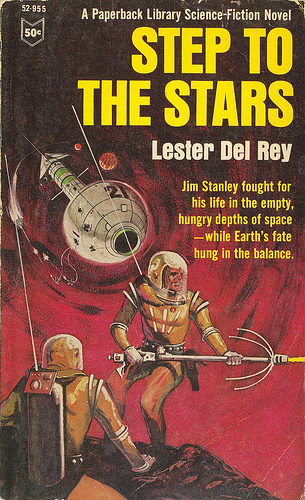
Step to the Stars by Lester del Rey

This one was published in 1954. Also, I don't recommend actually reading it because it is horribly racist and sexist.

(I think it's good that my formative SF-reading years were spent reading mostly Asimov, who isn't racist nor sexist*. I'm not sure what I would have made of the highly inflammatory and offensive preface to this book if I had read it at a more impressionable age. The preface, if you're curious, basically said that if We -- ie Americans, because no one else reads books in English, right? -- don't build a space station first, then They -- that is, the evil commies -- will kill Us all with space lasers. I'll admit I don't remember if space lasers were actually mentioned, but that was the gist. It might have been nukes, now that I come to think of it. Anyway...)

The premise is that in order to expand into space, the best approach is to build a space station and then launch ships to the moon and Mars and wherever from there. So the US government decides to build one in secret. Egads! There is no way that would have stayed secret as long as it did in the book. Sure, you might be able to put a few high-orbit military satellites up without your enemies noticing, but all the bits required for a space station? I think not. Not to mention that the actual space station would be reasonably noticeable (assuming you were looking for your enemies to do something, which given the context of the book, they would have been). But I am ranting about the wrong thing. (Also, gah! They recruited random engineers and mechanics to build the thing in space. What?! AND these people all kept quiet about the secret space station? OK, OK, moving on.)

I thought the descriptions of living in space were reasonable, particularly given that they were written before anyone had ever actually been in space. What I wanted to draw attention to was how del Rey portrayed rocket flight. The Loyal Citizens building the space station used small rocket-powered taxi ships (I hesitate to call them shuttles because of other connotations) to get around between the construction site and whatnot. (See how large this enterprise was? How could they think it would stay secret?) The way it was described, each little ship had just one largish rocket attached to it, so to break or turn, they had to point the rocket in another direction and fire. I believe gyroscopes were used to change orientation.

It's not so much that he got the physics wrong here (although rockets as we usually think of them would be much too powerful for these purposes, that is easily overcome), but the impracticality of the set up. Surely it would save time and training money to just put smaller rockets in for manoeuvring? This is what we do in the real world, more or less (the less being that the actual rockets used are nothing like the sort used to get off the ground because there's no gravity to overcome and no air-resistance either).

It's not just accurate science which is necessary -- del Rey was as accurate as he could be, from memory -- but practicality. Yes, you can use a gyroscope to flip your ship around and change direction, but think of how disorienting that would be for the pilot with all the spinning stars.


* I mean, Asimov's books aren't overfilled with female characters or anything, and they are in many ways a product of their times, but he had some competent women who were more than secretaries or love interests to the male characters. For example Susan Calvin in some of the robot stories, Arkady who was mentioned above, and several secondary characters whose names escape me. And he wasn't racist.


Wednesday, November 2, 2011

Weird Worlds: Kepler 14b

This post follows the same theme as last week's: planets in binary star systems. Last week's planet, Kepler 16(AB)b, orbited two stars which closely spun around each other. This week's planet, Kepler 14b, orbits one star, which in turn orbits another star at a further distance. This paper, by Buchhave et al (2011), is the main source of my data on Kepler 14b.

Kepler 14b is unlikely to have any sort of solid surface.
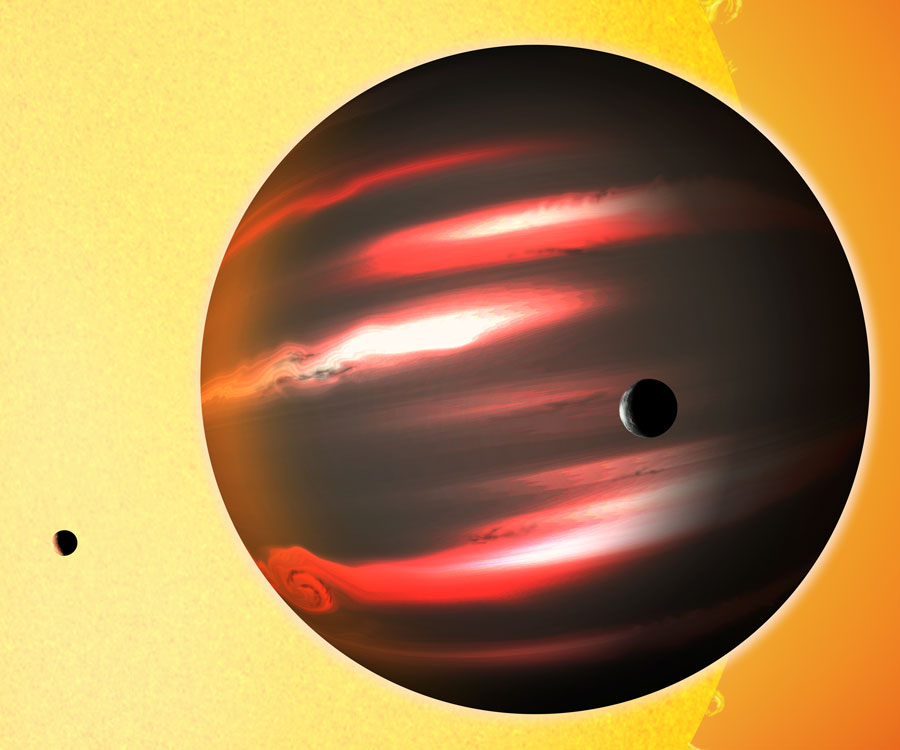
However, the two stars could look something like this. Maybe.
Honestly, I think this might be a re-purposed Io illustration
but NASA did use it on a Kepler 14b page, so who am I to argue?
Image credit: Susan Stanley for NASA Kepler Mission Education
and Public Outreach.
It turns out that unlike originally thought from the Kepler satellite data, the star Kepler 14 is not a star, but is two stars. Buchhave et al (2011) discovered this when they went and looked at it with an Earth-based optical telescope. The two stars are so close together in the sky as seen from Earth that it took fancy adaptive optics to be able to resolve them. Resolving, by the way, means being able to distinguish that there are two separate sources of light, not a single blob. The stars were too close together to be able to separate out their spectra (because this uses a different instrument than the one that images them normally), so a few assumptions had to be made, but none that should strongly affect the planet.

Some facts

The two stars that make up Kepler 14 are designated A and B with A being the one the planet orbits, but the nomenclature is a little fuzzy because the binary nature of the system was discovered later. Going on the basis that the system is 980 parsecs away (3200 light years), then the two stars are separated by 280 AU (remember, 1 AU is the distance from Earth to sun and Pluto is about 40 AU from the sun). Both stars are bigger, hotter and brighter than the sun. The sun is a G type star and the Kepler 14 stars are F types, one spectroscopic class hotter/bluer. They are 1.51 and 1.39 times the mass of the sun and orbit each other once every 2800 years.

The planet, Kepler 14b -- I am tempted at this point to make up a name for it. I dub it Keforb -- is 8.4 times the mass of Jupiter. This makes it a fairly large gas giant and definitely not habitable by human standards. Could one of it's moons be habitable? Well, let's keep looking at the planetary parameters.

The orbital period, the length of one Keforbian year, is 6.79 Earth days. That's pretty quick. If you've been playing along at home, you might remember that planets orbit faster the closer in to their star they are. Keforb is only about 0.08 AU from it's primary sun. (Mercury is about 0.4 AU from the sun.) I don't need to do any calculations to know that this planet is going to be way too hot for life, even if it had a suitably-sized moon. It's the sort of planet that's known as a hot Jupiter.

I found this pretty awesome NASA page which shows everything you need to know about Keforb (except for my awesome name) including, if you click on the buttons down the bottom, where Kepler 14's habitable zone is and the orbits of solar system planets for comparison.

So the habitable zone for this system is out past Mars's orbit, in the range of 2.17–3.56 AU, roughly where the asteroid belt is in our solar system.

Similar configurations?

OK, so there's no hope for life on the one known planet in the Kepler 14 system, but what about other possible planetary systems of similar configuration. I mentioned Tatooine last week as being similar to the planet in the Kepler 16 system. The Kepler 14 system is different because the planet orbits only one star, not both of them.

A system of this sort that pops up in fiction every now and again is a planet orbiting a red dwarf star which is in turn orbiting a larger, brighter star. I'm pretty sure I've read about this sort of thing more than once but the series that springs to mind first is the Second Sons Trilogy by Jennifer Fallon. Partly this is because it's one of my favourite series, so I may be biased. In the first book, Lion of Senet, we are introduced to a world with two suns: a small red sun and a more distant yellow sun. The world orbits the red sun and the red sun orbits the second yellow sun. The residents experience two different types of sun sets and sun rises and their "nights" are when only the red sun are up in the sky. They also get to experience side-effects from the tidal forces of a) having two suns and b) being in a relatively close orbit with the red dwarf. This means lots of volcanoes and tidal waves (I think the first book even opens just after a volcano, but I may be wrong and I don't have it on hand to check).

It's billed as a fantasy series, and it's certainly written in a fantasy style with feudalism and political intrigue and war and things (the rest of Jennifer Fallon's books are indisputably fantasy). However, there isn't any more magic than in our world which makes me tempted to say that it's technically sort of science fiction. But without laser guns (or any sort of guns. There are swords, though). Maybe "sword and science" rather than "sword and sorcery".

Anyway, I highly recommend it, not just because of the interesting celestial mechanics, but also because it's a damn good read. The hero, Dirk, goes around applying his brain, not brawn. Also, if you go in solely for the celestial mechanics, you might be disappointed because, while good for the reasons I've mentioned above, it's not quite perfect, mostly for reasons of plot.

Sometimes, it's best not to let science stand in the way of a good story. (So long as you try and at least some of the science is sensible.)

Wednesday, September 21, 2011

Responsible world-building

Something a little different this time. Despite my usual spiel about getting the science right and then attempting to elucidate said science, sometimes you just gotta make stuff up. Sometimes you really just need some FTL* spaceships or your whole plot falls over. There are only so many times you can write a story about slow space travel — or even relativistic space travel. All that I ask is a little consistency. So I'm not going to talk about building worlds in the sense of planets (there will be many other posts about that), I'm going to talk about making up convenient science in a sensible and coherent manner.

World building: not just about worlds.
Snagged from APOD.
Illustration Credit: David A. Aguilar (CfA), TrES, Kepler, NASA
Some things are physically impossible. Some impossibilities are standard science fiction tropes, and that's OK. I've mentioned FTL, there's also telepathy (which, as Asimov masterfully showed, doesn't actually require space opera or science fantasy to operate) and worm holes. I am a bit more suspicious of inertial dampeners and hyperspace, but it does sort of depend on the story. I'd lump teleportation into the former list too, but that's a good example of something that we thought was impossible that we can sort of kind of almost start to do. Scientists have teleported photons across a lab and, more recently, I remember reading about a Bose-Einstein condensate (a small collection of atoms) being teleported, but I can't find a link right now so I'm hoping I didn't imagine it.

What they're actually doing with the teleportation at the moment is teleporting the quantum state of the photons/atoms. (I say this because I'm going to talk a little bit more about it shortly.) But that doesn't really matter. If you want to have people using teleports instead of lifts, then go right ahead. But you'd better have a good reason for them to have spaceships. Or a reason, at the very least, or pedants like me will whinge about your inconsistencies on their blogs and no one wants that.

The other thing with teleportation is that at some point you are somehow going to transfer a human-sized pile of data from point A to point B. I don't really care how you do it, but it's going to be a large pile (the upper limit, if you're curious, is about 1045 bits) of data that does somehow have to be encoded and then travel. I guess the teleportation part is implying that the travelling is instantaneous (you can invoke quantum entanglement, for example). But what about the encoding? How long is it going to take to encode that sheer quantity of information? (Actually, I did a bit of rough approximating and I got about 1029 bytes** for an average-sized person because the upper bound is, well, the upper bound.)

I assume you are going to let your encoding travel at the speed of plot. That's fine, if you're going to have some arbitrary reason, plot is better than most. However, if you're encoding people so that they can teleport, say, within a building in the space of a few seconds, then you had better not have them waiting a long time for their email to download. The speed of plot is the speed of plot, but really, you can't have different speeds of plot to suit your whim. It's sloppy and it annoys people like me. If you really must have them wait for their email, you had better have a damned good pseudo-scientific explanation.

To emphasise my point:
  • So let's say a person is worth around 1029 bytes (if you want to pick a higher number, knock yourself out; it will only make your data speeds more magically fast).
  • If it takes them 5 seconds to teleport from A to B (and assuming it shouldn't matter how far apart A and B are) then that's 2.5 seconds to encode the data and 2.5 seconds to decode it at the other end. Or maybe decoding is faster. Whatever. Order of magnitude is close enough.
  • So if it takes 2 seconds to decode 1029 bytes...
  • ...that's really fast. 
  • I mean, have you ever tried to copy a gigabyte-sized movie from your computer to your memory stick? (and assuming you weren't using Vista...) A gigabyte is 109 bytes so a person is 1019 gigabytes.
  • And don't get me started on storing that much data.
But this is science fiction, so those aren't insurmountable obstacles. But they are obstacles that, once surmounted,  have vast-reaching ramifications. Like email. Or hacking into an enemy's database. So if you need slow transfer rates somewhere else, ask yourself why similar technology to what enables teleportation can't be used.

Obviously, these ideas apply more broadly than just teleportation, but that's the example I've run with. And with that I'll close this slightly sleep-deprived post.

Remember: build worlds responsibly.


* Faster Than Light, which is currently physically impossible.
**1 byte = 8 bits


Sunday, September 11, 2011

Science fiction done right: Inherit the Stars by James P Hogan

So far most of the content of this blog has been more about the science and less about the writing. Today, however, I want to highlight a book that gets the science spot on.

Inherit the Stars by James P Hogan was first published in 1978 and is now available from Baen (it's even part of their free library). It's got a bit of a "Golden Age" feel to it but it's also recent enough that the science it covers isn't very outdated.

Now, I'm not saying that every mention of science in Inherit the Stars is 100% spot on and accurate today — it can't be, there's been too much progress in the past thirty or so years — but what really makes it stand out is the way in which it presents the day-to-day science and the scientific method.

The story starts when some lunar colonists come across a space-suited body on the moon. A very old space-suited body. Human and yet very much pre-dating human space travel. And so the mystery begins.

The the book can be best described as a scientific mystery as the characters — mostly scientists — try and work out where the body came from, not to mention who it is and why they were even on the moon. The best part is, they do it in a very logical and scientific way. I found it to be a very realistic depiction of how real scientists would go around trying to work something like this out, clunky 70s technology notwithstanding.

The way it was paced, with new hints and bits of information being gradually uncovered (or in a few cases, coming to them completely out of the blue) made it continuously interesting. The main character also goes off and does other things and time passes before new information is uncovered. Unlike in Hollywood, significant scientific discoveries take time to fully understand (y'know more time than just the speed of the plot). Also, because of how the facts were meted out it was difficult to guess the ending ahead of the characters. Which isn't to say that knowing science didn't help me guess a few things before they were revealed, but it was nice not having to read about dull characters that can't put the pieces together and see what's obvious to the reader.

So there you have it, if you want to see a shining example of science done right, go read Inherit the Stars. It's free, so what's stopping you?

(I should also mention that it's the first of a series, but I haven't got around to reading the others yet, so I can't recommend them either way.)


LinkWithin

Related Posts Plugin for WordPress, Blogger...