Showing posts with label habitability. Show all posts

Friday, December 7, 2012

Year-long days and living in them

This blog post was inspired by an email conversation with someone regarding the possibility of a planet having year-long (or half-year long) day/night cycles. The original question was whether this is even possible and whether such a planet would be habitable.

From a purely astronomical point of view, this is definitely possible. There's no reason why you couldn't have a slowly rotating planet at around the same distance from it's sun as Earth is (well any reasons that do exist are fairly theoretical so we can ignore them). That said, if the planet is similar to Earth and its sun is similar to ours, then you kind of have to have the same length year because the length of the year (ie how long it takes to orbit the star) depends only on the mass of the star and the distance from it. This is due to Kepler's Laws, which I have previously discussed here. If you made no changes to star/planet distance, the year length would have to be the same.

Image nicked from Wiki here. The little red line
represents the same point on the surface of
Mercury. The numbers are the order in which
the positions happen: 6, 1, 2 are night for
the red line and 3, 4, 5 are day, roughly.

You could also have something similar to Mercury which has three rotations (called "sidereal days" which are measured relative to the stars, not the sun) to two years. Because it rotates so slowly, weird stuff happens with its solar days (the light/dark periods, completely ignoring the positions of stars) so that in one year it experiences half a solar day. Mercury is like this because it's so close to the sun. It could have been tidally locked (the same side always facing the sun – discussed further, including for Mercury in particular, here) but the gravitational effects of the other planets in the solar system caused this more unusual resonance.

However, if we're talking a planet as distant from the sun as Earth is, there's no danger of it becoming tidally locked in the sort of cosmological time frame we're currently living in. The time taken for the angular momentum between planet and star to be distributed into the tidally locked configuration takes longer the further apart they are (and the less massive when they're close enough). The Earth-moon system will eventually become more tidally locked: the moon already faces the same side towards us all the time, and eventually the same side of Earth will always point towards the moon.

But that's a bit of a tangent, back to planets with long days and nights. You could have a planet rotating as slowly/quickly as you like, but you should be mindful that the people living there would almost certainly have a way of distinguishing between sidereal and solar days. Ancient people on Earth already had this worked out (the difference between sidereal and solar days is why the stars move across the sky with the seasons).

Living there

Uranus: almost completely sideways.
If you did have a planet with a year-long day, the periods of day and night would be roughly equal in the same way they are on Earth, just scaled up. It could vary a bit depending on the planet's axial tilt (how much the line between the poles is tilted relative to the plane of it's orbit — Earth's is around 23º and changes slightly when earthquakes occur) so the more inclined the axis, the more extreme the seasons. If there was no or very little axial tilt, there wouldn't be seasons. The other variable in day/night lengths is the latitude. Further away from the equator sunrise and sunset would last longer and the shortness of winter days and length of summer days would be more extreme (as on Earth, but a different axial tilt could make this more so). If there was no axial tilt, the poles would be in a state of twilight permanently. The other extreme is something like Uranus which has a 90º-ish axial tilt so that during a southern summer the south pole points towards the sun and during a southern winter the south pole gets no sun at all. Spring and Autumn are the transition period. The equator is in twilight during summer and winter and has more "normal" days, like what we're used to, during spring and autumn.

Also, astronomical plausibility aside, I'm not convinced complicated life could naturally arise on a planet with a super-long day/night cycle, due to the long periods of boiling (day) and freezing (night). In terms of temperature-stability, probably only the twilight areas would be habitable. I suppose you could have migrating species (but that also has problems because in staying in permanent twilight they'd need sufficient landmasses connecting the two poles). Also, you'd probably get some sort of storms around the twilight zone, since the temperature would be in in a state of flux. I'm not an expert on atmospheres or meteorology, though, so that's a (-n educated) guess and I can't be too specific. But in short: our 24 hour days are what keeps Earth's temperature relatively temperate and suitable for life.

There's be fewer issues for microbial life to arise but I don't know that anything larger would be viable. Maybe at the poles: if the planet was slightly closer to its star than Earth is, there could be non-migratory life living near the poles and with a stable orbit and rotational period, it should survive. Since the non-polar regions wouldn't have naturally arising complex life, there could be with completely different ecosystems/forms of life at either pole with only something like microbial ancestors connecting them.

Thursday, March 22, 2012

Destroying the Earth

This post is inspired by a question I got on my Ask Tsana page. Katrina asked:
I'm trying to come up with a simple (haha) and plausible way to destroy a planet to kick things off for a story but am having trouble getting the science right.

One of the first sites I visited to figure this out was this Geocide site: http://qntm.org/geocide

Under the Geocide in fiction page (http://qntm.org/fictional), the author says, "The Sun Crusher is a relatively small ship which carries a small number of missiles, each of which is tough enough to shoot into the centre of a star and cause it to go nova, which would certainly annihilate any nearby Earthlike planet."

My question is, don't stars that get massive enough to go nova have brief lives and thus not live long enough for a habitable planet to develop? I'm just basing that on Wikipedia (http://en.wikipedia.org/wiki/Planetary_habitability#Massive_stars), though, so I was wondering if you could tell me more. Can the habitable zones of massive stars ever actually be inhabited (and then later die in a supernova)?
Excellent question!

The answer depends a bit on to what extent you want to destroy your planet. Geocide pretty much defines "destroy the Earth" as "annihilate in the particle physics sense, or dismantle/tear apart on either a macroscopic (large) or microscopic scale". He doesn't count Earth as destroyed if there's still a planet-like object there. However, for many narrative purposes, rendering the Earth entirely uninhabitable will do the trick.

So, leaving the dismantling and annihilation to Geocide (the website is amusing, although be warned that some of the details of physics are slightly off, but close enough), what are some ways of rendering Earth unfit for life?

Destroy all humans

So maybe what you want is not so much to destroy the planet as to destroy all the people on it. That's not really that hard. Or, at least, destroying most of the people isn't that hard. Some methods, which generally don't require elaboration:
  • Widespread nuclear holocaust
  • Some sort of plague
  • Climate change. No, really, melt the icecaps and raise the temperature enough so that it is too hot and humid to survive without air-conditioning and eventually you'll run out of people. Or throw in some crazy weather disasters too. The Rhesus Factor by Sonny Whitelaw touches on this a bit (see my review here), also on the plague scenario.
  • Very large volcano eruption. This is one of the things thought to have caused at least one of the prehistoric dinosaur(ish)-era extinctions. A less epically large volcano (actually, a few of them probably contributed) in 1816 caused the Northern Hemisphere (or Europe and America at least, not sure that Asia was affected as strongly, but google it if you're interested) to not thaw out in the summer. This was "the year without a summer". (And now I have that Rasputina song stuck in my head. Click the link and you will too.)
  • Asteroid -- this one's a toss up between destroying all (most) humans and destroying all life. Ultimately, I suppose it's a matter of scale. Let's say this asteroid kills human life but not necessarily all the microbes. It would be somewhat similar to the volcano in the throwing dust and rubbish into the atmosphere, blocking out light and generalised doom.
  • Magnetic field of the Earth turning off in the process of flipping. This is something that happens spontaneously every so often. It's bad because a whole bunch of ionising radiation (miscellaneous charged particles) from space is kept at bay thanks to our nifty magnetic field. Taking it away would give us a lot more cancer and sterility and could wipe out a large chunk of humanity. Microbes and probably a lot of (some?) sea life would be OK. Good luck artificially killing the magnetic field, though.
All of those methods probably won't wipe out all life and, frankly, it's possible/likely that some tenacious dregs of humanity will hold on. Generally, evacuation is the surest way to avoid these apocalypses. Or prevention, but that's only really applicable in two or three of those scenarios.

Destroy all life

Why aim low? Bugger humanity and everything else with one of these sterilising scenarios:
  • Self-replicating nanobots (von Neumann machines) which consume all the [insert important chemical here -- carbon is popular]. This is also know as the grey goo scenario. Depending on the nanobots, this is likely to render the Earth inhospitable to life while they're still doing their thing.
  • Large asteroid/comet or small moon colliding with Earth. Where a small impact would cause natural disasters (earthquakes, tsunamis) and potentially block out the sun with dust, a large impact could do many detrimental things. It could change the Earth's rotation, knock it into a slightly different orbit (or send it spiralling into the sun, but that would require a particularly large body), it could smash the Earth into chucks (which, thanks to gravity, would probably later re-collide to form Earth 2.0), render an appreciable fraction of the surface molten... Actually, I now have a brilliant mental picture of two or six asteroids hitting the Earth simultaneously from opposite sides and sort of turning it into molten goop... Not actually sure that would work with two, but six seems faintly plausible in a hand-waving way. Anyway, point is, hit Earth with something big enough and bye-bye life. Depending on conditions, it's possible life could spontaneously arise again, depending on how reliably life arises and how long it takes (before, for example, the sun goes red giant).
  • Supernova/nearby gamma ray burst. The main problem with this notion is the lack of suitable supernovaing stars nearby, as Geocide mentions. However, you mentioned destroying a planet, not specifically Earth. A planet orbiting a star when it went supernova would be toast. Probably, it would be fairly inhospitable before the actual explosion, if Eta Carinae is anything to go by. A planet orbiting a non-explosive star near another star that went supernova could well end up sterilised, which is what I talked about in my post about the galactic habitable zone (and near in the astronomical sense isn't that close by). And, actually, if we're talking about Type Ia (which is to say not core-collapse supernovae; not the death throes of a large star) supernovae, which involve white dwarfs and (probably) ordinary stars going through their red giant stage, we might not even see the supernova coming. That's a slightly unsettling thought.
  • Some sort of implausible doomsday device. Really, you can make up whatever rubbish you want for this one if you're so inclined. (But if you do, I don't promise not to tear your science apart if I read/see/whatever it.)

A few words on supernovae and novae

Supernovae are how stars bigger than about 8 solar masses end their lives. Novae are not small supernovae. I know, that's what I originally learnt as a child/teenager by osmosis from SF novels. I think the connection between the words nova and supernova are primarily historic; a star suddenly appeared or became much brighter and acquired the label (nova meaning new), but the different causes weren't understood until much more recently.

Stars smaller than around 8 solar masses don't explode. They expand relatively slowly (well, y'know, compared with a supernova explosion) when they run out of hydrogen to fuse in their cores, then contract then expand again when they run out of helium. At this point, a large star going through the stages much more rapidly would collapse again under its own gravity and then kaboom supernova. Smaller stars aren't massive enough to collapse again under their own gravity. Instead, after the helium is used up, leaving either carbon or oxygen (or a combination) in the star's core, what was once the stellar atmosphere will keep expanding indefinitely. Initially, it forms a planetary nebula (not actually anything to do with planets), but eventually it will all dissipate and be undetectable. What's left behind is a white dwarf; basically a small, hot star which was once the core of the red giant star.

Suppose there were two stars near each other, and one went through the red giant to white dwarf steps before the other. When the companion star undergoes its red giant phase, maybe it expands enough that some of it's outer atmosphere is close enough to the white dwarf to accrete onto it. The reason these stars didn't supernova is because they were too small. There is a very definite upper limit to how massive a white dwarf can be before it collapses in on itself and explodes. That limit is 1.4 solar masses (but remember, most of the original star's mass is lost when it's doing the expanding thing, which is why the original star can be up to 8 solar masses). If the companion star accretes too much matter onto the white dwarf, the white dwarf will go over the 1.4 solar mass limit and explode. This is a Type Ia supernova. For the record, the alternative explanation for Type Ia supernovae, which is presently gaining more traction, is two white dwarfs colliding.

Since white dwarfs are small (1.4 solar masses in a volume roughly the size of Earth), they're not very visible, especially once they start to cool down. See how we might not see that kind of supernova coming? It could potentially not be that difficult to artificially orchestrate, either, if you have enough spare matter to throw at a conveniently placed white dwarf. Well, y'know, sort of easier than some large-scale astro-engineering projects could be.

 Back to the point

 If you recall the original question, Katrina asked:
My question is, don't stars that get massive enough to go nova have brief lives and thus not live long enough for a habitable planet to develop? Can the habitable zones of massive stars ever actually be inhabited (and then later die in a supernova)?
In general, the bigger the star, the shorter its life. Our sun's total lifespan is something like 10 billion years, a blue giant could live only 10 million years, and a red dwarf's lifespan is in the trillions of years. The current theory is that it took a couple of billion years for (very basic) life to arise on Earth. It then took a long time to progress to where we are now (Earth's age is 4.6 billion years, from memory). If we see this as typical, it seems like there isn't enough time for life to arise around a much larger star. On the other hand, if there was a planet at a suitable distance from the star, it could be inhabited by sufficiently motivated humans with spaceships. They wouldn't be able to stay there indefinitely, but even a few million years is more than ages on human scales, so that's OK.

The other issue is metallicity. Planets like Earth have rocky cores, which means they have high metallicity. Remember, metallicity in an astronomical sense refers to the abundance of elements heavier than helium, not necessarily just the things chemists/sane people identify as metals. Very massive stars generally form in metal-poor environments and are metal-poor themselves. This makes the presence of heavier elements as requires for rocky planet building less likely. Not necessarily impossible, but much less likely.

So yes, you can potentially have planets around the sort of stars that go supernova and, while native life probably won't get very complex if it arises at all, said planets could be inhabited by plucky humans.


Friday, October 21, 2011

Bunch of links, mostly outdated

First up, square Earth anyone? Forget realism, let's just have a think about what an Earthlike planet would be like if it were a cube. Puts me in mind of the planet builders in Hitchhikers' Guide to the Galaxy. Brought to you by Discovery News.

Second, the Planetary Habitability Laboratory talks about brightnesses of the various planets in the solar system and also of exoplanets. An interesting read, particularly if you enjoyed my old How Bright is the Night? post.

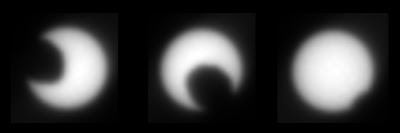
Martian moons eclipse the sun in these NASA photos from the Opportunity rover:
Credit: NASA/JPL/Cornell

Enceladus pics from Cassini. Enceladus is one of Saturn's moons, most famous for it's ice geysers.

Proposed space robot to cannibalise old satellites which have previously been boosted up to "graveyard" orbits. Many mentions of zombie satellites and grave robbing associated with this one ;-p . From New Scientist.

And finally, laser driven fusion in California. From New Scientist again.

Happy weekend, gentle readers!


Wednesday, September 7, 2011

Habitable Galaxies - Part 3: Galaxy Environments

This is part three in a series of posts about habitable galaxies. Post 1, covering types of galaxies and galaxy mergers, is here, last week's post 2 talking about active galaxies is here and this earlier post on the (most) habitable areas of our own galaxy is also relevant.

[Unrelated to the topic, but I wanted to say that I've been playing around with Blogger settings and made a favicon (the little icon that helps distinguish this tab from others) and an iOS home screen bookmark button. So now, if you're using Chrome or the latest version of Firefox (I suppose it should work for other versions of Firefox, but the second to most recent version failed for me) check out the little purple telescope on the white background. And if you're reading this on an iDevice, you can even see said telescope with a glossy Apple finish. What fun!]

So this week I'm talking about different galaxy environments. That is, the environment where a galaxy might be found, not environments within a galaxy (although I briefly covered that earlier). Let's start by looking at what sort of environments galaxies can be found in.

The universe has environments now?

What we mean when we talk about galaxy environments is more or less talking about how many other galaxies are nearby. It's possible to get isolated galaxies or galaxies clustered together in groups of varying sizes. Our galaxy, the Milky Way, is part of a group creatively labelled the Local Group, which has about forty-five members. Of these, the Milky Way is the second largest (probably), with Andromeda the largest. Other members include the Triangulum Galaxy, the Large and Small Magellanic Clouds and a non-literal pile of dwarf galaxies.

As far as classifications go, smaller collections of galaxies are termed groups, while larger collections—containing upwards of fifty more densely-packed members—are called clusters. This may seem like a bit of an arbitrary distinctions (what makes the Local Group a group and not a cluster if it has almost fifty galaxies in it?) but it's important to remember that while we know the Local Group is full of dwarf galaxies, other groups and clusters are too far away for us to be able to see their smaller members. So when we say a cluster has fifty members, we mean that many medium to large galaxies.

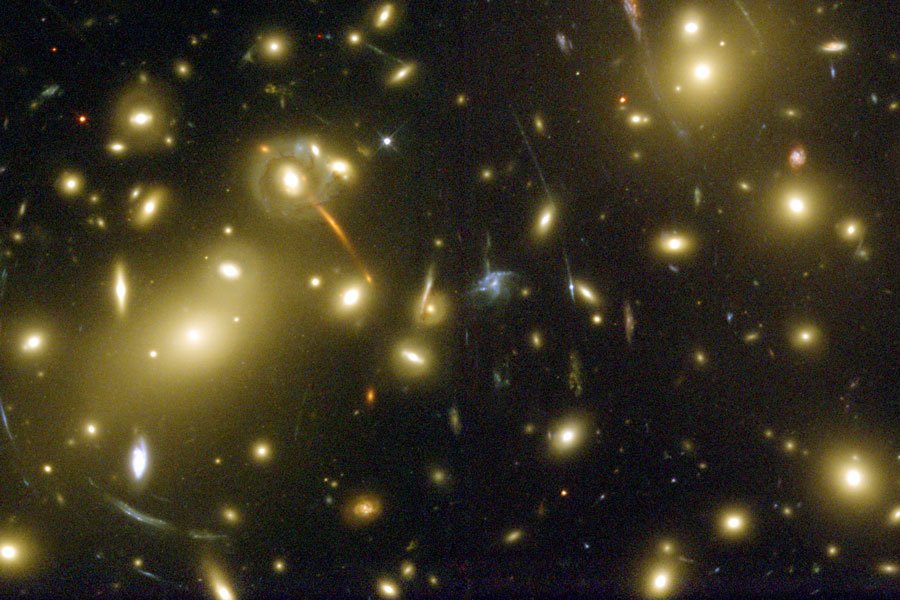
Galaxy cluster Abel 2218, from APOD.  The cluster is also a lens, but that's another story.
Image credit: Andrew Fruchter (STScI) et al., WFPC2, HST, NASA


Spot the difference

So what does it matter where a galaxy is, anyway? Well, when it comes to life, most of what determines habitability is internal rather than external to the galaxy. The only external influence I can think of which could inhibit life (and jump in in the comments if you disagree!) would be a nearby AGN blasting at the galaxy. And even then, I don't think it would prohibit life everywhere in the targeted galaxy, just in the parts being most irradiated.

However, there are some properties of galaxies which are dependent on their environment. In a denser environment, where there are more galaxies, there had to have been initially more matter for those galaxies to form from. Because there was (by chance) more matter in that area, it was more strongly gravitationally attracted to itself and hence formed earlier compared with a lone galaxy in a sparser environment. Our current leading theory of galaxy formation and evolution is called hierarchical assembly and one of its tenets is that larger (more massive) objects form first. In a sparse environment, matter is by definition more spread out and hence, as well as being more weakly gravitationally attracted to itself, has further to travel before it can clump and collapse into a galaxy.

The corollary to this is that big galaxies in clusters are older and more evolved (because have gone through more mergers, partly thanks to there being more proximate galaxies), while isolated galaxies are younger and have undergone fewer interactions with other galaxies.

Living around

As far as life developing in other galaxies is concerned, it seems pretty trivial now to make the conclusion that life would have had the opportunity to arise earlier in cluster galaxies and later in isolated galaxies. Group galaxies such as our own would fall somewhere in the middle.

On the other hand, cluster galaxies would have undergone more mergers, have a greater chance of having been in the path of an AGN and are more likely to be elliptical. Those first two points are merely hazards to the development of life, but the latter also gives rise to different experience for that life compared with our Milky Way existence. What off Earth am I talking about? The night sky.

Our night sky is covered in stars with the disc of the Milky Way running through them. An elliptical galaxy, not having a disc component, would not have such a band of dust, gas and denser stars. In fact, they wouldn't have much dust or gas at all, which means no nebulae and significantly fewer hints as to where stars even come from. Depending on the exact placement of the planet, they would likely have a more or less uniform distribution of stars in the sky, maybe with a brighter patch in the direction of the galactic core. Life that evolved in an elliptical galaxy might not ever get to observe young stars in their vicinity, let alone star formation. How might their understanding of astronomy and, in particular, stellar astrophysics be shaped by this? I think it's an interesting question to explore.

On the other end of the scale, we have isolated galaxies which could also harbour life (if they're big enough to develop sufficient metallicity in sufficient time). But if it's truly isolated, it might be that it's not possible to observe external galaxies with the naked eye. (We can, but they sort of look like stars until you put a telescope to them.)  Maybe such a civilisation would skip past the part of astronomy that labelled Andromeda and the Magellanic Clouds as nebulae but who knows how they might interpret distant blobs and spirals in the sky once they had the telescopes to see them? Also remember that isolated galaxies are going to be smaller and form later. By the time life even evolved there, would there be many other spiral galaxies left? How much more powerful would dark energy be at that point? How quickly would all the other galaxies be retreating from them?

How empty would the sky be?

Wednesday, August 31, 2011

Habitable Galaxies - Part 2: Active galaxies

This is part two in a series of posts about habitable galaxies. Post 1, covering types of galaxies and galaxy mergers, is here and this earlier post on the (most) habitable areas of our own galaxy is also relevant.

A major attribute of galaxies is whether or not they are active. There are a few different things active can mean—actively star-forming, for example—but what I want to focus on today is whether they have active nuclei.

What's in a nucleus?

At the centre of our galaxy and most other large galaxies, there is supermassive black hole. I have briefly mentioned black holes in the past and I will eventually get around to writing a dedicated post on them. Honest. What you need to know to understand their role in galactic nuclei is as follows:
  • They are very small and very dense.
  • The supermassive part means that they range from around a hundred thousand times to the mass of the sun to billions of solar masses. The Milky Way's central black hole was calculated in 2008 (by this group) to be about 4.1 million times the mass of the sun. In kilograms that's about 8 x 1036 or an 8 followed by thirty-six zeroes.
  • As their name suggests, supermassive black holes are very massive. What massive really means (in any physics context, not just with regards to black holes) is that they exert a strong gravitational force.
Before you ask, we don't really know where these come from—there are theories, but no single one is yet the most accepted—but we do know that they must form early on in a galaxy's life (possibly even before the stars form, depending on which theory you subscribe to) and their evolution is closely tied with the host galaxy's.

Other things that can be found in the centres of galaxies include stars, dust and gas. Although following the orbits of stars in the centre of our own galaxy is what convinced us there was a supermassive black hole there (nothing else could be so massive and so small), most of what those stars do is simply orbit. (Yes, it is possible for one to fall into the black hole and yes, that would be very interesting and would generate a lot of energy but from what we've observed, the Milky Way's central stars seem to be in stable orbits. If you are interested in reading a (short and fairly uncomplicated) paper about S2, the star closest to our supermassive black hole, you can find it here.

When there is gas or dust in the vicinity of the black hole, it will tend to spiral inwards until it eventually passes the event horizon*. As this occurs, huge amounts of energy are released, outshining all the stars in the galaxy. This is what is called an active galactic nucleus. It is also, more or less, what causes quasars, the most distant objects we observe (because they're so bright we can see them very far away, you see).

Here is a nice NASA / ESA Hubble Space Telescope picture of jets coming off the nearby AGN, M87.


 * The point of no return.

Active life?

So the next question, the crux of this post, is can we have life in a galaxy with an AGN? The short answer is maybe. Of course, we have no concrete proof either way. Sagittarius A* (yes, that asterisk is part of the name), our central black hole, is not currently active** and we have even less evidence for life in other galaxies than we do for life on other planets within the Milky Way. The slightly longer answer is, it depends. There is evidence to suggest that the Milky Way was active in the past few million years and since there is still life on Earth, we can suppose that an AGN doesn't necessarily sterilise a galaxy.

Some months ago, some colleagues and I got into a discussion regarding whether a really bright AGN (even one unrealistically bright for the size of our galaxy and Sag A*) could wipe out life. We came to the conclusion that it would only do so if you were standing close enough to it. From memory, we estimated that if a planet somehow managed to find itself*** in an orbit a parsec from the active black hole, the black hole would through about as much light at it as the sun does. However, AGN emit much harder radiation than stars, meaning that a larger proportion of the energy would be at X-ray and gamma ray frequencies, both unfavourable to life. If we put the planet where Earth is, then even with nothing blocking the way we don't have a very high increase in dangerous radiation.

However, something is blocking the way: dust. As far as we know, dust near the black hole is requisite for turning on an AGN. But even ignoring that, there are many clumps of dust in the disc of the Milky Way. So many that we are unable to see through it all if we look along the disc. (Schlegel et al surveyed the dust in the galaxy and came up with this map. White bits have more dust, black bits have less.) In essence, as well as making it hard for us to notice supernovae near the centre of the galaxy, this would help shield us from AGN light. I wouldn't be surprised if we didn't immediately notice the AGN. Of course, closer in to the centre of the galaxy you have more problems and it starts to depend more on exact placement. Also, the dust actually only shields visible and UV light, so once you get too close the more concentrated X-rays and gamma rays become more of a problem.

On the other hand, a planet is less likely to form in the path of an AGN jet, simply because there are fewer stars in that direction. If it did, however, it would definitely not survive the experience.

Elliptical galaxies have significantly less gas in them (some might say no gas, but there would have to be some in the centre for the AGN to turn on, not to mention dust created by dying stars).  This would mean less shielding, making the AGN more noticeable. The bigger barrier to surviving the experience, however, would be the fact that elliptical galaxies are larger with with more massive central black hole which would generate a more energetic AGN (with more detrimental radiation). The final point to consider is that theories suggest AGN in elliptical galaxies are turned on thanks to dust being stirred up (into the black hole) from a merger. So the merger event could have some impact (see last week's post) on continued habitability. The dearth of dust also means that new planets would not be able to form in an elliptical galaxy.

So to summarise, an AGN wouldn't necessarily sterilise a galaxy, but might kill off life that had set up too close to the centre. Depending on an inhabited planet's placement in a galaxy, an AGN might not have a very large effect on daily life. There are a few additional problems for elliptical galaxies, but again, so long as the planet isn't too close to the centre (and its sun doesn't migrate to the centre of the galaxy too quickly), there's no reason for life to automatically be extinguished. Score 2 for extragalactic life.

Next time: the habitability of galaxies in different environments in the universe.


** Probably.
*** I personally really don't think a planet would be able to form in that region thanks to the density of stars and subsequent gravitational forces. I don't have any hard evidence to support this, but to me it makes sense.

Wednesday, August 24, 2011

Habitable Galaxies - Part 1: Galaxy types and origins

Hello blog readers, I'm back :-)

I've talked about habitable planets and habitable parts of our galaxy before. Now I am going to talk about the possible habitability of other galaxies. It's a somewhat lengthy topic so it'll be spread out over a few weeks. Today, some background.

Miscellaneous types

There are two main classes of galaxies: spiral and elliptical. (Also known as late type and early type, but those names are silly as will soon become apparent.) These are called morphological types because they relate to the physical shape of the galaxy. You can also get dwarf galaxies, which are very small—on the scale of galaxies, although they're still billions of times the mass of our sun compares with tens of trillions of suns for galaxy like ours.

Once we get past galaxy shapes there are all sorts of interesting things galaxies can be doing. For example, you can have active (or not active) galaxies, galaxies which are merging, galaxies where stars are actively being born, galaxies filled with old, dying stars, galaxies with high or low metallicities, isolated galaxies and galaxies part of giant groups or clusters. There's a lot of variety, even within each of these (not always mutually exclusive) classifications. You think the two hundred billion* or so stars in our galaxy are a lot? There are eighty billion galaxies just in the observable universe. Which ones, other than carbon copies of our own, can we live in? Let's first have a look at where galaxies come from.

* I use billion here in the American sense to denote 1 000 000 000 = 109 for three reasons: 1. it's most commonly used this way in the scientific community, 2. the word "milliard" (as in the British counting convention) has fallen into disuse and 3. "thousand million" (the replacement for milliard) sounds clunky.

Galactogenesis

As Dougalas Adams said, in the beginning there was nothing, and then it exploded. After that, if we fast forward a bit (which, current theories suggest, the universe did), matter which at this stage consisting mostly of hydrogen with a little bit of helium that was fused in the primordial fires of the big bang, starts to clump together.

(At this point I feel the need to mention that I'm more or less ignoring dark matter because in this context it needlessly complicates things. But it's there too. Just so you know.)

These clouds then collapsed into discs and clumpiness within the discs led to star formation (that is, clumps of hydrogen collapsed in on themselves to make the first stars). So the first galaxies were all disc galaxies, another name (more or less) for spiral galaxies. However, not all clumpy areas are the same size, so you might get a clump of galaxy-sized clumps and then get a bunch of galaxies forming close together. Over time, gravity will pull these galaxies closer together and they will eventually merger (I'll get to mergers shortly). On the other hand, you could have an area of the universe where not much matter ended up and there was only enough stuff to make a few small galaxies.

If you look at our Local Group, there are two big spiral galaxies—ours and Andromeda—a medium-sized galaxy—the Large Magellanic Cloud—and a slew of tiny dwarf galaxies. Some of these dwarf galaxies are in the process of raining down onto the Milky Way or Andromeda. Others are further away and are falling into one of the big galaxies much more slowly. Andromeda and the Milky Way will merge on a time-scale of five or so billion years. Eventually, all the galaxies in the Local Group will merge into one giant Local Structure.

But I'm getting ahead of myself.

So current theory has galaxies being born as discs. Where do the elliptical galaxies, the round or oval balls of stars, come from? The currently popular answer is through mergers.

Mergers

On a cosmic time-scale, small galaxies are constantly falling into (accreting onto) larger galaxies. Every so often two medium-sized or larger galaxies might merge. These events are called major mergers. There are two possible outcomes of major mergers between spiral galaxies:
  1. A new, larger, spiral galaxy. There will often also be a period of more vigorous star formation after a major merger like this thanks to the gas and dust in the galaxies being shaken up and combined with more gas from the other galaxy. It is thought this outcome happens when there is enough spare gas in the two progenitor galaxies.
  2. An elliptical galaxy. When there isn't enough spare gas in the two merging galaxies, the stars don't rearrange themselves in a nice flat pattern (exactly why is unclear, I think) and we're left with a roundish blob of stars.
There is no question that minor mergers—small galaxies accreting onto larger ones—don't pose much of a threat for life. After all, small galaxies have been accreting onto the Milky Way far longer than we've been around. Whether planets will survive major mergers is another question. In principle, most planets should be more or less OK. Despite the billions or trillions of stars involved, they are actually quite spaced out within galaxies (for example, the nearest stars to our sun are more than four light years away). Therefore, the chances of stars colliding are very small, at least at the sort of distances from the centre of the galaxy where we find ourselves. If the stars don't pass too closely together, their planets will also remain unharmed.

Of course, it's possible that a particular planetary system could be unlucky, but then it could also be unlucky enough to have a supernova explode nearby. In fact, if enough gas nearby is stimulated into forming stars during and after the merger, it could be that a future supernova (from a newly formed massive star) is more of a threat than the actual merger itself.

Finally, will the Earth survive Andromeda and the Milky Way merging? Not exactly, but not because of the actual merger. You see, the sun is scheduled to turn into a red giant before we get to the merger stage, so Earth as we know it will be long gone already.

But wait, there's more

This isn't the full story, of course. Mergers also lead to increased activity in galactic nuclei, but that's a topic I'll be covering next week. Watch this space!

Wednesday, July 27, 2011

Weird Worlds: Gleise 581

A quick note before I jump into the meat of this week's post. From next week, I'm going to be on holiday for about two weeks. I'm going to try to queue up a couple of blog posts to self-update while I'm gone, but if something goes wrong I may not be able to do anything about it until I'm back in normal-internet land.

So this week, I thought I'd do another entry in my Weird Worlds series. This time about a planetary system which has gained quite a bit of media attention: Gliese 581. (Pronounced something like "glee-zeh", if you're curious.)

You may have heard of Gliese 581 discussed in the media with phrases like "second Earth" or "super Earth in the habitable zone" being thrown around. So how like Earth are we talking? Which part of the habitable zone? What sort of star is Gliese 581 anyway? Read on!

The Star

First the basics: Gliese 581 (which I will now refer to as Gliefeo because I am lazy and typing numbers is annoying it rolls off the tongue better) has four confirmed planets and two unconfirmed planets. For the sake of not getting too carried away I will focus on the four confirmed planets, although it was one of the unconfirmed ones which drew a large slice of media attention.

Gliefeo itself is a red dwarf star only about a third of the mass of our sun and a bit less than a third of the size. This means that to be within the habitable zone, its planets need to be significantly close to it than Earth is to Sol. Furthermore, the stellar environment these planets will be living with is very different to ours. Here is a nice Space.com article about it.

All of Gliefeo's planets were detected using the radial velocity method.


The Planets

As I mentioned above, Gliefeo's four confirmed planets are all quite close to their sun. In fact, as the image below (taken from my favourite exoplanet app) shows, all four are well within the orbit of Mercury (the grey circle). And the second image below (also taken from my favourite exoplanet app) shows two blue circles indicating radial distances of 0.1 AU and 0.3 AU (an AU is the distance between Earth and sun).

Gliese 581 and its four confirmed planets designated, from innermost to outer: e, b, c, d. The grey outline shows where the orbit of Mercury would be if Mercury's orbit were picked up and plonked around Gliese 581. The green annulus shows the habitable zone for Gliese 581 and both Gliese c and d are within the habitable zone for at least part of their orbits. Image from Exoplanet iOS app by Hanno Rein.

A representation of the Gliese 581 system. The inner blue outline denotes an orbit of radius 0.1 AU and the fainter outer circle (click to enlarge) shows an orbit of radius 0.3 AU. The four planets from inner to outer are designated e, b, c and d. Image from Exoplanet iOS app by Hanno Rein.

Some technical details on each of the planets (all taken from the Extrasolar Planets Encyclopaedia) :
  • Gliese 581 e:
    • Furthest distance from Gliefeo: 0.03 AU
    • Length of year: 3.15 Earth days
    • Mass: 1.94 Earth masses
  • Gliese 581 b:
    • Furthest distance from Gliefeo: 0.041 AU
    • Length of year: 5.37 Earth days
    • Mass: 15.64 Earth masses = 0.91 Neptune masses = 1.08 Uranus masses
  •  Gliese 581 c:
    • Furthest distance from Gliefeo: 0.07 AU
    • Length of year: 12.9 Earth days
    • Mass: 5.36 Earth masses
  • Gliese 581 d:
    • Furthest distance from Gliefeo: 0.22 AU
    • Length of year: 66.8 Earth days
    • Mass: 7.09 Earth masses = 0.41 Neptune masses = 0.49 Uranus masses
The last two planets, c and d, are the most interesting because of their location in the habitable zone.

Habitability

So are the two outermost planets of Gliefeo habitable? Well, probably not. In fact, chances are, none of these planets are able to support Earthlike life. Ignoring the issues with the star itself, as mentioned in the Space.com article I linked above, there are problems with all four planets.

Gliese 581 e is the closest to Earth in mass which, depending on its size (and composition) could mean that we could safely walk upon its surface from a gravitational point of view (well, safely is relative, but we probably wouldn't die instantly). However, it's so incredibly close to the star that it would definitely be to hot to support life.

Gliese 581 b is the largest of the four at around the size of Neptune. This almost certainly makes it a gas giant with a very dense atmosphere that would crush us if we tried to find a surface. It would also be very hot, not just because of it's proximity to the star, but because of the insulating effect of that thick atmosphere.

Gliese 581 c skirts the inner edge of the habitable zone, probably making it too warm for comfortable life. It's heavier mass also suggests a thicker atmosphere than Earth's (although this is purely speculation) and it could be more similar to Venus in terms of climate. That is to say: very inhospitable. It's surface gravity would probably also be a bit too strong for us, though this would depend a bit on composition.

Gliese 581 d falls into the class of planets somewhere between Earthlike and (mini) gas giant. We're not completely sure at what mass point planets stop being rocky and turn into mini gas giants.

(Side note: the mini and the giant should really cancel out, shouldn't they? Maybe we should call them gas balls to distinguish from larger gassy planets like the gas giants Jupiter and Saturn. But then, where would you draw the line? I suspect it would end up depending on the composition of the gas at lesat partially.)

So while Gliese 581 d spends roughly half its time in the habitable zone and half beyond it, it's probably not inhabitable itself. However, if it had any rocky moons like the solar system gas giants we know and love, those moons have a reasonable chance of being habitable. With the added advantage that they're going to be (probably) tidally locked to the planet, not to the sun, allowing the sun to more evenly warm its surface.

It's interesting, really, that of all the exoplanets discovered so far—not just around Gliefeo—the area most likely to be habitable is a moon of a gas giant. Really that says more about our detection techniques than anything else, but it does suggest some interesting possible world building.

Requests?

As I mentioned in the intro, I'm going away and hope to have some blog posts prepared in advance. However, my brain is all used up organising travel-related things without much room left for thinking about stories or reading new articles (my primary sources of blog post inspiration). So if any of you lovely readers have any requests for future posts, drop me a line in the comments!

Wednesday, July 13, 2011

The Galactic Habitable Zone

In the past, I've talked about the habitable zone around stars where water can exist as a liquid. This week, I'm going to talk about the galactic habitable zone which is the area in a galaxy where conditions are sufficiently hospitable for life to develop on planets which themselves are in an appropriate stellar habitable zone. Unlike the stellar habitable zone (also called circumstellar habitable zone), some aspects of the galactic habitable zone apply more broadly to theoretical life forms which might be completely different to the type of life we've encountered on Earth.

This post has been inspired by an article I came across on arXiv.org: A Model of Habitability Within the Milky Way Galaxy by Gowanlock, Patton & McConnell, which I will henceforth refer to as GPM. They constructed a few models of our galaxy and ran simulations to see which regions could be habitable.

What aspects should we care about?

The parent star
The sun of a potentially habitable planet orbits needs to be small enough that it survives for long enough for life to develop. Remember that more massive stars have shorter lifetimes and die explosive, sterilising deaths. The general consensus is that large, blue stars don't last long enough for complex life to develop. Even if a planet survives the actual supernova, its atmosphere would have been obliterated in the explosion and the corpse of the star—either a neutron star or a black hole, depending—wouldn't be very hospitable either.

Nearby stars
By a similar token, we don't want there to be a large short-lived star too close by either. A nearby star going supernova would also be quite bad for potential life harbouring planets. You don't have to be right next to a supernova for the gamma rays (and X-rays and cosmic rays) to do some serious molecule-killing sterilisation. However, if nearby supernovae happen early in the planet's history, there shouldn't be a problem with life developing later on (after the ozone layer heals).

GPM come to the conclusion that, depending on the type of supernova, it could sterilise planets within a range of 2-27 parsecs (6.5-88 light-years). The range is so broad because supernovae come in a variety if flavours from the dying stars I mentioned earlier, which can be of all different masses, to binary stars where the larger one throws off its outer layers first, turns into a white dwarf, cannibalises its partner and then explodes from over-eating. The latter are more bright and will on-average sterilise planets within 18 parsecs (59 light-years) whereas an average star-dying supernova will sterilise within 8 parsecs (26 light years). For a bit of perspective, the our galaxy is about 30 000 parsecs or 100 000 light-years in diameter.

As an aside, I should also mention that there is a theory that some past mass extinction events on Earth were caused by supernovae. Googling "extinction supernova" brought up a lot of hits for different extinctions. Here is one of the top hits, chosen a bit arbitrarily.

Finally, GPM conclude that there is no where outside of the central 2500 parsecs of the galaxy (which they didn't consider in detail) where there are always going to be too many supernovae for life to develop, where they've defined the time taken for complex life to develop as four billion years. That's four billion years either from the time the planet forms or from the time it gets sterilised by a nearby supernova.

Metallicity
This is sort of a less obvious one. Most of the universe is made of hydrogen and helium and a little bit of other rubbish. Although chemists define metals in a fairly specific way, astrophysicists tend to lump anything heavier than helium (that is, elements whose atoms have more than two protons in their nuclei) into the “metal” category.

Rocky planets are made out of, well, rocks rather than hydrogen or helium and if there are no heavier elements around, we'll only get gas giants forming. Heavier elements are produced when stars die, either in a supernova or in the more mundane red giant phase that our sun will eventually go through. Therefore, rocky planets can only form in areas where there have been enough stellar deaths to seed the interstellar medium with heavier elements. How big stars are depends mainly on how much gas there was around when they formed. Consequently, bigger stars are able to form closer to the centre of the galaxy (in the most dense environment) earlier, die explosively and leave metal-enriched dust behind. Then, when later generations of stars form, there is more chance of rocky planets forming around them.

The most metal-poor areas of the galaxy are the outer edge and the halo which is the spherical and sparsely populated area surrounding the disk of our galaxy. The spiral arms, where we are (if you're wondering, we're about two-thirds of the way out from the centre, close to the middle of the stellar disk). The other thing to note about metallicity is that it increases over the lifetime of the galaxy.

GPM looked at stars with lifetimes longer than four billion years whose planets escaped being irradiated by a nearby supernova for at least that period of time as well. Most of the habitable planets exist close to the centre of the galaxy, with half of them between 2500 parsecs and about 4000 parsecs, but life was still possible (though much sparser) up to the edge of the galaxy. (Remember, Earth is around 8500 parsecs from the centre.)

Other planets
I'm only going to cover this one briefly. The presence of other planets in any given system with a habitable planet could stuff around with our habitable planet. Our searches for extrasolar planets have found a lot of “hot Jupiters”—gas giants very close to the star—and our current theories of planetary formation suggest that these got there by migrating in after forming much further out. Such a migration would almost certainly spell terminal trouble for the previously habitable planet.

So where is this galactic habitable zone of which you speak?

Previous studies had defined the galactic habitable zone as an annulus (or flat doughnut, for those of you more culinarily and less mathematically inclined), with the inner rim defined by the radius at which there are too many hazards to life (for example from supernovae in the densely starred inner regions), and the outer rim determined by metallicity or lack thereof. In general, this region has in the past been calculated to be centred on our location in the galaxy, extending inwards and outwards by only 1000 or so parsecs.

On the other hand, GPM found that the whole galaxy (minus the inner region which they ignored but will study in a later paper) was habitable but the areas most amenable to life were close to the centre and a bit above and below the main concentration of stars in disk. The former for reasons of metallicity and the latter because those areas had the same metallicity as the main disk but there were fewer nearby stars to go boom and sterilise them. Our Earth, for comparison, is fairly close to the centre of the disk.

There is a bit more I'd like to say about galactic habitability, but I think I'll leave it for a future blog post. This post only covers habitability without our own galaxy, but stay tuned for more!

Wednesday, April 27, 2011

The humanly habitable zone

If you want your little book people (otherwise known as characters) living on the surface of a planet that isn't Earth and without constant artificial support, you probably want the planet to be habitable. This is where the habitable zone (and hence this blog post) comes in.

Why is it a zone?

First let's talk about what we need from a planet. Earth is great; it gives us lots of handy life-sustaining conditions; air, water, the right amount of gravity, sunlight and radiation... Of course, the reason the Earth is so well-tuned to keeping us alive is that we evolved on Earth. It's not tuned to us, we're tuned to it. There is no reason that aliens couldn't evolve in very different conditions to those found on Earth. Even on Earth there are many forms of life such as extremophiles which live in conditions we humans couldn't survive in. There's also a good chance that life is possible on Europa or Titan (moons of Jupiter and Saturn respectively), but on the former it would have to be in a subsurface ocean and the latter has a very different atmosphere and composition to Earth, meaning that life couldn't be water-based.

Aliens are all well and good, but if we're interested in what conditions humans can live unsupported on a planet's surface, we need to be much more specific.

The things I mentioned earlier (air, water, heat, etc) depend on two things:
  1. Planetary properties such as size and composition, and
  2. Planetary location.
The first of those is most easily summarised as having to be similar to Earth to sustain unaided human life. The latter is the subject of this blog post.

You see, although the planet needs to be similar to Earth, its sun doesn't have to be that similar to our sun. Different stars output different amounts of light and energy (previously discussed in terms of how bright they are). If we were to pick Earth up and put it in orbit around a larger, hotter star then, if we didn't want to be burnt to a crisp while all our water boiled, we would have to put Earth in a further out orbit to compensate for the extra energy coming off the star. Similarly, if we put Earth around a smaller, cooler star, we'd need to put it in a closer orbit to stop it turning into a snowball.

The optimal region in which to put a habitable planet is called the habitable zone. It's a zone because there's no reason for life to have not evolved on Earth if it had been slightly closer or further away from the sun. I'll get back to life evolving on other planets at the end of the post, though.

There are a few different ways of defining what constitutes a habitable zone. Some definitions involve the region in which liquid water is possible, temperature-wise (since our biochemistry depends heavily on liquid water), other definitions go a bit further and include things like carbon cycles and the greenhouse effect (pdf link, sorry). For the purposes of the habitable zone calculations which follow, I'm going to use the definitions given in Selsis et al. (2007).

Before that, though, let's work out how warm a planet is based on how far from its sun it is. I am using a formula adapted from a Melbourne Uni 3rd year physics lab manual because it's simpler than the one given in Selsis et al. (2007), although they both give the same results. The approximate temperature of a planet, given a stellar temperature and radius and ignoring complex atmospheric effects (but assuming that an atmosphere exists) is:

T is the approximate temperature of the planet in Kelvin, T* is the temperature of the star in Kelvin, A is the albedo of the planet (for reference, Earth's is 0.306, according to wiki), R* is the radius of the star and d is the distance of the planet from the star.
The only tricky thing here is that both R* and d have to be in the same units, so either both kilometres, or both AU etc.

According to Selsis et al. (2007), life is possible in the range where the temperature is between 277 K and 394 K. Rearranging the above equation then with these values and substituting R* in annoying units for solar radii (the HR diagram I linked to a few weeks ago can help you estimate this much more easily than in km or AU), we find that the habitable zone for any main sequence star in AU is given by:

Quantities as above. R is solar radii (multiples of the radius of the sun) and d now must be in AU.
So all you have to do now is work out what kind of star you want, find out it's general properties (easily googleable if you're using a real star) and throw in the numbers. Unless you have plans to make your planet unusual, it's probably best to keep A as the Earth's albedo. That said, habitable distance will change with albedo so the only reason not to change it is because albedo reflects the planetary composition (and we probably want to keep a similar composition to Earth...).

For reference, Selsis et al. (2007) find the sun's habitable zone to be between 0.95 and 2.4. (Note that they use a different albedo for the Earth.) Wiki lists some other numbers which seem to vary mostly in the outer edge prediction.

I should also point out that all of this assumes that there aren't any other stars near our planet. Things get a bit more complicated with multiple stars around, something I will definitely address in a later post.

Evolving elsewhere

As well as the habitable zone, there is something known as the continuously habitable zone (or CHZ). This is the region around a star which remains habitable throughout the star's (main sequence) lifetime. (Main sequence lifetime because different stars end their main sequence lives in different ways, mist of which make the continued survival of planets complicated at best. More on this in a future post, I think.) The reason we need to worry about different times in a star's life is that stars tend to increase their rate of energy output as they age and use up fuel (because as more fuel is used up, hotter core temperatures are required to sustain fusion which leads to an increase in luminosity). The CHZ is narrower than the habitable zone calculated at any given time during the star's lifetime and it is possible that as the star's luminosity changes, the habitable zone could shift so that the planet moves into or out of it over (astronomical) time.

Of course, this doesn't matter so much if we just want to find a planet to throw humans at. Continuous habitability becomes more relevant when we're talking about life evolving. Evolution from scratch takes a long time, but human civilisation to date has lasted an insignificant amount of time, on an astronomical scale.

LinkWithin

Related Posts Plugin for WordPress, Blogger...