Showing posts with label Europa. Show all posts

Friday, September 21, 2012

Gravity and atmospheric pressure

I have another response to an "Ask Tsana" question today.

Brookelin asked:
I was wondering... with planets like Europa and possibly Ganymede, who possible have oceans, if humans made future settlements under said oceans, would the pressure from the water above counteract the effects of reduced gravity on the human body?

Interesting question. A preliminary point: it's Jupiter's moons Europa and Callisto that probably have sub-surface oceans (especially Europa), not Ganymede which is a solid rocky moon.
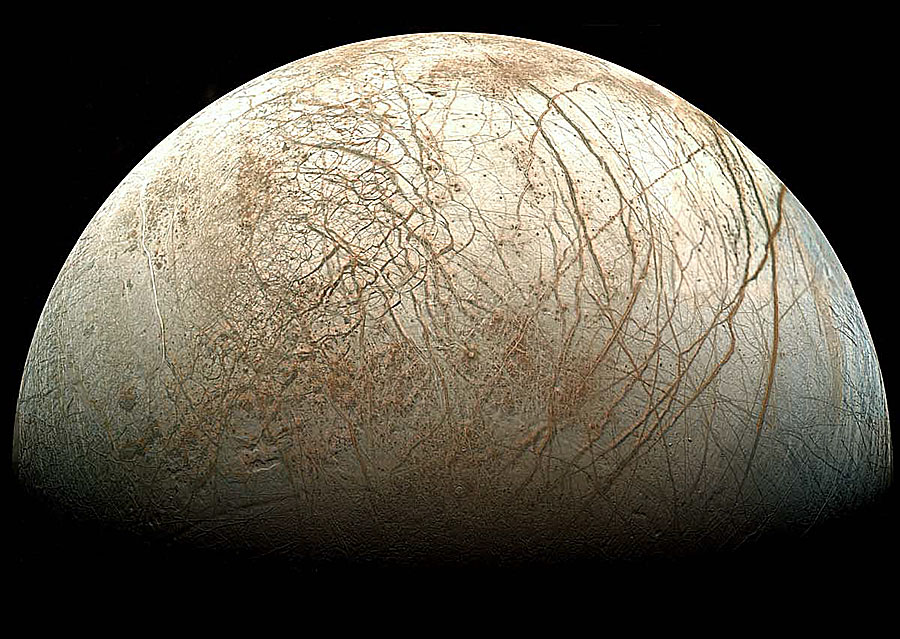
Europa, one of Jupiter's moons, has a vast ocean beneath
its surface. Credit: Galileo Project, JPL, NASA;
reprocessed by Ted Stryk
So, how do pressure and gravity work? In this context, gravity is the force that holds a planet/moon/star together and which attracts other objects to it. So we're all being pressed into the surface of Earth due to Earth's gravity. Pressure is the force a surrounding fluid (air, water, etc) exerts on something. So the atmospheric pressure we feel on Earth is pushing at us from all sides (well, OK, not out from the ground) and is due to all the air in Earth's atmosphere.

When you go swimming, the further you dive down, the higher the water pressure around you gets. This is because the deeper you are, the more water is above you to press down on you and the more water is above the bits of water on either side of you, also pressing into you. If you've ever been snorkelling (or scuba diving, I suppose but I can't vouch for that due to lack of experience) you might have noticed that it gets harder to breath the deeper you go (assuming a long enough snorkel). This is due to the water pressing down on your chest. Air does the same thing, but we're used to it, so we don't notice. The other thing that happens under water is that the water underneath you pushes up on you: this is called the buoyancy force and it's why things (people, tennis balls, icebergs, etc) float.

The higher up you go from sea level on Earth, the thinner the atmosphere gets (basically, the less atmosphere left above you). To halve the atmospheric pressure you experience, you need to go 5 km above sea level. (On the other hand, to double the pressure, you only need to be about 10 metres under water.) At that height, gravity is still pretty much the same as at sea level (the difference is about an eighth of a percent) and your main problems are getting enough oxygen (not a huge problem if your lung capacity is OK) and possibly altitude sickness (potentially a problem).

We need some amount of air pressure around us to survive which is part of the reason astronauts wear space suits. However, there is a range at which we can still function and that range increases if we have extra oxygen (and don't get altitude sickness). People have climbed Mt Everest (8.8 km above sea level) which has an atmospheric pressure of about a third that at sea level at it's peak without oxygen, but even doing it with oxygen requires training and acclimatisation and isn't something anyone can just decide to do one morning (well, unless they also decide to put in all the training).

On the surface of Europa or Callisto, there is no atmosphere and hence no atmospheric pressure. The ground is frozen water (probably not pure water, if only due to meteorite bombardment, but that's beside the point), but let's suppose we somehow got under the surface and set up a habitat. Since we're human and breathe air (a particular mix of mostly nitrogen, with some oxygen, carbon dioxide and misc) we'd have to have some sort of bubble habitat under the sea. But it's not just the air part that we need, we also need it to be around one (Earth) atmosphere of pressure. So we build a habitat with solid walls and fill it with the right amount of air... and then we're inside an air bubble and the water outside the bubble is having no effect on our bodies directly. The only way it would is if we went out into the water without pressure suits. Which probably wouldn't be the best idea in the world for a variety of health and safety reasons that don't necessarily have to do with the water pressure.

Now let's talk about gravity. The main way we detect small changes in pressure is though our ears, for example when they pop on taking off and landing in aeroplanes. The main way we detect changes in apparent gravity (which is the same as changes in acceleration) is when we feel lighter or heavier. If you're standing, this might manifest as extra strain on your legs, if the apparent gravity has increased, or a feeling like your stomach is moving upwards (possibly accompanied by nausea), if the apparent gravity has decreased. You don't experience the same feeling underwater or up a tall mountain because the gravity doesn't change in those places although the pressure does.

So what I'm ultimately trying to say is that the effects of gravity and atmospheric pressure are different. You can't compensate for a decrease in gravity by increasing pressure. Pressure is a force applied from all directions simultaneously, while gravity acts in just one direction. We know about the effects of Earth gravity, high gravity (from fighter pilots for example) and zero/microgravity (like on the space station) on people but much less about the effects of gravitational fields less than Earth's and more than zero. Europa's and Callisto's accelerations due gravity at the surface are about 13% Earth's and for comparison, the moon's is about 17% Earth's) so while we have had some experience with the moon landings during the Apollo missions, we don't really know how serious the health problems associated with spending prolonged periods at such low accelerations would be. There almost certainly would be some, but they probably wouldn't be as severe as zero gees. So while we can't use water pressure to compensate for gravity, it's not impossible for people to live on one of the moon's of Jupiter. We just don't know enough about what long term problems might arise.


Wednesday, July 25, 2012

Quick note on terraforming Galilean moons

This post comes from an "Ask Tsana" comment.

Sam Keola asked:
Aloha from Hawai'i again Tsana! I have a hypothetical question. If in the very distant future we had the technology to terraform, would it be best to terraform Callisto and Ganymede or set up domed bases? Ganymede is suppose to have an ocean similar to Europa, but I'm not sure if that's "world wide". Your thoughts on terraforming!
The main problem with terraforming either of those moons is their gravity isn't large enough to keep any atmospheric gases for long after they're introduced. Ganymede, which is larger, has a surface gravity of close to a seventh of Earth's which is less than half of Mars's and Mars has difficulty keeping much of an atmosphere itself. Purely from that point of view, domes or something else sealed would be better.
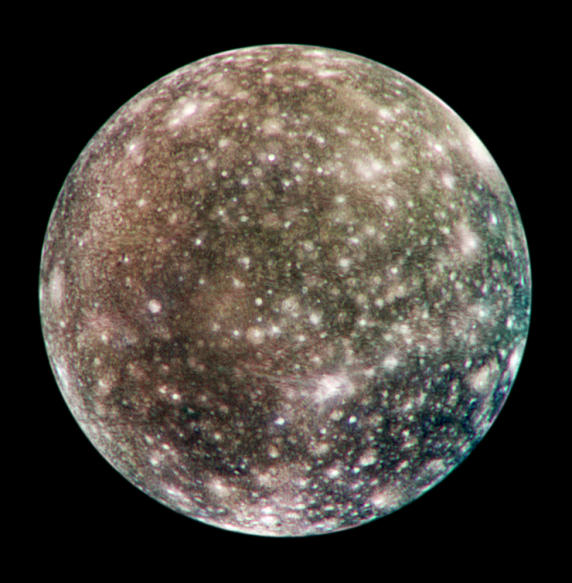
Callisto.
Credit: Galileo Project, Voyager Project, JPL, NASA

Once you've decided to build something sealed, then it would be better for colonists to build on Ganymede, as opposed to the other Galilean moons, for a few reasons:
  • It has the highest surface gravity, not by much but every little bit would prevent colonist's bodies from degrading. Actually, because the Galilean moons are less dense than Earth's moon, they have a lower surface gravity, despite being larger in volume. You're going to have low gravity-related heath problems in any case, however.
  • It's not as close to Jupiter as Europa (and Io!) is. The phenomenon responsible for keeping Europa's interior liquid is tidal friction thanks to its proximity to Jupiter. It's the sort of thing that also makes the surface more unstable (prone to volcanoes -- not as much as Io, of course -- and quakes) and less hospitable to people. You can read more about it here.
On the other hand, if what you're doing is mining and the minerals etc you're interested in are found on both Ganymede and Callisto, then Callisto is the place to put your colony. It's gravity slightly lower and, more importantly, it's further from Jupiter, meaning that when you're exporting your rocks, there's less gravitational pull from Jupiter to overcome.

In terms of finding water to mine, all three moons in question (ie, not Io) have water on them, so that shouldn't be too much of a problem, especially if you're already planning to mine other things.

Of course, there are also reasons why Europa would be a desirable place for a colony, especially for scientific reasons, exploring it's subsurface ocean primary among them. There's a good chance there's microbial life there.

So there you have it, if you're going to colonise the larger Galilean moons, it's better to build a close structure on them rather than try to impart an atmosphere. It would be even harder than giving Earth's moon a permanent atmosphere.

Saturday, June 2, 2012

Other Foreign Skies

This post is a response to a question I got on my Ask Tsana page.

Sam Keola asked:
Love the views of Jupiter from Ganymede and Io. How large would it appear from Europa or Callisto? And how large exactly would the sun appear? (I know tiny as hell, but another lovely picture would be amazing.)
The mathematical answer to that is explained in this old post. And my first set of Jupiter images (Io and Ganymede's skies) can be found here.

Jupiter

This time around, I used a different image of Jupiter so if you're wondering why it's rotated relative to the old pictures, that's why. For the Jovian images, I've used the same starting image because in the year since I last did this, I haven't managed to take a more suitable photo. Such is life.


The original photo with a full moon in Earth's sky.
So. Europa is the second Galilean moon out from Jupiter. It's made mostly of ice, is the smallest of the Galilean moons and might harbour life in its subsurface liquid ocean. The diameter of Jupiter as it would appear in the Europan sky is almost 24 full moons across. Remember that Europa's sky wouldn't actually look blue either since it doesn't have an atmosphere but I don't have a decent night skyline to work with. I'll do a night version eventually.

The size Jupiter would appear in Europa's sky. Or in Earth's sky if you swapped it with Europa.

You might be wondering whether Jupiter would actually be oriented the way it appears in these images. Well it depends. The direction the bands run relative to the moon's horizon would depend on where on the moon you were. Close to the equator, the bands would be vertical (although if Jupiter was high in the sky, it would be pretty difficult to tell. Perhaps better to say east-west). If you were near a pole, they'd be horizontal as in these images. And remember, the Galilean moons are all tidally locked, so Jupiter would never move, just change how much of it was illuminated by the sun.

And Callisto, the most distant of the Galilean moons. Callisto's Jupiter would appear "only" about 8.5 full moons across.

The size Jupiter would appear from Callisto. If Callisto had an Earth-like atmosphere and gum trees.

The Sun
 
The second part of Sam's question was how large would the sun appear from Jupiter. Well, on Earth, the sun and the moon appear to be approximately the same size (there's a little bit of a difference when the sun is at its closest and the moon at its furthest and vice versa). So the sun from Earth is about one full moon in diameter.

From Jupiter (or its moons) the sun would appear about 0.4 full moons across which is a little bit less than a sixth of the area of the sun as seen from Earth (remember, the moon and sun seen from Earth are on average the same size).

I cheated a little bit with these next two sun photos. They're actually two separate photos and I made the sun smaller in one of them. The reason the rest of the photo looks darker for the Jovian sun is because I was fiddling with settings on my camera. And if you're wondering why I chose sunsets, it's because those (and sunrises) are pretty much the only kinds of photos where the disc of the sun is properly visible.

Ordinary sunset on Earth:
Sunset. A little bit more than half the sun is below the horizon.
Sunset if Earth was at the same distance as Jupiter (but yet still warm enough to have liquid water. And plants. By the way, with these two, it's probably clearer if you click on the images to enlarge and compare the sun side by side.
A more diminutive sun, less than a sixth of the area of Earth's.
And there you have it. Photoshopped images (well, actually, I used Pixelmator) depicting the sizes of Jupiter and the sun from the Galilean moons and the Jovian system, respectively.

Wednesday, June 29, 2011

Weird Worlds: KOI 730

Before I get onto the main part of the post, I'd like to apologise for the lack of short posts over the weekend but life's been hectic. Part of the reason for this is that I'm going to be away at a conference next week. I plan to queue up a post to automatically go live next Wednesday since I'm not sure how reliable my internet access will be (also because I'm not taking my laptop and will be relying on Blogger's willingness to talk to my iPad, another thing of which I am not confident). On the other hand, said conference should give me lots of fodder for short, if not long, posts. So that's something to look forward to.

On to the topic of the week! Today I am going to be writing about another crazy exoplanetary system. However, unlike Kepler 11, this one isn't quite confirmed yet. KOI stands for Kepler Object of Interest and means that it's a system that the Kepler mission has identified as potentially containing some planets (four in this case) but they haven't been confirmed by other supporting data. Because science is all about the independent evidence. Nevertheless, this is a blog about science fiction, so we are quite at home to a little speculation. As such, please remember that all of the facts I state below about planets are as yet unconfirmed and haven't quite passed into official scientific cannon.

Kepler Object of Interest 730

First, some basic facts about the system. The star has designations KOI 730 or KIC #10227020 (one of these is easier to remember than the other, so guess which I'll be using). It is similar to the sun, but slightly larger and slightly cooler (by a couple of hundred degrees). It is more than 4200 light years away. The four planets are all very close in to the star, much closer than even Mercury's orbit in the solar system, making them conclusively uninhabitable to life as we know it.

Here is a screenshot illustrating the system from this Kepler Candidates Exoplanet app (not to be confused with the other one I've referenced before which was of confirmed planets, albeit otherwise pretty much identical).

The KOI 730 system side on (as would be seen by the Kepler telescope itself). Three of the four planets are visible in this illustration. The white line indicates the plane of the orbit (actually, it's a bit of a trail/track following each planet, but that doesn't come across too well side on). The planets are to scale relative to each other but not relative to their sun. Also, I don't think they get smaller when their on the opposite side of the star to the observer.


Resonating

That's OK, because that's not the particularly interesting thing about this system. The scientifically interesting thing is that this system is locked in an orbital resonance. An orbital resonance is when two planets (or moons) orbit in such a way that they both complete an integer number of orbits in the same length of time. (An integer is a whole number such as 1, 2, 3, etc.) Some examples from the solar system are the Jovian moons Io, Europa and Ganymede, which are locked in a 1:2:4 resonance of orbital periods. This means that Ganymede's and Europa's periods (how long it takes them to complete one orbit around Jupiter) are respectively four times and twice the period of Io. (Sometimes this might be written 4:2:1 indicating that Io makes completes four orbits in the time it takes Europa to complete two and Ganymede to complete one. It depends on the convention being used.) Another example is Neptune and Pluto locked in a 2:3 period orbital resonance (so Neptune completes three orbits in the time it takes Pluto to complete two). A different sort of resonance is that experienced by Mercury, which completes two orbits in the time it takes to make three revolutions (so three Mercurian days are equal to two Mercurian years).

Orbital resonances can either make the system, or more specifically, the bodies involved in the resonance, stable or unstable. Yep, I know that sounds like they don't do anything because both possible outcomes are covered, but that's not true. What I mean is that if the resonance is unstable, you get things like gaps in the rings of Saturn (caused by some of Saturn's moons). On the other hand, the Jovian moons I mentioned before are in a stable resonance and Mercury is in its spin-orbit resonance rather than being tidally locked thanks to the gravitational tugs of other planets.

Which brings me to some of the effects of orbital resonance. Bodies locked in an orbital resonance exert a greater gravitational influence on each other than they otherwise would. For example, when Ganymede, Io and Europa are all lined up (Io and Ganymede on one side, Europa on the opposite side of Jupiter), they all experience a heightened tidal effect as the gravitational pulls of the other two planets add directly to the pull of Jupiter, causing additional friction in the planet interiors (and, for example, contributing to Io's volcanism).

Back to KOI 730

So I mentioned that KOI 730 has four planets and that these are locked in an orbital resonance. According to the first articles I read about it (in New Scientist and somewhere else I can't recall) and the original paper (section 5.3 is specifically about KOI 730) the resonance scheme for KOI 730 is 6:4:4:3. Notice the two fours there? That is why there were a spate of pop science articles about this system. Those two fours indicate that two of the planets are in the same orbit since orbital periods depend only on the star's mass and the distance of the planet from the star.

Two planets in the same orbit. They're located at two of the Lagrange points you might remember me mentioning a while back. Due to their positioning, they are known as trojan planets after the trojan asteroids that follow and precede Jupiter and Saturn in these same Lagrange points. The two planets are 118º apart along their orbit and are slowly, over millions of years, edging towards each other (at least; the authors of the paper speculate that they might last billions of years).

But yes, eventually they will collide.

The configuration of these two planets, KOI 730.02 and KOI 730.03, is such that they form an equilateral triangle with the star as the third point. Unfortunately, this puts the second planet as far away from the first as the sun, making it about a quarter of the height of the full moon as seen in Earth's sky. It would also always be about two-thirds illuminated and it wouldn't move around in the sky relative to the stars. If the planets were tidally locked to their sun then the other planet would stay locked in the same position in the sky while the stars moved around it, which would be fairly cool to observer. (Just think of the mythology that could arise surrounding that set up!)

It also bears mentioning that one of the theories of Earth's creation has two proto-planets forming at Lagrange points like these trojan planets. The other proto-planet, usually labelled Theia, and proto-Earth, inched towards each other and eventually collided, merging and splashing, so to speak, to form Earth and moon as we now know them.

Later, when I googled this again in preparation for writing this blog post, I found this article from Sky & Telescope, which features one of the authors of the original paper saying that further analysis of the data suggests a 8:6:4:3 resonance might be more fitting. This turns one of the trojan planets into a different orbit, farther out, and makes the system less exciting. I mean, a system in which all the planets are in resonance with each other is still pretty notable, but it's just not quite as imagination-grabbing as TWO PLANETS IN THE SAME ORBIT. Although, there's still potential for interesting story-science there when the planets line up and whatnot.

Oh well, co-orbiting planets in KOI 730 or not, the concept was around before this paper was written and there's no firm reason to not suppose we couldn't have trojan planets somewhere else. Maybe a gas giant with, instead of trojan asteroids following/leading it around, a full-sized terrestrial planet. Or two terrestrial planets sharing a habitable orbit...

The possibilities are endless. And science is cool even when it's speculative.

Wednesday, May 11, 2011

Tides and their locks

Gravity causes tides. On Earth, a planet with a whole bunch of wet stuff sloshing around on the surface, this leads to the sort of sea and ocean tides that most of you have probably encountered at some point.

Tidal interactions

Tides on Earth are mainly caused by the gravitational force of the moon pulling on the Earth. Water, unlike the rock making up most of the surface of the Earth, is able to move a little bit towards the moon in response. Obviously, it's not a massive effect—we're not talking about losing chunks of ocean into space—but it's significant for the sea level to rise a few meters in certain places. The sun also has a similar effect on the Earth so if we didn't have a moon, we'd still have some tides, just on a smaller scale and rather more regularly. As it is, the reason tides are so irregular is because moon and sun aren't in sync (this is also why lunar calendars and solar calendars are so different).

I should also add that while the water on the side of the Earth closest to the moon becomes deeper due to the gravitational pull of the moon, it is conservation of angular momentum which causes the water on the side of the Earth furthest from the moon to also bulge out. I won't go into the specifics unless someone asks in the comments, but the short version is that that opposite bulge of water is require to "balance out" the bulge formed by the gravitational pull of the moon.

OK, so the only thing that really sloshes around on the Earth is water, but what would happen if the moon was bigger or the Earth was closer to the sun and had no water? Or what if we had a rocky moon orbiting close to a gas giant? Well, instead of water sloshing about, it's possible that the gravitational pull of the large planet would pull on the moon strongly enough to deform rock. This is exactly what happens with Io and Europa, Jupiter's two innermost (Galilean) moons (although Europa is more ice than rock). The tidal tug of gravity on Io is what keeps its core molten and causes so many volcanoes on its surface. It's what keeps the interior of Europa liquid (or at least, what keeps some water in liquid form below the surface) and it's also what keeps Earth's core molten (because of our moon's tidal forces). Without these tidal interactions, there would have been more than enough time for these planets and moons to cool enough for their cores to solidify. In the case of Io, I believe the smaller gravitational tugs of the other Galilean satellites, particularly Europa and Ganymede, may also play a small part in its tidal heating.

The take home message is: tidal forces cause volcanoes. It's an important point to remember if you're situating your planet/moon close to its star/primary.

Locked with tides

Let's move away from the Earth and the Jovian satellites for a moment and think about a miscellaneous rocky planet, close to it's star. Like Mercury, for example. For a long time, it was thought that Mercury was tidally locked, meaning that the same side always faces towards the sun. It turns out this isn't quite true thanks to gravitational tugs from some of the other, bigger planets. So let's ignore the other planets. We have a star and a planet forms in place around it. I've mentioned before that conservation of momentum dictates which direction planets and moons will initially rotate and orbit. Any deviations from this will be a result of later collisions. So the planet will form orbiting in the same direction that its star rotates and also rotating in this same direction. (If you're a bit confused about how an orbit and a rotation can be in the same direction, stick your thumb out and curl your fingers around. Your thumb is pointing in the direction of angular velocity of something rotating in the direction your fingers are curling. You could make a looser curl with your fingers to represent an orbit and, so long as your thumb continued pointing in the same direction, that orbit would be in the same direction as the previous rotation.)

The angular momentum of the star-planet system has to be conserved. (Angular) Momentum is mass multiplied by (angular) velocity for each body and then summed. Since the mass of the system isn't going to change much (ignore comets and spare dust/gas that might accrete), then for the planet's rotation to change (that is, get faster or slower) one of the other angular velocities has to change to compensate. This is exactly what happens when a planet becomes tidally locked around its star or when a moon becomes tidally locked around its primary (example: the Galilean moons of Jupiter); rotational angular momentum is slowly converted into orbital angular momentum resulting in a slightly faster orbit but a slower period of rotation. Given enough time, the planet will become locked in a synchronous orbit (the same side always facing its sun). This is where the "tidal" part of "tidally locked" comes from.

Now, it's possible to work out how long this process takes or, for a given time frame, what the "tidal lock radius" is; that is, the distance from the star inside of which planets will be tidally locked after that time period has elapsed. The general equation for this, as given by von Bloh et al. (2007) (and Kastings (1993), pdf sorry) is:

This isn't the most helpful equation ever. And the units are confusing
Where P0 is the original period of the planet, Q is a factor to do with the rotational properties of the planet and M* is the mass of the star. As the caption says, this isn't super useful and they use somewhat baffling units. Subbing in the values they assume for P0 and Q and assuming the same time they assume which is 4.5 Gyr (the G stands for giga—yes, just like in your computer—and means 4.5 billion years or 4 500 000 000 years), I get something close to:

See, isn't that nicer to deal with? And now we have rT in AU and M* in solar masses—yay!
So if you put in the mass of your star in units of solar masses (or the mass of your gas giant, but you still have to use solar masses) then you will learn the tidal lock radius in AU for systems which have had 4.5 Gyr in which to evolve. I think 4.5 Gyr was chosen because that's roughly the age of the Earth/solar system (actually, it's more like 4.6 Gyr, but close enough).

If you want to read more about orbital mechanics, I found a review written by the guy who originally worked this stuff out in 1977: Peale (1999) (pdf again, sorry). I haven't had the chance to read through all of it yet, and it's a bit heavy on the maths, but it looks interesting.

There is more that I want to say about tides, but I feel this post has gotten long enough so I'll leave it for a future blog. Coming up soon: the Roche limit and why Saturn has rings (and all the other gas giants too). Stay tuned!

Wednesday, March 16, 2011

Living on a moon: Marking time

There is a certain class of exotic location often used in science fiction and that is the surface of a moon.

Most of what I'm going to say will apply to moons like Earth's but I'm going to focus on the moons of gas giant planets like Jupiter and Saturn partly because they're a little more interesting and partly because if you want to know about day and night on the moon, it's more trivial to look up.

Planets orbiting a star

First, let's talk about ordinary (Earth-like) planets orbiting a star. They will have a year defined by how long it takes them to do a complete orbit of their sun and a day defined by how long it takes them to spin on their axis. Actually, there are two possible definitions of a day:
  • the solar day, which is how long it takes the planet to rotate all the way around so that the sun returns to the same place in the sky (or more accurately, until it returns to the same point above the planet. On Earth, the meridian passing through Greenwich and the middle of the Pacific ocean is the reference point we use).
  • and the sidereal day, which is how long it takes the planet to rotate about its axis so that the stars return to the same position in the sky.
On Earth, a sidereal day is slightly shorter than a solar day (only 23.9 hours) and this will be true of any planet that spins in the same direction as it orbits. So the Earth, looking down on the north pole, spins anti-clockwise and orbits the sun anticlockwise. Such a planet is in a prograde orbit. This is true of all the planets except Uranus, which is sideways, and most of their moons. It is in general going to be true of all systems if they formed together (thanks to conservation of angular momentum) and if a planet isn't prograde (that is, if it's particularly lopsided like Uranus or if it's retrograde meaning spins or orbits in the opposite direction) then it probably has a more interesting history. In the case of Uranus, it is thought that some collision knocked it sideways a long time ago. For retrograde planets, where one each of orbit and rotation are clockwise and anticlockwise, the implication is that they did not form where they are found, but are interlopers from elsewhere. Or there could also have been a collision, but it would have to be a very large collision in exactly the right place. It's interesting to note that all the planets orbit in the same direction as the sun rotates. This is strong evidence that they all formed from the same nebula at roughly the same time.

Moons: Mostly tidally locked

OK, enough background. On to the moons. Let's assume we have a rocky moon orbiting a gas giant planet. All the interesting moons in our solar system (which is to say, the ones I checked and generally most or all of the big ones) are tidally locked with their primary, including Earth's moon. What does tidally locked actually mean?

I won't go into the details of the physics, but if a satellite is tidally locked with its primary, the same side will always face the primary. So on Earth, we always see the same side of the moon. If you go to the moon and land on the near side, Earth will always be in the same place in the sky (assuming you don't travel far from your landing place) varying only in how much of it is lit up by the sun. It's also possible to have planets tidally locked with their sun, but they have to be quite close to their sun for this to happen. Consequently, most of those planets wouldn't be habitable for humans, unless the star in question was a red dwarf, but that's a topic for another blog post.

Back to our rocky moon orbiting a gas giant. Since it's tidally locked, you will need to decide where you want to place your colony/city. Directly under the primary planet so that it always sits high in the sky? On the side of the planet which never sees the primary? These choices will depend a bit on your whim and a bit on the purpose of the colony. For the latter, if it's a research installation studying the primary or a mining installation skimming gas from the primary's atmosphere, it makes the most sense to build it directly below the primary. On the other hand, if the research installation is built for astronomy observations, you'd want to put it on the non-planet side so that light from the sun reflected from the primary interferes with your telescopes less.

Days and nights?

Once you've made that decision, you probably want to know how long days and nights will be on your moon. This is where it gets a bit tricky. I'm going to use Ganymede, one of the larger moons of Jupiter, as an example. Thanks to its synchronous orbit (another way of saying that it's tidally locked), a sidereal day on Ganymede is the same as it's orbital period. Orbital period is the general term for how long it takes to orbit all they way around Jupiter. (I'd prefer to say "Jovian day", but unfortunately that term refers to one of Jupiter's solar days. :-/ ) So unless it orbits very quickly, orbital period would not be a useful measure of time to base diurnal cycles on. And if it did have a fast enough orbit, it probably wouldn't be very habitable since that would imply that it was very close to the primary like Io (the innermost Galilean moon of Jupiter), leading to a host of problems like extreme volcanism and earthquakes. As I hope the crude sketch I did below helps illustrate, a solar day on Ganymede (that is, the length of time it takes for the sun to move all the way across the sky and come back to its starting point) is also the same length as an orbital period.*


Not to scale! Top right circle is the sun, orange circle is Jupiter with the lighter half the half that is illuminated by the sun and the darker brown half the dark side. The grey shadow is Jupiter eclipsing the sun and the rainbow circle is Ganymede, so coloured to illustrate that the same side is always pointing towards Jupiter. The thick black line shows its orbit around Jupiter and the light and dark semicircles inside Jupiter's orbit are to help guess how full/dark/crescent/gibbous Jupiter would appear in Ganymede's sky (if you're on the side of Ganymede facing Jupiter).

We can also use that diagram to work out how much of Jupiter would be lit up by the sun if we're on a the side of Ganymede facing Jupiter. It should also be noted that, unlike the Earth being lit up by the moon and human lights at night and hence being visible from the moon even when it's not lit up by the sun, the dark side of Jupiter would be completely dark. Against the black sky of Ganymede (and the sky would always be black, even during the day, since Ganymede has no atmosphere to scatter photons with) it would just look like a black hole in the stars. A black hole about 15 full moons across.

*Technically it would be slightly less thanks to Jupiter's orbit around the sun, but Jupiter is so far out from the sun and has such a large distance to travel that day to day we can ignore the small difference to the length of a Ganymedean solar day. If your gas giant is much closer to its star, it might become relevant, but this calculation is left as an exercise for the reader. ;-)

Time moves forward

Finally, it would be useful to work out how quickly Jupiter and the sun change in Ganymede's sky, especially if you're writing a story that involves spending longer than a day there. I will make this section more general so that you can use for any hypothetical moon orbiting an arbitrary gas giant.

What you need to know or decide is the orbital period, let's call it T,  a piece of paper with your own approximation of the diagram above (without all the different positions of Ganymede drawn in yet), and a protractor (or a really good eye for angles). For Ganymede, T = 7.15 (Earth) days. If you're making up a planet-moon system of similar size, it's probably best you're numbers don't deviate too much. I think I might make the proper physics you need to consider when making up planets the subject of a future blog post.

On your hand drawn diagram, choose a starting position for your planet and a location on the surface for your colony. I suggest putting your colony close to the equator because a) it will be more picturesque and b) Ganymede has some crazy magnetic fields and I suspect that radiation shielding would be easiest to achieving within about 30º latitude of the equator. This doesn't automatically apply to all moons in similar systems, but still, it can't hurt. Draw your moon in it's starting position and mark the location of your colony with a cross or something. Remember that looking down from above the north pole, the moon will probably be orbiting anticlockwise if it's in our solar system.

Next, you need to do a small piece of maths. Decide how much time you want to pass before you mention what the gas giant is looking like in the sky again. Call this time t. Make sure T and t are in the same units (convert them both to days or both to hours, whichever is more convenient, if they don't match). To work out how many degrees, d, of a circle the moon has moved in this time, you need to use the following equation:
d = 360*t/T

In one Earth day, Ganymede will move d = 360*1/7.15 = 50.3º which is a bit more than an eight of a circle. On the diagram above, that's a little bit more than the distance between two consecutive rainbow Ganymedes (ignoring the two close together in Jupiter's shadow). Since T is so small for Ganymede, this means that Jupiter and the sun change quite dramatically in the sky (Earth) day to (Earth) day. Depending on how your planet-moon system is set up, your mileage may vary.

Multiple moons

And a quick bonus calculation: if your planetary system has multiple moons your feel like caring about, you can do the above calculation for each of them, choose starting points and then see how far each one moves in the span of time you're interested in. This doesn't need to be very hard at all. In the jovian system, Io completes four orbits in the time it takes Ganymede to complete one and Callisto completes two in the same time. This convenient state of events is thanks to the physical principle of resonance. Resonance happens in all sorts of places in nature and celestial mechanics, including Saturn's rings and Mercury, so feel free to implement it with impunity.

Hopefully, I've given you enough information to convincingly set a story on a moon orbiting a gas giant planet. Well, in a colony at least, where you don't have to worry too much about external climate, so long as you stay away from Io.

LinkWithin

Related Posts Plugin for WordPress, Blogger...