Showing posts with label gas giants. Show all posts

Wednesday, May 18, 2011

Ringing Tides

Saturn has rings. So do all the other gas giants in the solar system. Although we have no ability to confirm whether extra solar gas giants also have rings, chances are some do. Where do these rings come from? Why doesn't Earth have any?

Terrible Tides

The answer to the first question, as you may have guessed from the title of this post, is tides. Last week I talked about tides causing satellites to be locked in synchronous orbits around their primaries (recommended reading if you haven't already). The thing to remember now is that the side of a satellite closest to its primary experiences a stronger gravitational pull than the far side. The difference in forces depends on the mass of the primary, the distance of the satellite from the primary and the size if the satellite.

If you recall from the introduction to gravity post, the force of gravity exerted on a mass, m, a distance, r, from another mass, M, is given by:


If we take M to be the mass of the primary and then consider two smaller masses m1 and m2, one of which is located at r1 on the near side of the satellite, and the other at r2, the far side of the satellite. If we assume our two small masses are equal (you can think of it as considering a kilogram of moon rock in two different locations), then the ratio of the forces experienced by them will be:


That equation might seem a bit abstract, so let's look at it in the context of a few real examples.
  • Io is 4.217⨉108 m from Jupiter, on average, and has a radius of 1.8⨉106 m. The pull of Jupiter's gravity on the far side is just 99.15% that on the near side.
  • Doing a similar calculation for the moon (orbiting the Earth), we find far side gravity 99.10% that of near side.
  • Mercury orbiting the sun has far side gravity 99.99% that of the near side since, even though it's very close to the sun, it's a lot further away than the moons are from their primaries.
  • Let's look at Saturn now. Not one of Saturn's moons, but Saturn's rings. The main rings, according to Wiki, extend between 66 900 km and 480 000 km above the centre of Saturn. The gravitational pull from Saturn on the far edge is 83.6% that of the near edge. Compared with the solid bodies discussed above, that's a much more significant difference.

It is now possible to come up with a scenario where the pull of the primary on the near side of the satellite is bigger than the pull of its own gravity. Let's look at one of Saturn's tiny moonlets. Pan orbits inside Saturn's A ring (towards the outer edge of the ring system). It's radius is only 14.2 km and it weighs 5⨉1015 kg, making it's surface acceleration due to gravity 0.0016 m/s2 (less than a ten thousandth of a percent that of Earth's). By comparison, the acceleration due to gravity from Saturn at that distance is 2.12 m/s2, more than 1300 times greater. Clearly, Pan could not have formed where it now orbits since it's very much held together by chemical forces, not gravitational.

EDIT: Correction made to the above paragraph. Previously I had stated that if you stood on the Saturn-side of Pan you would fall up into Saturn. This is not true. The more accurate statement I should've made was that if you were floating around in the vicinity of Pan's orbit and Pan came past you, its gravity would not be strong enough to pull you in over Saturn's gravity. No matter how close to it you were (even if you could touch the surface), if you were not already moving along with it (and hence had enough centripetal acceleration to balance Saturn's gravitational acceleration), then Saturn's gravity would win out and you would fall towards Saturn, rather than towards Pan.

Making rings

Even further out than the point at which the primary's gravity becomes stronger than the satellite's gravity, the primary's gravity will start to deform the satellite. This effect is not dissimilar to the tidal bulge the moon causes on Earth. It is also part of the reason the Galilean moons of Jupiter are tidally locked.

(Interesting fact: over time, the tidal bulge of the Earth is causing the Earth to slow down its period of rotation since the change in shape (which isn't constant, remember, as the moon's orbit is much slower than the Earth's day) alters the way it rotates (catch phrase: conservation of angular momentum). The drag of the water in the tidal bulge is also pushing the moon back, slightly, in its orbit. Eventually (and we're talking a pretty long eventually) the Earth-moon system will settle into a mutually tidally locked rotation with the moon significantly further away than it is now. Here is an interesting article about it from Space.com.)

In the case of a satellite which is reasonably fluid and only being held together by its own gravitational pull (called self-gravity), then there is no reason for it to stay together as one lump. It will disintegrate because the part closer to the primary wants to orbit faster than the part further away. A disintegrated satellite will turn into a system of rings around the planet. The point at which this happens is called the Roche limit and the equation which tells us the distance from the primary of the Roche limit is:

d is the distance of the Roche limit from the centre of the primary,  R is the radius of the primary and M and m are the densities of the primary and the satellite respecively.

You'll notice that there are densities in the above formula. The density of the satellite is relevant because it's a measure of both mass and gravity (since we're talking satellites that are only held together by their self gravity and not chemical bonds). The density of the primary comes into it because we need to know the mass (which is proportional to radius cubed times density and R will becomes cubed if you move it inside the brackets) but the radius is also relevant because if the Roche limit is inside the primary, we can pretty much ignore it.

Of course, most satellite aren't balls of dust but are held together by other chemical forces (like Pan is). For example a rock on Earth isn't held together by gravity, it's held together by the chemical bonds between the different atoms and molecules inside (slightly different bonds depending on it's composition). Similarly, once a satellite has formed (outside of the Roche limit), then it probably goes through other experiences (such as tidal heating) which fuse it into a more solid lump. If it then wanders inside the Roche limit, it's not going to dissolve just because it couldn't've formed there. Pan and a handful of other moons in Saturn's rings prove this point. So what's the Roche limit for satellites held together by more than just gravitational forces? It sort of depends on the forces, but Roche himself derived an approximation for fluid satellites which deform a bit before they break up due to the tidal forces:


If you're wondering whether rock counts as fluid, it does. Everything will deform a bit under sufficiently strong forces.

So this last equation is the point at which a satellite will start to break up if it spirals in too close to its primary. For Earth-moon system, the moon will disintegrate if it wanders within 11 000 km. Luckily for the moon, this isn't likely to happen until the sun end's it's main sequence life.

Wednesday, April 13, 2011

Living on a moon: How bright is the night?

Let's say you've stuck a colony on the moon of a gas giant. I've already talked about the unusual way in which the sun and the primary planet move (or don't move) across the sky. As you might recall, there will be times in the moon's orbit when, depending on where you are on its surface, the only natural illumination comes from its primary planet. the question this post addresses is: just how much illumination can we expect?
There are two things we need to know to work out how much illumination the primary is giving the moon:
  1. How bright and far away is the sun?
  2. How reflective is the primary?

EDIT: I've added in some comparisons with light bulbs thanks to Patty Jansen pointing out that the human eye can adapt to see in lighting conditions much dimmer than the sun


Star light, star bright?

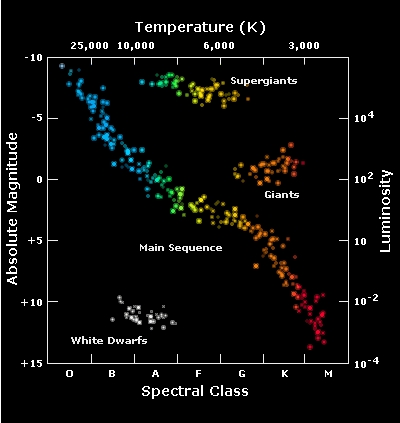
The amount of light that reaches your planet-moon system from its sun will depend on what kind of star it is. Stars come in different sizes and different temperatures. Most stars lie on what is known as the Main Sequence. Two notable exceptions are red giants and white dwarfs. The main sequence refers to the band of stars running diagonally through the Hertzsprung-Russell Diagram (HR diagram, previous links to two different images). Is basically a plot of how much light a star gives out (it's magnitude or luminosity) against it's colour or temperature. Stars are then divided into types (O, B, A, F, G, K, M) based on colour/temperature. Giant stars (other than blue giants) lie above the main sequence and white dwarfs lie below it. The sun is a G type star with temperature 5800 K (on the surface, that is; it's much hoter on the inside). K means Kelvin and is the standard unit of temperature. To convert from Kelvin and Celcius, you need to subtract 273, so the sun is 5500ºC (with rounding).

Using a star's temperature we can work out how much energy, in the form of light, reaches our planet. The first step is to assume that the star is a black body. This might sound conter-intuitive since the last word you're likely to use to describe the sun is "black", but from a physics perspective, a black body is something that absorbs all incident light and emits light based on its temperature. Well, I say "light", but really I mean electromagnetic radiation.

The Stefan-Boltzmann law tells us how much energy a black body emits based on its temperature. When we're talking about stars, this is called the luminosity. The formula for calculating luminosity is:

A stars luminosity, given it's radius, R, and temperature, T. σ = 5.67 × 10⁻⁸ is the Stefan-Boltzman constant and π = 3.14

The temperature has to be in Kelvin and the radius in meters to give luminosity in units of Watts (yes, like your light-bulbs) which is a measure of energy emitted per second. Radius and temperature are slightly trickier to come up with numbers for. If you're using a real star, you can just look it up on Wiki or Wolfram Alpha (Wiki even has a page listing the nearest stars to Earth). Otherwise you can make up a star with the characteristics you want such as temperature or class, then go to the second HR diagram I linked and look at the diagonal lines of radius. Whether you want a main sequence star, white dwarf or giant, this should give you an idea of radius (in units of the radius of the sun).

That's all well and good, but what we actually want to find is the light reaching a planet, not the total light emitted. Because stars emit light in all directions at once, their total energy output end up being diluted over an expanding sphere of light. Basically, not all the energy the sun produces hits our planet. It depends on how far away the planet is. This next formula will tell us how much energy hits the planet:

P is the energy per second hitting each square meter of the planet and D is the distance from the planet to its sun.

So P is the energy from the sun that hits a square meter of a planet which is D meters away from the sun. We're not quite there yet, but let's take a break and calculate some numbers. I'm going to work out the energy from the sun that hits the Earth/moon and Jupiter each second.
  • Earth/moon are about 1.5 × 10¹¹ m from the sun. The sun's radius is 6.955 × 10⁸ m and its temperature is 5800 K. The energy hitting a square meter of the Earth or moon each second is 1400 Joules.
  • Jupiter is 7.8 × 10¹¹ m from the sun. The energy hitting a square meter of Jupiter each second is 50 Joules, which is about 3.6% of the energy hitting the Earth. Jupiter's greater distance from the sun means that the sun's energy is about 30 times more spread out by the time it gets there. (As I calculate below, this is still about 14000 times brighter than the full moon as viewed from Earth.)

Planetshine

Light doesn't get completely absorbed by the planet, however. Some of it reflects back out into space and can illuminate other nearby objects. The property which determines how reflective something is (in this context) is called albedo. The average albedo of a planet is a number between 0 (non-reflective) and 1 (absolutely reflective), which represents the percentage of incident light that will be reflected.

In practice, it's fairly easy to implement albedo. The reflected energy is the incident energy multiplied by the albedo. Just multiply P above by albedo, A, and you get the power reflected off each square meter of planet. You can look up albedos for different planets/moons on Wiki and elsewhere. (But we all know Wiki's the easiest. It lists albedos in the summary box on the right of the relevant page. If more than one is given it's the Bond albedo, not the geometric albedo, that you want.)

What we actually care about, however, is how much of that reflected light goes on to reach the moon our colony is built on. In a way, we just reuse the equations I've already included above. Instead of putting L into the equation for P, use the P from the sun multiplied by albedo, radius becomes the radius of the planet, and distance is now the distance between planet and moon:


P is the energy per square meter per second hitting a moon, A is the albedo of the planet, R is the radius of their sun, r is the radius of the planet doing the reflecting, T is the temperature of their sun, d is the distance between planet and moon, D is the distance between planet/moon and sun. The last line is included because if you're using a real star, luminosity will probably be listed somewhere. Otherwise, the penultimate line is what you need to use.

OK, so this is getting increasingly more complicated looking, but remember that you only really have to do the last step. There rest are only there by way of explanation.

Now, one last thing before I calculate some more numbers. That last equation assumes that the primary planet appears full in the sky. If it's half full, you have to halve that number, if it's a quarter full you have to divide by four. Honestly? Just approximate.

  • The moon has an albedo of 0.136. The energy the full moon is reflecting at the earth is 0.0037 W/m2.
  • For the purposes of comparison, a 100 Watt light bulb from 10 meters away has a brightness of 0.02 W/m2.
  • The Earth has an albedo of 0.306. The energy Earth reflects at the moon is 0.12 W/m2. So because it's bigger and more reflective, the Earth as seen from the moon gives off about 32 times more energy per second. That means the full Earth in the lunar sky is roughly 32 times brighter than the full moon in Earth's sky and six times brighter than a 100 W light bulb.
  • Jupiter has an albedo of 0.343. Ganymede is 1.1 × 10⁹ m away. The brightness of full Jupiter in Ganymedean sky is 0.07 W/m2. That means Jupiter is almost twenty times brighter than the full moon. Not surprising given how big it is in the Ganymedean sky. A half-full Jupiter would be 10 times brighter than the full moon, a quarter-Jupiter about 5 times as bright and so-forth. The varying quantity here is what fraction of Jupiter's disk is illuminated (and that we're working under the assumption that Jupiter reflects evenly in all directions). A quarter-full Jupiter would be about as bright as a light bulb and a full Jupiter would be as bright as three and a half light bulbs 10 meters away.
  • Io is 4.2 × 10⁸ m from Jupiter. The brightness of full Jupiter in Io's sky is 0.48. So Jupiter is shining a whopping 130 times brighter than the full moon. By comparison, the sun as seen from Io is only about 100 times brighter than Jupiter. Light-bulb-wise, Jupiter would be as bright as 24 100W light bulbs 10 meters away.
  • For a bit of fun, the brightness of full Io (albedo 0.63) as seen from Ganymede varies from 1.2 × 10⁻⁴ W/m2 when it is at its closest point to Ganymede to 2.4 × 10⁻⁵ W/m2 when it is at its furthest. Neither of those are very bright, but it would still definitely be visible. It's about 0.6–3% the brightness of the full moon.
  • And finally, let's say we put Jupiter at the same distance from the sun as Earth is. Now Ganymede would get around the same amount of energy from the sun per square meter as Earth does and Jupiter would be a lot, lot brighter. How bright? 1.9 W/m2, which is 500 times more light that Earth gets from the moon and as bright as almost 100 light bulbs from a distance of 10 meters.

And there you have it. A method for approximating how much light you'd get reflected from a gas giant planet (or whatever planet/moon/asteroid you like). Unfortunately this post ended up being a little bit more complicated than I had initially anticipated (where complicated really means more maths), but it's a small price to pay for painstaking accuracy... Well, some semblance of accuracy, at any rate. There are a lot of approximations in the above (for example, the albedo varies for different types of terrain; so Earth's albedo is higher over clouds than over forest), but on average, it's close enough. Phew!

One last thing I came across after writing this post. I was looking for something else and came across this photo of Jupiter and Io. Notice how the line between Io's sun side and dark side (called the terminator) is very distinct and solid, whereas Jupiter has a bit more of a gradient going from light to dark? This is because Jupiter has an atmosphere (a very thick one, but the effect applies to Earth's atmosphere too) whereas Io's atmosphere is whispy and not really much to write home about. The atoms/molecules/particles in the atmosphere reflect light in all directions, allowing it to diffuse through a bit, giving us that gradient from light to dark. Io, on the other hand, only reflects light off its surface, leading to the solid terminator you can see in that image. Just something to think about when writing those realistic descriptive passages. ;-)

Update: I photoshopped some Jupiters into skies to give a size comparison with the full moon. You can see them here.

    Wednesday, March 16, 2011

    Living on a moon: Marking time

    There is a certain class of exotic location often used in science fiction and that is the surface of a moon.

    Most of what I'm going to say will apply to moons like Earth's but I'm going to focus on the moons of gas giant planets like Jupiter and Saturn partly because they're a little more interesting and partly because if you want to know about day and night on the moon, it's more trivial to look up.

    Planets orbiting a star

    First, let's talk about ordinary (Earth-like) planets orbiting a star. They will have a year defined by how long it takes them to do a complete orbit of their sun and a day defined by how long it takes them to spin on their axis. Actually, there are two possible definitions of a day:
    • the solar day, which is how long it takes the planet to rotate all the way around so that the sun returns to the same place in the sky (or more accurately, until it returns to the same point above the planet. On Earth, the meridian passing through Greenwich and the middle of the Pacific ocean is the reference point we use).
    • and the sidereal day, which is how long it takes the planet to rotate about its axis so that the stars return to the same position in the sky.
    On Earth, a sidereal day is slightly shorter than a solar day (only 23.9 hours) and this will be true of any planet that spins in the same direction as it orbits. So the Earth, looking down on the north pole, spins anti-clockwise and orbits the sun anticlockwise. Such a planet is in a prograde orbit. This is true of all the planets except Uranus, which is sideways, and most of their moons. It is in general going to be true of all systems if they formed together (thanks to conservation of angular momentum) and if a planet isn't prograde (that is, if it's particularly lopsided like Uranus or if it's retrograde meaning spins or orbits in the opposite direction) then it probably has a more interesting history. In the case of Uranus, it is thought that some collision knocked it sideways a long time ago. For retrograde planets, where one each of orbit and rotation are clockwise and anticlockwise, the implication is that they did not form where they are found, but are interlopers from elsewhere. Or there could also have been a collision, but it would have to be a very large collision in exactly the right place. It's interesting to note that all the planets orbit in the same direction as the sun rotates. This is strong evidence that they all formed from the same nebula at roughly the same time.

    Moons: Mostly tidally locked

    OK, enough background. On to the moons. Let's assume we have a rocky moon orbiting a gas giant planet. All the interesting moons in our solar system (which is to say, the ones I checked and generally most or all of the big ones) are tidally locked with their primary, including Earth's moon. What does tidally locked actually mean?

    I won't go into the details of the physics, but if a satellite is tidally locked with its primary, the same side will always face the primary. So on Earth, we always see the same side of the moon. If you go to the moon and land on the near side, Earth will always be in the same place in the sky (assuming you don't travel far from your landing place) varying only in how much of it is lit up by the sun. It's also possible to have planets tidally locked with their sun, but they have to be quite close to their sun for this to happen. Consequently, most of those planets wouldn't be habitable for humans, unless the star in question was a red dwarf, but that's a topic for another blog post.

    Back to our rocky moon orbiting a gas giant. Since it's tidally locked, you will need to decide where you want to place your colony/city. Directly under the primary planet so that it always sits high in the sky? On the side of the planet which never sees the primary? These choices will depend a bit on your whim and a bit on the purpose of the colony. For the latter, if it's a research installation studying the primary or a mining installation skimming gas from the primary's atmosphere, it makes the most sense to build it directly below the primary. On the other hand, if the research installation is built for astronomy observations, you'd want to put it on the non-planet side so that light from the sun reflected from the primary interferes with your telescopes less.

    Days and nights?

    Once you've made that decision, you probably want to know how long days and nights will be on your moon. This is where it gets a bit tricky. I'm going to use Ganymede, one of the larger moons of Jupiter, as an example. Thanks to its synchronous orbit (another way of saying that it's tidally locked), a sidereal day on Ganymede is the same as it's orbital period. Orbital period is the general term for how long it takes to orbit all they way around Jupiter. (I'd prefer to say "Jovian day", but unfortunately that term refers to one of Jupiter's solar days. :-/ ) So unless it orbits very quickly, orbital period would not be a useful measure of time to base diurnal cycles on. And if it did have a fast enough orbit, it probably wouldn't be very habitable since that would imply that it was very close to the primary like Io (the innermost Galilean moon of Jupiter), leading to a host of problems like extreme volcanism and earthquakes. As I hope the crude sketch I did below helps illustrate, a solar day on Ganymede (that is, the length of time it takes for the sun to move all the way across the sky and come back to its starting point) is also the same length as an orbital period.*


    Not to scale! Top right circle is the sun, orange circle is Jupiter with the lighter half the half that is illuminated by the sun and the darker brown half the dark side. The grey shadow is Jupiter eclipsing the sun and the rainbow circle is Ganymede, so coloured to illustrate that the same side is always pointing towards Jupiter. The thick black line shows its orbit around Jupiter and the light and dark semicircles inside Jupiter's orbit are to help guess how full/dark/crescent/gibbous Jupiter would appear in Ganymede's sky (if you're on the side of Ganymede facing Jupiter).

    We can also use that diagram to work out how much of Jupiter would be lit up by the sun if we're on a the side of Ganymede facing Jupiter. It should also be noted that, unlike the Earth being lit up by the moon and human lights at night and hence being visible from the moon even when it's not lit up by the sun, the dark side of Jupiter would be completely dark. Against the black sky of Ganymede (and the sky would always be black, even during the day, since Ganymede has no atmosphere to scatter photons with) it would just look like a black hole in the stars. A black hole about 15 full moons across.

    *Technically it would be slightly less thanks to Jupiter's orbit around the sun, but Jupiter is so far out from the sun and has such a large distance to travel that day to day we can ignore the small difference to the length of a Ganymedean solar day. If your gas giant is much closer to its star, it might become relevant, but this calculation is left as an exercise for the reader. ;-)

    Time moves forward

    Finally, it would be useful to work out how quickly Jupiter and the sun change in Ganymede's sky, especially if you're writing a story that involves spending longer than a day there. I will make this section more general so that you can use for any hypothetical moon orbiting an arbitrary gas giant.

    What you need to know or decide is the orbital period, let's call it T,  a piece of paper with your own approximation of the diagram above (without all the different positions of Ganymede drawn in yet), and a protractor (or a really good eye for angles). For Ganymede, T = 7.15 (Earth) days. If you're making up a planet-moon system of similar size, it's probably best you're numbers don't deviate too much. I think I might make the proper physics you need to consider when making up planets the subject of a future blog post.

    On your hand drawn diagram, choose a starting position for your planet and a location on the surface for your colony. I suggest putting your colony close to the equator because a) it will be more picturesque and b) Ganymede has some crazy magnetic fields and I suspect that radiation shielding would be easiest to achieving within about 30º latitude of the equator. This doesn't automatically apply to all moons in similar systems, but still, it can't hurt. Draw your moon in it's starting position and mark the location of your colony with a cross or something. Remember that looking down from above the north pole, the moon will probably be orbiting anticlockwise if it's in our solar system.

    Next, you need to do a small piece of maths. Decide how much time you want to pass before you mention what the gas giant is looking like in the sky again. Call this time t. Make sure T and t are in the same units (convert them both to days or both to hours, whichever is more convenient, if they don't match). To work out how many degrees, d, of a circle the moon has moved in this time, you need to use the following equation:
    d = 360*t/T

    In one Earth day, Ganymede will move d = 360*1/7.15 = 50.3º which is a bit more than an eight of a circle. On the diagram above, that's a little bit more than the distance between two consecutive rainbow Ganymedes (ignoring the two close together in Jupiter's shadow). Since T is so small for Ganymede, this means that Jupiter and the sun change quite dramatically in the sky (Earth) day to (Earth) day. Depending on how your planet-moon system is set up, your mileage may vary.

    Multiple moons

    And a quick bonus calculation: if your planetary system has multiple moons your feel like caring about, you can do the above calculation for each of them, choose starting points and then see how far each one moves in the span of time you're interested in. This doesn't need to be very hard at all. In the jovian system, Io completes four orbits in the time it takes Ganymede to complete one and Callisto completes two in the same time. This convenient state of events is thanks to the physical principle of resonance. Resonance happens in all sorts of places in nature and celestial mechanics, including Saturn's rings and Mercury, so feel free to implement it with impunity.

    Hopefully, I've given you enough information to convincingly set a story on a moon orbiting a gas giant planet. Well, in a colony at least, where you don't have to worry too much about external climate, so long as you stay away from Io.

    LinkWithin

    Related Posts Plugin for WordPress, Blogger...