Wednesday, October 5, 2011

Let's talk seasons

Depending on where you live, you probably experience two or four seasons a year. Does this have to be the case on planets other than Earth? What causes Earth's seasons and what else might cause seasons on other planets? Read on!

Tilting

Earth spins about an axis that runs approximately from the North Pole to the South Pole. It completes one rotation per day (and, indeed, a day is defined by the period of rotation). the degree of tilt of the axis never changes. This is because one of the fundamental laws of physics is that angular momentum must always be conserved. If the angle of tilt changed then the direction of the angular momentum would also change and this isn't possible without some sort of external influence (like an asteroid, which isn't quite something we want to happen).

What is this angle of tilt relative to? Well, it's the amount by which the axis of rotation differs from making a 90ยบ angle with the plane of Earth's orbit around the sun. Hopefully the image below helps.

Nabbed from Wiki. Credit: Dennis Nilsson, NASA.
As I said, the tilt doesn't change, so for part of the year the northern hemisphere is more exposed to the sun and for another part of the year, six months later, the southern hemisphere is more exposed to the sun. In temperate climates, these periods of greater exposure are called summer while the periods of least exposure are called winter. The in-betweens, as I'm sure you're aware, are spring and autumn. Here is another diagram to illustrate this:
Light and heat from the sun is hitting more of the southern hemisphere than the northern hemisphere.
Hot and/or tropical regions, which tend to lie close to the equator, experience two seasons: the wet season and the dry season. Similarly, the other extremes of the planet, the poles, also experience two seasons: polar day and polar night. This is because during winter the sun never rises the poles and never sets during summer. Within the polar circle but away from the actual rotational poles, there will be a period of transition between the two seasons (of varying length, depending on distance from the poles).

The greater the axial tilt, the more pronounced the differences between summer and winter will be (see the bit about Uranus at the very end for a very extreme case).

OK, so axial tilt causes Earth's seasons. What else can cause seasons?

Near and Far

Another possible cause of seasons is an elliptical orbit. This occurs when for part of the year a planet is noticeably closer to its sun than for the rest of the year. So when the planet is physically closer to the sun, the whole planet experiences summer (not just one hemisphere). During the more distant part of its orbit, the whole planet would experience winter.

On Earth, key seasonal dates, such as the solstices and equinoxes, are defined by the length of daylight (shortest day/night of the year and equal day and night respectively). On a planet with an elliptic orbit the key dates would be defined by significant points in the orbit. The equivalent of the summer solstice would be the periastron, the point of the planet's closest approach to the star. The winter solstice would be replaced with the apoastron, the time when the planet is furthest from the sun.

An interesting thing to note is that, thanks to Kepler's second law, a planet will move more quickly in its orbit when it's closer to its star than when it's further away. (If you follow that wiki link, there's a nice little animation which sort of explains it.) The result is that summer on such a plane will be briefer than winter. The more eccentric (non-circular) the orbit, the greater the difference between the lengths of summer and winter (and the closer the planet will be to its sun during summer). Could make for an interesting cultural interpretation of the seasons.

Pulsing star?

Some stars vary their brightness. Cepheid variables, for example, pulse with a regular period (which can be anywhere from one day to a few months). Theoretically, this could induce a seasonal variation for any surrounding planets. However, there is a problem when it comes to life evolving on such a planet. These stars are unstable and won't last very long (on an astronomical scale) in their pulsing state. This makes it a bit more difficult to justify having an inhabited planet around them. Maybe a planet with a colony that's studying the star. Anything more natural probably wouldn't last or might not have enough time to have evolved (depending on the size of the star). Of course, there's no rule saying impending doom couldn't be central to a plot.

Wacky planets

Uranus is sideways. (Also, the rings aren't
really red, just coloured that way for emphasis
here.) Credit: Lawrence Sromovsky, (Univ.
Wisconsin-Madison), Keck Observatory.
via APOD
Uranus is an interesting case. It's axis of rotation lies almost in the plane of it's orbit. So for part of the year the south pole points directly towards the sun and part of the year the south pole points directly away from the sun. In between is a transition similar to the type of seasons Earth experiences, but with more extreme beginning and end.

Of course, Uranus is too large and with too dense an atmosphere to support life as we know it. However, it's possible that a rocky planet more suitable for human habitation could also have this kind of extreme tilt. Everywhere except on the equator there would be periods of multiple days of darkness. Even on the equator, polar summer and winter would be spent in perpetual twilight.

I suspect this sort of configuration could also cause interesting weather/climate issues, but I think that would depend a lot on the atmosphere as well. Could be problematic.


Tuesday, October 4, 2011

More on Terra Nova

I had a few comments on my last post (and a surprisingly large number of hits--who knew writing about something so topical would be so popular?). Although I addressed the questions in the comments section there, I'm not convinced anyone will see them, so I thought I'd repost and expand my responses here.

Stars, not moon

The first comment pointed out that geeky girl in Terra Nova blamed the expansion of the universe for the stars in the sky being in different places, not the moon. My mistake. She's still wrong, though. The stars we see in the sky are all part of the Milky Way and hence too close to be expanding away from us (or more accurately, because they are gravitationally bound to the galaxy). They would still look different 85 million years ago, however. This is because all these stars, including our sun, are orbiting the centre of the galaxy. It takes the sun about 250 million years to orbit the centre of the galaxy. Even in 85 million years it, and all the other stars, would have all orbited part way around and be in different positions. The sun would actually have moved about a third of the way around it's orbit, but different stars closer or further in have different circumferences and would appear to have gone further or less far around.

The second commenter also raised a good point about the characters remembering the constellations, though. If the parents were young when they last were able to see the moon, it seems unlikely that they would ever have seen the constellations. Perhaps geeky girl studied them in class? (The parents don't actually mention the stars, just that the moon looks different and that they were young last time they saw it.)


Runaway moon?

The commenter two asked how, if the moon is moving away from us by 2 cm a year, has it not moved too far away by now?

Laser Ranging Retro Reflector, used to measure the exact distance
between Earth and moon, and how much this distance is changing.
Deployed by Apollo 14 astronauts.
Credit: NASA Johnson Space Center (NASA-JSC)
First, let me say that from bouncing lasers off reflectors left on the moon by Apollo astronauts, we know that right now the moon is moving 3.8 cm away per year. However, various theories suggest that the moon was moving away at different rates in the past. This makes sense since the Earth's gravitational influence becomes weaker as the moon moves further away, and because things like ice-ages would influence how much water was available for tidally sloshing around and influencing the moon.

In Terra Nova, the girl actually says the moon is moving away half a centimetre a year. I chose 2 cm when explaining it by accident, but it turns out this is roughly what palaeontological estimates predict the average may have been over that time (link and citations within).

A recession of 2 cm a year over 85 million years gives us a moon less than 2000 km closer 85 million years ago. Given that the moon varies more than that as it moves through closer (perigee) and further away (apogee) parts of its orbit now (at perigee it appears about 15% larger than at apogee), the real question is would the moon really be that noticeably bigger? If you're keen, you can use what I wrote in this blog post to work it out.

Of course, it might be. We only have theories and models for how the moon's rate of recession changes. But even using the present-day value of 3.8 cm/year, it would still only be 3200 km close 85 million years ago, which is less than a percent closer on average.


Saturday, October 1, 2011

Eureka & Terra Nova pilots: Sciencefail rant

You know what I really hate? Big budget productions with characters who are supposed to be geeky/nerdy/knowledgeable that say things that are wrong. When you have spent piles of money on special effects, isn't it in your best interests to make sure the dialogue isn't made of fail? As I'm sure you've probably guessed, this really annoys me. And, unfortunately, I've come across two pilot TV episodes in as many days that had a "smart" character explain something erroneously (where the fact it was an error wasn't part of the plot).

Lunacy

First up was Terra Nova, a show where colonists from a over-polluted future travel back in time 85 million years to where the air is fresh and dinosaurs roam the Earth. One of the important characters is a geeky girl whose main function so far has been to explain backstory in a sciencey and geeky way. Fine.

The moon looked bigger 85 million years ago because it was closer to the Earth. True story.
(Screen capture from pilot of Terra Nova.)
So back in 85 million years ago, they look up at the night sky and are amazed to see the moon because in their time the sky is too smoggy. The one of the parents says something like, "Was it always this big?" And geeky girl answers, "No, it moves two centimetres further from the Earth each year." So far so good. But then she says that it's because of the expansion of the universe.

That was when I died a little bit inside. The expansion of the universe is a large scale effect. Over cosmologically small distances gravity dominates. Like a lot. I touched on this in one of my galaxy posts when I said that the Milky Way and Andromeda will eventually merge. Basically, yes the universe is expanding, but it's only really far away things that are moving away from us. Even the nearby galaxies are being pulled gravitationally closer to us. Galaxies are made up of stars. Stars have planets around them and planets have moons. Our moon is much to close to the Earth for the expansion of the universe to pull it away.

So what is really causing the moon to drift away? Tidal forces, something else I've mentioned in the past. The moon causes tides on Earth by pulling water in the oceans towards it slightly, making it bulge out (and a bulge also forms on the opposite side to balance it). However, the Earth is rotating faster than the moon is orbiting it, so the bulge gets dragged along with the ground as it spins and in turn exerts a slightly different gravitational pull on the moon, pulling it forwards along its orbit. This causes an angular momentum exchange between Earth and moon--the Earth's rotation is slowing down and the moon's orbit is becoming wider (it's actually moving more slowly though...). Fun fact, that means tides would have been a bit higher back in the day, too.

There you have it. 85 million years ago, the moon was closer to the Earth because it hadn't had as much time to steal angular momentum from the Earth and hence widen its orbit. It has nothing to do with with the expansion of the universe.

Speaking of the expanding universe...

In the beginning there was the big bang. We don't know what caused it and for the purposes of my next rant, it doesn't really matter. At one point, everything was in the same place. Then it exploded.

I am going to digress slightly and talk about everyday explosions. (Well, hopefully things don't explode in your everyday life, but you know what I mean.) When something explodes, for simplicity let's say a bomb, then a sudden burst of energy--be it chemical or nuclear--pushes the material of the bomb (the outer casing or what have you) away from the centre. Depending on location and conditions, this material will fly through the air or water or whatever. In this sense, the big bang wasn't an explosion.

Matter, the stuff the universe is made of, did not explode out from a single location. It did not explode into anything because the universe is everything. There is nothing physically accessible outside it (M-brane theory notwithstanding). A common metaphor is this: imagine an un-inflated balloon with a bunch of galaxy clusters stuck onto its surface. The balloon part of the balloon is the universe. When you inflate it, the universe-balloon stretches and the galaxy clusters all move further away from each other. It's the space between the clusters that's expanding. You could make the balloon very small in its un-inflated form to get everything coming from one point. Then, at that point, everything was in the same place; all the space was together at the origin. Then it expanded. There is no single point that was once the origin, all the points were at the origin.

Imagine my frustration, then, when a genius scientist in the pilot episode of Eureka is looking for the origin point of the universe. It made me very angry. The fact that the MacGuffin of the plot hinged on his research was also a bit annoying. That he was trying to use an optical telescope to look for the beginning of the universe is just hilariously ridiculous (he would need to use very long wavelength radio waves, not visible light to do that--but I'll write a proper blog post about telescopes some time soon). It also really, really didn't help that the genius in question was a massively arrogant prick, but would it have killed the writers to make him a scientifically accurate prick? That would have mitigated my annoyance somewhat (not that much because the show is more sexist than it should be, but that's not a rant for this blog).

The moral of the story

If you don't take the time to get someone to check your facts (or if you do--and I know many Hollywood studios do--and then ignore the expert), you will piss geeks off. If you are making science fiction and geeks are a chuck of your target audience, why would you want to annoy them?

(And if you're wondering, I did actually like Terra Nova, it was just one line that irritated me. Eureka on the other hand, continued to annoy me with episode 2, even if irritating scientist prick wasn't in it.)

End rant.

PS You can read a bit more about the Terra Nova part of this (with more science and slightly less rant) in this post.

Friday, September 30, 2011

Chatter

Well, today saw the launch of the CSFG anthology Winds of Change, with my story "Time Capsule" in it. Unfortunately, being on the other side of the world, I wasn't able to be there, but Twitter tells me it all went well. Cover art on the left and I'll post some links on how you can get your hands on it when I have them. (I believe the most reliable way to get a copy right now is from the Conflux 7 convention which is happening in Canberra this weekend. ;-) )

On a completely unrelated note, New Scientist have this neat article about detecting life on other planets. Unfortunately, it requires a free registration to read (and is only going to be freely available for 5 more days). Which is unfortunate for those of us who lack subscriptions. On the other hand, here is a link (pdf) to a poster that accompanies their article (jpeg here). I don't think you need to sign in or anything to see it.

And in the inane memes department, I made a word chart thingy with Wordle. I think it just used the first page-worth of blog posts, so it's a bit skewed. Still, word chart thingies are cool.

Click to enbiggen.

Wednesday, September 28, 2011

Day/Night (super) Stars

A supernova is the explosion of a large star that has fused all its hydrogen into helium (and other, heavier, elements). Well, actually, there are two types of supernovae. The first sentence describes a core-collapse supernova, which is all supernova types other than Type Ia. Ia supernovae occur when a white dwarf sucks so much matter from a red giant companion that it collapses under the weight and explodes. This blog is not about the differences between types of supernovae.

This blog post is about how supernovae affect civilisations. I've mentioned them before in the context of sterilising planets and hence halting the development of life. Today, I talk about supernovae that are distant enough to not kill everything while still being clearly visible to the unaided eye.

Historically

In the past millennium, there have been several (obviously non-sterilising) supernovae visible from Earth. We know about them thanks to various historical records, which tend to get more scientific as they become more recent. Don't think that being distant enough not to kill us means that they aren't bright. Most of them have been brighter than all the other objects in the night sky (other than the moon) and some were even still visible during the day.

Some comments on the Milky Way's historical supernovae:
  • Lupus is now the remnant of a supernova which exploded in 1006. It is 2.2 kpc away (kpc = kiloparsecs; that distance is 7200 light years). It was visible during the day and apparently illuminated the landscape at night. (Interesting fact: if you take out the moon, it was brighter than the rest of the night sky put together.) It was recorded by Chinese, Arabic and European astronomers of the day.
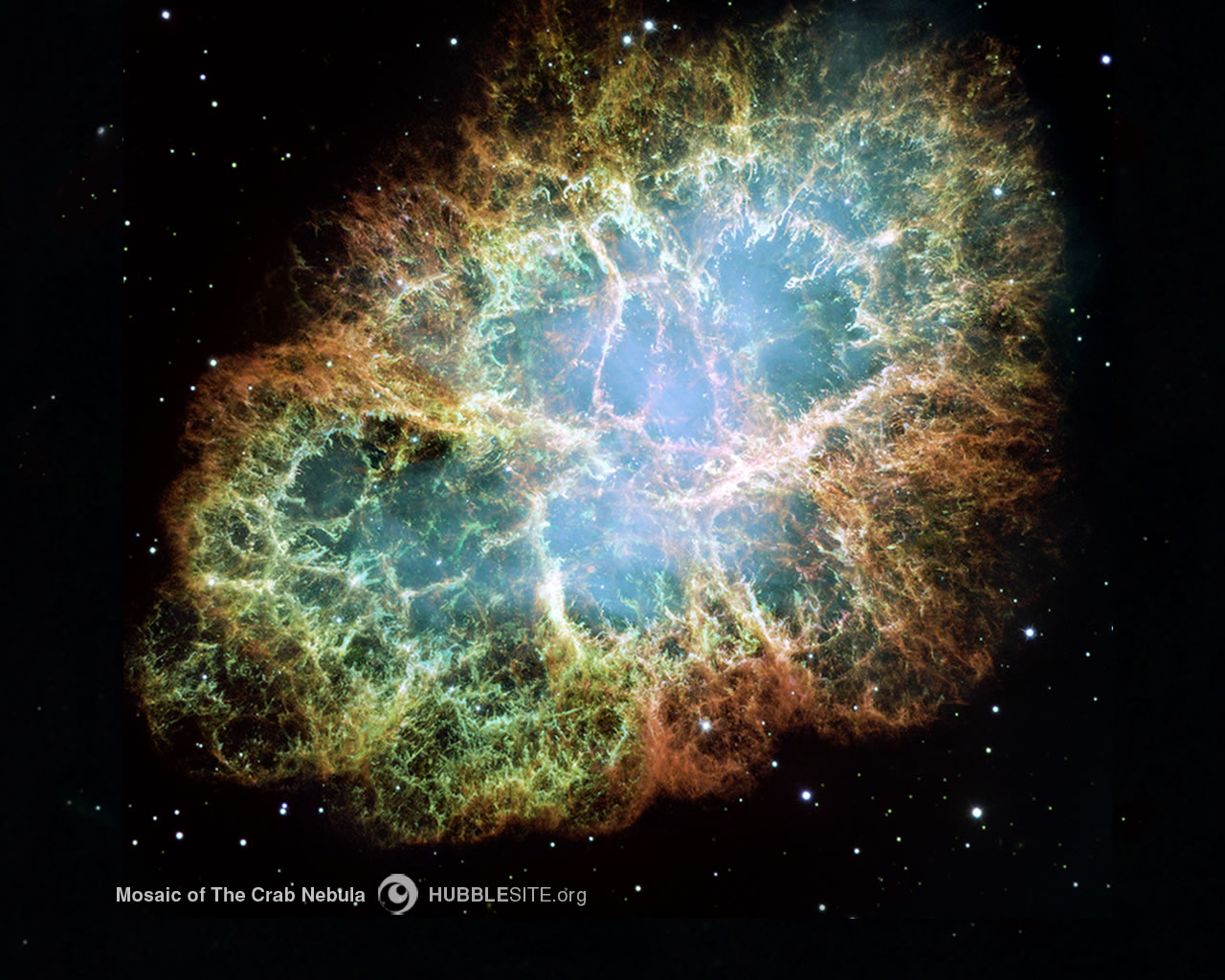
  • Crab, as in the Crab Nebula and the Crab pulsar, is the remnant of the supernova that exploded in 1054. It is about 2 kpc (= 6500 light years) away and was well documented throughout Asia and the Middle East. It was visible in the sky for two years, though it was less bright than Lupus (due to there being more dust obscuring its light in that direction), it was very much visible during the day.
    Crab Nebula Mosaic from HST
    Image Credit: NASA, ESA, J. Hester, A. Loll (ASU)
    Acknowledgement: Davide De Martin (Skyfactory)
  • 3C 58 is one of the less inspiring names for a supernova remnant (pre-dominantly pulsar in this case). It was seen in 1181 by Chinese and Japanese astronomers and was only visible a night albeit as the brightest star in the sky. It's possible that the pulsar in that direction is older than the supernova event, but its hard to know for certain. It is 3.1 kpc (= 10 000 light years) away.
  • Tycho is the next supernova on the list. It exploded in 1572 and is named after Tycho Brahe not because he discovered it (how can you "discover" something that everyone can see, even during the day) but because he studied it extensively (some have said obsessively). It inspired him (and others) to revolutionise the astronomy of the day.
  • Kepler came next, with his supernova which was first observed in 1604. (4.8 kpc = 15 600 light years away.) It was bright enough to be visible during the day, but not when the sun was high. As with Tycho, Kepler didn't discover it but he wrote a book about it, which led to it being named after him. Wiki says this was the most recent observed supernova in the Milky Way, but there are two more about which less fuss was made because they were less glaringly obvious.
  • Cassiopeia A probably exploded in 1680 but that date uncertain. It was noted down in a routine sky catalogue by the first Astronomer Royal, John Flamsteed, then later erased as an erroneous entry because there was no long a star at that location. The modern remnant wasn't discovered until 1947, after which it was linked to the erroneous catalogue entry. Although the remnant is 3.4 kpc (= 11 000 light years) away, it wasn't easily visible because of the large amount of dust in that direction.
  • Speaking of dust, this last supernova is an interesting case. It doesn't have a nice name, merely one based on its galactic co-ordinates: G1.9+0.3, or G1.9 for short. No one saw it explode. there is a lot of dust in that direction. Most of the dust in the Milky Way lies in the plane of the disc and, looking towards G1.9, we are looking right through that disc of dust. From the speed of the remnant expansion, we predict that it exploded around 1868. Anyway, this one is less relevant to the thrust of this post, I just thought it was cool.
You may have also heard of supernova 1987a (which exploded in 1987, hence the moniker), but that was actually in the Large Magellanic Cloud, not the Milky Way.

Because I can, here is a little graphic showing the various directions of these supernovae:
Image credit: NASA/CXC/M.Weiss


Auspicious portent?

So supernovae are pretty cool (or incredibly hot, if you want to be literal about it) and now it's time to tie it back into stories.

Before we, as civilisations, knew what supernovae really were (and to be fair, that occurred relatively recently, compared with all those historical supernovae), they were seen as new stars, visiting stars. In fact that's what the "nova" part indicates: newness.

Lacking a physical explanation, imagine what those people must have thought when a new light appeared in the sky and then, incredibly, was visible during the day. It's the sort of thing that, these days, might make someone less abreast of astronomy think of aliens. What would it have been back then? Portents?

We know that comets were often hailed as portentous, so why not an auspicious supernova? Supernovae are even rarer which, one would think, would make them even more significant, mythologically speaking. In a world of myth and legend, what might the appearance of a bright new star lead people to do? I hesitate to suggest that people would panic (unless goats with two heads were born at the same time, maybe) but it would surely affect their lives. Especially if it lit up the night enough to see by (like Lupus probably did).

In a world of myth and legend, what might someone do if a new star lit up the day sky? Would they, perhaps, set out on a quest to follow it? What would their reaction be to whatever they found beneath it on their journey?


Sunday, September 25, 2011

Two links. Because I can

First, cells made out of metal, or at least, research heading in that direction. New Scientist has the story.

And here's a picture to capture your imagination: a supermassive black hole at the centre of a galaxy... stars flit around it in tight orbits. Some of those stars have planets. Some had planets but they were ripped from their orbits by the black hole's gravity. Starless planets, hurtling around erratically, if not being pulled apart, then smashing into each other. Their deaths leaving behind a dusty shroud. New Scientist. ArXiv.

It's posts like these that make me think that Tumblr might be a good idea. (Of course, my usual weekly posts are much less Tumblresque.)

Wednesday, September 21, 2011

Responsible world-building

Something a little different this time. Despite my usual spiel about getting the science right and then attempting to elucidate said science, sometimes you just gotta make stuff up. Sometimes you really just need some FTL* spaceships or your whole plot falls over. There are only so many times you can write a story about slow space travel — or even relativistic space travel. All that I ask is a little consistency. So I'm not going to talk about building worlds in the sense of planets (there will be many other posts about that), I'm going to talk about making up convenient science in a sensible and coherent manner.

World building: not just about worlds.
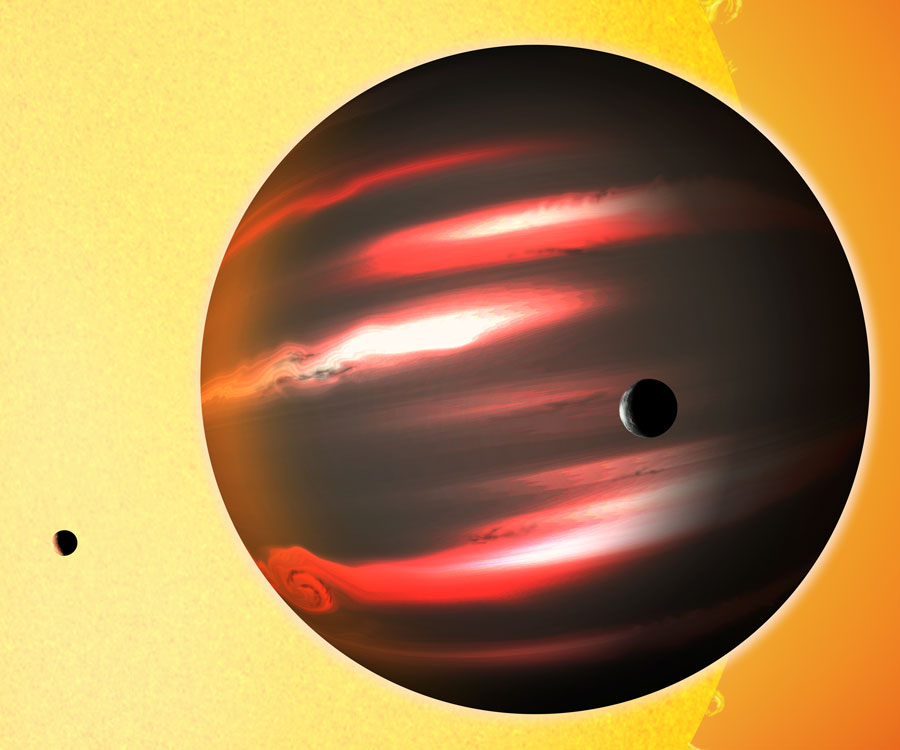
Snagged from APOD.
Illustration Credit: David A. Aguilar (CfA), TrES, Kepler, NASA
Some things are physically impossible. Some impossibilities are standard science fiction tropes, and that's OK. I've mentioned FTL, there's also telepathy (which, as Asimov masterfully showed, doesn't actually require space opera or science fantasy to operate) and worm holes. I am a bit more suspicious of inertial dampeners and hyperspace, but it does sort of depend on the story. I'd lump teleportation into the former list too, but that's a good example of something that we thought was impossible that we can sort of kind of almost start to do. Scientists have teleported photons across a lab and, more recently, I remember reading about a Bose-Einstein condensate (a small collection of atoms) being teleported, but I can't find a link right now so I'm hoping I didn't imagine it.

What they're actually doing with the teleportation at the moment is teleporting the quantum state of the photons/atoms. (I say this because I'm going to talk a little bit more about it shortly.) But that doesn't really matter. If you want to have people using teleports instead of lifts, then go right ahead. But you'd better have a good reason for them to have spaceships. Or a reason, at the very least, or pedants like me will whinge about your inconsistencies on their blogs and no one wants that.

The other thing with teleportation is that at some point you are somehow going to transfer a human-sized pile of data from point A to point B. I don't really care how you do it, but it's going to be a large pile (the upper limit, if you're curious, is about 1045 bits) of data that does somehow have to be encoded and then travel. I guess the teleportation part is implying that the travelling is instantaneous (you can invoke quantum entanglement, for example). But what about the encoding? How long is it going to take to encode that sheer quantity of information? (Actually, I did a bit of rough approximating and I got about 1029 bytes** for an average-sized person because the upper bound is, well, the upper bound.)

I assume you are going to let your encoding travel at the speed of plot. That's fine, if you're going to have some arbitrary reason, plot is better than most. However, if you're encoding people so that they can teleport, say, within a building in the space of a few seconds, then you had better not have them waiting a long time for their email to download. The speed of plot is the speed of plot, but really, you can't have different speeds of plot to suit your whim. It's sloppy and it annoys people like me. If you really must have them wait for their email, you had better have a damned good pseudo-scientific explanation.

To emphasise my point:
  • So let's say a person is worth around 1029 bytes (if you want to pick a higher number, knock yourself out; it will only make your data speeds more magically fast).
  • If it takes them 5 seconds to teleport from A to B (and assuming it shouldn't matter how far apart A and B are) then that's 2.5 seconds to encode the data and 2.5 seconds to decode it at the other end. Or maybe decoding is faster. Whatever. Order of magnitude is close enough.
  • So if it takes 2 seconds to decode 1029 bytes...
  • ...that's really fast. 
  • I mean, have you ever tried to copy a gigabyte-sized movie from your computer to your memory stick? (and assuming you weren't using Vista...) A gigabyte is 109 bytes so a person is 1019 gigabytes.
  • And don't get me started on storing that much data.
But this is science fiction, so those aren't insurmountable obstacles. But they are obstacles that, once surmounted,  have vast-reaching ramifications. Like email. Or hacking into an enemy's database. So if you need slow transfer rates somewhere else, ask yourself why similar technology to what enables teleportation can't be used.

Obviously, these ideas apply more broadly than just teleportation, but that's the example I've run with. And with that I'll close this slightly sleep-deprived post.

Remember: build worlds responsibly.


* Faster Than Light, which is currently physically impossible.
**1 byte = 8 bits


LinkWithin

Related Posts Plugin for WordPress, Blogger...