Sunday, December 18, 2011

Weird Worlds: Kepler 22b

It's what all the cool kids are (still) talking about, so why not a post on it? In the glut of Kepler mission transiting planets, a new planet has risen to the fore as the possibly most Earthlike extrasolar planet. Huzzah! (And in a few months yet another new planet will take its place. Just watch).

Credit: NASA/Ames/JPL-Caltech

What we know

Kepler 22 is a star very similar to our sun. It is slightly smaller (0.98 times the radius of the sun) and slightly smaller (0.97 times the mass of the sun). It is 587.1 light years away, so it's not something we're going to be visiting soon.

So far, it only has one known planet, dubbed -- as these things go -- Kepler 22b. This planet is smack bang in the habitable zone ...on the inner edge, so OK, maybe not that smack bang... BUT. The part people are getting exciting about is that it's the smallest planet we've found in the habitable zone thus far.

How small? 2.38 Earth radii. For comparison, Neptune, the next biggest solar planet after Earth, is 3.88 times Earth's radius. That puts Kepler 22b just on the smaller side of halfway between Earth and Neptune. In terms of size.

What we don't know is how massive it is. The way the Kepler satellite detects exoplanets is by looking at stars and measuring how much dimmer they get when (if) a planet passes between the star and us. By knowing how much light the star gives out usually, and how far away it is, it's possible to work out how large the planet is. (And, actually, even if you don't know how far away the star is, you could still work out how big the planet has to be as a fraction of the size of the star.)

We know how long its year is, basically by measuring how often it passes in front of the star. Yeah. It's that simple (particularly since there seems to be just one planet in this system at the moment). So Kepler 22b's year is 290 days long, not drastically different to Earth's. That and its position in the habitable zone have lead people to suppose that maybe it's not so different to Earth.

Based on how far it is from its star etc, the average surface temperature would be about -11º Celsius if it had no atmosphere. However, if it had an atmosphere like Earth's average temperature would be about 22º C. Perhaps a slightly less insulating atmosphere would be in order, however, since Earth's mean surface temperature is actually 14º C. (Because we have to take global lows and highs into account, you see, and average over the whole planet, never mind that 22º is just about room temperature.)

Harping on what we don't know

It's that mass. And the fact that we don't have a planet of that size in our solar system. It's in the transitional zone, as I said, between rocky terrestrial planet and mini gas giant. If it's rocky, it's likely that the gravity will be stronger than Earth's, thanks to it's larger size. In fact, if it's the same density as Earth, the surface gravity will be about 2.4 times Earth. Which isn't long-term viable. At Neptune's density, we get a ball of gas with surface gravity 0.72 times Earth. A ball of ice would result in gravity 4.3 times Earth. The least dense terrestrial planet in our solar system is Mars and at Mars' density, Kepler 22b would have gravity 1.7 Earth's.

So there's quite a spectrum of possibilities there. We really don't know enough to make any definitive judgements at this stage. That doesn't make it less exciting, of course, and it's true that there might be oceans and continents there. Or it could be a small dense ball with a thick gaseous atmosphere inhabited by dragons (perhaps even fire-breathing ones, if there's methane in the atmosphere and breathing fire is a viable way to catch prey). Which would also be cool. Arguably, cooler.


Saturday, December 10, 2011

Australian Women Writers Challenge


Next year, I am going to take on the Australian Women Writers Challenge. To make it particularly challenging and to tie in better with the contents of my blog, I am going to try to read only science fictional books by female Australians.

The specifics of my challenge:

Genre challenge: Purist: one genre only

Challenge level: Miles (read 6 and review at least 3*)

* Should include at least one substantial length review


I'm excited! But also kind of glad that there are still a few weeks left in 2011 to finish the Vorkorsigan Saga which I'm in the grips of. (Only, um, 4-5 books to go...)

Book list

And here is my preliminary list of books/authors that I plan to read. The order I've listed them is more or less the order they occurred to me / were suggested to me on Twitter / I saw them on past Aurealis Awards short lists. Also, I think some of these will be difficult to acquire, so that will definitely affect my ability to get through them all.
  • Marianne de Pierres (definitely Angel Arias which is sitting on my bookshelf, quite possibly others)
  • Patty Jansen (Watchers Web / The Far Horison)
  • Kim Westwood (Courier's New Bicycle)
  • Maria Quinn (Gene Thieves)
  • 
Sara Creasy (Song of Scarabaeus)
  • Sonny Whitelaw (Rhesus Factor)
  • Claire Corbett (When We Have Wings)
  • Sue Isle (Nightsiders)
  • Maxine McArthur (Less Than Human / Time Future)
  • Michelle Marquardt (Blue Silence -- seems very hard to find though)
  • Tess Williams (Sea as Mirror)
  • Sally Rogers-Davidson (Spare Parts)
 I've put a link along the top bar thingy under the banner to a page where I'll be collating reviews and keeping track of the books I've read.

Wednesday, December 7, 2011

Measuring distances: the furthest away objects


[First up, apologies for the unscheduled hiatus. Being sick and moving house (mercifully not simultaneously) sort of quashed any blogging plans I may have had. OK, so I don't mean so much quashed as put out of my mind entirely, but whatever.

Also, thanks to changing life routines, I think I'll be changing my update schedule from Wednesday nights to weekends. For the time being it seems more manageable.]

This week I thought I'd talk about something a little bit outside the realms of foreseeable future SF: extragalactic distances. I say outside in the sense that there is currently no plausible way to travel to neighbouring galaxies, let alone galaxies at the edges of the observable universe.

How far is far?

The thing to understand here is that the universe is really big. Like, amazingly, mind-blowingly large. Douglas Adams said it well:
Space is big. You just won't believe how vastly, hugely, mind-bogglingly big it is. I mean, you may think it's a long way down the road to the chemist's, but that's just peanuts to space.
Light travels 300 000 km in one second (in a vacuum). It takes about eight minutes for light to travel from the sun to Earth. About five and a half hours from light to travel from the sun to Pluto. It takes a hundred thousand years for light to travel from one edge of our galaxy to the far edge (along the disc). By this stage, I'm sure you've heard the term light year. It's the distance that light can travel in one year and is about 9 460 000 000 000 kilometers (about 1013 km or ten trillion kilometres). The nearest galaxy is two and a half million light years away. See how all these distances stack up?

Most astronomers don't actually measure or think about distances in light years. They're somewhat useful for conceptualising things, but parsecs (abbreviated to pc) are more common. One parsec is 3.26 light years. That puts the nearest galaxy, Andromeda almost 800 kpc away (kpc is kiloparsec where the kilo indicates a factor of 1000). Mostly galaxy distances are measured in megaparsecs (Mpc) where one megaparsec is a million parsecs.

Even larger distances are measured using a scale called redshift. The universe is expanding. When light leaves a distant galaxy and travels towards us, it takes time. Possibly millions or billions of years, depending on just how distant that galaxy is. In all that time while it's travelling, the universe continues expanding. The expansion stretches out the light so by the time it gets to us, it has a longer wavelength. Longer wavelength means redder (on the visible spectrum, although in reality this light could have started at any wavelength, depending on what emitted it, and could finish up stretched out all the way into the radio region). Hence the term "redshift".

Doing the Measuring

I touched upon spectroscopy when I talked about the Doppler effect in this astronavigation post. Basically, you look for some known lines (often hydrogen lines) and see how far they've shifted towards the red end of the spectrum.

So we should just be able to use this to measure distances, since we know how fast the universe is expanding, right? Not quite. In the post I linked above, I talked about Doppler shift. This is different to redshift but it can look very similar. Far away galaxies can be moving relative to their neighbours (galaxies in a cluster orbiting a central galaxy, for example). These local motions are called peculiar velocites. This means that you could work out spectroscopic redshifts for galaxies in a cluster, which are all around the same distance from us, but get different results because of their peculiar velocities.

Instead we have to use a combination of different methods, two of which I'll talk about now. The same principle underlies both. Basicaly, in the 70s and 80s, it was discovered that there are a few "scaling relations" which galaxies obey. For example the Tully-Fisher relation relates a spiral galaxy's luminosity (how much light it gives out in total) and the rotational velocity of it's stars (how quickly they orbit the centre).

Spiral Galaxy M101
A spiral galaxy. Although, for a Tully-Fisher measurement, you'd
want it to be side-on, not face-on. But face-on looks prettier.
Source: Hubblesite.org
We can measure the rotational velocity of the stars in a spiral galaxy using the Doppler effect (even though the galaxy is moving away, the stars on one side will be moving towards us and on the other side away from us -- the difference between the two sides can be used to work out the rotational velocity). Once we know that, we get a prediction for the luminosity of the galaxy. However, the galaxy is far away and looks dim, much like a light in a high-ceilinged hall that isn't too bright too look at although it would hurt your eyes if you were up close. Exactly how dim a galaxy looks depends exactly on how far away it is. So if we know how bright it should be, we can compare with how bright it appears and work out how far away it is. Huzzah.

There is a similar, albeit slightly more complicated, relationship for elliptical galaxies called the Fundamental Plane.

Both the Tully-Fisher relation and the Fundamental Plane are constantly being improved upon as we build better telescopes that give more precise measurements and also as we understand the underlying physics governing them better. (At the moment, we're not super sure why they exist.) However, we're still able to use them to measure things like Hubble's constant. Who knows, maybe there are super advanced aliens out there who can set up extragalactic wormholes and need to know how far away to place them.

Probably not, though. I did say this post was outside the realm of plausibility.

Wednesday, November 16, 2011

Strong Characters (Audience participation post!)

Although not strictly science- or space-based, this post has been kicking around my mind for a while. I decided that today (when my sinuses are trying to kill me and I don't quite have the energy to talk about exploding meteorites in Terra Nova), would be a good time to write it. And fair warning, I am going to Use Examples from Harry Potter, because JK Rowling not only provided good examples, but most of the world already knows what happened in the end so I don't feel bad about possible spoilers. Sorry to those three people in the developed world who haven't read Harry Potter. Well done.

Actually, it's not so much the blog post that's been rattling in my head so much as the question: what makes a strong character "strong"?

Several people have written all over the internet that "strong", when we're talking about characterisation, does not automatically imply physical strength (particularly relevant when we're talking about strong female characters, but that's not quite the point I want to raise today). I want to talk about emotional strength and skip the argument as to whether that's equal to physical strength.

Strong characters in Harry Potter.
It is easy to identify characters that lie at extreme ends of the emotional strength spectrum. The hero/ine who sacrifices a lot to save her friends/village/the world is almost certainly going to be a strong character because (assuming it's a good story) they are going to have various obstacles to overcome, both physical and emotional, perhaps stemming from their flaws. Antagonists in some ways have less stringent requirements. Voldemort won't allow anyone to stand in his way (making him strong, if Evil), but Wormtail spends his time attaching himself to strong people around him (first James and Sirius, later Voldemort). And I'm sure he's described as "snivelling" at least once; a clear indication of a weak character.

There are other situations when the distinctions between weak and strong are less cut and dried. There's the character who does the right thing for the wrong reasons or the character who does the wrong thing for the right reasons. There's Snape who did very difficult things for love and, ultimately fought on the side of Good. He didn't do it for noble reasons (in my opinion) like the lead trio, but he still had to be very strong to prevent Voldemort from catching on.

What about the character who is so strongly affected by something (a death, a breakup) that they have difficulty functioning? Are they stronger or weaker than the character who represses their emotions or (for whatever reason) doesn't feel anything? It seems clear to me that the character who is terribly saddened but still carries on through their hurt is emotionally strong. (Although, if you want to argue in the comments, knock yourselves out.) I ask you, which is "stronger": character A, who can't come to terms with the terminal illness of character C and avoids them because they hurt too much to see them suffer, or character B who isn't as emotionally affected but stays by character C out of a sense of duty? It's a grey area, although I'm sure character C would appreciate B more, especially from a practical point of view. (And character D who is heart-broken but stays around anyway would be the clear winner, but they aren't always an option.)

On the other hand, the character who isn't scared can't be brave.

What are your thoughts on the matter? What makes a strong character for you? What are some good examples of weak and strong characters in fiction?


Thursday, November 10, 2011

Future Tech in Fiction

I thought this week I'd talk about some incorrect technology predictions in fiction. My aim is more to highlight ways in which authors can be wrong rather than mock them. I mean, you can't expect to be right all the time, but I think it's interesting to note exactly how they were wrong and why (from a somewhat philosophical point of view).

So I've chosen three books, all old (60ish years) and all containing some piece of technology which didn't quite work out as foreseen.

Second Foundation by Isaac Asimov

Second Foundation the final book in the original Foundation trilogy was first published in 1953 (although it was serialised in Astounding Magazine -- now known as Analog -- prior to that between 1948 and 1950). For those unfamiliar with the Foundation series, it is set in a post-galactic empire world as said galactic empire is crumbling. So a good thousand years or so in the future.

I remember quite clearly a passage where one of the characters, a teenage girl called Arkady, is writing an essay for school. These days, obviously, she would be typing it on a computer. In Second Foundation she was dictating to a typewriter that printed in nice calligraphy on pink (I think) scented paper. I don't think it was called a typewriter (but I don't have the book nearby to check) but it seems an apt label since I think when she mispronounced something she had to redo the page. Definitely no screen.

Asimov himself has said that he completely failed to predict a few major things, one of which was the miniaturisation of computers (up until the microchip was invented in the real world his future tech computers still had vacuum tubes). Does that make Asimov's work wrong or bad? No, it doesn't. A typewriter you can talk at is a possible evolution of writing hardware, just not the one we followed. It's not that we can't make a dictation-typewriter now, it's that we have better things, like editable text. (See, that story even pre-dated electric typewriters.)

Would Asimov's story been better if he had somehow foreseen laptops or smartphones and given his characters those instead of juiced up typewriters? I think not, for a couple of reasons:
  1. It was a fairly minor point in the story and stopping to explain a laptop to a 1950s audience would have taken several unnecessary pages and not added anything to the actual story (the point of the scene, from memory, is to build setting and to later show us how she grows throughout the story).
  2. Once you have something like a laptop, a lot of the other technology would need upgrading (no more vacuum tubes on spaceships either) which would lead to more needless explaining of concepts. It's not that there isn't a place for explaining future tech in stories -- it's what puts the "hard" in hard SF after all -- but I think you need to choose your battles in terms of what's most relevant to the story at hand.
This example reminds me of the quote by Henry Ford, who invented the car: "If I had asked customers what they wanted, they would have said a faster horse." But maybe sometimes we need a faster horse. I think that often what we really want the future to be like is more or less like now, but a bit better, faster and shinier. Unless you're dealing with dystopian SF, which Asimov assuredly was not.

Prelude to Space by Arthur C Clarke

This novel was written in 1947 but, according to Wiki, not published until 1951. It was set in the near future (relative to when it was written); the 1970s. It recounts the events leading up to the launch of the first manned mission to the moon in delightful detail. (If you're wondering, it's the British, launching from Woomera in Australia, who win this space race. Possibly unsurprising given Clarke's nationality.)

I am in no way faulting Clarke for getting the year wrong for the moon landing (and he wasn't that far off). I do think having the British achieve it was a bit optimistic on his part, but I don't have a problem with that either (and being set in Australia gets bonus points from me ;-p ). In fact I've included it here for pretty much just one flippant statement made by a character about the future of spaceflight.

At some point, one of the characters makes the remark that atomic rockets were necessary to get to the moon and that it would never have been possible with chemical rockets. The problem? Chemical rockets are exactly how we got to the moon, and just about everywhere else, at least in part. Some prototypes and a few probes have done more interesting things, but all manned missions used chemical rockets.

The problem isn't that the book had nuclear powered space flight, it was the sweeping generalisation that quickly dated it. OK, so the whole "we don't need to speculate about how we're going to get to the moon once we've been there and know how we got there" also contributed to that. Perhaps I should have said that the sweeping generalisation made me laugh when I read it.

My suggestion is not to make sweeping generalisations about future tech if you can avoid it, especially if you're writing something reasonably near-future. I think it might become less important in other sub-genres such as dystopian science fiction for example.

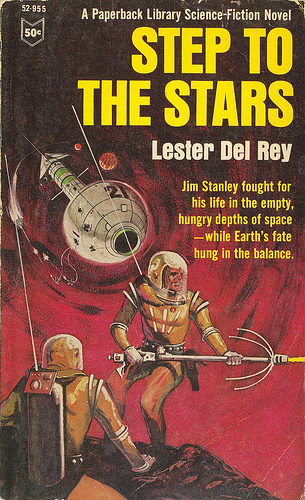
Step to the Stars by Lester del Rey

This one was published in 1954. Also, I don't recommend actually reading it because it is horribly racist and sexist.

(I think it's good that my formative SF-reading years were spent reading mostly Asimov, who isn't racist nor sexist*. I'm not sure what I would have made of the highly inflammatory and offensive preface to this book if I had read it at a more impressionable age. The preface, if you're curious, basically said that if We -- ie Americans, because no one else reads books in English, right? -- don't build a space station first, then They -- that is, the evil commies -- will kill Us all with space lasers. I'll admit I don't remember if space lasers were actually mentioned, but that was the gist. It might have been nukes, now that I come to think of it. Anyway...)

The premise is that in order to expand into space, the best approach is to build a space station and then launch ships to the moon and Mars and wherever from there. So the US government decides to build one in secret. Egads! There is no way that would have stayed secret as long as it did in the book. Sure, you might be able to put a few high-orbit military satellites up without your enemies noticing, but all the bits required for a space station? I think not. Not to mention that the actual space station would be reasonably noticeable (assuming you were looking for your enemies to do something, which given the context of the book, they would have been). But I am ranting about the wrong thing. (Also, gah! They recruited random engineers and mechanics to build the thing in space. What?! AND these people all kept quiet about the secret space station? OK, OK, moving on.)

I thought the descriptions of living in space were reasonable, particularly given that they were written before anyone had ever actually been in space. What I wanted to draw attention to was how del Rey portrayed rocket flight. The Loyal Citizens building the space station used small rocket-powered taxi ships (I hesitate to call them shuttles because of other connotations) to get around between the construction site and whatnot. (See how large this enterprise was? How could they think it would stay secret?) The way it was described, each little ship had just one largish rocket attached to it, so to break or turn, they had to point the rocket in another direction and fire. I believe gyroscopes were used to change orientation.

It's not so much that he got the physics wrong here (although rockets as we usually think of them would be much too powerful for these purposes, that is easily overcome), but the impracticality of the set up. Surely it would save time and training money to just put smaller rockets in for manoeuvring? This is what we do in the real world, more or less (the less being that the actual rockets used are nothing like the sort used to get off the ground because there's no gravity to overcome and no air-resistance either).

It's not just accurate science which is necessary -- del Rey was as accurate as he could be, from memory -- but practicality. Yes, you can use a gyroscope to flip your ship around and change direction, but think of how disorienting that would be for the pilot with all the spinning stars.


* I mean, Asimov's books aren't overfilled with female characters or anything, and they are in many ways a product of their times, but he had some competent women who were more than secretaries or love interests to the male characters. For example Susan Calvin in some of the robot stories, Arkady who was mentioned above, and several secondary characters whose names escape me. And he wasn't racist.


Wednesday, November 2, 2011

Weird Worlds: Kepler 14b

This post follows the same theme as last week's: planets in binary star systems. Last week's planet, Kepler 16(AB)b, orbited two stars which closely spun around each other. This week's planet, Kepler 14b, orbits one star, which in turn orbits another star at a further distance. This paper, by Buchhave et al (2011), is the main source of my data on Kepler 14b.

Kepler 14b is unlikely to have any sort of solid surface.
However, the two stars could look something like this. Maybe.
Honestly, I think this might be a re-purposed Io illustration
but NASA did use it on a Kepler 14b page, so who am I to argue?
Image credit: Susan Stanley for NASA Kepler Mission Education
and Public Outreach.
It turns out that unlike originally thought from the Kepler satellite data, the star Kepler 14 is not a star, but is two stars. Buchhave et al (2011) discovered this when they went and looked at it with an Earth-based optical telescope. The two stars are so close together in the sky as seen from Earth that it took fancy adaptive optics to be able to resolve them. Resolving, by the way, means being able to distinguish that there are two separate sources of light, not a single blob. The stars were too close together to be able to separate out their spectra (because this uses a different instrument than the one that images them normally), so a few assumptions had to be made, but none that should strongly affect the planet.

Some facts

The two stars that make up Kepler 14 are designated A and B with A being the one the planet orbits, but the nomenclature is a little fuzzy because the binary nature of the system was discovered later. Going on the basis that the system is 980 parsecs away (3200 light years), then the two stars are separated by 280 AU (remember, 1 AU is the distance from Earth to sun and Pluto is about 40 AU from the sun). Both stars are bigger, hotter and brighter than the sun. The sun is a G type star and the Kepler 14 stars are F types, one spectroscopic class hotter/bluer. They are 1.51 and 1.39 times the mass of the sun and orbit each other once every 2800 years.

The planet, Kepler 14b -- I am tempted at this point to make up a name for it. I dub it Keforb -- is 8.4 times the mass of Jupiter. This makes it a fairly large gas giant and definitely not habitable by human standards. Could one of it's moons be habitable? Well, let's keep looking at the planetary parameters.

The orbital period, the length of one Keforbian year, is 6.79 Earth days. That's pretty quick. If you've been playing along at home, you might remember that planets orbit faster the closer in to their star they are. Keforb is only about 0.08 AU from it's primary sun. (Mercury is about 0.4 AU from the sun.) I don't need to do any calculations to know that this planet is going to be way too hot for life, even if it had a suitably-sized moon. It's the sort of planet that's known as a hot Jupiter.

I found this pretty awesome NASA page which shows everything you need to know about Keforb (except for my awesome name) including, if you click on the buttons down the bottom, where Kepler 14's habitable zone is and the orbits of solar system planets for comparison.

So the habitable zone for this system is out past Mars's orbit, in the range of 2.17–3.56 AU, roughly where the asteroid belt is in our solar system.

Similar configurations?

OK, so there's no hope for life on the one known planet in the Kepler 14 system, but what about other possible planetary systems of similar configuration. I mentioned Tatooine last week as being similar to the planet in the Kepler 16 system. The Kepler 14 system is different because the planet orbits only one star, not both of them.

A system of this sort that pops up in fiction every now and again is a planet orbiting a red dwarf star which is in turn orbiting a larger, brighter star. I'm pretty sure I've read about this sort of thing more than once but the series that springs to mind first is the Second Sons Trilogy by Jennifer Fallon. Partly this is because it's one of my favourite series, so I may be biased. In the first book, Lion of Senet, we are introduced to a world with two suns: a small red sun and a more distant yellow sun. The world orbits the red sun and the red sun orbits the second yellow sun. The residents experience two different types of sun sets and sun rises and their "nights" are when only the red sun are up in the sky. They also get to experience side-effects from the tidal forces of a) having two suns and b) being in a relatively close orbit with the red dwarf. This means lots of volcanoes and tidal waves (I think the first book even opens just after a volcano, but I may be wrong and I don't have it on hand to check).

It's billed as a fantasy series, and it's certainly written in a fantasy style with feudalism and political intrigue and war and things (the rest of Jennifer Fallon's books are indisputably fantasy). However, there isn't any more magic than in our world which makes me tempted to say that it's technically sort of science fiction. But without laser guns (or any sort of guns. There are swords, though). Maybe "sword and science" rather than "sword and sorcery".

Anyway, I highly recommend it, not just because of the interesting celestial mechanics, but also because it's a damn good read. The hero, Dirk, goes around applying his brain, not brawn. Also, if you go in solely for the celestial mechanics, you might be disappointed because, while good for the reasons I've mentioned above, it's not quite perfect, mostly for reasons of plot.

Sometimes, it's best not to let science stand in the way of a good story. (So long as you try and at least some of the science is sensible.)

Wednesday, October 26, 2011

Weird Worlds: Kepler 16

I have talked about the Kepler exoplanet-finding mission in the past (planet spotting, Kepler 11, KOI 730). Today I'm going to look at a planet Kepler has found in a binary star system: Kepler 16(AB)b and next week I'll talk about Kepler 14b which is also in a binary system but in a different configuration.

A binary star system is where two stars are close enough together to be in orbit around each other, instead of individually orbiting the centre of the galaxy. Instead they orbit the centre of the galaxy together, much the same way as the Earth and the moon orbit the sun together. Also sort of like on Tatooine from Star Wars.

Kepler 16b


Artist's impression of the Kepler 16 system.
Credit: NASA/JPL-Caltech/R. Hurt
Basic stats for the Kepler 16 system are somewhat unartistically presented here. I'll go over some of them below.

As far as we know, there are three bodies in the Kepler 16 system: the two stars which are designated Kepler 16A and B (and together Kepler 16(AB). As per usual convention, the more massive star will be A while the smaller will be B. The usual convention, for non-binary systems, is that the star is designated Whatever-a and planets in order of discovery then mass (so mass when several are discovered simultaneously) are designated Whatever-b, Whatever-c etc. The lower-case a for the stars is a bit redundant here, though. Masses and distances for the system are as follows:
  • Star A:
    • Mass: 0.69 solar masses
    • Size: 0.65 solar radii
    • Temperature: 4450 Kelvin (about 4180º C or 7600º F)
  • Star B:
    • Mass: 0.20 solar masses
    • Size: 0.23 solar radii
  • Stars AB together:
    • Orbital period: 41 days
    • Orbital separation: 0.224 AU (for comparison, Mercury's orbit is 0.387 AU from the sun)
  • Planet Kepler 16(AB)b:
    • Mass: 0.33 Jovian masses
    • Size: 0.75 Jovian radii
    • Orbital period: 229 days
    • Orbital radius: 0.70 AU (Venus is 0.72 AU from the sun)
It's not possible to separate out and measure the temperature of star B because it is completely overwhelmed by the light from star A. We can only make guesses based on it's spectral type which is determined from its chemical make up. Also note that the distance measurement for the planet is from the centre of mass of the two stars -- the barycentre.

For a bit of fun, let's work out how big and bright each star would be from the planet, relative to the sun. I should note that this is a gas giant planet and so any possible light would be more likely to exist on one of its moons, not the planet. The suns would appear the same size from a moon, though.

First, how big would the suns appear? (See this post for details on the calculation.) Remember for comparison that the sun (and moon) have an angular diameter of about 0.5º. So, sizes:
  • Star A as seen from planet on average: 0.49º, so about the same as the sun
    •  Range: 0.43º to 0.59º
  • Star B as seen from planet on average: 0.18º, which is about a third of the diameter of the sun
    • Range: 0.15º to 0.21º
Now, how much light would reach the planet from the two suns? Or how brightly would the stars illuminate the planet? This is a slightly more complicated calculation which you can read about here (and for comparative purposes, about 1400 Joules of energy hit each square metre of the Earth from the sun each second). Remember, also, that sometimes star B will pass behind star A, sometimes they will appear next to each other and sometimes B will be in front of A, blocking out some of A's light but contributing its own. I'm just going to calculate them separately.
  • Star A: 410 Joules per square metre per second, which is a bit less than a third of the light energy the Earth gets from the sun. It is also going to be redder light, thanks to the cooler temperature of the star.
  • Star B: assuming its temperature is about 2500 K which is within the plausible range for M type stars (star A is K type, if you're curious), I get about 5 Joules. That's 3-4% of the light from the sun hitting Earth. On the other hand, it's still a lot brighter than the full moon in Earth's sky (and significantly redder). About 1400 times brighter, in fact. And about as bright as 260 100 Watt light bulbs at a distance of 10 m. Except it would probably feel dimmer thanks to the redness.
Finally, let's suppose that there is an Earth-like moon of this gas giant planet Kepler 16b. How warm would the suns make it? The calculations are discussed in this post on the habitable zone. Since most of the warming comes from star A, I'm going to ignore star B for this calculation. The average temperature I get is about 190 K which is about -85º C or -121ºF. So a little bit too cold for life, but not too hot, which is a harder problem to solve. Maybe throw in a bit of greenhouse warming and a lot of snow gear and you have yourself a snowball planet with two suns. Not just cold, but pretty cool.

And if you want to read more, here is a nice New Scientist article about it. And, below, a video from APOD:


LinkWithin

Related Posts Plugin for WordPress, Blogger...