Friday, September 21, 2012

Gravity and atmospheric pressure

I have another response to an "Ask Tsana" question today.

Brookelin asked:
I was wondering... with planets like Europa and possibly Ganymede, who possible have oceans, if humans made future settlements under said oceans, would the pressure from the water above counteract the effects of reduced gravity on the human body?

Interesting question. A preliminary point: it's Jupiter's moons Europa and Callisto that probably have sub-surface oceans (especially Europa), not Ganymede which is a solid rocky moon.
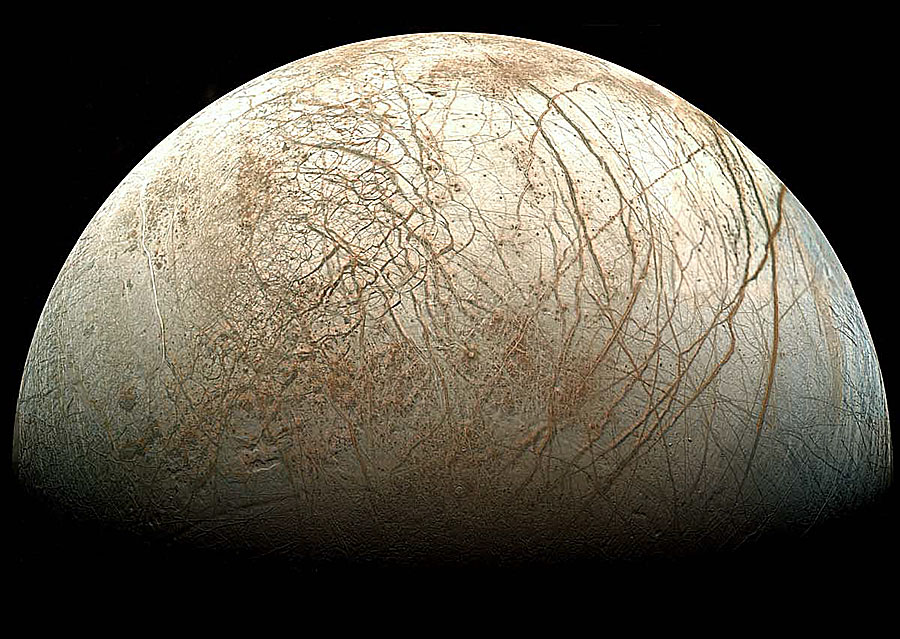
Europa, one of Jupiter's moons, has a vast ocean beneath
its surface. Credit: Galileo Project, JPL, NASA;
reprocessed by Ted Stryk
So, how do pressure and gravity work? In this context, gravity is the force that holds a planet/moon/star together and which attracts other objects to it. So we're all being pressed into the surface of Earth due to Earth's gravity. Pressure is the force a surrounding fluid (air, water, etc) exerts on something. So the atmospheric pressure we feel on Earth is pushing at us from all sides (well, OK, not out from the ground) and is due to all the air in Earth's atmosphere.

When you go swimming, the further you dive down, the higher the water pressure around you gets. This is because the deeper you are, the more water is above you to press down on you and the more water is above the bits of water on either side of you, also pressing into you. If you've ever been snorkelling (or scuba diving, I suppose but I can't vouch for that due to lack of experience) you might have noticed that it gets harder to breath the deeper you go (assuming a long enough snorkel). This is due to the water pressing down on your chest. Air does the same thing, but we're used to it, so we don't notice. The other thing that happens under water is that the water underneath you pushes up on you: this is called the buoyancy force and it's why things (people, tennis balls, icebergs, etc) float.

The higher up you go from sea level on Earth, the thinner the atmosphere gets (basically, the less atmosphere left above you). To halve the atmospheric pressure you experience, you need to go 5 km above sea level. (On the other hand, to double the pressure, you only need to be about 10 metres under water.) At that height, gravity is still pretty much the same as at sea level (the difference is about an eighth of a percent) and your main problems are getting enough oxygen (not a huge problem if your lung capacity is OK) and possibly altitude sickness (potentially a problem).

We need some amount of air pressure around us to survive which is part of the reason astronauts wear space suits. However, there is a range at which we can still function and that range increases if we have extra oxygen (and don't get altitude sickness). People have climbed Mt Everest (8.8 km above sea level) which has an atmospheric pressure of about a third that at sea level at it's peak without oxygen, but even doing it with oxygen requires training and acclimatisation and isn't something anyone can just decide to do one morning (well, unless they also decide to put in all the training).

On the surface of Europa or Callisto, there is no atmosphere and hence no atmospheric pressure. The ground is frozen water (probably not pure water, if only due to meteorite bombardment, but that's beside the point), but let's suppose we somehow got under the surface and set up a habitat. Since we're human and breathe air (a particular mix of mostly nitrogen, with some oxygen, carbon dioxide and misc) we'd have to have some sort of bubble habitat under the sea. But it's not just the air part that we need, we also need it to be around one (Earth) atmosphere of pressure. So we build a habitat with solid walls and fill it with the right amount of air... and then we're inside an air bubble and the water outside the bubble is having no effect on our bodies directly. The only way it would is if we went out into the water without pressure suits. Which probably wouldn't be the best idea in the world for a variety of health and safety reasons that don't necessarily have to do with the water pressure.

Now let's talk about gravity. The main way we detect small changes in pressure is though our ears, for example when they pop on taking off and landing in aeroplanes. The main way we detect changes in apparent gravity (which is the same as changes in acceleration) is when we feel lighter or heavier. If you're standing, this might manifest as extra strain on your legs, if the apparent gravity has increased, or a feeling like your stomach is moving upwards (possibly accompanied by nausea), if the apparent gravity has decreased. You don't experience the same feeling underwater or up a tall mountain because the gravity doesn't change in those places although the pressure does.

So what I'm ultimately trying to say is that the effects of gravity and atmospheric pressure are different. You can't compensate for a decrease in gravity by increasing pressure. Pressure is a force applied from all directions simultaneously, while gravity acts in just one direction. We know about the effects of Earth gravity, high gravity (from fighter pilots for example) and zero/microgravity (like on the space station) on people but much less about the effects of gravitational fields less than Earth's and more than zero. Europa's and Callisto's accelerations due gravity at the surface are about 13% Earth's and for comparison, the moon's is about 17% Earth's) so while we have had some experience with the moon landings during the Apollo missions, we don't really know how serious the health problems associated with spending prolonged periods at such low accelerations would be. There almost certainly would be some, but they probably wouldn't be as severe as zero gees. So while we can't use water pressure to compensate for gravity, it's not impossible for people to live on one of the moon's of Jupiter. We just don't know enough about what long term problems might arise.


Wednesday, July 25, 2012

Quick note on terraforming Galilean moons

This post comes from an "Ask Tsana" comment.

Sam Keola asked:
Aloha from Hawai'i again Tsana! I have a hypothetical question. If in the very distant future we had the technology to terraform, would it be best to terraform Callisto and Ganymede or set up domed bases? Ganymede is suppose to have an ocean similar to Europa, but I'm not sure if that's "world wide". Your thoughts on terraforming!
The main problem with terraforming either of those moons is their gravity isn't large enough to keep any atmospheric gases for long after they're introduced. Ganymede, which is larger, has a surface gravity of close to a seventh of Earth's which is less than half of Mars's and Mars has difficulty keeping much of an atmosphere itself. Purely from that point of view, domes or something else sealed would be better.
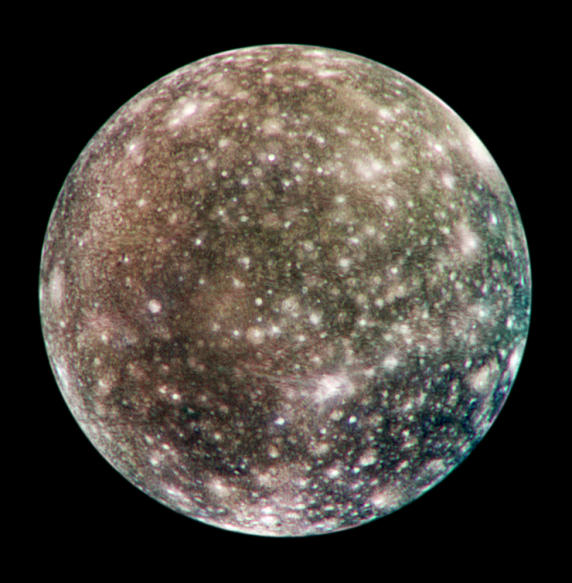
Callisto.
Credit: Galileo Project, Voyager Project, JPL, NASA

Once you've decided to build something sealed, then it would be better for colonists to build on Ganymede, as opposed to the other Galilean moons, for a few reasons:
  • It has the highest surface gravity, not by much but every little bit would prevent colonist's bodies from degrading. Actually, because the Galilean moons are less dense than Earth's moon, they have a lower surface gravity, despite being larger in volume. You're going to have low gravity-related heath problems in any case, however.
  • It's not as close to Jupiter as Europa (and Io!) is. The phenomenon responsible for keeping Europa's interior liquid is tidal friction thanks to its proximity to Jupiter. It's the sort of thing that also makes the surface more unstable (prone to volcanoes -- not as much as Io, of course -- and quakes) and less hospitable to people. You can read more about it here.
On the other hand, if what you're doing is mining and the minerals etc you're interested in are found on both Ganymede and Callisto, then Callisto is the place to put your colony. It's gravity slightly lower and, more importantly, it's further from Jupiter, meaning that when you're exporting your rocks, there's less gravitational pull from Jupiter to overcome.

In terms of finding water to mine, all three moons in question (ie, not Io) have water on them, so that shouldn't be too much of a problem, especially if you're already planning to mine other things.

Of course, there are also reasons why Europa would be a desirable place for a colony, especially for scientific reasons, exploring it's subsurface ocean primary among them. There's a good chance there's microbial life there.

So there you have it, if you're going to colonise the larger Galilean moons, it's better to build a close structure on them rather than try to impart an atmosphere. It would be even harder than giving Earth's moon a permanent atmosphere.

Thursday, June 7, 2012

Review: Polymer by Sally Rogers-Davidson

This  review is posted as part of my Australian Women Writers Challenge. I have cross-posted it on my review blog.

Polymer by Sally Rogers-Davidson is a science fiction story which I would categorise as adventure. Apart from being in first person, it reminded me of pulpy SF adventure stories from way back when. Except with a female protagonist and, like, more female issues than would ever have come up in those books.

The main story takes place within the pages of a long-lost journal written by Polly Meridian (aka Polymer). On the night of her graduation ceremony, her space station home is invaded by aliens. (Aliens, in this book, pretty much means "people not from the same place as me who might be human or could be blue aliens".) She almost dies in the invasion but is "lucky" enough to be taken prisoner and enslaved instead.

Without spoiling any plot, a lot of things happen to her. Some of them are externally driven (like being taken prisoner) and some are on her own initiative. Either way, the book is full of action (although I thought there was a bit of a slump shortly after the invasion, it definitely picked up later on).

Unlike Spare Parts, the other Sally Rogers-Davidson book I've read, I wouldn't call this one YA. Sometimes the writing felt like it could be and the main character is horribly naïve as isn't uncommon in YA, but ultimately the book dealt with more grown-us issues. I wouldn't stop a teenager reading it — it's not very M rated (there's sex and a bit of rape but it's mostly off screen or not described in detail) — but I wouldn't call it YA. Also, I think the main character is right on the cusp of the YA protagonist age range.

There were some problematic elements in the book. I don't want to spoil anything, but I felt a bit uncomfortable by Polly's shifting attitudes towards one of her captors. Given earlier events, it just didn't sit well with me, even though I could understand it from her point of view.

I would recommend Polymer to anyone who enjoys a SF adventure story. I think Rogers-Davidson's writing style improved in Spare Parts, but that's understandable since Polymer was published four years earlier and I think it was her debut novel. If you enjoyed Spare Parts, give Polymer a go. It's a very different setting, but there are some similarities in outlook (relatively cheery). From a science point of view, it's fairly soft. There's hyperspace and FTL comms but it's not trying to be realistic, so the lack of rigour is in no way abrasive.

If you're wondering about the different covers, the top is the recently released ebook cover (which is the version I have), the middle is the original paperback cover, now out of print, and the bottom is the re-released paperback. I think the bottom is my favourite.

You can currently purchase Polymer from Lulu in paper or ebook formats. Hopefully the ebook will be coming to Smashwords and other retailers soon.

3.5 / 5 stars

Saturday, June 2, 2012

Other Foreign Skies

This post is a response to a question I got on my Ask Tsana page.

Sam Keola asked:
Love the views of Jupiter from Ganymede and Io. How large would it appear from Europa or Callisto? And how large exactly would the sun appear? (I know tiny as hell, but another lovely picture would be amazing.)
The mathematical answer to that is explained in this old post. And my first set of Jupiter images (Io and Ganymede's skies) can be found here.

Jupiter

This time around, I used a different image of Jupiter so if you're wondering why it's rotated relative to the old pictures, that's why. For the Jovian images, I've used the same starting image because in the year since I last did this, I haven't managed to take a more suitable photo. Such is life.


The original photo with a full moon in Earth's sky.
So. Europa is the second Galilean moon out from Jupiter. It's made mostly of ice, is the smallest of the Galilean moons and might harbour life in its subsurface liquid ocean. The diameter of Jupiter as it would appear in the Europan sky is almost 24 full moons across. Remember that Europa's sky wouldn't actually look blue either since it doesn't have an atmosphere but I don't have a decent night skyline to work with. I'll do a night version eventually.

The size Jupiter would appear in Europa's sky. Or in Earth's sky if you swapped it with Europa.

You might be wondering whether Jupiter would actually be oriented the way it appears in these images. Well it depends. The direction the bands run relative to the moon's horizon would depend on where on the moon you were. Close to the equator, the bands would be vertical (although if Jupiter was high in the sky, it would be pretty difficult to tell. Perhaps better to say east-west). If you were near a pole, they'd be horizontal as in these images. And remember, the Galilean moons are all tidally locked, so Jupiter would never move, just change how much of it was illuminated by the sun.

And Callisto, the most distant of the Galilean moons. Callisto's Jupiter would appear "only" about 8.5 full moons across.

The size Jupiter would appear from Callisto. If Callisto had an Earth-like atmosphere and gum trees.

The Sun
 
The second part of Sam's question was how large would the sun appear from Jupiter. Well, on Earth, the sun and the moon appear to be approximately the same size (there's a little bit of a difference when the sun is at its closest and the moon at its furthest and vice versa). So the sun from Earth is about one full moon in diameter.

From Jupiter (or its moons) the sun would appear about 0.4 full moons across which is a little bit less than a sixth of the area of the sun as seen from Earth (remember, the moon and sun seen from Earth are on average the same size).

I cheated a little bit with these next two sun photos. They're actually two separate photos and I made the sun smaller in one of them. The reason the rest of the photo looks darker for the Jovian sun is because I was fiddling with settings on my camera. And if you're wondering why I chose sunsets, it's because those (and sunrises) are pretty much the only kinds of photos where the disc of the sun is properly visible.

Ordinary sunset on Earth:
Sunset. A little bit more than half the sun is below the horizon.
Sunset if Earth was at the same distance as Jupiter (but yet still warm enough to have liquid water. And plants. By the way, with these two, it's probably clearer if you click on the images to enlarge and compare the sun side by side.
A more diminutive sun, less than a sixth of the area of Earth's.
And there you have it. Photoshopped images (well, actually, I used Pixelmator) depicting the sizes of Jupiter and the sun from the Galilean moons and the Jovian system, respectively.

Monday, May 21, 2012

Cool article

Browsing the internets, I came across this rather neat article about Earth's final solar eclipse (many, many years hence). Check it out here. It talks about the moon moving away from the Earth until one day it will be too small to completely cover the sun in our sky.

If that sounds familiar, it might be because of this post I wrote about the moon being closer to the Earth in the (now cancelled) TV show Terra Nova. (Hint: not for the reasons they said in the show.)

Monday, May 14, 2012

Review: When We Have Wings by Claire Corbett

This review is part of my Science Fiction Australian Women Writers Challenge. You can check my progress here and about the challenge in general here. Since starting the challenge, I have started a review-only blog and this review is cross-posted there.

When We Have Wings by Claire Corbett is set in a vaguely near future Sydney where the rich can fly thanks to having wings implanted on their backs.

Before I get into talking about the story, I want to point out that, from a physics point of view, Corbett has described a very plausible situation. The wings people get are quite large (the impression I got was comparable to the height of the person) and they also get treatments to change the physiology to make their bones lighter (carbon fibre was involved) and their muscles stronger. And, of course, to grow the new muscles needed to control their wings. (For the record, the fictional wings were larger and more interestingly-coloured than on the cover, although it’s a nice cover despite that.)

I have little idea of how plausible the biology was, but assuming those biological modifications were possible, the physics seemed to check out (y’know, without actually writing out equations or anything). The descriptions of flight and weather patterns were also quite rigorous and I commend Corbett on her dedicated research. Those details made the book all the more realistic and helped with the suspension of disbelief so we could focus on the social issues surrounding flight.

The story follows two characters: Zeke, a PI investigating a nanny kidnapping the child of a flyer couple, and Peri, the nanny on the run. The mystery of why and where the nanny took the baby is not the real mystery, however — especially since about half the story is told from her point of view. The real mysteries become apparent when Zeke digs a little deeper and when events get away from everyone.

The setting isn’t a dystopia. Similar to what I said about Spare Parts, just because there is a widening gap between haves and have nots, doesn’t make it a dystopia. Especially when, other than the size of the gap, there aren’t many social or political differences to our world. It’s a commentary on where our world could go, given enough scientific progress. And it doesn’t make the assumption that the medical developments are inherently a bad thing, either. Partly, this is explored through Zeke having to make a choice as to whether to give his toddler son wings from an early age (it’s easier when they’re children) or whether to deprive him of flight and bar entrance into the elite flyer society.

In many ways, flight is a metaphor in When We Have Wings. However, it’s not just a metaphor, as evidenced by the rigorous world building and the real exploration of social issues surrounding flight. What makes us human? How much of a disadvantage is not being able to afford wings? Is being an ordinary human (in their world), without modification, edging towards being a disability since they can’t fly? There was a lot of background political discussion about equality and quotas (of non-modified humans) and equal access. In a world where everyone is expected to choose the most favourable characteristics for their unborn children and concerns like baldness are trivial to “fix” where do you draw the line? If you want an unadulterated genome, where does that leave you (other than as a member of the conservative anti-modification cult)?

Progress marches on.

When We Have Wings was an excellent read. I highly recommend it to fans of science fiction, fantasy and anything in between. I suspect it’s being at least partially marketed as main stream, so hey, all readers of fiction, go out and buy it!

4.5 / 5 stars

Thursday, April 26, 2012

Review: Black Glass by Meg Mundell

This review is part of my Australian Women Writers Challenge (see banner at side). Since starting the challenge, I've started a dedicated review blog (with fantasy as well as SF books reviewed) here. This post is cross posted from said other blog.

Black Glass, debut novel by Meg Mundell, caught my eye because it was shortlisted for Aurealis Awards in both the SF and YA categories. (And being written by a woman, hence counting towards my SF Aussie Women Writers Challenge also helped.)

The narrative style and presentation of the story and characters is exactly the sort I usually dislike. The scenes, as well as presenting the two most central characters in a reasonably conventional narrative, alternate scenic mood scenes (sometimes with a temporary character as a focus), often (always?) in present tense, and dialogue without any framing.

I’ve stopped reading books written like this in the past because they annoyed me. But you know what? Mundell pulls it off really well. I was captivated from the start, never bored and the ending packed an unexpected punch.

The setting is Melbourne, a depressing near future. A dystopia but a plausible one, scarily close to our world now. Just a little bit more technology, regulation and surveillance than today. Unlike certain other YA dystopias I could mention like The Hunger Games, Uglies or Divergent, there is no bizarre disconnect between our world and the world of Black Glass. (Infinitely so when you compare with Divergent — good book, but I found the back story mind-bogglingly implausible. You’re unsatisfied with the world so you sort yourselves into factions resembling Hogwarts houses? REALLY?) Also, it’s set in Australia, so it gets bonus setting points for not being doomed-US.

The most science fictiony element, and my second favourite part of the world building (my favourite being that it was set in Melbourne and I enjoy visiting home vicariously), was the side story of Milk the mood engineer. He uses scents and subtle changes in lighting to evoke moods and emotions in whoever is in range of his devices. His mission is to artistically make the spaces he works with more harmonious and the people in them happier. I thought it was a fascinating concept and explored with surprising depth in the relatively short novel.

The central-most characters, Tally 13 and Grace 16, are sisters who, up until the first chapter or so, have spent their lives following their deadbeat father around small Australian towns, often leaving town at a moment’s notice. The story starts when an accident kills their father and separates the sisters. They had been planning to run away to the city (Melbourne) “soon” but now they are forced to make their way there separately.

We follow the girls, the city and a few miscellaneous characters, sometimes obliquely, as they make ends meet, get by and wonder where their lives are going. By the time I was reading the climax, I was sceptical of a satisfactory ending but by golly, I was not disappointed. On the other hand, without spoilers, I can understand other people not feeling the same way.

I’m not sure I’d call Black Glass YA. The other characters are mostly adults and a lot of the concepts explored are things you don’t necessarily want kids to have to worry about. Of course, the reality is that many kids today do worry about similar things to Tally and Grace. I wouldn’t stop a twelve year old from reading it, but I would also encourage them to wait a few years. I could see it as the sort of book that might be studied in year 11 or 12, though.

In any case, it’s an excellent piece of writing. I highly recommend Back Glass to not only science fiction fans but everyone. Even if you think you don’t like science fiction, science fictional element in Black Glass is so minor you’ll barely notice.

4.5 / 5 stars

LinkWithin

Related Posts Plugin for WordPress, Blogger...