Wednesday, September 14, 2011

Masers in Space, or Cool Stuff You Didn't Know Existed

I think the title of this post pretty well sums up what it's going to be about.

What is a maser?

I am going to go ahead and assume that you've all at least heard of lasers and probably experienced them in a pointing at things from a distance context. Did you know Einstein developed the theoretical underpinnings of lasers in 1917? He sure did a lot of fundamental physics for someone who didn't like the idea of quantum uncertainty.

Although it's now written all in lower-case, LASER was originally an acronym: Light Amplification by Stimulated Emission of Radiation. The acronym is actually a fairly good summary of how lasers work; they emit light (a form of radiation), which has been amplified thanks to stimulation. Yeah, OK, rephrasing it like that doesn't actually help. On the other hand, going into the quantum mechanics of it won't either. Briefly, a laser works thusly:
  1. You need an optical cavity, which is just a fancy way of saying a container (usually a metal tube) with mirrors at either end and filled with the right kind of material (which varies depending on the colour/wavelength you want to get out).
  2. You put some photons (particles of light) into it (or some other form of energy, like electrical, which will ultimately lead to photons) and they bounce back and forth thanks to the mirrors. The input light should be of a similar wavelength to what you want to emit.
  3. While the photons are bouncing around, the material inside your cavity — called the "gain medium" — absorbs some of them and then re-emits them at a very specific frequency/wavelength. The reason for the specific part is because quantum physics dictates that the intervals between different energy states (in the gain medium, in this case) have very specific and discrete values. The properties of your laser will dictate exactly which energy transition (and hence which
  4. So you end up with a whole lot of photons of the same frequency* bouncing around inside your cavity. At some point, you have more photons being emitted than are being absorbed and you can reap the rewards of your lasering. 
  5. When you let these photons out of the cavity, you are releasing a whole lot of light which is exactly the same wavelength/frequency/colour and, thanks to the properties of the cavity, which is perfectly in synch (you can think of it as focussed, which is also true but actually a different property). That's why lasers are singularly coloured and why more energetic lasers can burn.
That's nice, you may be thinking, but what in space does this have to do with masers? Well, dear readers, it is no coincidence that "maser" sounds very much like "laser". It's a bastardisation of the acronym, standing instead for Microwave Amplification by Stimulated Emission of Radiation. The principle is the same but with microwave radiation instead of optical** (and because of the longer wavelengths involved, the industrial construction is a bit different). Interestingly enough, the first laser built was actually a maser. (See the history section on the laser wiki article I also linked to above.)

* If you're wondering why I keep randomly switching between frequency and wavelength, it's because they're interchangeable via a simple formula and we scientists tend to just use whichever we feel like in the context. The formula, if you're wondering is speed of light = frequency x wavelength. And the speed of light is constant (more or less).

** All forms of electromagnetic radiation are in principle the same, just longer or shorter wavelengths. From the shortest — gamma rays, X-rays, UV light — to optical light that we can see with our eyes, to the longer wavelengths — infrared, microwave, radio waves — it all works the same way just with different amounts of energy involved.  

Um, so where's the space part?

Glad you asked! This is where it gets really cool. (Arguably lasers are already cool, but bear with me.)

 In space, anywhere where there are large collections of molecules — for example in molecular clouds (d'uh), around dying stars, and some planetary atmospheres — the following sequence of events isn't uncommon:
  1. Some external source excites a molecule. The source is probably starlight, but there are a few other things that could also do it. Beside the point at the moment. The term excitation refers to the molecule absorbing a single particle of light (photon) and thus increasing its internal energy level.
  2. At some point, the molecule will spontaneously de-excite, emitting a photon of exactly the energy difference between the excited and less excited energy states. (This could be the energy of the original photon it absorbed, but in the case of masers often the exciting photon jumps the molecule up several energy levels and it drops down them one by one.)
  3. The emitted photon goes on to be absorbed by another molecule of the same type (where there's one there's almost always going to be a bunch more) or it can stimulate another molecule to de-excite by exactly the same amount. (It's a bit of quantum magic, but it does happen.) And now you have two photons of the same energy.
  4. Loop steps 2–3.
  5. A whole lot of light of exactly the same frequency will escape the cloud (and some of it will shine at Earth, so that we can see it).
Sound familiar? Yep. There are natural masers in space.

If you are curious, some of the sorts of molecules which often exhibit masing* are water, carbon monoxide, methanol, hydroxide, molecular hydrogen, formaldehyde, ammonia, and a bunch more. We can easily tell the difference between these molecules because the exact energies of the light they emit is specific to the molecule. It's even possible to tell the difference between different isotopes of oxygen, nitrogen, carbon, etc. And yes, that means all those molecules are floating around in space or surrounding dying stars with other stuff ejected during their death throes.

* Science likes making up words.

One more thing...

Image credit: NASA/ESA
A cool link: Giant reservoir of water found surrounding a quasar (discovered thanks to water masers, although it doesn't explicitly say so in that article). Above is the image to go with it, because NASA/ESA are good at finding artists to draw cool things in space.

Sunday, September 11, 2011

Science fiction done right: Inherit the Stars by James P Hogan

So far most of the content of this blog has been more about the science and less about the writing. Today, however, I want to highlight a book that gets the science spot on.

Inherit the Stars by James P Hogan was first published in 1978 and is now available from Baen (it's even part of their free library). It's got a bit of a "Golden Age" feel to it but it's also recent enough that the science it covers isn't very outdated.

Now, I'm not saying that every mention of science in Inherit the Stars is 100% spot on and accurate today — it can't be, there's been too much progress in the past thirty or so years — but what really makes it stand out is the way in which it presents the day-to-day science and the scientific method.

The story starts when some lunar colonists come across a space-suited body on the moon. A very old space-suited body. Human and yet very much pre-dating human space travel. And so the mystery begins.

The the book can be best described as a scientific mystery as the characters — mostly scientists — try and work out where the body came from, not to mention who it is and why they were even on the moon. The best part is, they do it in a very logical and scientific way. I found it to be a very realistic depiction of how real scientists would go around trying to work something like this out, clunky 70s technology notwithstanding.

The way it was paced, with new hints and bits of information being gradually uncovered (or in a few cases, coming to them completely out of the blue) made it continuously interesting. The main character also goes off and does other things and time passes before new information is uncovered. Unlike in Hollywood, significant scientific discoveries take time to fully understand (y'know more time than just the speed of the plot). Also, because of how the facts were meted out it was difficult to guess the ending ahead of the characters. Which isn't to say that knowing science didn't help me guess a few things before they were revealed, but it was nice not having to read about dull characters that can't put the pieces together and see what's obvious to the reader.

So there you have it, if you want to see a shining example of science done right, go read Inherit the Stars. It's free, so what's stopping you?

(I should also mention that it's the first of a series, but I haven't got around to reading the others yet, so I can't recommend them either way.)


Winds of Change - Now with its very own book trailer

The wonderfully talented Nicole Murphy has made a book trailer for the upcoming Canberra Science Fiction Guild anthology Winds of Change. (I posted the table of contents here.)

And so, without further ado, the trailer:


Very cool.


Wednesday, September 7, 2011

Habitable Galaxies - Part 3: Galaxy Environments

This is part three in a series of posts about habitable galaxies. Post 1, covering types of galaxies and galaxy mergers, is here, last week's post 2 talking about active galaxies is here and this earlier post on the (most) habitable areas of our own galaxy is also relevant.

[Unrelated to the topic, but I wanted to say that I've been playing around with Blogger settings and made a favicon (the little icon that helps distinguish this tab from others) and an iOS home screen bookmark button. So now, if you're using Chrome or the latest version of Firefox (I suppose it should work for other versions of Firefox, but the second to most recent version failed for me) check out the little purple telescope on the white background. And if you're reading this on an iDevice, you can even see said telescope with a glossy Apple finish. What fun!]

So this week I'm talking about different galaxy environments. That is, the environment where a galaxy might be found, not environments within a galaxy (although I briefly covered that earlier). Let's start by looking at what sort of environments galaxies can be found in.

The universe has environments now?

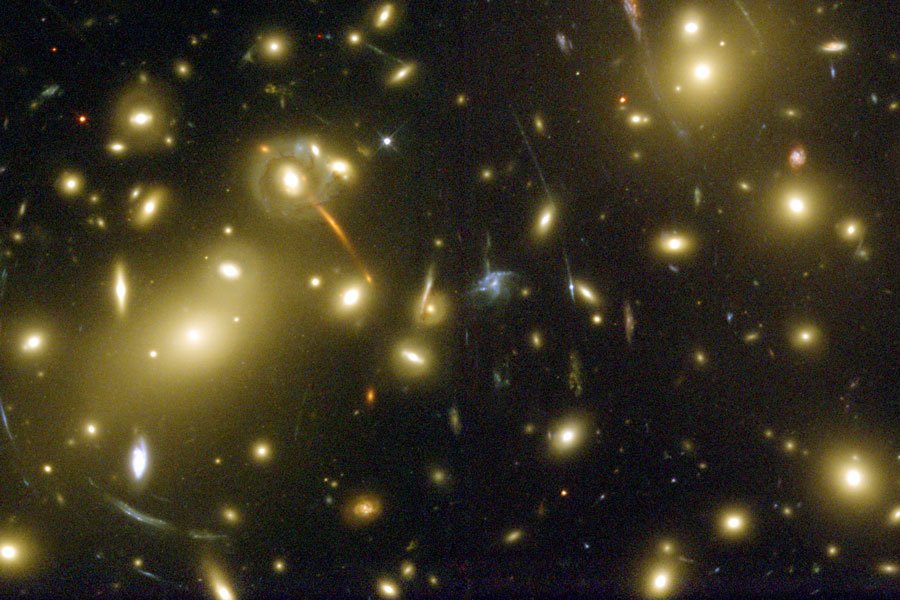
What we mean when we talk about galaxy environments is more or less talking about how many other galaxies are nearby. It's possible to get isolated galaxies or galaxies clustered together in groups of varying sizes. Our galaxy, the Milky Way, is part of a group creatively labelled the Local Group, which has about forty-five members. Of these, the Milky Way is the second largest (probably), with Andromeda the largest. Other members include the Triangulum Galaxy, the Large and Small Magellanic Clouds and a non-literal pile of dwarf galaxies.

As far as classifications go, smaller collections of galaxies are termed groups, while larger collections—containing upwards of fifty more densely-packed members—are called clusters. This may seem like a bit of an arbitrary distinctions (what makes the Local Group a group and not a cluster if it has almost fifty galaxies in it?) but it's important to remember that while we know the Local Group is full of dwarf galaxies, other groups and clusters are too far away for us to be able to see their smaller members. So when we say a cluster has fifty members, we mean that many medium to large galaxies.

Galaxy cluster Abel 2218, from APOD.  The cluster is also a lens, but that's another story.
Image credit: Andrew Fruchter (STScI) et al., WFPC2, HST, NASA


Spot the difference

So what does it matter where a galaxy is, anyway? Well, when it comes to life, most of what determines habitability is internal rather than external to the galaxy. The only external influence I can think of which could inhibit life (and jump in in the comments if you disagree!) would be a nearby AGN blasting at the galaxy. And even then, I don't think it would prohibit life everywhere in the targeted galaxy, just in the parts being most irradiated.

However, there are some properties of galaxies which are dependent on their environment. In a denser environment, where there are more galaxies, there had to have been initially more matter for those galaxies to form from. Because there was (by chance) more matter in that area, it was more strongly gravitationally attracted to itself and hence formed earlier compared with a lone galaxy in a sparser environment. Our current leading theory of galaxy formation and evolution is called hierarchical assembly and one of its tenets is that larger (more massive) objects form first. In a sparse environment, matter is by definition more spread out and hence, as well as being more weakly gravitationally attracted to itself, has further to travel before it can clump and collapse into a galaxy.

The corollary to this is that big galaxies in clusters are older and more evolved (because have gone through more mergers, partly thanks to there being more proximate galaxies), while isolated galaxies are younger and have undergone fewer interactions with other galaxies.

Living around

As far as life developing in other galaxies is concerned, it seems pretty trivial now to make the conclusion that life would have had the opportunity to arise earlier in cluster galaxies and later in isolated galaxies. Group galaxies such as our own would fall somewhere in the middle.

On the other hand, cluster galaxies would have undergone more mergers, have a greater chance of having been in the path of an AGN and are more likely to be elliptical. Those first two points are merely hazards to the development of life, but the latter also gives rise to different experience for that life compared with our Milky Way existence. What off Earth am I talking about? The night sky.

Our night sky is covered in stars with the disc of the Milky Way running through them. An elliptical galaxy, not having a disc component, would not have such a band of dust, gas and denser stars. In fact, they wouldn't have much dust or gas at all, which means no nebulae and significantly fewer hints as to where stars even come from. Depending on the exact placement of the planet, they would likely have a more or less uniform distribution of stars in the sky, maybe with a brighter patch in the direction of the galactic core. Life that evolved in an elliptical galaxy might not ever get to observe young stars in their vicinity, let alone star formation. How might their understanding of astronomy and, in particular, stellar astrophysics be shaped by this? I think it's an interesting question to explore.

On the other end of the scale, we have isolated galaxies which could also harbour life (if they're big enough to develop sufficient metallicity in sufficient time). But if it's truly isolated, it might be that it's not possible to observe external galaxies with the naked eye. (We can, but they sort of look like stars until you put a telescope to them.)  Maybe such a civilisation would skip past the part of astronomy that labelled Andromeda and the Magellanic Clouds as nebulae but who knows how they might interpret distant blobs and spirals in the sky once they had the telescopes to see them? Also remember that isolated galaxies are going to be smaller and form later. By the time life even evolved there, would there be many other spiral galaxies left? How much more powerful would dark energy be at that point? How quickly would all the other galaxies be retreating from them?

How empty would the sky be?

Friday, September 2, 2011

Some Links!

Some interesting sciencey links, presented in the order in which I came across them (which I think is the order they were published anyway).

First up! This New Scientist article is about how the wakes of ships (the white "trail" they leave behind as they plough through the ocean) temporarily increases the albedo of the Earth—how much light from the sun it reflects. This would be good news for climate change (that is, enacting a more positive change and less the "oh gods we're all going to die in a tropical hell" sort) if not for all the greenhouse gases those ships also produce...

Next! This arXiv paper, "Kepler Exoplanet Candidate Host Stars are Preferentially Metal Rich", seems to back up some of the assumptions made in the paper I discussed a short while ago about the galactic habitable zone. In that paper they assumed that sufficient metallicity would be required to form planets and it looks like Kepler has confirmed that.

Penultimately! Forget about Martian meteorites containing fossilised life, simulations have shown that life from Earth may have made it off world and could be set to land on another planet. Could it be that when we finally get around to drilling through the Europan ice, we find Earthly extremophiles instead of aliens? Cosmos magazine have the full story.

Finally! National Geographic have an article about a newly discovered planet which has the potential to be Earth-like. Seems that it gets less energy from its sun than Venus does from Sol, but more than Earth receives. It's habitability thus depends on the appropriate weather conditions but with surface gravity 1.4 times Earth's it should be more or less possible to walk on the surface.

Wednesday, August 31, 2011

Habitable Galaxies - Part 2: Active galaxies

This is part two in a series of posts about habitable galaxies. Post 1, covering types of galaxies and galaxy mergers, is here and this earlier post on the (most) habitable areas of our own galaxy is also relevant.

A major attribute of galaxies is whether or not they are active. There are a few different things active can mean—actively star-forming, for example—but what I want to focus on today is whether they have active nuclei.

What's in a nucleus?

At the centre of our galaxy and most other large galaxies, there is supermassive black hole. I have briefly mentioned black holes in the past and I will eventually get around to writing a dedicated post on them. Honest. What you need to know to understand their role in galactic nuclei is as follows:
  • They are very small and very dense.
  • The supermassive part means that they range from around a hundred thousand times to the mass of the sun to billions of solar masses. The Milky Way's central black hole was calculated in 2008 (by this group) to be about 4.1 million times the mass of the sun. In kilograms that's about 8 x 1036 or an 8 followed by thirty-six zeroes.
  • As their name suggests, supermassive black holes are very massive. What massive really means (in any physics context, not just with regards to black holes) is that they exert a strong gravitational force.
Before you ask, we don't really know where these come from—there are theories, but no single one is yet the most accepted—but we do know that they must form early on in a galaxy's life (possibly even before the stars form, depending on which theory you subscribe to) and their evolution is closely tied with the host galaxy's.

Other things that can be found in the centres of galaxies include stars, dust and gas. Although following the orbits of stars in the centre of our own galaxy is what convinced us there was a supermassive black hole there (nothing else could be so massive and so small), most of what those stars do is simply orbit. (Yes, it is possible for one to fall into the black hole and yes, that would be very interesting and would generate a lot of energy but from what we've observed, the Milky Way's central stars seem to be in stable orbits. If you are interested in reading a (short and fairly uncomplicated) paper about S2, the star closest to our supermassive black hole, you can find it here.

When there is gas or dust in the vicinity of the black hole, it will tend to spiral inwards until it eventually passes the event horizon*. As this occurs, huge amounts of energy are released, outshining all the stars in the galaxy. This is what is called an active galactic nucleus. It is also, more or less, what causes quasars, the most distant objects we observe (because they're so bright we can see them very far away, you see).

Here is a nice NASA / ESA Hubble Space Telescope picture of jets coming off the nearby AGN, M87.


 * The point of no return.

Active life?

So the next question, the crux of this post, is can we have life in a galaxy with an AGN? The short answer is maybe. Of course, we have no concrete proof either way. Sagittarius A* (yes, that asterisk is part of the name), our central black hole, is not currently active** and we have even less evidence for life in other galaxies than we do for life on other planets within the Milky Way. The slightly longer answer is, it depends. There is evidence to suggest that the Milky Way was active in the past few million years and since there is still life on Earth, we can suppose that an AGN doesn't necessarily sterilise a galaxy.

Some months ago, some colleagues and I got into a discussion regarding whether a really bright AGN (even one unrealistically bright for the size of our galaxy and Sag A*) could wipe out life. We came to the conclusion that it would only do so if you were standing close enough to it. From memory, we estimated that if a planet somehow managed to find itself*** in an orbit a parsec from the active black hole, the black hole would through about as much light at it as the sun does. However, AGN emit much harder radiation than stars, meaning that a larger proportion of the energy would be at X-ray and gamma ray frequencies, both unfavourable to life. If we put the planet where Earth is, then even with nothing blocking the way we don't have a very high increase in dangerous radiation.

However, something is blocking the way: dust. As far as we know, dust near the black hole is requisite for turning on an AGN. But even ignoring that, there are many clumps of dust in the disc of the Milky Way. So many that we are unable to see through it all if we look along the disc. (Schlegel et al surveyed the dust in the galaxy and came up with this map. White bits have more dust, black bits have less.) In essence, as well as making it hard for us to notice supernovae near the centre of the galaxy, this would help shield us from AGN light. I wouldn't be surprised if we didn't immediately notice the AGN. Of course, closer in to the centre of the galaxy you have more problems and it starts to depend more on exact placement. Also, the dust actually only shields visible and UV light, so once you get too close the more concentrated X-rays and gamma rays become more of a problem.

On the other hand, a planet is less likely to form in the path of an AGN jet, simply because there are fewer stars in that direction. If it did, however, it would definitely not survive the experience.

Elliptical galaxies have significantly less gas in them (some might say no gas, but there would have to be some in the centre for the AGN to turn on, not to mention dust created by dying stars).  This would mean less shielding, making the AGN more noticeable. The bigger barrier to surviving the experience, however, would be the fact that elliptical galaxies are larger with with more massive central black hole which would generate a more energetic AGN (with more detrimental radiation). The final point to consider is that theories suggest AGN in elliptical galaxies are turned on thanks to dust being stirred up (into the black hole) from a merger. So the merger event could have some impact (see last week's post) on continued habitability. The dearth of dust also means that new planets would not be able to form in an elliptical galaxy.

So to summarise, an AGN wouldn't necessarily sterilise a galaxy, but might kill off life that had set up too close to the centre. Depending on an inhabited planet's placement in a galaxy, an AGN might not have a very large effect on daily life. There are a few additional problems for elliptical galaxies, but again, so long as the planet isn't too close to the centre (and its sun doesn't migrate to the centre of the galaxy too quickly), there's no reason for life to automatically be extinguished. Score 2 for extragalactic life.

Next time: the habitability of galaxies in different environments in the universe.


** Probably.
*** I personally really don't think a planet would be able to form in that region thanks to the density of stars and subsequent gravitational forces. I don't have any hard evidence to support this, but to me it makes sense.

Saturday, August 27, 2011

Winds of Change ToC

And now for something completely different.

Rather than a science post, this is a quick note to tell you about the upcoming anthology from the Canberra Science Fiction Guild which includes one of my stories. The anthology is called Winds of Change and is edited by Elizabeth Fitzgerald. The table of contents is at the end of this post.

(Yes, I am a bit late with this announcement, but my excuse is I was on holiday, so shhh.)

My story, "Time Capsule" is third, which, I have decided, is a golly good place to be. And despite all my spacey writing on this blog, the story is set entirely on Earth, so make of that what you will.

Winds of Change is going to be launched at Conflux, the annual Canberran science fiction and fantasy convention, on Friday 30 September. I will post more info about getting your hands on a copy (other than if you're at Conflux, of course) when it's available.

The table of contents:


Winds of Change
Edited by Elizabeth Fitzgerald

Stories and authors:

Wraiths by Jason Nahrung

Gravity Express by Naomi Mondello

Time Capsule by Tsana Dolichva

The Tether of Time by Leife Shallcross

Trigger by Zena Shapter

Babel by Robin Shortt

Saint Olivia's Light by Carol Ryles

In Need of Assistance by Chris Andrews

After the Bombs by Adam Tucker

The Horns of Elfland by Crisetta MacLeod

Time Spent by David Coleman

Soul of the Machine by Maxine McArthur

Dream Shadow by Alan Baxter

Giant by Annelise Roberts

Evolution Baby by Lesley Boland

The Princess by Valerie Y.L. Toh

Children of the Ashes by Greg Mellor

By Watcher's Pool by James Goodrum

Turning the Blood by Donna Maree Hanson

Watching by Nicole R Murphy

The Stormchilds by Helen Stubbs

The Fool by Jane Virgo

Dragonfly by Cat Sheely

Stone-singer by Joanna Fay

LinkWithin

Related Posts Plugin for WordPress, Blogger...