Thursday, March 22, 2012

Destroying the Earth

This post is inspired by a question I got on my Ask Tsana page. Katrina asked:
I'm trying to come up with a simple (haha) and plausible way to destroy a planet to kick things off for a story but am having trouble getting the science right.

One of the first sites I visited to figure this out was this Geocide site: http://qntm.org/geocide

Under the Geocide in fiction page (http://qntm.org/fictional), the author says, "The Sun Crusher is a relatively small ship which carries a small number of missiles, each of which is tough enough to shoot into the centre of a star and cause it to go nova, which would certainly annihilate any nearby Earthlike planet."

My question is, don't stars that get massive enough to go nova have brief lives and thus not live long enough for a habitable planet to develop? I'm just basing that on Wikipedia (http://en.wikipedia.org/wiki/Planetary_habitability#Massive_stars), though, so I was wondering if you could tell me more. Can the habitable zones of massive stars ever actually be inhabited (and then later die in a supernova)?
Excellent question!

The answer depends a bit on to what extent you want to destroy your planet. Geocide pretty much defines "destroy the Earth" as "annihilate in the particle physics sense, or dismantle/tear apart on either a macroscopic (large) or microscopic scale". He doesn't count Earth as destroyed if there's still a planet-like object there. However, for many narrative purposes, rendering the Earth entirely uninhabitable will do the trick.

So, leaving the dismantling and annihilation to Geocide (the website is amusing, although be warned that some of the details of physics are slightly off, but close enough), what are some ways of rendering Earth unfit for life?

Destroy all humans

So maybe what you want is not so much to destroy the planet as to destroy all the people on it. That's not really that hard. Or, at least, destroying most of the people isn't that hard. Some methods, which generally don't require elaboration:
  • Widespread nuclear holocaust
  • Some sort of plague
  • Climate change. No, really, melt the icecaps and raise the temperature enough so that it is too hot and humid to survive without air-conditioning and eventually you'll run out of people. Or throw in some crazy weather disasters too. The Rhesus Factor by Sonny Whitelaw touches on this a bit (see my review here), also on the plague scenario.
  • Very large volcano eruption. This is one of the things thought to have caused at least one of the prehistoric dinosaur(ish)-era extinctions. A less epically large volcano (actually, a few of them probably contributed) in 1816 caused the Northern Hemisphere (or Europe and America at least, not sure that Asia was affected as strongly, but google it if you're interested) to not thaw out in the summer. This was "the year without a summer". (And now I have that Rasputina song stuck in my head. Click the link and you will too.)
  • Asteroid -- this one's a toss up between destroying all (most) humans and destroying all life. Ultimately, I suppose it's a matter of scale. Let's say this asteroid kills human life but not necessarily all the microbes. It would be somewhat similar to the volcano in the throwing dust and rubbish into the atmosphere, blocking out light and generalised doom.
  • Magnetic field of the Earth turning off in the process of flipping. This is something that happens spontaneously every so often. It's bad because a whole bunch of ionising radiation (miscellaneous charged particles) from space is kept at bay thanks to our nifty magnetic field. Taking it away would give us a lot more cancer and sterility and could wipe out a large chunk of humanity. Microbes and probably a lot of (some?) sea life would be OK. Good luck artificially killing the magnetic field, though.
All of those methods probably won't wipe out all life and, frankly, it's possible/likely that some tenacious dregs of humanity will hold on. Generally, evacuation is the surest way to avoid these apocalypses. Or prevention, but that's only really applicable in two or three of those scenarios.

Destroy all life

Why aim low? Bugger humanity and everything else with one of these sterilising scenarios:
  • Self-replicating nanobots (von Neumann machines) which consume all the [insert important chemical here -- carbon is popular]. This is also know as the grey goo scenario. Depending on the nanobots, this is likely to render the Earth inhospitable to life while they're still doing their thing.
  • Large asteroid/comet or small moon colliding with Earth. Where a small impact would cause natural disasters (earthquakes, tsunamis) and potentially block out the sun with dust, a large impact could do many detrimental things. It could change the Earth's rotation, knock it into a slightly different orbit (or send it spiralling into the sun, but that would require a particularly large body), it could smash the Earth into chucks (which, thanks to gravity, would probably later re-collide to form Earth 2.0), render an appreciable fraction of the surface molten... Actually, I now have a brilliant mental picture of two or six asteroids hitting the Earth simultaneously from opposite sides and sort of turning it into molten goop... Not actually sure that would work with two, but six seems faintly plausible in a hand-waving way. Anyway, point is, hit Earth with something big enough and bye-bye life. Depending on conditions, it's possible life could spontaneously arise again, depending on how reliably life arises and how long it takes (before, for example, the sun goes red giant).
  • Supernova/nearby gamma ray burst. The main problem with this notion is the lack of suitable supernovaing stars nearby, as Geocide mentions. However, you mentioned destroying a planet, not specifically Earth. A planet orbiting a star when it went supernova would be toast. Probably, it would be fairly inhospitable before the actual explosion, if Eta Carinae is anything to go by. A planet orbiting a non-explosive star near another star that went supernova could well end up sterilised, which is what I talked about in my post about the galactic habitable zone (and near in the astronomical sense isn't that close by). And, actually, if we're talking about Type Ia (which is to say not core-collapse supernovae; not the death throes of a large star) supernovae, which involve white dwarfs and (probably) ordinary stars going through their red giant stage, we might not even see the supernova coming. That's a slightly unsettling thought.
  • Some sort of implausible doomsday device. Really, you can make up whatever rubbish you want for this one if you're so inclined. (But if you do, I don't promise not to tear your science apart if I read/see/whatever it.)

A few words on supernovae and novae

Supernovae are how stars bigger than about 8 solar masses end their lives. Novae are not small supernovae. I know, that's what I originally learnt as a child/teenager by osmosis from SF novels. I think the connection between the words nova and supernova are primarily historic; a star suddenly appeared or became much brighter and acquired the label (nova meaning new), but the different causes weren't understood until much more recently.

Stars smaller than around 8 solar masses don't explode. They expand relatively slowly (well, y'know, compared with a supernova explosion) when they run out of hydrogen to fuse in their cores, then contract then expand again when they run out of helium. At this point, a large star going through the stages much more rapidly would collapse again under its own gravity and then kaboom supernova. Smaller stars aren't massive enough to collapse again under their own gravity. Instead, after the helium is used up, leaving either carbon or oxygen (or a combination) in the star's core, what was once the stellar atmosphere will keep expanding indefinitely. Initially, it forms a planetary nebula (not actually anything to do with planets), but eventually it will all dissipate and be undetectable. What's left behind is a white dwarf; basically a small, hot star which was once the core of the red giant star.

Suppose there were two stars near each other, and one went through the red giant to white dwarf steps before the other. When the companion star undergoes its red giant phase, maybe it expands enough that some of it's outer atmosphere is close enough to the white dwarf to accrete onto it. The reason these stars didn't supernova is because they were too small. There is a very definite upper limit to how massive a white dwarf can be before it collapses in on itself and explodes. That limit is 1.4 solar masses (but remember, most of the original star's mass is lost when it's doing the expanding thing, which is why the original star can be up to 8 solar masses). If the companion star accretes too much matter onto the white dwarf, the white dwarf will go over the 1.4 solar mass limit and explode. This is a Type Ia supernova. For the record, the alternative explanation for Type Ia supernovae, which is presently gaining more traction, is two white dwarfs colliding.

Since white dwarfs are small (1.4 solar masses in a volume roughly the size of Earth), they're not very visible, especially once they start to cool down. See how we might not see that kind of supernova coming? It could potentially not be that difficult to artificially orchestrate, either, if you have enough spare matter to throw at a conveniently placed white dwarf. Well, y'know, sort of easier than some large-scale astro-engineering projects could be.

 Back to the point

 If you recall the original question, Katrina asked:
My question is, don't stars that get massive enough to go nova have brief lives and thus not live long enough for a habitable planet to develop? Can the habitable zones of massive stars ever actually be inhabited (and then later die in a supernova)?
In general, the bigger the star, the shorter its life. Our sun's total lifespan is something like 10 billion years, a blue giant could live only 10 million years, and a red dwarf's lifespan is in the trillions of years. The current theory is that it took a couple of billion years for (very basic) life to arise on Earth. It then took a long time to progress to where we are now (Earth's age is 4.6 billion years, from memory). If we see this as typical, it seems like there isn't enough time for life to arise around a much larger star. On the other hand, if there was a planet at a suitable distance from the star, it could be inhabited by sufficiently motivated humans with spaceships. They wouldn't be able to stay there indefinitely, but even a few million years is more than ages on human scales, so that's OK.

The other issue is metallicity. Planets like Earth have rocky cores, which means they have high metallicity. Remember, metallicity in an astronomical sense refers to the abundance of elements heavier than helium, not necessarily just the things chemists/sane people identify as metals. Very massive stars generally form in metal-poor environments and are metal-poor themselves. This makes the presence of heavier elements as requires for rocky planet building less likely. Not necessarily impossible, but much less likely.

So yes, you can potentially have planets around the sort of stars that go supernova and, while native life probably won't get very complex if it arises at all, said planets could be inhabited by plucky humans.


Thursday, March 15, 2012

Review: The Rhesus Factor by Sonny Whitelaw

The Rhesus Factor by Sonny Whitelaw has been sitting on my harddrive for a few years, waiting for me to finally get around to reading it. The Australian Women Writers Challenge gave me the push I needed to pick it up. The Rhesus Factor can be downloaded as a free pdf from Whitelaw's website (you have to click on the link in the left menu).

In essence, The Rhesus Factor is an eco-thriller. Set in the near future when the Gulf Stream has stopped, climate change is decidedly noticeable and drug-resistant epidemics are sweeping the Earth. Since it was written about ten years ago, some of the technology of our very near future isn't quite here (no space planes to hop across the pacific in a matter of hours, not even for the US Airforce) but some of her predictions are eerily true. There was a throwaway paragraph that included severe bushfires in southern Australia and Brisbane flooding, for example. Granted, those aren't exactly outlandish predictions, and the Gulf Stream is still with us, but still, some of the crazy weather Whitelaw describes doesn't feel like it's as outlandish as it would have been ten years ago.

There was also this great line about the US congress which predicts a situation that has become slightly old news now:

"So you voted in a Democratic President—but hedged your bets with a Republican Congress that will not entertain any motion to install a fair and equitable health care system."
Sound familiar?

Anyway, back to the story. The Rhesus Factor follows a handful of characters through dramatic* climate change, the discovery of a virus which is on track to sterilising 99% of humanity, terrorist attacks, and assorted other emergencies. Some of the characters are clearly there to demonstrate consequences to ordinary folk, but most of them play some sort of governmental role (including scientific research) in mitigating the damage. A nice touch, I thought, was that almost all of the characters were quite competent and none of the disasters were because of any one person stuffing up. They were all just sort of inevitable.

My favourite character, and the one I felt was the most developed, was Kristin: an Australian marine engineer, initially based in Vanuatu, who has the unfortunate luck to be present for almost all the on-page explosions. (There are a lot of explosions.) Her back story, complete with an ex-boyfriend who has the emotional intelligence of a wet rag, is well drawn and she's not one of the people who knows everything up front, so it was nice to discover some of what was going on as she did. She also had a strong "Australian, no-nonsense" pragmatism which helped keep up the pace of the book (not that it was ever in any danger of dragging).

Another enjoyable character to read was the Australian Prime Minister. I suspect half the reason I liked him is because the world would be a better place if we had more political leaders that cut through bullshit and did what needed to be done. The other half is that his scenes — particularly some of the comments he makes when not in front of the press — were some of the most amusing and did a good job of diffusing some of the inherent doom of the novel. The most unbelievable aspect of both his character and the US President is that, before becoming politicians, both were scientists with ecology-related (I forget the specifics) PhDs. I just don't really buy that they got elected, especially the President, but it's a good thing for their world that they did.

I also enjoyed Australia being so central to many of the events taking place. Other prominent settings were Vanuatu and the US, but while the US was obligatory (greatest impact of Gulf Stream failure, powerful government), the Australian scenes were more lovingly carved. From the outback, down to Kristin complaining about Canberran weather.

The Rhesus Factor is a fast-paced, thriller crammed with one disaster after another. Set in the near future in a world a little bit more disease-ridden, with a slightly more altered climate than ours, it will keep you flipping/tapping the pages to find out what happens next. I should warn you though, Whitelaw set out to present a realistic picture of the near future. The only fabricated factor is, as the title will tell you, the Rhesus factor which acts as a catalyst for some disasters and an also-ran for others. There is no quick-fix offered in the novel and the ending isn't exactly a happy one — though it is somewhat hopeful. Nevertheless, it's an entertaining and, if you're into getting science out of your fiction, an educational# one.

4.5 / 5 stars


* I say dramatic because the Gulf Stream failed. It's not quite Hollywood dramatic, if you're wondering.
# Actually, The Rhesus Factor is available as a free pdf because at one point it was cited by an Australian MP in Queensland parliament for its realistic and alarming predictions.


Saturday, March 10, 2012

Sciencefail rant: Across the Universe by Beth Revis

First things first: sorry it's been a while between posts. Life has been busier of late and I haven't quite had the brain space to devote to writing a serious sciencey blog post. Until now. I was reading Across the Universe by Beth Revis, a recent YA science fiction book set on a generation ship and just as I got up to the "ooh, things are getting interesting" plot-thickening part, I was smacked in the face by an epic science fail. This is what I am now going to rant about.

There will be spoilers. Many crucial spoilers. If you'd rather read a spoiler-free review and live in science fail ignorance, then you can read my ordinary review here.

~

I mentioned spoiler-warning, right?

~

Don't read on if you don't want to be spoiled.

~

The Fail of the Science

Some background

In Across the Universe we have two main characters: an American teenage girl and the future leader of the generation ship. The girl gets frozen and loaded onto the ship as cargo because her parents are part of the colonisation mission on the new planet they're going to. For reasons unimportant to science fail (and which I hence won't spoil), she is accidentally unfrozen early, supposedly 50 years before they're due to land. The entire journey was supposed to take 300 years.

When she wakes up, she finds herself in a very different world to the Earth she left behind. Blah, blah, dystopia -- if you're interested in that aspect, go read my proper review. In the course of events, the two main characters discover that among all the secrets and lies aboard ship is the secret of what's going on with the ship's engine.

The parts I don't have a problem with is that the engine nuclear and they have some sort of process which is supposed to recycle the uranium so that it keeps running long enough. I mean, I'm sceptical of the whole re-enriching uranium part -- entropy, conservation of energy, the lack of a particle accelerator on board, etc -- but I'm willing to buy future technology with fancy engines. If we didn't have future tech with better stuff than our present tech, then science fiction would be a little dull.

Unfortunately for the residents (and cryo-residents, I suppose) of the generation ship, there is something wrong with the engine. It is losing efficiency. Given the magic physics that was making it run in the first place, this isn't surprising either. Do you know what is surprising? The fact that the engine failing is somehow slowing the ship down.

SPACE IS NOT AN OCEAN!

I know, I know, I don't usually actually scream when I'm ranting, but this blatant disregard for one of the most basic and fundamental ideas in physics infuriated me. I shouted, in real life, and bashed the book on the couch in my frustration* at this neglect of research. Ask anyone who's taken a first year university physics subject, gosh, even anyone who passed high school physics, and they should be able to tell you what happens on a spaceship when the engines fail.

It keeps going in a straight line until it hits something.

IT DOES NOT SLOW DOWN.

Galileo, who lived way back in the 1500s–1600s, worked out that an object will continue to move in a straight line. Newton, in 1687, appropriated this concept and dubbed it his first law of motion:
A body in motion will continue moving with a constant velocity unless an external force is applied to it.
On Earth, friction is usually that external force. Your car's engine has to keep running while you drive because if it doesn't, you're car will eventually roll to a stop as the friction between the axle holding the wheel in and whatever's on the other end of the axle. A boat slows down because of the drag force of the water around it -- drag force being a type of friction. Your bike might roll down a hill, but if you don't pedal, friction in the axles will eventually bring you to a stop. An aeroplane needs to keep firing its engines because of the drag force of the air slowing it down (they can sometimes coast down to a landing if the engines fail, but they need to over come the drag to maintain a constant speed so that they can stay in the air because of other physics I'm not going to go into right now).

You get the idea.

The drag force happens because something -- air particles, water molecules, etc -- collide with the moving object and push it slightly in the opposite direction. If only one particle hit the much larger object, it wouldn't make a difference, but there are very many particles in the air around you right now. There are even more surrounding a boat (or person) in water. That's why it's harder to move underwater than in air. The fewer particles around to collide with an object down, the less it will be slowed down.

Space, unlike the surface and atmosphere of Earth, is characterised by its vacuum. It's lack of anything substantial. There is no air in space. Sure, there are a few stray molecules and atoms floating around but, except in the densest of nebulae/molecular clouds, they are far sparser than even the best industrial vacuum we can create on Earth.

In space, there is no drag force. There is nothing to slow you down. If your engine failed, you wouldn't slow down, you would just keep going, indefinitely, until you collided with something, or came close enough to a gravitational field (of a star, for example) to change direction. Then you would keep going in that direction unless you were particularly well aimed to go into orbit around that star.

So when the engine of the generation ship in Across the Universe starts to fail, their problem isn't that it will take them longer to reach their destination. If it fails completely, they will not be "dead in the water". There is no water. It might be called a spaceship, but that doesn't mean it shares the same watery drag force as an ocean liner.

Their problems are more likely to be related to not being able to land or go into orbit around their destination, or not being able to make course corrections, or not being able to slow down and zooming straight past their destination.

By a similar token, people or things ejected out of the airlock wouldn't get left behind. Again, space is not an ocean. Once the airlock is opened and the air rushes out (pushing any lose objects out with it, perhaps), the ejected objects would appear to float close to the ship, continuing to move in the same direction along with the ship. If someone was thrown out an airlock, their body would only stop shadowing the ship when the ship did one of: speed up, slow down or change direction.

I grant that if the ship has magic artificial gravity (which the generation ship in Across the Universe does), some strange things might happen to throw the body further away from the ship, or make it somehow react unusually with the artificial gravitational field, but there was absolutely no indication of that being the case in this book.
 
* Don't worry, the book was unharmed.

Acceleration?

My first thought, in my brain's desperate attempt to fix the gaping science fail hole in Across the Universe, was that maybe the ship was accelerating and that's why they needed the engine to maintain efficiency and why things thrown out of the air lock got left behind.

Unfortunately, it can't have been.

According to the original mission plan (which the book gives us no reason to believe is a trick), the voyage is supposed to take 300 years. Also, their destination is called Centauri-Earth (and our world is referred to as Sol-Earth). This could refer to Alpha Centauri, the closest star, but given the fact that the planet they're headed for is supposed to be habitable, that doesn't seem likely (Alpha Centauri is a triple star system and the chances of conveniently habitable planet being there are slim). So it must be another star with Centauri in the name. There are lots. Here is Wiki's list of stars in the Centaurus constellation. If you sort that list by distance, you see that there aren't that many stars within 300 light years.

Since no relativistic effects are ever mentioned (see this blog about travelling close to the speed of light, and this one about accelerating up to fractions of the speed of light), it seems fair to assume that they never reach an appreciable fraction of the speed of light. Let's say that means less than around five percent time dilation goes on (see aforementioned links for previous posts if you're lost at this point). Well, travelling at a third of the speed of light gives us six percent time dilation, so close enough. So the maximum speed we're allowing is 0.33c. If we ignore acceleration, that limits us to stars within 100 light years. Habitability is probably limited to F, G, K and maybe M stars. Within 100 light years in the Centaurus constellation, that leaves us with... 14 viable stars (11 of which don't actually have Centauri in their name...). The furthest with Centauri in the name (not an unreasonable requirement, given the context of the book. If they were going to a star with a dull designation, surely they would have given it their own name?) is about 60 light years away.

If we assume they're accelerating until they get half way, then decelerating the rest of the way (the fastest way of getting there and also the main way to require the engine running the entire time), that requires a very low acceleration of 0.0013g or 1.3 cm/s2. Which at least explains why a uranium engine might be the fuel source of choice. (For the record, if their destination was Alpha Centauri, then this value wouldn't change appreciably - it would be about 0.05 cm/s2 less. Furthermore, for Alpha Centauri it would make much more sense to accelerate a bit and then spend most of the journey coasting until they needed to slow down at the other end.) The maximum velocity the ship would reach would be 0.37c, so that's not too far above my imposed limit of 0.33.

This low acceleration means that my point about bodies not being left behind when ejected from the airlock still stands. They still wouldn't appear to drift away that quickly.

The final piece of information we're given in the book is that the engine started failing when they were about halfway through their journey. What does this mean? It means that they wouldn't be able to decelerate, would reach their destination faster not slower and would zoom straight past it too quickly to go into orbit. Pretty much the exact opposite of the problems described in the book.

Over-reaction?

No. For two reasons. The first is just it's bad writing -- the science fail error jolted me completely out of the story and undermined my suspension of disbelief and plausibility of the whole setting. To achieve the same plot-mandated end, the author could have had the engine start to fail while accelerating or, without much consequence to the plot (as far as book 1 in the trilogy goes, at any rate) the ship could be unable to slow down, unable to correct its course or they could have found out that the planet wasn't as viable as they originally thought. Each of these things would have got the job done, but no, the author chose to not check physics.

The second reason is twofold. From a personal point of view, when learning physics for the first time, in high school or university, it's usual to relate everyday situations to the concepts you learn. In this way, you can intuitively predict basic mechanics based on experience. However, everyday situations tend to take place on the surface of Earth, so when trying to predict the mechanics of what happens in space (which, yes, does come up in physics classes -- take some if you don't believe me) the situations the student has to fall back on are what's portrayed in various media -- books, movies, perhaps computer games. However, thanks to the the generalised scientific illiteracy of most of society, half of these portrayals are plain wrong. They're why I have this blog, in fact. Honestly, having taught physics to new students, I have seen a lot of evidence for this sort of thing contributing to poor understanding and requiring a lot of unlearning.

Hollywood, poorly researched books, and other media undermine what little science education kids get. At least if the media surrounding us strived for some semblance of accuracy, perhaps people would pick up some science by osmosis. Then the climate debate wouldn't be so controversial, US presidential candidates wouldn't think a moon colony in 20 years was a viable idea, and we wouldn't have an anti-vaccination movement. Scientific literacy is important and, really, science fiction as a genre is uniquely positioned to encourage an interest in science. Sure, this wasn't a hard SF tech-centric book, but it was a giant spaceship. That's the sort of thing that can capture an imagination and ingraining wrong science while doing so is just irresponsible.

And it makes me angry.

(Other than the science fail aspect, this isn't a terrible book. I give it 3.5 / 5 stars -- half a star subtracted for the science fail. For a less science-oriented discussion of the book -- y'know, an actual review -- see my book reviews blog.)


Monday, February 13, 2012

Review: Wanted: One Scoundrel by Jenny Schwartz

I stumbled upon this book quite by accident after following a link that took me to the author's website. When I saw she had written a steampunk novella set in Australia, how could I possibly resist buying it? I didn't really need the added incentive of being able to count it towards the Australian Women Writers Challenge. And before you argue, steampunk counts as science fiction because of the technological and scientific sentiment inherent in (the characters) inventing new old tech.

Wanted: One Scoundrel by Jenny Schwartz is set in and around the Swan River colony -- mostly in Perth and Fremantle. The protagonist, Esme, is the daughter of a gold prospector and inventor who struck it rich relatively recently. She is also a suffragette spearheading a political party with the goal of giving women and non-Anglos rights and votes.

The story opens with her realisation that, since her main political opponent has somehow arranged for all political debates to take place at gentlemen's clubs, she needs a male spokesperson to be a figurehead leader. Unfortunately, all her present male supporters are too busy with their own affairs to devote sufficient time to actually leading a political party. So, with the aid of her captain uncle, she set about finding herself a newly arrived scoundrel ("fresh off the boat" -- would that there weren't other connotations to that phrase) whom she intends to pay to be her puppet.

Enter Jed. A conveniently unknown American recently arrived from England with her uncle's (steam-powered) ship. Jed quickly agrees to be the front-runner for her political party and a friendship/attraction blossoms between them (well, it is also a romance story).

Esme's main rival is an old-money easterner (insofar as there is any aristocracy in pre-federation Australia, he seems to be a prime example). Unlikeable to the bone, he doesn't seem to realise that Esme finds his desire to prevent anyone that isn't male, white or rich (or, really, anyone that isn't him or his friends) from voting abhorrent. He started off merely an arrogant prat, but this escalated for the climax in an exciting way, I thought. (No spoilers.)

The steampunk elements are scattered throughout the story. For example there are the steam powered boats that make it to Swan River from England in a matter of weeks, not months, miscellaneous minor steam-powered contraptions and even forays into electricity and magnetism (Tesla gets a very brief mention, too). From a scientific point of view, I found no obvious faults, although I'm a little sceptical of the kangaroo-inspired land vehicle mentioned at one point.

As I implied at the start, the thought of a steampunk story set in Australia made me very keen to read this and I was not disappointed. I hereby encourage more Australian authors to write Australian steampunk. Steam + gold rush allows for a wealth of material to draw from.

Speaking of the gold rush, being an easterner myself, I only really know a bit about Victoria's gold rush, and next to nothing about Western Australia's (arguably, I know more about Western Australia's current mining boom than any of the past). It was nice to read about a slightly different gold rush. I even learnt about the significant Indian population of the time (cf Chinese miners in Victoria).

The writing was ever so slightly clunky in places, mostly when there was an instance of head-hopping (between Esme and Jed) within the same scene. I also found the story got more amusing as it went along -- after a slightly uneventful beginning --  and I really enjoyed the climax and ending. It had my laughing out loud a few times in the second half. I loved Esme, who was strong, progressive (obviously) and kept her head in trying circumstances. Overall, I recommend this to anyone with a passing interest in steampunk or Australian history.

(Oh and if you're wondering, the Christmas element is extremely minor, limited to a single Christmas in July ball, so yeah, ignore that subtitle. Well, unless you like Christmas, in which case, read the book anyway.)

4 / 5 stars.

Saturday, February 11, 2012

Relatively Faster

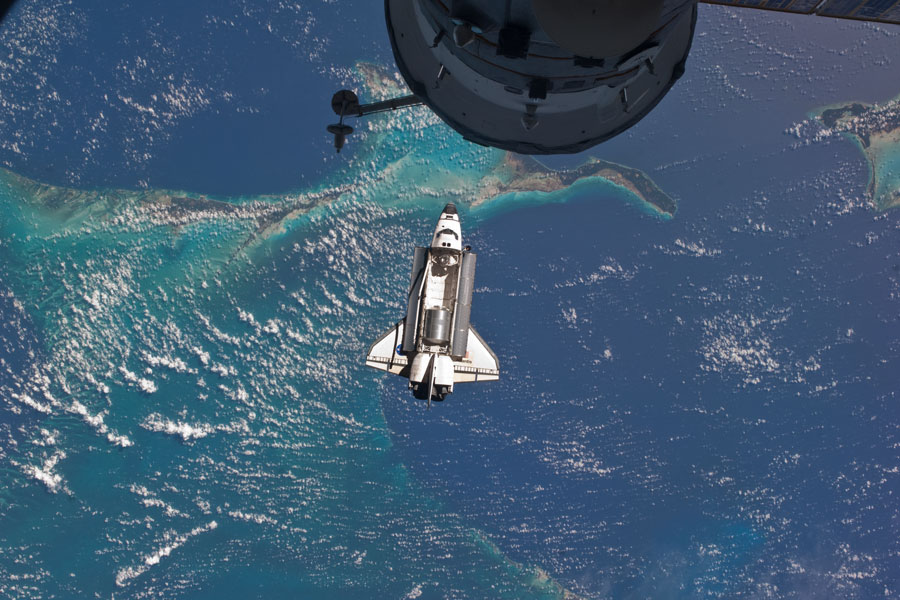
Space shuttle moves pretty slowly and stays close to Earth.
Image credit: ISS Expedition 28 Crew, NASA
Following on from my last blog, in which I talked about travelling at an appreciable fraction of the speed of light, today I'm going to add acceleration into the mix. But first, a few other funky consequences and transformations that apply when travelling close to the speed of light.

To recap last week's post, when travelling close to the speed of light, time dilates and length contracts. That means time moves more slowly and distance shrinks. The factor which dictates how much is called the Lorentz factor and is denoted by the Greek letter gamma:

Here v is the speed of your rocket or whatever and c = 3 x 10⁸ m/s is the speed of light.
The rate at which time appears to pass (to an outside observer) in a rocket travelling at v is given by the time that passes for the observer multiplied by gamma (which is always greater than or equal to 1). This is also called the proper time for the people inside the rocket. The apparent distance between A and B for a moving observer is given by the distance between A and B as seen by an observer at rest with respect to the two points (so that A and B don't seem to be moving) divided by gamma.

Moving on

Another funky thing that changes with speed is mass -- it increases proportionally with gamma. Well, it's sort of more accurate to say momentum, and it doesn't mean that you'll feel heavier when you're in a fast-moving rocket, but that it will take more energy or force to accelerate you further. Basically, what this boils down to is the faster you're going, the harder it is to go faster.

What about if we have two rockets, travelling in opposite directions at 0.75c (that is, three quarters of the speed of light)? The apparent speed of one rocket as seen from the other must be less than the speed of light (all speeds of massive objects are less than the speed of light in all inertial reference frames). So we need to use another transformation to work it out. Without going into too much mathematical detail, the equation we need is:

See below for slightly complicated explanation of values.
The tricky part is that now we're talking about three frames of reference, not two. There's a frame of reference for each of our moving spaceships, and the third frame which is dictating how quickly the two spaceships are travelling (in their own frame, of course, each spaceship is stationary and we don't have a problem to work out). This third frame we're going to call the rest frame. We want to work out u, which is how fast spaceship A appears to be travelling from spaceship B's point of view. U is the velocity of spaceship A from the rest frame, v is the velocity of spaceship B from the rest frame. For the equation to make sense, one of U or v has to be negative (to account for the opposite directions part) c remains the speed of light (3x10⁸ m/s).

Whew, OK, bit complicated to keep track of things there.


Getting faster

Next up, let's talk about acceleration when travelling at relativistic speeds. So far, we've only considered things moving at a constant speed. Accelerating frames are, by definition, not inertial (since an inertial frame is defined as not accelerating), so we can't quite apply all the same assumptions to them. When you are accelerating, you are moving into a different inertial frame for each instant that your speed is changing. (Of course, when you stop accelerating, you'll stay in your last frame unless you decelerate.)

If you're in an inertial frame and a relativistic spaceship accelerates past, what acceleration does it appear to have? Well, the following formula will tell us and, it's interesting to note, the apparent acceleration changes with the ship's velocity, even though, from on board the ship, the acceleration feels constant.

I was going to include the equation, but upon further consideration, it's not terribly useful or relevant. Moving on to more practical relativistic space travel, I'd like to point you in the direction of this excellent website. The set of rocket equations as explained on that site are as follows:

Equations taken (and re-typeset) from this excellent website.

So these equations assume that the ship is travelling at a constant acceleration, a. The velocity, v, is the speed it reaches, as measured from a "stationary" reference frame -- which for the sake of brevity I'll call Earth* -- after a t-long period of acceleration. The distance over which the acceleration takes place is d and Ï„ (pronounced tau) is the time that passes for the rocket and the people inside it (generally speaking, less time will pass inside the rocket than for people on Earth).

That inverse cosh function (also called arccosh) in the last equation is a bit of an odd one. It's short for inverse hyperbolic cosine. A good scientific calculator should have the appropriate function (you'd probably have to use the shift key to get to it) and failing that, there's always WolframAlpha.com.

There are a few ways to use these equations, depending on the circumstances of your spaceship.

Accelerate constantly until the half way mark, then decelerate until destination

  • So, acceleration is good for us. It maintains things like muscle mass and bone density. It's broadly a good idea to maintain Earth acceleration (9.8 m/s2 is the acceleration due to gravity).
  • If we accelerate the whole way, we'll go splat at our destination. The sensible thing, if we want to accelerate the whole time, is to accelerate constantly to the half way mark, flip the ship and then decelerate the rest of the way. (Flipping the ship is so that the floor doesn't turn into the ceiling. Obviously you'd have to stop the accelerating to do the flipping.)
  • So we use the time taken equation (the first one) but put in half the distance (because we're only accelerating 'til the halfway mark), then double the resultant time to include the time taken to decelerate (conveniently, these things are symmetric).
In general, it's easier to deal with light years (rather than meters) and years (rather than seconds) when we're talking about interstellar distances. However, to get a sensible answer out, we need to put acceleration into years and light years as well. Skipping the maths, 1g = 9.8 m/s2 = 1.03 ly/yr2 so you can use that value for a. You can also just multiply by a factor if you decide you'd like to save fuel by accelerating at only 0.5g or 0.75g. Or save time by going at 1.5g (which humans might be able to adapt to). Also, remember that the speed of light in these units is 1 ly/yr.

To work out the time taken, follow the same procedure as above, but using the time equation (whichever one you're interested in). Again, put in half the distance then double the result.

Accelerate up to a set velocity

Because accelerating for an indefinite period of time might get a bit silly and use up an unrealistic amount of fuel. Also, you'd be smashing into atoms pretty hard and starlight (and the cosmic background radiation if you end up going fast enough) would get blueshifted to higher frequencies. Both of these phenomena would require extra radiation shielding, which adds extra mass and requires extra fuel. So, let's accelerate just up to a set velocity, travel at that velocity for the bulk of the journey and then decelerate again.
  • First we need to know the distance required to reach our desired velocity (and potentially also the time). The procedure isn't too different to the first case. We do need to rearrange the velocity equation a little first. Using c = 1 ly/yr we get:
  • Throw in our final velocity and the desired acceleration and we get the time taken (from an Earthly reference frame). Throw the time into the distance equation and we get out how far we've come when we stop accelerating. Double this to account for the distance and/or time taken decelerating again, subtract that from the total distance and we're left with the distance spent travelling at a constant velocity.
  • You can work out the time that section of travel takes from last time's blog (here).

And there you have it, journey times at relativistic speeds with accelerations. Huzzah!


* Technically not inertial, but it'll do if you ignore the gravity and the motion around the sun. Theoretically we should take the sun as our standard rest frame, so you can pretend I really mean the sun when I say Earth if that makes you feel better. 


Monday, January 23, 2012

Review: Nightsiders by Sue Isle

Nightsiders by Sue Isle is a collection of four short stories set in the same world. It is part of Twelfth Planet Press's Twelve Planets series, twelve collections which are showcasing the work of twelve Australian female authors. I believe it's the only one so far to be entirely science fictional (that said, the only other I've read is Love and Romanpunk by Tansy Rayner Roberts -- an excellent blend of Roman mythology, the past and the future -- and I'm not sure what's planned for the rest of the series).

Nightsiders is set in Western Australia, in and around Perth. I want to say it's post-apocalyptic, but that's not quite true. It seems part local apocalypse, part generalised catastrophic climate change. The Australian climate has changed so that the west coast is no longer particularly habitable, with hints at the start that things are better in the east. The former city of Perth is now generally referred to as Nightside, because the people living there have turned nocturnal, seeking shelter during the heat of the day and going about their business in the marginally cooler nights.

A few words on each of the stories:


The Painted Girl

13 year old girl has been with walking with an older woman (who isn't her mother) as long as she remembers. One day, her life abruptly changes and she learns there's more to it than she'd realised.

The Nation of the Night

Ash, 17 year old a trans boy, goes east for an operation. The story is mostly about the stark differences between the parched west and the drowning east. He quickly learns that life is far from perfect in Melbourne, even if they still have hospitals and infrastructure. In Nightside (aka Perth), everyone helps their neighbours, in Melbourne, the infrastructure is overcrowded and they're trying to keep out as many surplus people as they can manage.

Paper Dragons

Some of the kids in Nightside put on a play based on some old TV scripts they found in an abandoned home. Turns out it's a soap about the trivialities of teenage life as in our time. Nightside's entire population of old folk (who remember life before the bombings and the evacuation) turn out to watch.

The Schoolteacher's Tale

This was my favourite story. Mostly, I think, because it filled in some of the gaps left by the other stories with teenage protagonists who didn't know life before Nightside. The titular schoolteacher is a 70 year old woman who had been mentioned as a key figure in the lives of the characters in the previous two stories. We are exposed to some of her reminiscences of how much the world has changed and, through the story, we learn a bit of where Nightside is headed in the future.

~

It sort of feels strange that I can summarise each of the stories in a few sentences but barely even touch on what the stories are really about. Partly this is avoiding spoilers, and partly because there are some themes and ideas that run through all four stories which are hard to pin down to just one of them.

An idea that runs through all the stories (though features the most in the first one) is that of the Drainers. They are a group of people with a genetic mutation that gives them a tolerance for the harsh sun and helps them go a bit longer between sips of water. They come out during the day when everyone else is sleeping, and hide in caves and drains (hence the name, I suppose) at night. There are stories of them eating people or draining their blood and, because they move about when everyone else is sleeping, they're regarded almost as reverse vampires, a notion which appealed to me.

All the children protagonists have adapted better to life in Nightside than the adults. They have good night vision (and poor day vision) and, of course, they are used to the only life they have ever known. One theme that ran heavily through the first three stories is that of abandonment. In the two middle stories, the children were abandoned by parents who went east during the evacuation. There's a heavy implication that this happened to almost all of the children of Nightside, with some of the remaining adults acting as foster parents to many of them. It sort of felt a bit much. Of course, the children that weren't abandoned when their parents went east wouldn't have still been around. But really, children are pretty much top of the list of things parents take with them when leaving a war zone. Where are the parents that stayed behind with children? Where are the children whose parents were killed rather than left? I appreciate that the theme of abandonment fits in with the greater theme of Nightside being abandoned by its former inhabitants and the rest of the country, but it felt a little bit lopsided by the time I got to the end.

On a happier note, this was a collection full of strong and well drawn female characters. With the exception of Ash (trans) in the second story, all the protagonists were female. There was also a good balance of male and female secondary/background characters, which is always nice to see.

To a small degree, the setting put me in mind of Daughters of Moab by Kim Westwood, but the writing style was very different and thematically the setting and the idea of adaptation to a hostile environment were the only things the two have in common.

Overall, I found Nightsiders an interesting read.

Rating 4 / 5 stars

Sunday, January 22, 2012

Rapid slow space travel

Credit: Craig Crawford on APoD
I have posted in the past about mundane space travel such as might be used with the solar system (or another star system if we're talking aliens or whatnot). However, with speeds that slow, it would take an extremely long time to reach another star, even the closest. To have any hope of reaching another star, we need to be able to travel much faster.

Right now, we aren't technologically equipped to do so and that's not what this post is about. What I'm going to talk about is what happens when we (or rabbits or clocks or whatever) travel at high speeds. Because strange and interesting things do happen. Welcome to the weird and wonderful world of Einstein's special relativity.

Immutable

We live in a world with three spatial dimensions and one time dimension. All this really means is that we can define a co-ordinate system (for example x-, y- and z-axes) which can define any point in space by listing three numbers (the x, y, z co-ordinates) and which can define any point in time with a single number (although it doesn't look like a single number, that's how we can think of "11:00 am on 21 January 2012"). Any point in spacetime (that is to say, our universe, past and present) can be defined by combining those two co-ordinate systems to give four numbers, unique to each point.

Now, say you're in a long corridor. There are several ways you might try to measure how long it is. You might walk along it and count steps or use a measuring tape. You might jog or walk at a know speed and time how long it takes to get to the other end. If you were particularly eager and the corridor sufficiently long, you could bounce light (or radio waves) off the far end and time how long it takes to complete a round trip.

Of these three options, I'd hazard that most people would use a length-based measurement as per the first option.

Now suppose your room is actually a space ship traveling close to the speed of light with you inside it. (For now we're ignoring how it got up to that speed.) You can still use the same three methods to measure it. Remember, when you're moving at a constant speed, you don't feel the movement. Aside from bumpiness due to uneven roads/train tracks/turbulence, the only sort of movement you can detect without looking out a window are the periods of acceleration and deceleration. So, if you're traveling at a constant velocity in a spaceship with no windows, you would have no way of checking how fast you're going, but other than that, nothing weird would seem to be happening.

On the other hand, if you were outside the spaceship watching it go past, how could you measure how long it was? Being on the outside rules out walking along it with a tape measure (unless it's stationary, but then it's not going past, is it?), but the other two methods more or less work. If you know how fast it's going, you can time how long it takes to go past. If you know how long it is, you can time how long it takes to go past and work out how fast it's going.

Intuitively, we might expect that spaceship length doesn't change and that the speed of the spaceship is the only thing that determines the time taken for it to go past. This isn't strictly true.

The one immutable quantity when we're talking about moving objects in a vacuum (that is, spaceships in space) is not how long they are or, strictly speaking, how fast they're going. It is, in fact, the speed of light. The old mantra of special relativity is:

The speed of light is constant in all inertial reference frames.

A definition before I go on: inertial reference frame is a set of co-ordinates which isn't accelerating. If you are in an inertial reference frame, you can define your spacetime position with respect to those co-ordinates.

Also, an important point is that it's not possible for any object with mass to move at the speed of light (or faster). The only reason light gets away with it is because photons, particles of light, are massless.


Goin' fast

Say your fancy long spaceship is constantly going at half the speed of light. Because the speed of light is constant in all inertial reference frames, light from a torch you shine inside the spaceship will still travel at the same speed of light as it would anywhere else. Furthermore, just because you're traveling at half the speed of light doesn't mean the light from your torch will appear to travel at one and a half times the speed of light to someone outside your spaceship who can look inside.

Sounds paradoxical, doesn't it?

To make up for the apparent paradox, two things happen. Remember that speed or velocity is basically the amount of distance covered in a stretch of time. To keep the speed of light constant, both distance and time change, depending on how fast you're observing from.

A fast moving object appears to be shorter than it would were both object and observer in the same reference frame (that is, traveling at the same speed in the same direction). This applies to the outside distance for a fast-moving spaceship -- the distance traveled/left to go appears shorter than if the spaceship was stationary with respect to it. This is called length contraction.

Quick side note: this means that all distance is relative and there is no such thing as being truly stationary, just stationary with respect to some other reference frame.

The faster your spaceship goes, the more slowly time passes for you. Well, actually, to you it would seem that between starting your journey and ending it, time passed more quickly planetside than it did for you. (It's all relative, see?) This is called time dilation.

The amount by which time slows down or distance shrinks is dictated by the relative speed of your spaceship. There's a mathematical quantity called the Lorentz factor, represented by the Greek letter gamma, which tells us how much.

Gamma, the squiggle on the left, is the Lorentz factor, v is the speed the spaceship or whatever is traveling, and c is the speed of light, equal to 3 x 10⁸ metres per second.


So if you're traveling at half the speed of light, gamma would be equal to about 1.15, so time would pass 1.15 times more slowly. An hour on the spaceship would take about 69 minutes to pass on Earth. The length of the spaceship, to someone on Earth, would be 1.15 times shorter. One metre would appear to be about 87 cm long.

Some other values of gamma for speeds which are significant fractions of the speed of light are:
  • Speed: 0.75c, gamma =1.51
  • Speed: 0.867c, gamma = 2
  • Speed: 0.9c, gamma = 2.3
  • Speed: 0.95c, gamma = 3.2
  • Speed: 0.99c, gamma =7.1
  • Speed: 0.9999c, gamma =70.7
To work out the time dilation, multiply by gamma, to work out the length contraction, divide by gamma.

This isn't quite all there is to know. For example, objects traveling at relativistic velocities (at an appreciable fraction of the speed of light) also increase in mass by the same factor of gamma and accelerating up to high speeds is also a bit strange. More on that next week.

And in case you're wondering how fast you have to go for these relativistic effects to kick in, or even how we know they're real... well, they exist no matter how fast you're going, it's just that at the sort of speeds we experience on a day to day basis, the time differences are entirely negligible. We have been able to test relativity, however, in a couple of ways. Flying super-precise atomic clocks around on aeroplanes has shown that time passes more slowly for them relative to us. The same has been shown for GPS and possibly other satellites. On a much larger scale, measurements of binary pulsars have also confirmed Einstein's theory of special relativity.

Stay tuned for more next week.


LinkWithin

Related Posts Plugin for WordPress, Blogger...